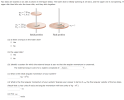
The 1.9 kg , 4.6-cm-diameter disk is rotating as shown in (Figure 1). What is the...
The 1.9 kg , 4.6-cm-diameter disk is rotating as shown in (Figure 1). What is the angular momentum of the disk about the axle?
Homework Answers


Add Answer to:
The 1.9 kg , 4.6-cm-diameter disk is rotating as shown in
(Figure 1). What is the...
1. A gyroscope consists of a rotating disk with a 25 cm radius suitably mounted at...
1. A gyroscope consists of a rotating disk with a 25 cm radius suitably mounted at the midpoint of a 20 cm long axle so that it can spin and precess freely. One end is supported by a stand. The disk spins at 2000 rpm. The mass of the disk is 2 kg, and the axle can be taken as massless. a. Draw the gyroscope, indicating the direction of the initial angular speed and the initial angular momentum. Choose a...
2: Angular Momentum and Energy of a Rotating Spinning Wheel The 15-kg circular disk spins about...
 2: Angular Momentum and Energy of a Rotating Spinning Wheel The 15-kg circular disk spins about its axle with a constant angular velocity of w 10rad/s. Simultaneously, the yoke is rotating with a constant angular velocity of 5rad/s. Determine the angular momentum of the disk about its center of mass O, and its kinetic energy. 5o mm
A disk of mass 1.0 kg and radius 25 cm is rotating about a fixed axis...
A disk of mass 1.0 kg and radius 25 cm is rotating about a fixed axis through its center at 8 rad/s. What is its kinetic energy? What is the angular momentum of the disk in question?
1. (4 points) Four forces are acting on a disk as shown in the Figure 1....
 1. (4 points) Four forces are acting on a disk as shown in the Figure 1. The radius and the mass of the disk are 10 cm and 2 kg, respectively. The disk is free to rotate about a frictionless axle going through its center. (laisk = {MR2) y (a) Find the torque produced by each force. Make 10 N V2N sure to specify the directions. 15 N (b) Find the angular acceleration of the disk. (c) How many turns...
A block with mass mb = 1.9 kg is connected by a rope across a 50-cm-diameter,...
 A block with mass mb = 1.9 kg is connected by a rope
across a 50-cm-diameter, 2.0 kg pulley, as shown in (Figure 1).
There is no friction in the axle, but there is friction between the
rope and the pulley; the rope doesn't slip. The weight is
accelerating upward at 1.2 m/s2. What is the tension in the rope on
the right side of the pulley?
A block with mass mb = 1.9 kg is connected by a rope
across a 50-cm-diameter, 2.0 kg pulley, as shown in (Figure 1).
There is no friction in the axle, but there is friction between the
rope and the pulley; the rope doesn't slip. The weight is
accelerating upward at 1.2 m/s2. What is the tension in the rope on
the right side of the pulley?
A 5.0 kg, 60-cm-diameter disk rotates on an axle passing through one edge.
 A 5.0 kg, 60-cm-diameter disk rotates on an axle passing throughone edge.The axle is parallel to the floor. The cylinder isheld with the center of mass at thesame height as the axle, thenreleased.What is the cylinder's initial angularacceleration? in rad/s^2What is the cylinder's angular velocity when itis directly below the axle? in rad/s
5. Disk A, of radius R1=10.0 cm and mass m1=5 kg is rotating about its axis...
 5. Disk A, of radius R1=10.0 cm and mass m1=5
kg is rotating about its axis at a rate of 42.0 rpm. It is brought
in contact with another disk, B, of radius R2=15.0 cm and mass m2=6
kg at rest. Quickly, both disks start to rotate together at the
same rate. Both disks rotate on their shafts on low friction
bearings.
a) What is the energy of the first disk before contact?
b) What is the angular momentum of...
5. Disk A, of radius R1=10.0 cm and mass m1=5
kg is rotating about its axis at a rate of 42.0 rpm. It is brought
in contact with another disk, B, of radius R2=15.0 cm and mass m2=6
kg at rest. Quickly, both disks start to rotate together at the
same rate. Both disks rotate on their shafts on low friction
bearings.
a) What is the energy of the first disk before contact?
b) What is the angular momentum of...
An axle consists of a rotating disk of radius 30.5 cm centered about a rod of radius 12.7 cm, as shown. The rotation of...
 An axle consists of a rotating disk of radius 30.5 cm
centered
about a rod of radius 12.7 cm, as shown. The rotation of the axle
is
controlled by a pulling force (ccw) and dragging force (cw).
The
designer is worried about the presence of friction between the
rod
and disk. When the pull force is 25.0 N and a drag force is 12.0 N,
the
net torque on the disk is 3.33 Nm in the ccw direction. Determine
the...
An axle consists of a rotating disk of radius 30.5 cm
centered
about a rod of radius 12.7 cm, as shown. The rotation of the axle
is
controlled by a pulling force (ccw) and dragging force (cw).
The
designer is worried about the presence of friction between the
rod
and disk. When the pull force is 25.0 N and a drag force is 12.0 N,
the
net torque on the disk is 3.33 Nm in the ccw direction. Determine
the...
Disk A, with a mass of 2.0 kg and a radius of 70 cm , rotates...
Disk A, with a mass of 2.0 kg and a radius of 70 cm , rotates clockwise about a frictionless vertical axle at 20 rev/s . Disk B, also 2.0 kg but with a radius of 30 cm , rotates counterclockwise about that same axle, but at a greater height than disk A, at 20 rev/s . Disk B slides down the axle until it lands on top of disk A, after which they rotate together. After the collision, what...
Two dlsks are located on an axle as shown In the figure below. The lower disk...
 Two dlsks are located on an axle as shown In the figure below. The lower disk Is Initlally spinning at 24 rad/s, and the upper one Is not spinning. T upper dlsk then falls onto the lower dlsk, and they stlck together. m2 7.0 kg R1.0 m m 20 kg R1 2.0 m Initial position Final position (a) Is there a torque on the lower disk? Yes No On the upper disk? Yes No (b) Identify a system for which...
 2: Angular Momentum and Energy of a Rotating Spinning Wheel The 15-kg circular disk spins about its axle with a constant angular velocity of w 10rad/s. Simultaneously, the yoke is rotating with a constant angular velocity of 5rad/s. Determine the angular momentum of the disk about its center of mass O, and its kinetic energy. 5o mm
 1. (4 points) Four forces are acting on a disk as shown in the Figure 1. The radius and the mass of the disk are 10 cm and 2 kg, respectively. The disk is free to rotate about a frictionless axle going through its center. (laisk = {MR2) y (a) Find the torque produced by each force. Make 10 N V2N sure to specify the directions. 15 N (b) Find the angular acceleration of the disk. (c) How many turns...
 A block with mass mb = 1.9 kg is connected by a rope
across a 50-cm-diameter, 2.0 kg pulley, as shown in (Figure 1).
There is no friction in the axle, but there is friction between the
rope and the pulley; the rope doesn't slip. The weight is
accelerating upward at 1.2 m/s2. What is the tension in the rope on
the right side of the pulley?
A block with mass mb = 1.9 kg is connected by a rope
across a 50-cm-diameter, 2.0 kg pulley, as shown in (Figure 1).
There is no friction in the axle, but there is friction between the
rope and the pulley; the rope doesn't slip. The weight is
accelerating upward at 1.2 m/s2. What is the tension in the rope on
the right side of the pulley?
 5. Disk A, of radius R1=10.0 cm and mass m1=5
kg is rotating about its axis at a rate of 42.0 rpm. It is brought
in contact with another disk, B, of radius R2=15.0 cm and mass m2=6
kg at rest. Quickly, both disks start to rotate together at the
same rate. Both disks rotate on their shafts on low friction
bearings.
a) What is the energy of the first disk before contact?
b) What is the angular momentum of...
5. Disk A, of radius R1=10.0 cm and mass m1=5
kg is rotating about its axis at a rate of 42.0 rpm. It is brought
in contact with another disk, B, of radius R2=15.0 cm and mass m2=6
kg at rest. Quickly, both disks start to rotate together at the
same rate. Both disks rotate on their shafts on low friction
bearings.
a) What is the energy of the first disk before contact?
b) What is the angular momentum of...
 An axle consists of a rotating disk of radius 30.5 cm
centered
about a rod of radius 12.7 cm, as shown. The rotation of the axle
is
controlled by a pulling force (ccw) and dragging force (cw).
The
designer is worried about the presence of friction between the
rod
and disk. When the pull force is 25.0 N and a drag force is 12.0 N,
the
net torque on the disk is 3.33 Nm in the ccw direction. Determine
the...
An axle consists of a rotating disk of radius 30.5 cm
centered
about a rod of radius 12.7 cm, as shown. The rotation of the axle
is
controlled by a pulling force (ccw) and dragging force (cw).
The
designer is worried about the presence of friction between the
rod
and disk. When the pull force is 25.0 N and a drag force is 12.0 N,
the
net torque on the disk is 3.33 Nm in the ccw direction. Determine
the...
 Two dlsks are located on an axle as shown In the figure below. The lower disk Is Initlally spinning at 24 rad/s, and the upper one Is not spinning. T upper dlsk then falls onto the lower dlsk, and they stlck together. m2 7.0 kg R1.0 m m 20 kg R1 2.0 m Initial position Final position (a) Is there a torque on the lower disk? Yes No On the upper disk? Yes No (b) Identify a system for which...
Most questions answered within 3 hours.
-
Where is the error in this code sequence?
String s1 = "Hello";
String s2 = "ello";...
asked 10 months ago -
Financial data for Joel de Paris, Inc., for last year
follow:
Joel de Paris, Inc.
Balance...
asked 10 months ago -
Consider this reaction:
Al2(SO4)3 (aq)+ BaCl3
(aq) Al2Cl6 (aq)- +
3BaSO4(s) . What is the...
asked 10 months ago -
Suppose that Savneet is considering increasing her
recent random sample from 20 car rentals to 40...
asked 10 months ago -
Trucks arrive at an unloading terminal at an average rate of 120
per hour.
Trucks arrive...
asked 10 months ago -
Why are methanol and ethanol completely soluble in water while
octanol is not very little soluble....
asked 10 months ago -
A facilities manager at a university reads in a research report
that the mean amount of...
asked 10 months ago -
When the CuSO4 is rehydrated by adding water to the anhydrous
compound, is this an endothermic...
asked 10 months ago -
A ray of sunlight is passing from diamond into crown glass; the
angle of incidence is...
asked 10 months ago -
A block of mass 0.249 kg is placed on top of a light, vertical
spring of...
asked 10 months ago -
how do the kidneys compensate in the presences of acidosis
a) trigger hyperventilate
b) reserve acid...
asked 10 months ago -
Question 501 pts
The rental rate of capital to the firm increases. Which of the
following...
asked 10 months ago