Structural Theory
A timber member supported by three steel links to a concrete frame has to carry the loads as shown.
(a) Calculate the reactions at support A.
(b) Determine the axial forces in all links. Indicate if each link is in compression or tension.
(w = 3 kips/ft)

Homework Answers
a)
Draw free body diagram of the structure.

Consider equilibrium of the structure and take moment about point .
.

Therefore, the moment at support is
is  acting clockwise direction.
Consider equilibrium of horizontal forces acting on the structure.

Therefore, the horizontal reaction at support is
is  acting towards left.
Consider equilibrium of vertical forces acting on the system.

Therefore, the vertical reaction at support is
is  acting upwards.
b)
In order to calculate the axial forces in the links, draw free body diagram of the timber member.

Consider equilibrium of the timber member.
Consider the horizontal forces acting.

Hence, the horizontal force in the member  is
is  .
.
Calculate the horizontal component and vertical component of the axial force in the link.
Substitute  for
for  .
.

Write the expression to calculate the axial force in link.

Substitute  for
for  and
and  for
for 

Therefore, the axial force in the link is
is  .
.
Take moment about point .
.


Hence, the force in the member CG is  .
.
Consider the vertical equilibrium on the timber member.


Therefore, the vertical reaction at support is
is  acting upwards.
a)
Draw free body diagram of the structure.

Consider equilibrium of the structure and take moment about point .
.

Therefore, the moment at support is
is  acting clockwise direction.
Consider equilibrium of horizontal forces acting on the structure.

Therefore, the horizontal reaction at support is
is  acting towards left.
Consider equilibrium of vertical forces acting on the system.

Therefore, the vertical reaction at support is
is  acting upwards.
b)
In order to calculate the axial forces in the links, draw free body diagram of the timber member.

Consider equilibrium of the timber member.
Consider the horizontal forces acting.

Hence, the horizontal force in the member  is
is  .
.
Substitute  for
for  .
.

Write the expression to calculate the axial force in link.

Substitute  for
for  and
and  for
for 

Therefore, the axial force in the link is
is  .
.
Take moment about point .
.


Hence, the force in the member CG is  .
.
Consider the vertical equilibrium on the timber member.


Therefore, the vertical reaction at support is
is  acting upwards.
A timber member supported by three steel links to a concrete frame has to carry the...
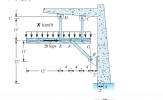 A timber member supported by three steel links to a concrete
frame has to carry the loads shown in the figure. Given: X = 9
kips/ft.
Find the reactions and the directions of Ax,Ay, and Ma\
X kips/ft ) kips E F 12' 2 2'
A timber member supported by three steel links to a concrete
frame has to carry the loads shown in the figure. Given: X = 9
kips/ft.
Find the reactions and the directions of Ax,Ay, and Ma\
X kips/ft ) kips E F 12' 2 2'
2. Design Wide flange column section only of A992 steel to serve as a pinned- end main member column 30 ft long to carry an axial compression loads in a braced structure, based on AISC LRFD metho...
 2. Design Wide flange column section only of A992 steel to serve as a pinned- end main member column 30 ft long to carry an axial compression loads in a braced structure, based on AISC LRFD method. The dead load is 50 kips A992 13-0" and live load is 70 kips. The member has strong axis direction supported at 17ft height from the bottom of the column. Dead load is 20 kips and live load is 40 kips. Assume the...
a simply supported beam shown has a span length of 16 ft. the beam is laoded...
 a simply supported beam shown has a span length of 16 ft. the
beam is laoded with to concentrated service live loads of 40 kips
and 80 kips as shown. if lateral support is provided only at both
ends, select the lightest w section of A992 steel that can carry
these applied loads. neglect the weight of the beam.
***Need this answered ASAP please***
***Please show ALL steps***
steel design - please show what tables the values come from.
thank...
a simply supported beam shown has a span length of 16 ft. the
beam is laoded with to concentrated service live loads of 40 kips
and 80 kips as shown. if lateral support is provided only at both
ends, select the lightest w section of A992 steel that can carry
these applied loads. neglect the weight of the beam.
***Need this answered ASAP please***
***Please show ALL steps***
steel design - please show what tables the values come from.
thank...
Question 2 (40 points): For the reinforced concrete section shown below, determine the nominal sh...
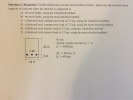 Question 2 (40 points): For the reinforced concrete section shown below, determine the nominal shear capacity of concrete when the member is subjected to a) no axial loads, using the simplified method b) no axial loads, using the more detailed method c) a factored axial compression load of 12 kip, using the simplified method d) a factored axial compression load of 12 kip, using the more detailed method e) a factored axial tension load of 12 kip, using the simplified...
Use Moment Distribution to determine all final member-end-moments for the frames given below. With these moments...
 Use Moment Distribution to determine all final member-end-moments for the frames given below. With these moments and statics, find member-end-shears and axial forces, as well as all reactions. Draw shear moment and axial force diagrams. Note that the first frame does not sway but the 2nd frame can 85 kips 50 kips 30 kips 35 ft Pin ID E 90 ft o (Ctrl
Problem 22. Two-story, one-bay unbraced frame shown below is subjected to gravitational dead and live loads...
 Problem 22. Two-story, one-bay unbraced frame shown below is subjected to gravitational dead and live loads and wind lateral load. The columns are made of W18x65 (I,-1070 in , Ag- 19.1 in2, r-7.49 in, ry-1.69 in) and beams are made of W18x71 (1, 1170 in). The table below shows the moments at the ends of column 4-5 due to three load cases. The frame is fully braced in lateral direction. Use Grade50 steel Bending is about strong axis. All gravity...
I believe D is a double Shear and B is single shear Rigid beam ABC is...
 I believe D is a double Shear and B is single shear
Rigid beam ABC is supported by a pin support at A and axial member (1). Member (1) is connected by two different pin conditions as shown in the figure and it has a diameter of 3". Each pin has a diameter of 1.5 a) Calculate the internal force in member (1) in kips and clearly indicate Tension (T) or 2) Compression (C). [Ans. to Check: 62.5 k b)...
I believe D is a double Shear and B is single shear
Rigid beam ABC is supported by a pin support at A and axial member (1). Member (1) is connected by two different pin conditions as shown in the figure and it has a diameter of 3". Each pin has a diameter of 1.5 a) Calculate the internal force in member (1) in kips and clearly indicate Tension (T) or 2) Compression (C). [Ans. to Check: 62.5 k b)...
A compound frame is subjected to a set of loads as shown in Figure 4 20...
 A compound frame is subjected to a set of loads as shown in Figure 4 20 kips w= 5 kips/ft OTO Behinge Figure 4: Compound frame with UDL and point load Draw the shear and moment diagrams for each member of the frame. Hints: (1) Break the frame at hinge B to solve for all the reactions (2) Treat segment BCD as a single member
assume P=10,000 Ib a. Solve for the reactions at Cand D. b. Use the method of...
 assume P=10,000 Ib
a. Solve for the reactions at Cand D. b. Use the method of joints to obtain the forces in each member of the truss. Label them as tension or compression C. Assume that the links are made of ordinary steel and can hold up to 12,000 psi. Determine the minimum area needed for each link. d. If the links are solid and have a circular cross-section, what is the minimum diameter of each rod? e. If you...
assume P=10,000 Ib
a. Solve for the reactions at Cand D. b. Use the method of joints to obtain the forces in each member of the truss. Label them as tension or compression C. Assume that the links are made of ordinary steel and can hold up to 12,000 psi. Determine the minimum area needed for each link. d. If the links are solid and have a circular cross-section, what is the minimum diameter of each rod? e. If you...
1. For the truss structure shown below, determine a. b. The reaction forces at D and...
 1. For the truss structure shown below, determine a. b. The reaction forces at D and F The force in each truss member. Indicate whether each is in tension or compression. 1 kip I kip 6.4 ft 24 kips 12 ft 12 ft
 A timber member supported by three steel links to a concrete
frame has to carry the loads shown in the figure. Given: X = 9
kips/ft.
Find the reactions and the directions of Ax,Ay, and Ma\
X kips/ft ) kips E F 12' 2 2'
A timber member supported by three steel links to a concrete
frame has to carry the loads shown in the figure. Given: X = 9
kips/ft.
Find the reactions and the directions of Ax,Ay, and Ma\
X kips/ft ) kips E F 12' 2 2'
 2. Design Wide flange column section only of A992 steel to serve as a pinned- end main member column 30 ft long to carry an axial compression loads in a braced structure, based on AISC LRFD method. The dead load is 50 kips A992 13-0" and live load is 70 kips. The member has strong axis direction supported at 17ft height from the bottom of the column. Dead load is 20 kips and live load is 40 kips. Assume the...
 a simply supported beam shown has a span length of 16 ft. the
beam is laoded with to concentrated service live loads of 40 kips
and 80 kips as shown. if lateral support is provided only at both
ends, select the lightest w section of A992 steel that can carry
these applied loads. neglect the weight of the beam.
***Need this answered ASAP please***
***Please show ALL steps***
steel design - please show what tables the values come from.
thank...
a simply supported beam shown has a span length of 16 ft. the
beam is laoded with to concentrated service live loads of 40 kips
and 80 kips as shown. if lateral support is provided only at both
ends, select the lightest w section of A992 steel that can carry
these applied loads. neglect the weight of the beam.
***Need this answered ASAP please***
***Please show ALL steps***
steel design - please show what tables the values come from.
thank...
 Question 2 (40 points): For the reinforced concrete section shown below, determine the nominal shear capacity of concrete when the member is subjected to a) no axial loads, using the simplified method b) no axial loads, using the more detailed method c) a factored axial compression load of 12 kip, using the simplified method d) a factored axial compression load of 12 kip, using the more detailed method e) a factored axial tension load of 12 kip, using the simplified...
 Use Moment Distribution to determine all final member-end-moments for the frames given below. With these moments and statics, find member-end-shears and axial forces, as well as all reactions. Draw shear moment and axial force diagrams. Note that the first frame does not sway but the 2nd frame can 85 kips 50 kips 30 kips 35 ft Pin ID E 90 ft o (Ctrl
 Problem 22. Two-story, one-bay unbraced frame shown below is subjected to gravitational dead and live loads and wind lateral load. The columns are made of W18x65 (I,-1070 in , Ag- 19.1 in2, r-7.49 in, ry-1.69 in) and beams are made of W18x71 (1, 1170 in). The table below shows the moments at the ends of column 4-5 due to three load cases. The frame is fully braced in lateral direction. Use Grade50 steel Bending is about strong axis. All gravity...
 I believe D is a double Shear and B is single shear
Rigid beam ABC is supported by a pin support at A and axial member (1). Member (1) is connected by two different pin conditions as shown in the figure and it has a diameter of 3". Each pin has a diameter of 1.5 a) Calculate the internal force in member (1) in kips and clearly indicate Tension (T) or 2) Compression (C). [Ans. to Check: 62.5 k b)...
I believe D is a double Shear and B is single shear
Rigid beam ABC is supported by a pin support at A and axial member (1). Member (1) is connected by two different pin conditions as shown in the figure and it has a diameter of 3". Each pin has a diameter of 1.5 a) Calculate the internal force in member (1) in kips and clearly indicate Tension (T) or 2) Compression (C). [Ans. to Check: 62.5 k b)...
 A compound frame is subjected to a set of loads as shown in Figure 4 20 kips w= 5 kips/ft OTO Behinge Figure 4: Compound frame with UDL and point load Draw the shear and moment diagrams for each member of the frame. Hints: (1) Break the frame at hinge B to solve for all the reactions (2) Treat segment BCD as a single member
 assume P=10,000 Ib
a. Solve for the reactions at Cand D. b. Use the method of joints to obtain the forces in each member of the truss. Label them as tension or compression C. Assume that the links are made of ordinary steel and can hold up to 12,000 psi. Determine the minimum area needed for each link. d. If the links are solid and have a circular cross-section, what is the minimum diameter of each rod? e. If you...
assume P=10,000 Ib
a. Solve for the reactions at Cand D. b. Use the method of joints to obtain the forces in each member of the truss. Label them as tension or compression C. Assume that the links are made of ordinary steel and can hold up to 12,000 psi. Determine the minimum area needed for each link. d. If the links are solid and have a circular cross-section, what is the minimum diameter of each rod? e. If you...
 1. For the truss structure shown below, determine a. b. The reaction forces at D and F The force in each truss member. Indicate whether each is in tension or compression. 1 kip I kip 6.4 ft 24 kips 12 ft 12 ft
Most questions answered within 3 hours.
-
Where is the error in this code sequence?
String s1 = "Hello";
String s2 = "ello";...
asked 11 months ago -
Financial data for Joel de Paris, Inc., for last year
follow:
Joel de Paris, Inc.
Balance...
asked 11 months ago -
Consider this reaction:
Al2(SO4)3 (aq)+ BaCl3
(aq) Al2Cl6 (aq)- +
3BaSO4(s) . What is the...
asked 11 months ago -
Suppose that Savneet is considering increasing her
recent random sample from 20 car rentals to 40...
asked 11 months ago -
Trucks arrive at an unloading terminal at an average rate of 120
per hour.
Trucks arrive...
asked 11 months ago -
Why are methanol and ethanol completely soluble in water while
octanol is not very little soluble....
asked 11 months ago -
A facilities manager at a university reads in a research report
that the mean amount of...
asked 11 months ago -
When the CuSO4 is rehydrated by adding water to the anhydrous
compound, is this an endothermic...
asked 11 months ago -
A ray of sunlight is passing from diamond into crown glass; the
angle of incidence is...
asked 11 months ago -
A block of mass 0.249 kg is placed on top of a light, vertical
spring of...
asked 11 months ago -
how do the kidneys compensate in the presences of acidosis
a) trigger hyperventilate
b) reserve acid...
asked 11 months ago -
Question 501 pts
The rental rate of capital to the firm increases. Which of the
following...
asked 11 months ago