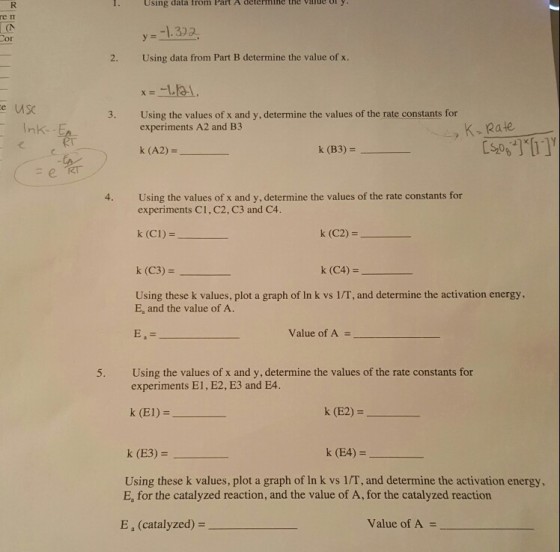
HELP! I'm not sure how to find the rate constants
Homework Answers
Reaction Rate =K* [(NH4)2S2O8]x*[KI]y -(1)
Given, x=-1.12, y=-1.32
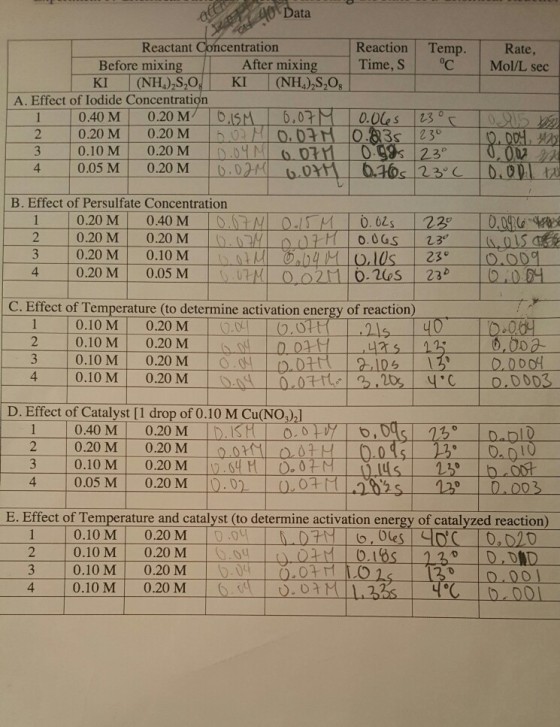
3), For A2 reaction, [(NH4)2S2O8]=0.2 mol/litre, [KI]=0.2 mol/litre
Given, Reaction rate = 0.004 mol/litre/second
Putting values in (1), K(A2) = 8.13*10^-5 mol^3.44 litre^-3.44 s
For B3 reaction, [(NH4)2S2O8]=0.1 mol/litre, [KI]=0.2 mol/litre
Given, Reaction rate = 0.009 mol/litre/second
Putting values in (1), K(B3) = 8.42*10^-5 mol^3.44 litre^-3.44 s
4)
For C1 reaction, [(NH4)2S2O8]=0.2 mol/litre, [KI]=0.1 mol/litre
Given, Reaction rate = 0.004 mol/litre/second
Putting values in (1), K(C1) = 3.3*10^-5 mol^3.44 litre^-3.44 s
For C2 reaction, [(NH4)2S2O8]=0.2 mol/litre, [KI]=0.1 mol/litre
Given, Reaction rate = 0.002 mol/litre/second
Putting values in (1), K(C2) = 1.65*10^-5 mol^3.44 litre^-3.44 s
For C3 reaction, [(NH4)2S2O8]=0.2 mol/litre, [KI]=0.1 mol/litre
Given, Reaction rate = 0.0004 mol/litre/second
Putting values in (1), K(C3) = 0.33*10^-5 mol^3.44 litre^-3.44 s
For C4 reaction, [(NH4)2S2O8]=0.2 mol/litre, [KI]=0.1 mol/litre
Given, Reaction rate = 0.0003 mol/litre/second
Putting values in (1), K(C4) = 0.24*10^-5 mol^3.44 litre^-3.44 s
| Reaction | K | T, degC | T, deg K | lnK | 1/T |
| C1 | 3.3*10^-5 | 40 | 313 | -4.45 | .0031 |
| C2 | 1.65*10^-5 | 23 | 296 | -4.82 | .0033 |
| C3 | 0.33*10^-5 | 13 | 286 | -5.5 | .0034 |
| C4 | 0.24*10^-5 | 4 | 277 | -5.63 | .0036 |
Performing regression on above values, log(K) = 3.378+(-2531)*R/T
General equation is, log(K) = log(A)-Ea/R/T
Comparing both, log(A)=3.378, => A = 2344.2 mol^3.44 litre^-3.44 s
-Ea/R = -2531
R=8.3 joule/mol/K
Therefore E=21 KJ/mol
5)
For E1 reaction, [(NH4)2S2O8]=0.2 mol/litre, [KI]=0.1 mol/litre
Given, Reaction rate = 0.02 mol/litre/second
Putting values in (1), K(E1) = 0.00016 mol^3.44 litre^-3.44 s
For E2 reaction, [(NH4)2S2O8]=0.2 mol/litre, [KI]=0.1 mol/litre
Given, Reaction rate = 0.01 mol/litre/second
Putting values in (1), K(E2) = 8.26*10^-5 mol^3.44 litre^-3.44 s
For E3 reaction, [(NH4)2S2O8]=0.2 mol/litre, [KI]=0.1 mol/litre
Given, Reaction rate = 0.001 mol/litre/second
Putting values in (1), K(E3) = 0.82*10^-5 mol^3.44 litre^-3.44 s
For E4 reaction, [(NH4)2S2O8]=0.2 mol/litre, [KI]=0.1 mol/litre
Given, Reaction rate = 0.001 mol/litre/second
Putting values in (1), K(CE4) = 0.82*10^-5 mol^3.44 litre^-3.44 s
| Reaction | K | T, degC | T, deg K | lnK | 1/T |
| E1 | 16*10^-5 | 40 | 313 | -8.74 | .0031 |
| E2 | 8.26*10^-5 | 23 | 296 | -9.4 | .0033 |
| E3 | 0.82*10^-5 | 13 | 286 | -11.7 | .0034 |
| E4 | 0.82*10^-5 | 4 | 277 | -11.7 | .0036 |
Performing regression on above values, ln(K) = 11.65+(-6577)*R/T
General equation is, ln(K) = ln(A)-Ea/R/T
Comparing both, ln(A)=11.65, => A = 114691 mol^3.44 litre^-3.44 s
-Ea/R = -6577
R=8.3 joule/mol/K
Therefore E=54.5 KJ/mol
Add Answer to:
HELP! I'm not sure how to find the rate constants
1. Using data Irom Part A...
The data on the table follow an exponential model y-aebx, Fill in the blanks 0.4 800...
 The data on the table follow an exponential model y-aebx, Fill in the blanks 0.4 800 [a1] [b1] [c1] [d1] 0.8 975 [a2] [b2] [c2] [d2] 1.2 1500 [a3] b3] [c3] [d3] 1.6 1950 [a4] b4] [c4] [d4] 2 2900 [a5 [b5] [c5] [d5 2.3 3600 [a6] [b6] [c6] [d6] Sum [a b c7] [d7] The average value of w is [e1] The average value of z is [e2] a1- [e3] a0- [e4] а» [e5] b- [e6]
a. A reaction has the following activation energy and reaction rate k constant at 20 °C...
 a. A reaction has the following activation energy and reaction rate k constant at 20 °C 10,000 cal/mo k2 1.42 h Calculate: a. reaction rate constants for 10, 15, 20, 25, 30, 35 and 40 oC b.construct the Arrhenius plot (x-1/T versus y - log k) using the reaction rate constants calculated in a. calculate Qio for each pair of temperatures with the difference od 10°C, such as between 10 and 20°C., 15 and 25 °C, etc. (you will have...
question 5,6 part 1 and 2 please Question #5 Here are the relevant data to determine the activation energy of the...
 question 5,6 part 1 and 2 please
Question #5 Here are the relevant data to determine the activation energy of the reaction. Rate constant (units not shown) Temperature (K) .13 293 0.11 308 Use the data above to determine the activation energy of the reaction. -3628 kl/mol Submit Please enter your results to the correct precision. Question #6 Here are your data for trial of Lab 7 (the trial at room temperature without the catalyst): [103 initial (S2032 Jinitial Initial...
question 5,6 part 1 and 2 please
Question #5 Here are the relevant data to determine the activation energy of the reaction. Rate constant (units not shown) Temperature (K) .13 293 0.11 308 Use the data above to determine the activation energy of the reaction. -3628 kl/mol Submit Please enter your results to the correct precision. Question #6 Here are your data for trial of Lab 7 (the trial at room temperature without the catalyst): [103 initial (S2032 Jinitial Initial...
4. Include a graph (made in Excel) of In(rate) vs. 1/T (where T is in Kelvin)....
 4. Include a graph (made in Excel) of In(rate) vs. 1/T (where T is in Kelvin). The slope of this line can be used to determine the activation energy (see Equation 5 of the lab manual) 5. Show the calculation for the determination of the activation energy and report this value (including units!). Time Volume Vol S203 H2O 20 30 20 30 20 30 20 30 20 30 Vol HCI Temp Initial 5 10.2 20. 6 5 29. 7 45.2...
Please answer both part A and B ASAP!!! CORRECT ANSWER NEEDED. THANKS Constants 1 Periodic Table...
 Please answer both part A and B ASAP!!! CORRECT ANSWER NEEDED.
THANKS
Constants 1 Periodic Table Below is an Arrhenius plot for the isomerization of cyclopropane to propene, showing the equation for the linear best fit to the data. Arrhenius Plot for the Isomerization of Cyclopropane Part A Determine the activation energy, E., for the reaction. Express your answer to four significant figures and include the appropriate units. y = - 14622x + 22.008 In (k/s) OT ♡ ♡ T...
Please answer both part A and B ASAP!!! CORRECT ANSWER NEEDED.
THANKS
Constants 1 Periodic Table Below is an Arrhenius plot for the isomerization of cyclopropane to propene, showing the equation for the linear best fit to the data. Arrhenius Plot for the Isomerization of Cyclopropane Part A Determine the activation energy, E., for the reaction. Express your answer to four significant figures and include the appropriate units. y = - 14622x + 22.008 In (k/s) OT ♡ ♡ T...
1. Use the diagram below (results of reduction kinetics of methylene blue) to help you answer...
 1. Use the diagram below (results of reduction kinetics of methylene blue) to help you answer question i)-vi) pdo gainst [Asc) Kpseudo VS [HCI] 500 05 0.1 500 y-10352x-624.82 R 0.4968 1000 1500 [HCIl mol 1 b) i Determine the order of reaction of a) b) and c) ii) Use the slope of the graphs from (a) and (b) above as well as the fixed concentrations of the other reactants to determine the rate constants of the uncatalyzed (k) and...
ln(k) = -E_a/R 1/T + ln(A) A plot of ln (k)versus 1/T result in a straight...
 ln(k) = -E_a/R 1/T + ln(A) A plot of ln (k)versus 1/T result in a straight line with a slope = -E_a/R. The value of E_a can then be calculated using the value of R and to the slope of the line. This experiment uses the Arrhenius equation, which relates the temperature and specific reaction rate constant to determine the activation energy for the crystal violet reaction. The reaction will be performed at different temperatures. Once the order of reaction...
1. Consider the circuit shown below. Cl e, (0) c, e。(t) Find the transfer function below using t...
 Please help with this dynamics circuit
analysis.
Please show work and explain.
Thank you!!
1. Consider the circuit shown below. Cl e, (0) c, e。(t) Find the transfer function below using time-domain and impedance methods. (a) Determine the differential equation for the relationship between eo(1) and e(1) (b) Find the transfer function E, (s)/E,(s) and determine the system time constant in terms of the circuit element values C, C, and R 17 2 (c) Find the transfer function E, (s)/E,...
Please help with this dynamics circuit
analysis.
Please show work and explain.
Thank you!!
1. Consider the circuit shown below. Cl e, (0) c, e。(t) Find the transfer function below using time-domain and impedance methods. (a) Determine the differential equation for the relationship between eo(1) and e(1) (b) Find the transfer function E, (s)/E,(s) and determine the system time constant in terms of the circuit element values C, C, and R 17 2 (c) Find the transfer function E, (s)/E,...
Please help me find the value of -Ea/R from ln k' vs 1/T graph E. Determination...
 Please help me find the value of -Ea/R from ln k' vs 1/T graph
E. Determination of Activation Energy Time for color change Reaction rate Calc. K 1 Ink Temperature 1/T(K) 1. Trial 4 34 sec 4.35 x 10" 66.35*100] -14.27 .: 292,654 3.42x10- 2. Cold 116sec 8.62x10 m 1.24x10 -15.90 278.15K 3.60*10*** 3. Warm 17.5 sec 5.71x10⁷m 8.24x10° -14,01 308.15K 3.25% 10 4. Instructor's Approval of Data Plot *calwlations attached on separate snert 5. Value of (-E/R) from In...
Please help me find the value of -Ea/R from ln k' vs 1/T graph
E. Determination of Activation Energy Time for color change Reaction rate Calc. K 1 Ink Temperature 1/T(K) 1. Trial 4 34 sec 4.35 x 10" 66.35*100] -14.27 .: 292,654 3.42x10- 2. Cold 116sec 8.62x10 m 1.24x10 -15.90 278.15K 3.60*10*** 3. Warm 17.5 sec 5.71x10⁷m 8.24x10° -14,01 308.15K 3.25% 10 4. Instructor's Approval of Data Plot *calwlations attached on separate snert 5. Value of (-E/R) from In...
ause the reaction is first order wiurTo stant, k, by plotting a graph of In Absorbance...
 ause the reaction is first order wiurTo stant, k, by plotting a graph of In Absorbance vs. time. hoose New Calculated Column from the Data menu. nter "In Absorbance" as the Name, and leave the unit blank. nter the correct formula for the column into the Equation edit e Function list, and selecting "Absorbance" from the Variables list c lick on the y-axis label. Choose In Absorbance. A graph of In absorhan ow be displayed. Change the scale of the...
 The data on the table follow an exponential model y-aebx, Fill in the blanks 0.4 800 [a1] [b1] [c1] [d1] 0.8 975 [a2] [b2] [c2] [d2] 1.2 1500 [a3] b3] [c3] [d3] 1.6 1950 [a4] b4] [c4] [d4] 2 2900 [a5 [b5] [c5] [d5 2.3 3600 [a6] [b6] [c6] [d6] Sum [a b c7] [d7] The average value of w is [e1] The average value of z is [e2] a1- [e3] a0- [e4] а» [e5] b- [e6]
 a. A reaction has the following activation energy and reaction rate k constant at 20 °C 10,000 cal/mo k2 1.42 h Calculate: a. reaction rate constants for 10, 15, 20, 25, 30, 35 and 40 oC b.construct the Arrhenius plot (x-1/T versus y - log k) using the reaction rate constants calculated in a. calculate Qio for each pair of temperatures with the difference od 10°C, such as between 10 and 20°C., 15 and 25 °C, etc. (you will have...
 question 5,6 part 1 and 2 please
Question #5 Here are the relevant data to determine the activation energy of the reaction. Rate constant (units not shown) Temperature (K) .13 293 0.11 308 Use the data above to determine the activation energy of the reaction. -3628 kl/mol Submit Please enter your results to the correct precision. Question #6 Here are your data for trial of Lab 7 (the trial at room temperature without the catalyst): [103 initial (S2032 Jinitial Initial...
question 5,6 part 1 and 2 please
Question #5 Here are the relevant data to determine the activation energy of the reaction. Rate constant (units not shown) Temperature (K) .13 293 0.11 308 Use the data above to determine the activation energy of the reaction. -3628 kl/mol Submit Please enter your results to the correct precision. Question #6 Here are your data for trial of Lab 7 (the trial at room temperature without the catalyst): [103 initial (S2032 Jinitial Initial...
 4. Include a graph (made in Excel) of In(rate) vs. 1/T (where T is in Kelvin). The slope of this line can be used to determine the activation energy (see Equation 5 of the lab manual) 5. Show the calculation for the determination of the activation energy and report this value (including units!). Time Volume Vol S203 H2O 20 30 20 30 20 30 20 30 20 30 Vol HCI Temp Initial 5 10.2 20. 6 5 29. 7 45.2...
 Please answer both part A and B ASAP!!! CORRECT ANSWER NEEDED.
THANKS
Constants 1 Periodic Table Below is an Arrhenius plot for the isomerization of cyclopropane to propene, showing the equation for the linear best fit to the data. Arrhenius Plot for the Isomerization of Cyclopropane Part A Determine the activation energy, E., for the reaction. Express your answer to four significant figures and include the appropriate units. y = - 14622x + 22.008 In (k/s) OT ♡ ♡ T...
Please answer both part A and B ASAP!!! CORRECT ANSWER NEEDED.
THANKS
Constants 1 Periodic Table Below is an Arrhenius plot for the isomerization of cyclopropane to propene, showing the equation for the linear best fit to the data. Arrhenius Plot for the Isomerization of Cyclopropane Part A Determine the activation energy, E., for the reaction. Express your answer to four significant figures and include the appropriate units. y = - 14622x + 22.008 In (k/s) OT ♡ ♡ T...
 1. Use the diagram below (results of reduction kinetics of methylene blue) to help you answer question i)-vi) pdo gainst [Asc) Kpseudo VS [HCI] 500 05 0.1 500 y-10352x-624.82 R 0.4968 1000 1500 [HCIl mol 1 b) i Determine the order of reaction of a) b) and c) ii) Use the slope of the graphs from (a) and (b) above as well as the fixed concentrations of the other reactants to determine the rate constants of the uncatalyzed (k) and...
 ln(k) = -E_a/R 1/T + ln(A) A plot of ln (k)versus 1/T result in a straight line with a slope = -E_a/R. The value of E_a can then be calculated using the value of R and to the slope of the line. This experiment uses the Arrhenius equation, which relates the temperature and specific reaction rate constant to determine the activation energy for the crystal violet reaction. The reaction will be performed at different temperatures. Once the order of reaction...
 Please help with this dynamics circuit
analysis.
Please show work and explain.
Thank you!!
1. Consider the circuit shown below. Cl e, (0) c, e。(t) Find the transfer function below using time-domain and impedance methods. (a) Determine the differential equation for the relationship between eo(1) and e(1) (b) Find the transfer function E, (s)/E,(s) and determine the system time constant in terms of the circuit element values C, C, and R 17 2 (c) Find the transfer function E, (s)/E,...
Please help with this dynamics circuit
analysis.
Please show work and explain.
Thank you!!
1. Consider the circuit shown below. Cl e, (0) c, e。(t) Find the transfer function below using time-domain and impedance methods. (a) Determine the differential equation for the relationship between eo(1) and e(1) (b) Find the transfer function E, (s)/E,(s) and determine the system time constant in terms of the circuit element values C, C, and R 17 2 (c) Find the transfer function E, (s)/E,...
 Please help me find the value of -Ea/R from ln k' vs 1/T graph
E. Determination of Activation Energy Time for color change Reaction rate Calc. K 1 Ink Temperature 1/T(K) 1. Trial 4 34 sec 4.35 x 10" 66.35*100] -14.27 .: 292,654 3.42x10- 2. Cold 116sec 8.62x10 m 1.24x10 -15.90 278.15K 3.60*10*** 3. Warm 17.5 sec 5.71x10⁷m 8.24x10° -14,01 308.15K 3.25% 10 4. Instructor's Approval of Data Plot *calwlations attached on separate snert 5. Value of (-E/R) from In...
Please help me find the value of -Ea/R from ln k' vs 1/T graph
E. Determination of Activation Energy Time for color change Reaction rate Calc. K 1 Ink Temperature 1/T(K) 1. Trial 4 34 sec 4.35 x 10" 66.35*100] -14.27 .: 292,654 3.42x10- 2. Cold 116sec 8.62x10 m 1.24x10 -15.90 278.15K 3.60*10*** 3. Warm 17.5 sec 5.71x10⁷m 8.24x10° -14,01 308.15K 3.25% 10 4. Instructor's Approval of Data Plot *calwlations attached on separate snert 5. Value of (-E/R) from In...
 ause the reaction is first order wiurTo stant, k, by plotting a graph of In Absorbance vs. time. hoose New Calculated Column from the Data menu. nter "In Absorbance" as the Name, and leave the unit blank. nter the correct formula for the column into the Equation edit e Function list, and selecting "Absorbance" from the Variables list c lick on the y-axis label. Choose In Absorbance. A graph of In absorhan ow be displayed. Change the scale of the...
Most questions answered within 3 hours.
-
Where is the error in this code sequence?
String s1 = "Hello";
String s2 = "ello";...
asked 10 months ago -
Financial data for Joel de Paris, Inc., for last year
follow:
Joel de Paris, Inc.
Balance...
asked 10 months ago -
Consider this reaction:
Al2(SO4)3 (aq)+ BaCl3
(aq) Al2Cl6 (aq)- +
3BaSO4(s) . What is the...
asked 10 months ago -
Suppose that Savneet is considering increasing her
recent random sample from 20 car rentals to 40...
asked 10 months ago -
Trucks arrive at an unloading terminal at an average rate of 120
per hour.
Trucks arrive...
asked 10 months ago -
Why are methanol and ethanol completely soluble in water while
octanol is not very little soluble....
asked 10 months ago -
A facilities manager at a university reads in a research report
that the mean amount of...
asked 10 months ago -
When the CuSO4 is rehydrated by adding water to the anhydrous
compound, is this an endothermic...
asked 10 months ago -
A ray of sunlight is passing from diamond into crown glass; the
angle of incidence is...
asked 10 months ago -
A block of mass 0.249 kg is placed on top of a light, vertical
spring of...
asked 10 months ago -
how do the kidneys compensate in the presences of acidosis
a) trigger hyperventilate
b) reserve acid...
asked 10 months ago -
Question 501 pts
The rental rate of capital to the firm increases. Which of the
following...
asked 10 months ago