The rate of the reaction: NO2(g) + CO(g) → NO(g) + CO2(g) was determined in three...
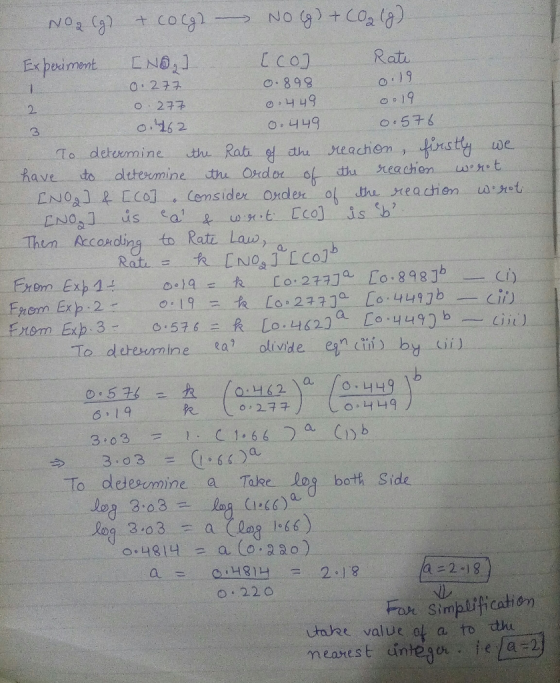
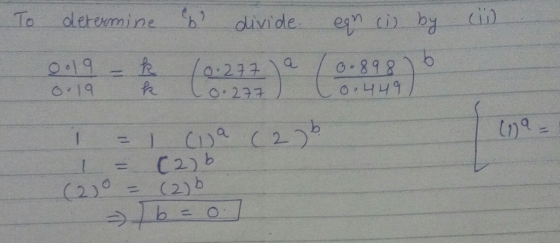
The rate of the reaction: NO2(g) + CO(g) → NO(g) + CO2(g) was determined in three experiments at 225°C. The results are given in the following table:
|
Experiment |
NO2(M) |
CO (M) |
Initial Rate –ΔNO2/Δt (M/s) |
|
1 |
0.277 |
0.898 |
0.19 |
|
2 |
0.277 |
0.449 |
0.19 |
|
3 |
0.462 |
0.449 |
0.576 |
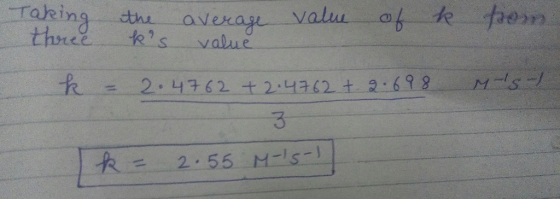
Calculate the value of the rate constant at 225°C using reaction 1 data
Homework Answers
![2 freen.ct) - ラー一0-1 a A. Lo.233] atm (1) 2.4762 Ms O 212 farem 6i](http://img.homeworklib.com/questions/c1ac5870-14e6-11ec-bc12-07017848004d.png?x-oss-process=image/resize,w_560)
Hope it will help you.
Thankyou :)
Add Answer to:
The rate of the reaction: NO2(g) + CO(g)
→ NO(g) + CO2(g) was determined in three...
The reaction rate of CO and NO2 in the reaction CO(g) + NO2(g) → CO2(g) +...
The reaction rate of CO and NO2 in the reaction CO(g) + NO2(g) → CO2(g) + NO(g) is measured using the initial rates method. The results are tabulated below. [CO] (mol/L) NO2 (mol/L) -([CO]/Δt (mol/L·s) 8.00 10-4 5.50 10-4 8.40 10-8 8.00 10-4 7.78 10-4 1.68 10-7 1.60 10-3 5.50 10-4 1.68 10-7 Determine the rate expression and calculate the rate constant for the reaction.
Reaction Equation: NO2 (g) + CO(g) ⟶ NO(g) + CO2 (g) Experiment Number Inital concentration of...
Reaction Equation: NO2 (g) + CO(g) ⟶ NO(g) + CO2 (g) Experiment Number Inital concentration of [NO2] (M) Inital concentration of [CO] (M) Initial rate (M/s) 1 0.200 0.200 5.00X10⁻⁴ 2 0.200 0.800 8.00X10⁻³ 3 0.600 0.200 5.00X10⁻⁴ A.) Determine the order (0, 1, or 2) with respect to NO2. B.) Determine the order (0, 1, or 2) with respect to CO.
• For the reaction CO (g) + NO2 (g) → CO2(g) + NO (g) • Reaction...
• For the reaction CO (g) + NO2 (g) → CO2(g) + NO (g) • Reaction rate = k[CO][NO2] • k = 1.9 L/mol•h • Determine the initial rate of reaction when [CO] = 3.8 x 10⁻⁴ mol/L and [NO2] = 0.650 x 10⁻⁴ mol/L. Answer: 4.7 x 10⁻⁸ mol/L•h know it is something simple I am not plugging in correctly, but I can't get this answer.
The reaction NO2(g) + CO(g) CO2(g) + NO(g) has a rate constant of 2.57 M−1∙s−1 at...
The reaction NO2(g) + CO(g) CO2(g) + NO(g) has a rate constant of 2.57 M−1∙s−1 at 701 K and 567 M−1∙s−1 at 895 K. Find the activation energy in kJ/mol
If the mechanism behind the reaction NO2(g) + CO(g) Ó NO(g) + CO2(g) is : 1-...
 If the mechanism behind the reaction NO2(g) + CO(g) Ó NO(g) + CO2(g) is : 1- 2NO2(g) à 2NO(g) + O2(g) (slow) 2- NO(g) + CO(g) + O2(g) à NO2(g) + CO2(g) (fast) Then its rate law is: A) Rate = k [NO2] . [CO] B) Rate = k [NO2] . [CO2] C) Rate = k [NO 212 D) Rate = k [co]2
The rate of the reaction: CO (g) + NO2 (g) à CO2 (g) + NO (g)...
The rate of the reaction: CO (g) + NO2 (g) à CO2 (g) + NO (g) was measured at several temperatures, and the following data were collected: Temp (oC) K (M-1s-1) 35 0.184 45 0.322 Using this data determine the value of Ea (energy of activation)
You have the following reaction: NO2 (g) + CO (g) ⟶ NO (g) + CO2 (g)...
You have the following reaction: NO2 (g) + CO (g) ⟶ NO (g) + CO2 (g) The rate constant (k) at 701 K is 2.57 M-1s-1. If the activation energy is 150 kJ/mol, what is k at 895 K? R = 8.314 J/(mol*K) A) 680 M-1s-1 B) 443 M-1s-1 C) 2.58 M-1s-1 D) 0.950 M-1s-1 E) 6.52 M-1s-1
The gas phase decomposition of nitrogen dioxide at 383 °C NO2(g)NO(g) + ½ O2(g) is second...
The gas phase decomposition of nitrogen dioxide at 383 °C NO2(g)NO(g) + ½ O2(g) is second order in NO2. In one experiment, when the initial concentration of NO2 was 0.449 M, the concentration of NO2 dropped to 5.84×10⁻² M after 20.6 seconds had passed. Based on these data, the rate constant for the reaction is_______ M-1 s-1?
Is no2(g)+co(g)→no(g)+co2(g) an elementary reaction? Rate = k[NO2]^2 Please explain if possible why It is or...
Is no2(g)+co(g)→no(g)+co2(g) an elementary reaction? Rate = k[NO2]^2 Please explain if possible why It is or is not an elementary reaction
For the reaction NO2(g) + CO(g) → NO(g) + CO2(g)
 For the reaction NO2(g) + CO(g) → NO(g) + CO2(g) calculate the order of the reaction with respect to the following reactants according to the following experimental data: Part 1 (1 point) Order of the reaction with respect to NO2: Part 2 (1 point) Order of the reaction with respect to CO:
 If the mechanism behind the reaction NO2(g) + CO(g) Ó NO(g) + CO2(g) is : 1- 2NO2(g) à 2NO(g) + O2(g) (slow) 2- NO(g) + CO(g) + O2(g) à NO2(g) + CO2(g) (fast) Then its rate law is: A) Rate = k [NO2] . [CO] B) Rate = k [NO2] . [CO2] C) Rate = k [NO 212 D) Rate = k [co]2
Most questions answered within 3 hours.
-
Where is the error in this code sequence?
String s1 = "Hello";
String s2 = "ello";...
asked 11 months ago -
Financial data for Joel de Paris, Inc., for last year
follow:
Joel de Paris, Inc.
Balance...
asked 11 months ago -
Consider this reaction:
Al2(SO4)3 (aq)+ BaCl3
(aq) Al2Cl6 (aq)- +
3BaSO4(s) . What is the...
asked 11 months ago -
Suppose that Savneet is considering increasing her
recent random sample from 20 car rentals to 40...
asked 11 months ago -
Trucks arrive at an unloading terminal at an average rate of 120
per hour.
Trucks arrive...
asked 11 months ago -
Why are methanol and ethanol completely soluble in water while
octanol is not very little soluble....
asked 11 months ago -
A facilities manager at a university reads in a research report
that the mean amount of...
asked 11 months ago -
When the CuSO4 is rehydrated by adding water to the anhydrous
compound, is this an endothermic...
asked 11 months ago -
A ray of sunlight is passing from diamond into crown glass; the
angle of incidence is...
asked 11 months ago -
A block of mass 0.249 kg is placed on top of a light, vertical
spring of...
asked 11 months ago -
how do the kidneys compensate in the presences of acidosis
a) trigger hyperventilate
b) reserve acid...
asked 11 months ago -
Question 501 pts
The rental rate of capital to the firm increases. Which of the
following...
asked 11 months ago