
Homework Answers
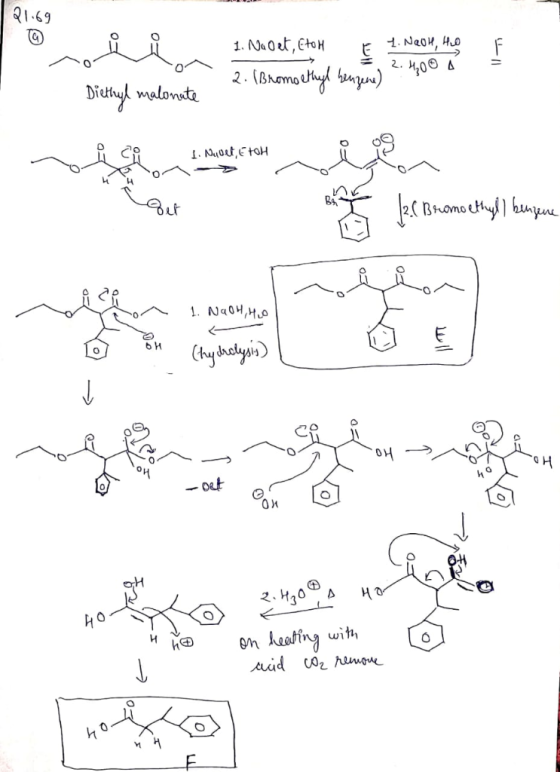
a) NaOEt abstract acidic proton from diethyl malonate and forms enolate than this attack on bromoethyl benzene and forms product E. And the hydrolysis of E take place by NaOH, H2O and then heating with acid remove CO2 and forms product F.
b) NaOC(CH3)3 removes acidic proton from product E and the addition of pentane takes place and forms product G. And hydrolysis of G takes place by NaOH, H2O and then heating with acid removes CO2 and form product H.
See handwritten answer below carefully for complete mechanism.
 Hope it helps you.
Add Answer to:
21.69 Draw structures for compounds E through H. 1. NaOH, H2O 1. NaOEt, EtOH (a) Diethyl...
Fill in the boxes below with the correct structures of enolate reaction products. NaOEt EtOH 1. N...
 Fill in the boxes below with the correct structures of enolate reaction products. NaOEt EtOH 1. NaOH 0 3. heat Michael addition NaOH NaOH heat H+ Crossed Aldol 3 NaOH 1. NaOH CH3 3 Br2 Haloform
Fill in the boxes below with the correct structures of enolate reaction products. NaOEt EtOH 1. NaOH 0 3. heat Michael addition NaOH NaOH heat H+ Crossed Aldol 3 NaOH 1. NaOH CH3 3 Br2 Haloform
Fill in the boxes below with the correct structures of enolate reaction products. NaOEt EtOH 1. NaOH 0 3. heat Michael addition NaOH NaOH heat H+ Crossed Aldol 3 NaOH 1. NaOH CH3 3 Br2 Haloform
Identify compounds A,B, and C 112 Identify compounds A, B, and C points] 1. NaOEt, EtOH...
 Identify compounds A,B, and
C
112 Identify compounds A, B, and C points] 1. NaOEt, EtOH 2. CH3Br 1. NaOEt, EtOH 2. CH3CH2CH2CH2Br 1. excess NaOH, H2O 2. Hao heat
Identify compounds A,B, and
C
112 Identify compounds A, B, and C points] 1. NaOEt, EtOH 2. CH3Br 1. NaOEt, EtOH 2. CH3CH2CH2CH2Br 1. excess NaOH, H2O 2. Hao heat
NaOEt OET ETOH HCI H2O NaOH H2O 1. LIAIHA 2. H20 CH420 Question 2 (1 pt)...
 NaOEt OET ETOH HCI H2O NaOH H2O 1. LIAIHA 2. H20 CH420 Question 2 (1 pt) When treated with aqueous NaOH, the following compounds give an aldol product which then undergoes dehydration to give a new product (with Estereochemistry). Please give structural formulas for both products. NaOH NaOH + H20 Н20 H20 Aldol product Question 3 (1 pt) How many different aldols (B-hydroxyaldehydes), including constitutional isomers and stereoisomers, are formed upon treatment of propanal with a base?
For each reacuon ere s only as an aid for you. 1) KOH, H-O, heat Diethyl malonate B 1) Ph3P, ether 2) nBuLi, ether CIH1...
 For each reacuon ere s only as an aid for you. 1) KOH, H-O, heat Diethyl malonate B 1) Ph3P, ether 2) nBuLi, ether CIH1204 2) H, H2O, heat C1SH2406 CHH1202 NaOEt, EtOH Br OCH2CH3 3) PHCHO NH/heat Note: The C-13 NMRS for Structures C, D, and E each show 7 resonances LIAIH D E C1HNO ether C1H1SN Br 1) SOCI2, pyridine F 2) CH3OH 1) CH2COCI,AICI3 1) Mg(s), Et20 H 2) diisopropyl amine, pH 4.5, NaBH3CN 2) CO2 (s)...
4. Draw the structures of the compounds formed in the following synthetic schemes. Br2 (CH3)2CHCH2CH3 UV NaOEt HBr...
 4. Draw the structures of the compounds formed in the following synthetic schemes. Br2 (CH3)2CHCH2CH3 UV NaOEt HBr C ROOR 1. Br2 E KOTBU ETOH 2. NaNH2(xs) 3. Нао light a. OH CHCH3 TsCl -сHа HBr B ROOR Кови A На C NaCECH 1. BH E 2. H2O2 NaOH F base Lindlars catalyst b. Br NaOMe HBr A ROOR 1. Br2 с 2. NANH2(xs) 3. H2O KOtBu В (CH3)2CCH2CH3 D MeOH с. Br2 NaOMe HBr c NaC CHD На (CH3)3CH...
2. Draw the structures of the organic compounds formed in the following reactions: Thiamine HCI H3C...
 2. Draw the structures of the organic compounds formed in the following reactions: Thiamine HCI H3C 3M aq. NaOH EtOH-H2O Same reaction using only p-Chlorobenzaldehyde
What's the major product in each step of the reaction? e) 1. NaOEt, EtOH dilute OEt...
 What's the major product in each step of the reaction?
e) 1. NaOEt, EtOH dilute OEt Eto 2. HyO*, heat 1. LiAIH4, ether 1. DIBAL, THF 2. H', H2O h) 1.2 eq. CH,CH2MgBr, ether 2. D3O OCH, 1) OH, H20 3) EtOH, H,o* 2) H,o 4) excess CHMgBr 5) H,O
What's the major product in each step of the reaction?
e) 1. NaOEt, EtOH dilute OEt Eto 2. HyO*, heat 1. LiAIH4, ether 1. DIBAL, THF 2. H', H2O h) 1.2 eq. CH,CH2MgBr, ether 2. D3O OCH, 1) OH, H20 3) EtOH, H,o* 2) H,o 4) excess CHMgBr 5) H,O
Draw the structures of organic compounds A and B. Indicate stereochemistry where applicable. Draw the structures...
 Draw the structures of organic compounds A and B. Indicate
stereochemistry where applicable.
Draw the structures orga C Compounds A ama P. Indicate StereoChemistry where applicao 1) NaNH2 H--C C- 2) CH3CH2CH2Br CH2 (1 equiv.) CH3 CH2 H2 Lindlar cat H20, OH H2O CH3 H3C
Draw the structures of organic compounds A and B. Indicate
stereochemistry where applicable.
Draw the structures orga C Compounds A ama P. Indicate StereoChemistry where applicao 1) NaNH2 H--C C- 2) CH3CH2CH2Br CH2 (1 equiv.) CH3 CH2 H2 Lindlar cat H20, OH H2O CH3 H3C
Draw the missing structure. NaOEt Ph-N PhNH2 50 + Coret / CO,Et (2 equiv) EtOH corer...
 Draw the missing structure.
NaOEt Ph-N PhNH2 50 + Coret / CO,Et (2 equiv) EtOH corer cozet 1) NaOH, H2O 2) H30, heat
Draw the missing structure.
NaOEt Ph-N PhNH2 50 + Coret / CO,Et (2 equiv) EtOH corer cozet 1) NaOH, H2O 2) H30, heat
Draw mechanisms and explain 21.12 Draw the correct structures for the following rxn sequences. 1. OCH...
 Draw mechanisms and explain
21.12 Draw the correct structures for the following rxn sequences. 1. OCH CH 2. 1-bromo-propane A 1. OH 2. H+, quench B A, c diethyl malonate B CS HO HOY maller alle and 1. "OCH CH3 1. OH 2. H+, quench ethyl acetoacetate 3. H+, quench B = lors u cha Or OH OH ОН
Draw mechanisms and explain
21.12 Draw the correct structures for the following rxn sequences. 1. OCH CH 2. 1-bromo-propane A 1. OH 2. H+, quench B A, c diethyl malonate B CS HO HOY maller alle and 1. "OCH CH3 1. OH 2. H+, quench ethyl acetoacetate 3. H+, quench B = lors u cha Or OH OH ОН
 Fill in the boxes below with the correct structures of enolate reaction products. NaOEt EtOH 1. NaOH 0 3. heat Michael addition NaOH NaOH heat H+ Crossed Aldol 3 NaOH 1. NaOH CH3 3 Br2 Haloform
Fill in the boxes below with the correct structures of enolate reaction products. NaOEt EtOH 1. NaOH 0 3. heat Michael addition NaOH NaOH heat H+ Crossed Aldol 3 NaOH 1. NaOH CH3 3 Br2 Haloform
Fill in the boxes below with the correct structures of enolate reaction products. NaOEt EtOH 1. NaOH 0 3. heat Michael addition NaOH NaOH heat H+ Crossed Aldol 3 NaOH 1. NaOH CH3 3 Br2 Haloform
 Identify compounds A,B, and
C
112 Identify compounds A, B, and C points] 1. NaOEt, EtOH 2. CH3Br 1. NaOEt, EtOH 2. CH3CH2CH2CH2Br 1. excess NaOH, H2O 2. Hao heat
Identify compounds A,B, and
C
112 Identify compounds A, B, and C points] 1. NaOEt, EtOH 2. CH3Br 1. NaOEt, EtOH 2. CH3CH2CH2CH2Br 1. excess NaOH, H2O 2. Hao heat
 NaOEt OET ETOH HCI H2O NaOH H2O 1. LIAIHA 2. H20 CH420 Question 2 (1 pt) When treated with aqueous NaOH, the following compounds give an aldol product which then undergoes dehydration to give a new product (with Estereochemistry). Please give structural formulas for both products. NaOH NaOH + H20 Н20 H20 Aldol product Question 3 (1 pt) How many different aldols (B-hydroxyaldehydes), including constitutional isomers and stereoisomers, are formed upon treatment of propanal with a base?
 For each reacuon ere s only as an aid for you. 1) KOH, H-O, heat Diethyl malonate B 1) Ph3P, ether 2) nBuLi, ether CIH1204 2) H, H2O, heat C1SH2406 CHH1202 NaOEt, EtOH Br OCH2CH3 3) PHCHO NH/heat Note: The C-13 NMRS for Structures C, D, and E each show 7 resonances LIAIH D E C1HNO ether C1H1SN Br 1) SOCI2, pyridine F 2) CH3OH 1) CH2COCI,AICI3 1) Mg(s), Et20 H 2) diisopropyl amine, pH 4.5, NaBH3CN 2) CO2 (s)...
 4. Draw the structures of the compounds formed in the following synthetic schemes. Br2 (CH3)2CHCH2CH3 UV NaOEt HBr C ROOR 1. Br2 E KOTBU ETOH 2. NaNH2(xs) 3. Нао light a. OH CHCH3 TsCl -сHа HBr B ROOR Кови A На C NaCECH 1. BH E 2. H2O2 NaOH F base Lindlars catalyst b. Br NaOMe HBr A ROOR 1. Br2 с 2. NANH2(xs) 3. H2O KOtBu В (CH3)2CCH2CH3 D MeOH с. Br2 NaOMe HBr c NaC CHD На (CH3)3CH...
 2. Draw the structures of the organic compounds formed in the following reactions: Thiamine HCI H3C 3M aq. NaOH EtOH-H2O Same reaction using only p-Chlorobenzaldehyde
 What's the major product in each step of the reaction?
e) 1. NaOEt, EtOH dilute OEt Eto 2. HyO*, heat 1. LiAIH4, ether 1. DIBAL, THF 2. H', H2O h) 1.2 eq. CH,CH2MgBr, ether 2. D3O OCH, 1) OH, H20 3) EtOH, H,o* 2) H,o 4) excess CHMgBr 5) H,O
What's the major product in each step of the reaction?
e) 1. NaOEt, EtOH dilute OEt Eto 2. HyO*, heat 1. LiAIH4, ether 1. DIBAL, THF 2. H', H2O h) 1.2 eq. CH,CH2MgBr, ether 2. D3O OCH, 1) OH, H20 3) EtOH, H,o* 2) H,o 4) excess CHMgBr 5) H,O
 Draw the structures of organic compounds A and B. Indicate
stereochemistry where applicable.
Draw the structures orga C Compounds A ama P. Indicate StereoChemistry where applicao 1) NaNH2 H--C C- 2) CH3CH2CH2Br CH2 (1 equiv.) CH3 CH2 H2 Lindlar cat H20, OH H2O CH3 H3C
Draw the structures of organic compounds A and B. Indicate
stereochemistry where applicable.
Draw the structures orga C Compounds A ama P. Indicate StereoChemistry where applicao 1) NaNH2 H--C C- 2) CH3CH2CH2Br CH2 (1 equiv.) CH3 CH2 H2 Lindlar cat H20, OH H2O CH3 H3C
 Draw the missing structure.
NaOEt Ph-N PhNH2 50 + Coret / CO,Et (2 equiv) EtOH corer cozet 1) NaOH, H2O 2) H30, heat
Draw the missing structure.
NaOEt Ph-N PhNH2 50 + Coret / CO,Et (2 equiv) EtOH corer cozet 1) NaOH, H2O 2) H30, heat
 Draw mechanisms and explain
21.12 Draw the correct structures for the following rxn sequences. 1. OCH CH 2. 1-bromo-propane A 1. OH 2. H+, quench B A, c diethyl malonate B CS HO HOY maller alle and 1. "OCH CH3 1. OH 2. H+, quench ethyl acetoacetate 3. H+, quench B = lors u cha Or OH OH ОН
Draw mechanisms and explain
21.12 Draw the correct structures for the following rxn sequences. 1. OCH CH 2. 1-bromo-propane A 1. OH 2. H+, quench B A, c diethyl malonate B CS HO HOY maller alle and 1. "OCH CH3 1. OH 2. H+, quench ethyl acetoacetate 3. H+, quench B = lors u cha Or OH OH ОН
Most questions answered within 3 hours.
-
Where is the error in this code sequence?
String s1 = "Hello";
String s2 = "ello";...
asked 10 months ago -
Financial data for Joel de Paris, Inc., for last year
follow:
Joel de Paris, Inc.
Balance...
asked 10 months ago -
Consider this reaction:
Al2(SO4)3 (aq)+ BaCl3
(aq) Al2Cl6 (aq)- +
3BaSO4(s) . What is the...
asked 10 months ago -
Suppose that Savneet is considering increasing her
recent random sample from 20 car rentals to 40...
asked 10 months ago -
Trucks arrive at an unloading terminal at an average rate of 120
per hour.
Trucks arrive...
asked 10 months ago -
Why are methanol and ethanol completely soluble in water while
octanol is not very little soluble....
asked 10 months ago -
A facilities manager at a university reads in a research report
that the mean amount of...
asked 10 months ago -
When the CuSO4 is rehydrated by adding water to the anhydrous
compound, is this an endothermic...
asked 10 months ago -
A ray of sunlight is passing from diamond into crown glass; the
angle of incidence is...
asked 10 months ago -
A block of mass 0.249 kg is placed on top of a light, vertical
spring of...
asked 10 months ago -
how do the kidneys compensate in the presences of acidosis
a) trigger hyperventilate
b) reserve acid...
asked 10 months ago -
Question 501 pts
The rental rate of capital to the firm increases. Which of the
following...
asked 10 months ago