
Homework Answers
Add Answer to:
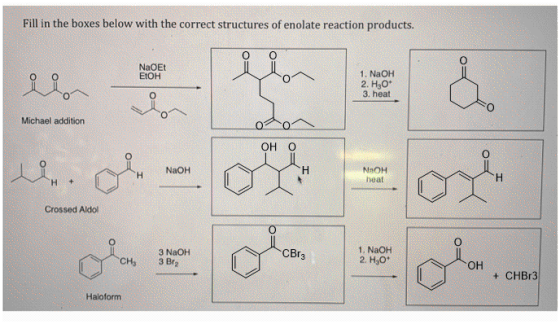
Fill in the boxes below with the correct structures of enolate reaction products. NaOEt EtOH 1. N...
Q1- Fill in the boxes with the product of the following reactions. Draw only the PREDOMİNANT...
 Q1- Fill in the boxes with the product of the following reactions. Draw only the PREDOMİNANT REGIOISOMER. When a racemic mixture is formed mark the chiral center with an ASTERICK () and write RACEMİC in the box. 1 Eq LDA 0 1 Eq NaOH 1) 0.5 Eq LDA1) Cat NaOH 2) H30 јнзо-, Heat , NaOEt, EtOH 1. NaOEt EtOH Br 1) NaOH, H2O 2) H3O 3) Heat 1) (CH3)zMgBr 2) H30 2 a2- Fill in the boxes with the...
Need Help. Will Rate If Complete. 1) NaoEt, EtOH Br 2) O 3) H30+ / A....
 Need Help. Will Rate If Complete.
1) NaoEt, EtOH Br 2) O 3) H30+ / A. 1) NaoEt, EtOH (s) ar 2) Y Br 3) Hz0+ / A 1) NaOme/MeOH ~ Br OMe 3) Hz0+/A. 1) NaOEt, EtOH 2) V Br 3) NaOEt, EtOH COOEt 5) H30+/A Robinson Annulation NaoEt, EtOH/A come lui OMe 28- The following molecules can be formed by either: Michael Reaction; Enamine Acylation; Acetoacetic Ester Synthesis; Michael Addition; Malonic Ester Synthesis; Robinson Annulation; Aldol Condensation; Claisen...
Need Help. Will Rate If Complete.
1) NaoEt, EtOH Br 2) O 3) H30+ / A. 1) NaoEt, EtOH (s) ar 2) Y Br 3) Hz0+ / A 1) NaOme/MeOH ~ Br OMe 3) Hz0+/A. 1) NaOEt, EtOH 2) V Br 3) NaOEt, EtOH COOEt 5) H30+/A Robinson Annulation NaoEt, EtOH/A come lui OMe 28- The following molecules can be formed by either: Michael Reaction; Enamine Acylation; Acetoacetic Ester Synthesis; Michael Addition; Malonic Ester Synthesis; Robinson Annulation; Aldol Condensation; Claisen...
21.69 Draw structures for compounds E through H. 1. NaOH, H2O 1. NaOEt, EtOH (a) Diethyl...
 21.69 Draw structures for compounds E through H. 1. NaOH, H2O 1. NaOEt, EtOH (a) Diethyl malonate 2. (Bromomethyl)benzene Same as above 1. NaOH, H2O 1. NaOC(CH3)3, (CH3)3COH (b) E 2. 1-lodopentane
1. The reaction web includes most of the reactions of enolates we have studied. The products...
 1. The reaction web includes most of the reactions of enolates we have studied. The products of these reactions can be treated with other reagents to generate new functionality - think synthesis! Make up your own examples - e.g. What if you treated compound D with CH,MgBr? In the table, summarize the types of products produced from these reactions. CH3 MgBr acid quench acid quench NaOH, H2O EIO OEt acid quench acid quench acid quench D LIAIHA acid quench acid...
Predict the products and provide the complete arrow-pushing mechanism for the reaction below. NaOEt EtOH
 Predict the products and provide the complete arrow-pushing mechanism for the reaction below. NaOEt EtOH
13. Reactions: Fill in the missing products for each of the boxes in the following reaction...
 13. Reactions: Fill in the missing products for each of the boxes in the following reaction sequences. (30) OH Na2Cr2O7 H2SO4 H2O PCC NaBH HOCH, PBr3 Br2, H20 NaH BrMg- 2. H2O* NaOEt 1. OsO4 2. NaHSO3
Predict the major organic product of the following reaction and complete its mechanism below. 1) NaOEt/EtOH...
 Predict the major organic product of the following reaction and complete its mechanism below. 1) NaOEt/EtOH 2) CH3CH2CH2Br 3) dilute NaOH/heat 4) H30* 5) heat Complete the curved-arrow mechanism for the scheme below by adding any missing atoms, bonds, charges, nonbonding electrons, and curved arrows. :O O: :Br. CH3CH2OH Do not show curved arrows for this step. Added acid Dilute HH NaOH and heat hydrolyzes the ester. O: Na Br - H20, Na* O: 100-150 °C O:
4) Fill in the boxes with the correct organic structures: NaOH Heat + HCI IZ
 4) Fill in the boxes with the correct organic structures: NaOH Heat + HCI IZ
1. Predict the major product for the reactions shown below; pick any 5: HO xs CHal Ag20 NaOEt EtOH, Δ -H2O HO но он 0 он H2SO4 H20, A heat 1) PhMgBr 1) NaOH, Br2 2) 5% HCI 2)H3O+, Δ OEt 1) PPh3 3...
 1. Predict the major product for the reactions shown below; pick any 5: HO xs CHal Ag20 NaOEt EtOH, Δ -H2O HO но он 0 он H2SO4 H20, A heat 1) PhMgBr 1) NaOH, Br2 2) 5% HCI 2)H3O+, Δ OEt 1) PPh3 3) KOtBu 2) O 1) NaOH on. Br 2) O o
1. Predict the major product for the reactions shown below; pick any 5: HO xs CHal Ag20 NaOEt EtOH, Δ -H2O HO но он 0 он...
1. Predict the major product for the reactions shown below; pick any 5: HO xs CHal Ag20 NaOEt EtOH, Δ -H2O HO но он 0 он H2SO4 H20, A heat 1) PhMgBr 1) NaOH, Br2 2) 5% HCI 2)H3O+, Δ OEt 1) PPh3 3) KOtBu 2) O 1) NaOH on. Br 2) O o
1. Predict the major product for the reactions shown below; pick any 5: HO xs CHal Ag20 NaOEt EtOH, Δ -H2O HO но он 0 он...
Draw the structures of the 2 enolate products from the reaction below. One is called the...
 Draw the structures of the 2 enolate products from the reaction
below. One is called the "kinetic enolate", and the other is the
"thermodynamic enolate". Which is which, and why?
+ Bi z enolates (draw structures) one called "Kinete enolate" - the other called "Thermodynamic enclate" - which is which & wity ? - Tell are
Draw the structures of the 2 enolate products from the reaction
below. One is called the "kinetic enolate", and the other is the
"thermodynamic enolate". Which is which, and why?
+ Bi z enolates (draw structures) one called "Kinete enolate" - the other called "Thermodynamic enclate" - which is which & wity ? - Tell are
 Q1- Fill in the boxes with the product of the following reactions. Draw only the PREDOMİNANT REGIOISOMER. When a racemic mixture is formed mark the chiral center with an ASTERICK () and write RACEMİC in the box. 1 Eq LDA 0 1 Eq NaOH 1) 0.5 Eq LDA1) Cat NaOH 2) H30 јнзо-, Heat , NaOEt, EtOH 1. NaOEt EtOH Br 1) NaOH, H2O 2) H3O 3) Heat 1) (CH3)zMgBr 2) H30 2 a2- Fill in the boxes with the...
 Need Help. Will Rate If Complete.
1) NaoEt, EtOH Br 2) O 3) H30+ / A. 1) NaoEt, EtOH (s) ar 2) Y Br 3) Hz0+ / A 1) NaOme/MeOH ~ Br OMe 3) Hz0+/A. 1) NaOEt, EtOH 2) V Br 3) NaOEt, EtOH COOEt 5) H30+/A Robinson Annulation NaoEt, EtOH/A come lui OMe 28- The following molecules can be formed by either: Michael Reaction; Enamine Acylation; Acetoacetic Ester Synthesis; Michael Addition; Malonic Ester Synthesis; Robinson Annulation; Aldol Condensation; Claisen...
Need Help. Will Rate If Complete.
1) NaoEt, EtOH Br 2) O 3) H30+ / A. 1) NaoEt, EtOH (s) ar 2) Y Br 3) Hz0+ / A 1) NaOme/MeOH ~ Br OMe 3) Hz0+/A. 1) NaOEt, EtOH 2) V Br 3) NaOEt, EtOH COOEt 5) H30+/A Robinson Annulation NaoEt, EtOH/A come lui OMe 28- The following molecules can be formed by either: Michael Reaction; Enamine Acylation; Acetoacetic Ester Synthesis; Michael Addition; Malonic Ester Synthesis; Robinson Annulation; Aldol Condensation; Claisen...
 21.69 Draw structures for compounds E through H. 1. NaOH, H2O 1. NaOEt, EtOH (a) Diethyl malonate 2. (Bromomethyl)benzene Same as above 1. NaOH, H2O 1. NaOC(CH3)3, (CH3)3COH (b) E 2. 1-lodopentane
 1. The reaction web includes most of the reactions of enolates we have studied. The products of these reactions can be treated with other reagents to generate new functionality - think synthesis! Make up your own examples - e.g. What if you treated compound D with CH,MgBr? In the table, summarize the types of products produced from these reactions. CH3 MgBr acid quench acid quench NaOH, H2O EIO OEt acid quench acid quench acid quench D LIAIHA acid quench acid...
 Predict the products and provide the complete arrow-pushing mechanism for the reaction below. NaOEt EtOH
 13. Reactions: Fill in the missing products for each of the boxes in the following reaction sequences. (30) OH Na2Cr2O7 H2SO4 H2O PCC NaBH HOCH, PBr3 Br2, H20 NaH BrMg- 2. H2O* NaOEt 1. OsO4 2. NaHSO3
 Predict the major organic product of the following reaction and complete its mechanism below. 1) NaOEt/EtOH 2) CH3CH2CH2Br 3) dilute NaOH/heat 4) H30* 5) heat Complete the curved-arrow mechanism for the scheme below by adding any missing atoms, bonds, charges, nonbonding electrons, and curved arrows. :O O: :Br. CH3CH2OH Do not show curved arrows for this step. Added acid Dilute HH NaOH and heat hydrolyzes the ester. O: Na Br - H20, Na* O: 100-150 °C O:
 4) Fill in the boxes with the correct organic structures: NaOH Heat + HCI IZ
 1. Predict the major product for the reactions shown below; pick any 5: HO xs CHal Ag20 NaOEt EtOH, Δ -H2O HO но он 0 он H2SO4 H20, A heat 1) PhMgBr 1) NaOH, Br2 2) 5% HCI 2)H3O+, Δ OEt 1) PPh3 3) KOtBu 2) O 1) NaOH on. Br 2) O o
1. Predict the major product for the reactions shown below; pick any 5: HO xs CHal Ag20 NaOEt EtOH, Δ -H2O HO но он 0 он...
1. Predict the major product for the reactions shown below; pick any 5: HO xs CHal Ag20 NaOEt EtOH, Δ -H2O HO но он 0 он H2SO4 H20, A heat 1) PhMgBr 1) NaOH, Br2 2) 5% HCI 2)H3O+, Δ OEt 1) PPh3 3) KOtBu 2) O 1) NaOH on. Br 2) O o
1. Predict the major product for the reactions shown below; pick any 5: HO xs CHal Ag20 NaOEt EtOH, Δ -H2O HO но он 0 он...
 Draw the structures of the 2 enolate products from the reaction
below. One is called the "kinetic enolate", and the other is the
"thermodynamic enolate". Which is which, and why?
+ Bi z enolates (draw structures) one called "Kinete enolate" - the other called "Thermodynamic enclate" - which is which & wity ? - Tell are
Draw the structures of the 2 enolate products from the reaction
below. One is called the "kinetic enolate", and the other is the
"thermodynamic enolate". Which is which, and why?
+ Bi z enolates (draw structures) one called "Kinete enolate" - the other called "Thermodynamic enclate" - which is which & wity ? - Tell are
Most questions answered within 3 hours.
-
Where is the error in this code sequence?
String s1 = "Hello";
String s2 = "ello";...
asked 11 months ago -
Financial data for Joel de Paris, Inc., for last year
follow:
Joel de Paris, Inc.
Balance...
asked 11 months ago -
Consider this reaction:
Al2(SO4)3 (aq)+ BaCl3
(aq) Al2Cl6 (aq)- +
3BaSO4(s) . What is the...
asked 11 months ago -
Suppose that Savneet is considering increasing her
recent random sample from 20 car rentals to 40...
asked 11 months ago -
Trucks arrive at an unloading terminal at an average rate of 120
per hour.
Trucks arrive...
asked 11 months ago -
Why are methanol and ethanol completely soluble in water while
octanol is not very little soluble....
asked 11 months ago -
A facilities manager at a university reads in a research report
that the mean amount of...
asked 11 months ago -
When the CuSO4 is rehydrated by adding water to the anhydrous
compound, is this an endothermic...
asked 11 months ago -
A ray of sunlight is passing from diamond into crown glass; the
angle of incidence is...
asked 11 months ago -
A block of mass 0.249 kg is placed on top of a light, vertical
spring of...
asked 11 months ago -
how do the kidneys compensate in the presences of acidosis
a) trigger hyperventilate
b) reserve acid...
asked 11 months ago -
Question 501 pts
The rental rate of capital to the firm increases. Which of the
following...
asked 11 months ago