Given the following data for a chemical reaction, determine whether it is a zero, first, or...
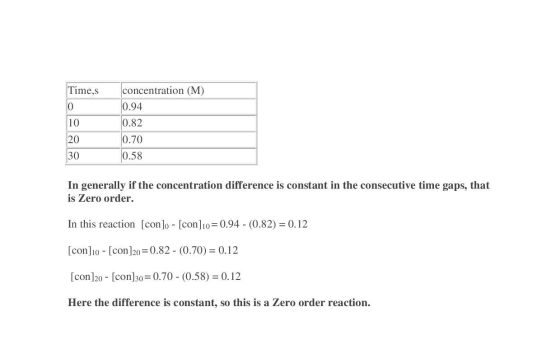
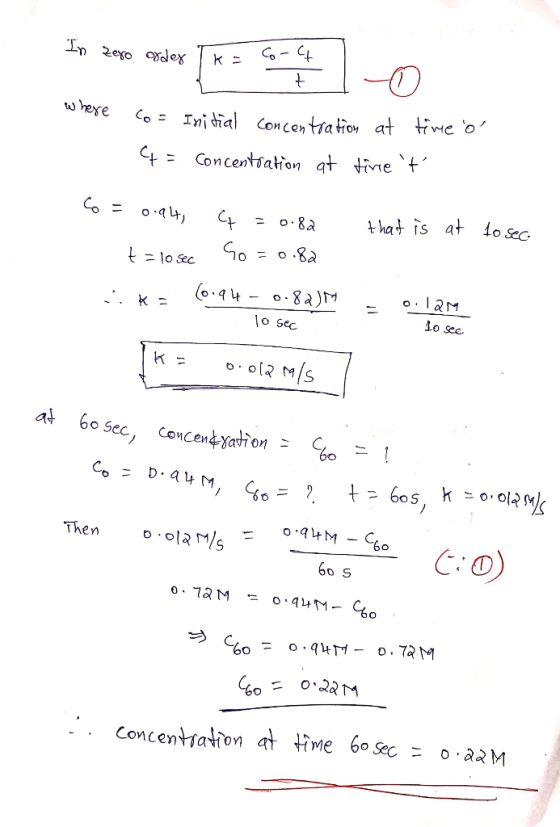
Given the following data for a chemical reaction, determine whether it is a zero, first, or second order reaction, and then calculate the concentration at time = 60 seconds. (Enter in units of M).
| Time(s) | 0 | 10.0 | 20.0 | 30.0 |
| Concentration (M) | 0.94 | 0.82 | 0.70 | 0.58 |
Homework Answers
Add Answer to:
Given the following data for a chemical reaction, determine
whether it is a zero, first, or...
The following data were obtained for the concentration vs. time for a certain chemical reaction. Values...
The following data were obtained for the concentration vs. time for a certain chemical reaction. Values were measured at 1.00 s intervals, beginning at 0.00 and ending at 20.00 s. Concentrations in mM are: 10.00, 6.91, 4.98,4.32, 3.55, 3.21, 2.61, 2.50, 2.22, 1.91, 1.80, 1.65, 1.52, 1.36, 1.42, 1.23, 1.20, 1.13, 1.09, 1.00, and 0.92. A. Decide whether the data best fits zero-order, first-order, or second-order rate kinetics. Make sure to calculate the rate coefficients (with units) for the reaction...
18. From the reaction data below, determine whether the reaction is first-order or second-order. Time (S)...
 18. From the reaction data below, determine whether the reaction is first-order or second-order. Time (S) Reactant (M) 6.67 1.59 0.74 0.39 0.16 25 a. First-order. b. Second-order. c. Zero-order. d. Cannot determine. 19. In the Question 18, what is the rate constant for the reaction? a. 0.12 b. 0.15 c. 0.24 d. 0.72 20. In the Question 18, what is the half-life for the reaction? a. 0.2 sec b. 0.6 sec c. 1.0 sec d. 1.3 sec
1. The following chemical reaction: A → products shows first order kinetics with respect to A;...
1. The following chemical reaction: A → products shows first order kinetics with respect to A; rate = k[A]. Assume k = 10.09 x 10⁻⁴ s-1 . If the initial concentration of A was 0.82 mol L-1 and then decreased to 0.11 mol L-1 , how much time elapsed in minutes? 2. Consider the following balanced chemical equation: H2O2 (aq) + 3 I-(aq) + 2 H+(aq) → I3- (aq) + 2 H2O (l) In the first 62.9 seconds of the...
8) The reaction A → B is first order in [A]. Consider the following data. Time...
8) The reaction A → B is first order in [A]. Consider the following data. Time (s) [A] (M) 0.0 1.4 10.0 0.35 20.0 0.088 The half-life of this reaction is ________ s.
Compare and contrast how first-order reaction kinetics and zero-order reaction kinetics differ in terms of the...
Compare and contrast how first-order reaction kinetics and zero-order reaction kinetics differ in terms of the depletion of a reactant A in a chemical reaction. Assume an initial concentration of 420 mg of A. Assume a half-life of 30 minutes if first-order kinetics are obeyed, and a depletion rate of 60 mg/hour if zero-order kinetics are obeyed. Use a clearly drawn graph(s) to determine which rate will result in complete depletion of A over the shortest time. Assume 99% to...
Part D Based on the data given and a rate constant of 0.031 M−1⋅min−1, calculate the...
Part D Based on the data given and a rate constant of 0.031 M−1⋅min−1, calculate the time at which the concentration of reactant A will be 0.150 M . Express your answer in minutes to two significant Examine experimental data Consider a second-order reaction in which reactant A decomposes according to the chemical equation 2A→products.The data given below is the time, in minutes, and the corresponding change in the concentration of reactant A for this reaction. t (min) [A]t(M) 0.00...
The isomerization of N-chloroacetanilide to parachloroacetanilide in the presence of hydrochloric acid may be zero, first...
The isomerization of N-chloroacetanilide to parachloroacetanilide in the presence of hydrochloric acid may be zero, first or second order. From the data below determine the reaction order. From the data below determine the reaction rate constant. Time (minutes) molarity of N-chloroacetanilide 0.0 0.0245 15.0 0.0181 30.0 0.0133 45.0 0.0097
Consider this balanced chemical equation: H2O2(?q) + 3I−(?q) + 2H+(?q) → I3−(?q) + 2H2O(?) In the...
Consider this balanced chemical equation: H2O2(?q) + 3I−(?q) + 2H+(?q) → I3−(?q) + 2H2O(?) In the first 10.0 seconds of the reaction, the concentration of I− drops from 1.000 M to 0.868 M. Calculate the average rate of this reaction in this time interval. Determine the rate of change in the concentration of [H+]
4. For the reaction: (CH3),CBr +1 → (CH3),CI + Br* the following data were collected: (CH3)3Br)...
 4. For the reaction: (CH3),CBr +1 → (CH3),CI + Br* the following data were collected: (CH3)3Br) (M) Time (s) 0.600 0 0.424 10.0 0.300 20.0 0.212 30.0 0.150 40.0 Determine the rate law for this reaction and calculate the rate constant. (20 points)
4. For the reaction: (CH3),CBr +1 → (CH3),CI + Br* the following data were collected: (CH3)3Br)...
 4. For the reaction: (CH3),CBr +1 → (CH3),CI + Br* the following data were collected: (CH3)3Br) (M) Time (s) 0.600 0 0.424 10.0 0.300 20.0 0.212 30.0 0.150 40.0 Determine the rate law for this reaction and calculate the rate constant. (20 points)
 18. From the reaction data below, determine whether the reaction is first-order or second-order. Time (S) Reactant (M) 6.67 1.59 0.74 0.39 0.16 25 a. First-order. b. Second-order. c. Zero-order. d. Cannot determine. 19. In the Question 18, what is the rate constant for the reaction? a. 0.12 b. 0.15 c. 0.24 d. 0.72 20. In the Question 18, what is the half-life for the reaction? a. 0.2 sec b. 0.6 sec c. 1.0 sec d. 1.3 sec
 4. For the reaction: (CH3),CBr +1 → (CH3),CI + Br* the following data were collected: (CH3)3Br) (M) Time (s) 0.600 0 0.424 10.0 0.300 20.0 0.212 30.0 0.150 40.0 Determine the rate law for this reaction and calculate the rate constant. (20 points)
 4. For the reaction: (CH3),CBr +1 → (CH3),CI + Br* the following data were collected: (CH3)3Br) (M) Time (s) 0.600 0 0.424 10.0 0.300 20.0 0.212 30.0 0.150 40.0 Determine the rate law for this reaction and calculate the rate constant. (20 points)
Most questions answered within 3 hours.
-
Where is the error in this code sequence?
String s1 = "Hello";
String s2 = "ello";...
asked 10 months ago -
Financial data for Joel de Paris, Inc., for last year
follow:
Joel de Paris, Inc.
Balance...
asked 10 months ago -
Consider this reaction:
Al2(SO4)3 (aq)+ BaCl3
(aq) Al2Cl6 (aq)- +
3BaSO4(s) . What is the...
asked 10 months ago -
Suppose that Savneet is considering increasing her
recent random sample from 20 car rentals to 40...
asked 10 months ago -
Trucks arrive at an unloading terminal at an average rate of 120
per hour.
Trucks arrive...
asked 10 months ago -
Why are methanol and ethanol completely soluble in water while
octanol is not very little soluble....
asked 10 months ago -
A facilities manager at a university reads in a research report
that the mean amount of...
asked 10 months ago -
When the CuSO4 is rehydrated by adding water to the anhydrous
compound, is this an endothermic...
asked 10 months ago -
A ray of sunlight is passing from diamond into crown glass; the
angle of incidence is...
asked 10 months ago -
A block of mass 0.249 kg is placed on top of a light, vertical
spring of...
asked 10 months ago -
how do the kidneys compensate in the presences of acidosis
a) trigger hyperventilate
b) reserve acid...
asked 10 months ago -
Question 501 pts
The rental rate of capital to the firm increases. Which of the
following...
asked 10 months ago