Hi, I'm having a problem with finding a unit of a slope for the given function:...
Hi, I'm having a problem with finding a unit of a slope for the given function: y=(1/2)((L^2eB)/(mv)). (y is a deflection(meters), e is the charge of an electron, L is a distance (meters), m is the mass of an electron, and v is the velocity). Here, magnetic field, B, is the only variable and everything else is a constant. If so, what should be the unit for the slope?
Homework Answers
Usually the slope is defined as
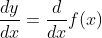
Where 
Here x is the independent variable and y is the dependent variable. If let us say that the unit of x is some X and unit if y is some Y, then the unit of slope is the ratio between Y and X. In your case you have magnetic field as a dependent variable and deflection as a independent variable. Now the slope of this can be found by evaluating

In this the unit of numerator is meter and that of denominator is Tesla. So the unit of slope is just the ratio between these two. It is given by

This is the answer.
Add Answer to:
Hi, I'm having a problem with finding a unit of a slope for the
given function:...
Hi, I'm having a problem with finding a unit of a slope for the given function:...
Hi, I'm having a problem with finding a unit of a slope for the given function: y=(VqD)/(dmv). (y is a deflection(meters), V is voltage, q is a charge of an electron, D and d is a distance (meters), m is the mass of an electron, and v is the velocity). Here, Voltage, V, is the only variable and everything else is a constant. If so, what should be the unit for the slope? Or is there just no slope at...
Hi, I'm having trouble finding Theoretical Period T. For table 1, the mass is .068kg and...
 Hi, I'm having trouble finding Theoretical Period T.
For table 1, the mass is .068kg and pendulum length is 1.31m. For
table 2, mass is 0.668kg and 25 degrees.
We were unable to transcribe this imageData table 2: To investigate how the period small angle 0 s10) 2: To investigate how the period T depends on length Mass: 60 kg 0 degrees. Length % error Experimental Period T Experimental Avg. T Theoretical (meters) Avg. T 73 2.36 11.05m 2.07 .94m...
Hi, I'm having trouble finding Theoretical Period T.
For table 1, the mass is .068kg and pendulum length is 1.31m. For
table 2, mass is 0.668kg and 25 degrees.
We were unable to transcribe this imageData table 2: To investigate how the period small angle 0 s10) 2: To investigate how the period T depends on length Mass: 60 kg 0 degrees. Length % error Experimental Period T Experimental Avg. T Theoretical (meters) Avg. T 73 2.36 11.05m 2.07 .94m...
3. Fill the blanks and the Proof - J.J. Thomson's experiment to fine the charge-to-mass ratio of the tt) (25 po...
 3. Fill the blanks and the Proof - J.J. Thomson's experiment to fine the charge-to-mass ratio of the tt) (25 points) electron (i.e. e/m; The first is the experiment of Joseph John Thomson, who first demonstrated that atoms are actually composed of aggregates of charged particles. Prior to his work, it was believed that atoms were the fundamental building blocks of matter. The first evidence contrary to this notion came when people began studying the properties of atoms in large...
2. (i) The governing equation of motion for a single electron of mass m and charge -e moving with velocity y in uniform time-independent magnetic and electric fields is given by mayx B where B- (B, 0...
 2. (i) The governing equation of motion for a single electron of mass m and charge -e moving with velocity y in uniform time-independent magnetic and electric fields is given by mayx B where B- (B, 0,0) di dr (a) Suppose the electron initially moves with velocity y (0,vo 0) in an electric field parallel to the magnetic field E-E-(E,00) By taking vf)-v +vi, where y i0, obtain v, and show that the speed vis constant. Describe (in words) the...
Finding the charge to mass (e/m) ratio of the electron Often in physics, we look for ways to find fundamental physical...
 Finding the charge to mass (e/m) ratio of the electron Often in physics, we look for ways to find fundamental physical constants. From the set-up demonstrated in class, we are able to find a monumental combination of two physical constants-the charge of an electron (e) and the mass of an electron (m). Since the charge of an electron (e) is well known through other experiments, we will use the ratio of charge to mass to find the mass of an...
Finding the charge to mass (e/m) ratio of the electron Often in physics, we look for ways to find fundamental physical...
 Finding the charge to mass (e/m) ratio of the electron Often in physics, we look for ways to find fundamental physical constants. From the set-up demonstrated in class, we are able to find a monumental combination of two physical constants-the charge of an electron (e) and the mass of an electron (m). Since the charge of an electron (e) is well known through other experiments, we will use the ratio of charge to mass to find the mass of an...
Problem 1 In this problem, we will analyze the method used by J.J. Thomson in 1897...
 Problem 1 In this problem, we will analyze the method used by J.J. Thomson in 1897 to measure the charge/mass ratio of the electron. A beam of electrons with charge q and mass m and velocity V vi enters a region that has a uniform electric field E Ei and a uniform magnetic field B- Bi. Thus the magnetic and electric fields are at right angles to each other and to the beam (a) Suppose that E is adjusted so...
(20 pts/5 pt. each) As shown in the figure, the magnetic field over a certain range is given by B...
 Plz answer all questions
(20 pts/5 pt. each) As shown in the figure, the magnetic field over a certain range is given by B- B,k, where B,-0.5T.A proton moves into the magnetic field with a velocity - i+v,j+v,k, where v,-1x 10 m/s, By 3 x 10s m/s, and v, 3x10s m/s. The charge ofthe proton is 160x10" C,and the mass ofthe proton is 1.67 x 10 kg Here t.J.k are unit vectors in the x, y and z directions, respectively...
Plz answer all questions
(20 pts/5 pt. each) As shown in the figure, the magnetic field over a certain range is given by B- B,k, where B,-0.5T.A proton moves into the magnetic field with a velocity - i+v,j+v,k, where v,-1x 10 m/s, By 3 x 10s m/s, and v, 3x10s m/s. The charge ofthe proton is 160x10" C,and the mass ofthe proton is 1.67 x 10 kg Here t.J.k are unit vectors in the x, y and z directions, respectively...
Motion of Electrons in a Magnetic Field
 An electron of mass m and charge -e is moving through a uniform magnetic field \(\vec{B}=\left(B_{x}, 0,0\right)\)
in vacuum. At the origin, it has velocity \(\vec{v}=\left(v_{x}, v_{y}, 0\right)\), where vx>0 and vy >0. A screen is mounted perpendicular to the x axis at a distance D from the origin.The motion of the electron can be broken down into two parts: 1. constant motion in the x direction plus2. a periodic part, the projection of which in the yz plane is circular. Find the angular...
An electron of mass m and charge -e is moving through a uniform magnetic field \(\vec{B}=\left(B_{x}, 0,0\right)\)
in vacuum. At the origin, it has velocity \(\vec{v}=\left(v_{x}, v_{y}, 0\right)\), where vx>0 and vy >0. A screen is mounted perpendicular to the x axis at a distance D from the origin.The motion of the electron can be broken down into two parts: 1. constant motion in the x direction plus2. a periodic part, the projection of which in the yz plane is circular. Find the angular...
Solve problem 2 and 3 with details . Thank you Notre Dame University-Louaize Faculty of Natural& Applied Sciences Department of Physics& Astronomy PHS 212-Electridity & Magnetism Fall 201...
 Solve problem 2 and 3 with details . Thank you
Notre Dame University-Louaize Faculty of Natural& Applied Sciences Department of Physics& Astronomy PHS 212-Electridity & Magnetism Fall 2018 Final Exam (22Dec18, 120min) Closed-book, Closed-notes, Close-everything Exam List in detail any assumptions that you make. Show all your work. You can use a calcalater Useful Constants: e1.6x 10C, charge of 1 electron k-8.9875x10 Nm/C2 mass of 1 electron: 9.11 x 10 kg 1. Three point charges, q +15 C, q +35...
Solve problem 2 and 3 with details . Thank you
Notre Dame University-Louaize Faculty of Natural& Applied Sciences Department of Physics& Astronomy PHS 212-Electridity & Magnetism Fall 2018 Final Exam (22Dec18, 120min) Closed-book, Closed-notes, Close-everything Exam List in detail any assumptions that you make. Show all your work. You can use a calcalater Useful Constants: e1.6x 10C, charge of 1 electron k-8.9875x10 Nm/C2 mass of 1 electron: 9.11 x 10 kg 1. Three point charges, q +15 C, q +35...
 Hi, I'm having trouble finding Theoretical Period T.
For table 1, the mass is .068kg and pendulum length is 1.31m. For
table 2, mass is 0.668kg and 25 degrees.
We were unable to transcribe this imageData table 2: To investigate how the period small angle 0 s10) 2: To investigate how the period T depends on length Mass: 60 kg 0 degrees. Length % error Experimental Period T Experimental Avg. T Theoretical (meters) Avg. T 73 2.36 11.05m 2.07 .94m...
Hi, I'm having trouble finding Theoretical Period T.
For table 1, the mass is .068kg and pendulum length is 1.31m. For
table 2, mass is 0.668kg and 25 degrees.
We were unable to transcribe this imageData table 2: To investigate how the period small angle 0 s10) 2: To investigate how the period T depends on length Mass: 60 kg 0 degrees. Length % error Experimental Period T Experimental Avg. T Theoretical (meters) Avg. T 73 2.36 11.05m 2.07 .94m...
 3. Fill the blanks and the Proof - J.J. Thomson's experiment to fine the charge-to-mass ratio of the tt) (25 points) electron (i.e. e/m; The first is the experiment of Joseph John Thomson, who first demonstrated that atoms are actually composed of aggregates of charged particles. Prior to his work, it was believed that atoms were the fundamental building blocks of matter. The first evidence contrary to this notion came when people began studying the properties of atoms in large...
 2. (i) The governing equation of motion for a single electron of mass m and charge -e moving with velocity y in uniform time-independent magnetic and electric fields is given by mayx B where B- (B, 0,0) di dr (a) Suppose the electron initially moves with velocity y (0,vo 0) in an electric field parallel to the magnetic field E-E-(E,00) By taking vf)-v +vi, where y i0, obtain v, and show that the speed vis constant. Describe (in words) the...
 Finding the charge to mass (e/m) ratio of the electron Often in physics, we look for ways to find fundamental physical constants. From the set-up demonstrated in class, we are able to find a monumental combination of two physical constants-the charge of an electron (e) and the mass of an electron (m). Since the charge of an electron (e) is well known through other experiments, we will use the ratio of charge to mass to find the mass of an...
 Finding the charge to mass (e/m) ratio of the electron Often in physics, we look for ways to find fundamental physical constants. From the set-up demonstrated in class, we are able to find a monumental combination of two physical constants-the charge of an electron (e) and the mass of an electron (m). Since the charge of an electron (e) is well known through other experiments, we will use the ratio of charge to mass to find the mass of an...
 Problem 1 In this problem, we will analyze the method used by J.J. Thomson in 1897 to measure the charge/mass ratio of the electron. A beam of electrons with charge q and mass m and velocity V vi enters a region that has a uniform electric field E Ei and a uniform magnetic field B- Bi. Thus the magnetic and electric fields are at right angles to each other and to the beam (a) Suppose that E is adjusted so...
 Plz answer all questions
(20 pts/5 pt. each) As shown in the figure, the magnetic field over a certain range is given by B- B,k, where B,-0.5T.A proton moves into the magnetic field with a velocity - i+v,j+v,k, where v,-1x 10 m/s, By 3 x 10s m/s, and v, 3x10s m/s. The charge ofthe proton is 160x10" C,and the mass ofthe proton is 1.67 x 10 kg Here t.J.k are unit vectors in the x, y and z directions, respectively...
Plz answer all questions
(20 pts/5 pt. each) As shown in the figure, the magnetic field over a certain range is given by B- B,k, where B,-0.5T.A proton moves into the magnetic field with a velocity - i+v,j+v,k, where v,-1x 10 m/s, By 3 x 10s m/s, and v, 3x10s m/s. The charge ofthe proton is 160x10" C,and the mass ofthe proton is 1.67 x 10 kg Here t.J.k are unit vectors in the x, y and z directions, respectively...
 An electron of mass m and charge -e is moving through a uniform magnetic field \(\vec{B}=\left(B_{x}, 0,0\right)\)
in vacuum. At the origin, it has velocity \(\vec{v}=\left(v_{x}, v_{y}, 0\right)\), where vx>0 and vy >0. A screen is mounted perpendicular to the x axis at a distance D from the origin.The motion of the electron can be broken down into two parts: 1. constant motion in the x direction plus2. a periodic part, the projection of which in the yz plane is circular. Find the angular...
An electron of mass m and charge -e is moving through a uniform magnetic field \(\vec{B}=\left(B_{x}, 0,0\right)\)
in vacuum. At the origin, it has velocity \(\vec{v}=\left(v_{x}, v_{y}, 0\right)\), where vx>0 and vy >0. A screen is mounted perpendicular to the x axis at a distance D from the origin.The motion of the electron can be broken down into two parts: 1. constant motion in the x direction plus2. a periodic part, the projection of which in the yz plane is circular. Find the angular...
 Solve problem 2 and 3 with details . Thank you
Notre Dame University-Louaize Faculty of Natural& Applied Sciences Department of Physics& Astronomy PHS 212-Electridity & Magnetism Fall 2018 Final Exam (22Dec18, 120min) Closed-book, Closed-notes, Close-everything Exam List in detail any assumptions that you make. Show all your work. You can use a calcalater Useful Constants: e1.6x 10C, charge of 1 electron k-8.9875x10 Nm/C2 mass of 1 electron: 9.11 x 10 kg 1. Three point charges, q +15 C, q +35...
Solve problem 2 and 3 with details . Thank you
Notre Dame University-Louaize Faculty of Natural& Applied Sciences Department of Physics& Astronomy PHS 212-Electridity & Magnetism Fall 2018 Final Exam (22Dec18, 120min) Closed-book, Closed-notes, Close-everything Exam List in detail any assumptions that you make. Show all your work. You can use a calcalater Useful Constants: e1.6x 10C, charge of 1 electron k-8.9875x10 Nm/C2 mass of 1 electron: 9.11 x 10 kg 1. Three point charges, q +15 C, q +35...
Most questions answered within 3 hours.
-
Where is the error in this code sequence?
String s1 = "Hello";
String s2 = "ello";...
asked 10 months ago -
Financial data for Joel de Paris, Inc., for last year
follow:
Joel de Paris, Inc.
Balance...
asked 10 months ago -
Consider this reaction:
Al2(SO4)3 (aq)+ BaCl3
(aq) Al2Cl6 (aq)- +
3BaSO4(s) . What is the...
asked 10 months ago -
Suppose that Savneet is considering increasing her
recent random sample from 20 car rentals to 40...
asked 10 months ago -
Trucks arrive at an unloading terminal at an average rate of 120
per hour.
Trucks arrive...
asked 10 months ago -
Why are methanol and ethanol completely soluble in water while
octanol is not very little soluble....
asked 10 months ago -
A facilities manager at a university reads in a research report
that the mean amount of...
asked 10 months ago -
When the CuSO4 is rehydrated by adding water to the anhydrous
compound, is this an endothermic...
asked 10 months ago -
A ray of sunlight is passing from diamond into crown glass; the
angle of incidence is...
asked 10 months ago -
A block of mass 0.249 kg is placed on top of a light, vertical
spring of...
asked 10 months ago -
how do the kidneys compensate in the presences of acidosis
a) trigger hyperventilate
b) reserve acid...
asked 10 months ago -
Question 501 pts
The rental rate of capital to the firm increases. Which of the
following...
asked 10 months ago