Motion of Electrons in a Magnetic Field
An electron of mass m and charge -e is moving through a uniform magnetic field \(\vec{B}=\left(B_{x}, 0,0\right)\)
in vacuum. At the origin, it has velocity \(\vec{v}=\left(v_{x}, v_{y}, 0\right)\), where vx>0 and vy >0. A screen is mounted perpendicular to the x axis at a distance D from the origin.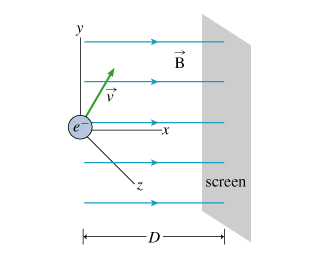
The motion of the electron can be broken down into two parts:
1. constant motion in the x direction plus
2. a periodic part, the projection of which in the yz plane is circular. Find the angular velocity w of the electron associated with the circular component of its motion. Express the magnitude of the angular velocity in terms of Bx, the magnitude of the electric charge e, and other known quantities.
Homework Answers

2. Consider a charged particle in a magnetic field. Let -e = -1.60 x 10-191C) be...
 2. Consider a charged particle in a magnetic field. Let -e = -1.60 x 10-191C) be an electron, under B=0.1T) of a uniform magnetic field directed out of the page direction (o-direction). At t = 0[sec] the particle is at the origin, and the initial velocity is toward positive y direction. (a) Sketch the initial configuration of this electron (-e at the origin) into (x,y)-plane. Applying the right hand rule, indicate the magnetic force on this moving electron. Note that...
A cat rides a merry-go-round turning with uniform circular motion. At time t1 = 2.00 s,...
A cat rides a merry-go-round turning with uniform circular motion. At time t1 = 2.00 s, the cat’s velocity is given by vx = 3.00 m/s and vy = 4.00 m/s. At t2 = 5.00 s, the cat’s velocity is given by vx= −3.00 m/s and vy = −4.00 m/s. Take the coordinate system of the merry-go-round to have its origin at the center. (a) What is the magnitude of the cat’s centripetal acceleration? (b) What is the magnitude of...
A cat rides a merry-go-round tuning with a uniform circular motion. At t1= 2.00 s, the...
A cat rides a merry-go-round tuning with a uniform circular motion. At t1= 2.00 s, the cat's velocity is given by vx= 3.00 m/s and vy= 4.00 m/s. At t2= 5.00 s, the cat's velocity is given by vx= -3.00 m/s and vy= -4.00 m/s. Take the coordinate system of the merry-go-round to have its origin at the center. (a) What is the magnitude of the cat's centripetal acceleration? (b) What is the magnitude of the cat's average acceleration during...
Active Figure Motion of a Charged Particle in a Uniform Magnetic Field The animation below illustrates...
 Active Figure Motion of a Charged Particle in a Uniform Magnetic Field The animation below illustrates a charged particle moving in circular motion due to the magnetic force caused by a constant and uniform magnetic field oriented into the page. The blue crosses represent the tails of the magnetic field vectors nstructions: Use the blue sliders to adjust the mass, speed, particle charge and magnetic field magnitude. Change each parameter and observe the eftect on the particle's motion. If the...
A charged particle of mass m and positive charge q moves in uniform electric and magnetic...
A charged particle of mass m and positive charge q moves in uniform electric and magnetic fields, E pointing in the y direction and B in the z direction. suppose the particle is initially at the origin and is given a kick at time t=0 along the x axis with vx = vxo (positive or negative). a) Write down the equation of motion for the particle and resolve it into its three components. show that the motion remains in the...
Part A In a region of space, a magnetic field points in the +x-direction (toward the...
 Part A In a region of space, a magnetic field points in the +x-direction (toward the right). Its magnitude varies with position according to the formula B = Bo + bx, where Bo and b are positive constants, for 3 > 0. A flat coil of area A moves with uniform speed v from right to left with the plane of its area always perpendicular to this field. What is the emf induced in this coil while it is to...
Help me solve this question asap nfluenced by magnetic An electron moves following a circular path...
 Help me solve this question asap
nfluenced by magnetic An electron moves following a circular path in vacuum i field. The radius of the electron's path is 2.0 x 10² m, magnetic field strength is 2.0x 10⁻² T, and specific charge electron e/m is-I .76 x 1011 C kg" (b) i. Write an expression for angular velocity of electron. ii. Calculate its orbital period ii. What happen to the electron's path when its velocity decreases? [10 marks]
Help me solve this question asap
nfluenced by magnetic An electron moves following a circular path in vacuum i field. The radius of the electron's path is 2.0 x 10² m, magnetic field strength is 2.0x 10⁻² T, and specific charge electron e/m is-I .76 x 1011 C kg" (b) i. Write an expression for angular velocity of electron. ii. Calculate its orbital period ii. What happen to the electron's path when its velocity decreases? [10 marks]
A thin plastic rod bent into a semicircular arc find electric field and momentum
 consider a thin plastic rod bent into a semicircular arc of radius R with center at the origin. The rod carries a uniformly distributed negative charge -Q.(a) Determine the electric field \(\vec{E}\) at the origin contributed by the rod. (Indicate the direction with the sign of your answer. Use any variable or symbol stated above along with the following as necessary: \(\left.\varepsilon_{0} .\right)\)\(E_{x}=\)\(E_{y}=\)(b) An ion with charge \(-4 e\) and mass \(M\) is placed at rest at the origin. After...
TACTICS BOX 1.5 Drawing a pictorial representation Draw a motion diagram. The motion diagram develops your...
 TACTICS BOX 1.5 Drawing a pictorial representation
Draw a motion diagram. The motion diagram
develops your intuition for the motion and, especially important,
determines whether the signs of v? and
a? are positive or negative.
Establish a coordinate system. Select your axes
and origin to match the motion. For one-dimensional motion, you
want either the x axis or the y axis parallel to
the motion.
Sketch the situation. Not just any sketch. Show
the object at the beginning of the motion, at...
TACTICS BOX 1.5 Drawing a pictorial representation
Draw a motion diagram. The motion diagram
develops your intuition for the motion and, especially important,
determines whether the signs of v? and
a? are positive or negative.
Establish a coordinate system. Select your axes
and origin to match the motion. For one-dimensional motion, you
want either the x axis or the y axis parallel to
the motion.
Sketch the situation. Not just any sketch. Show
the object at the beginning of the motion, at...
 2. Consider a charged particle in a magnetic field. Let -e = -1.60 x 10-191C) be an electron, under B=0.1T) of a uniform magnetic field directed out of the page direction (o-direction). At t = 0[sec] the particle is at the origin, and the initial velocity is toward positive y direction. (a) Sketch the initial configuration of this electron (-e at the origin) into (x,y)-plane. Applying the right hand rule, indicate the magnetic force on this moving electron. Note that...
 Active Figure Motion of a Charged Particle in a Uniform Magnetic Field The animation below illustrates a charged particle moving in circular motion due to the magnetic force caused by a constant and uniform magnetic field oriented into the page. The blue crosses represent the tails of the magnetic field vectors nstructions: Use the blue sliders to adjust the mass, speed, particle charge and magnetic field magnitude. Change each parameter and observe the eftect on the particle's motion. If the...
 Part A In a region of space, a magnetic field points in the +x-direction (toward the right). Its magnitude varies with position according to the formula B = Bo + bx, where Bo and b are positive constants, for 3 > 0. A flat coil of area A moves with uniform speed v from right to left with the plane of its area always perpendicular to this field. What is the emf induced in this coil while it is to...
 Help me solve this question asap
nfluenced by magnetic An electron moves following a circular path in vacuum i field. The radius of the electron's path is 2.0 x 10² m, magnetic field strength is 2.0x 10⁻² T, and specific charge electron e/m is-I .76 x 1011 C kg" (b) i. Write an expression for angular velocity of electron. ii. Calculate its orbital period ii. What happen to the electron's path when its velocity decreases? [10 marks]
Help me solve this question asap
nfluenced by magnetic An electron moves following a circular path in vacuum i field. The radius of the electron's path is 2.0 x 10² m, magnetic field strength is 2.0x 10⁻² T, and specific charge electron e/m is-I .76 x 1011 C kg" (b) i. Write an expression for angular velocity of electron. ii. Calculate its orbital period ii. What happen to the electron's path when its velocity decreases? [10 marks]
 TACTICS BOX 1.5 Drawing a pictorial representation
Draw a motion diagram. The motion diagram
develops your intuition for the motion and, especially important,
determines whether the signs of v? and
a? are positive or negative.
Establish a coordinate system. Select your axes
and origin to match the motion. For one-dimensional motion, you
want either the x axis or the y axis parallel to
the motion.
Sketch the situation. Not just any sketch. Show
the object at the beginning of the motion, at...
TACTICS BOX 1.5 Drawing a pictorial representation
Draw a motion diagram. The motion diagram
develops your intuition for the motion and, especially important,
determines whether the signs of v? and
a? are positive or negative.
Establish a coordinate system. Select your axes
and origin to match the motion. For one-dimensional motion, you
want either the x axis or the y axis parallel to
the motion.
Sketch the situation. Not just any sketch. Show
the object at the beginning of the motion, at...
Most questions answered within 3 hours.
-
Where is the error in this code sequence?
String s1 = "Hello";
String s2 = "ello";...
asked 11 months ago -
Financial data for Joel de Paris, Inc., for last year
follow:
Joel de Paris, Inc.
Balance...
asked 11 months ago -
Consider this reaction:
Al2(SO4)3 (aq)+ BaCl3
(aq) Al2Cl6 (aq)- +
3BaSO4(s) . What is the...
asked 11 months ago -
Suppose that Savneet is considering increasing her
recent random sample from 20 car rentals to 40...
asked 11 months ago -
Trucks arrive at an unloading terminal at an average rate of 120
per hour.
Trucks arrive...
asked 11 months ago -
Why are methanol and ethanol completely soluble in water while
octanol is not very little soluble....
asked 11 months ago -
A facilities manager at a university reads in a research report
that the mean amount of...
asked 11 months ago -
When the CuSO4 is rehydrated by adding water to the anhydrous
compound, is this an endothermic...
asked 11 months ago -
A ray of sunlight is passing from diamond into crown glass; the
angle of incidence is...
asked 11 months ago -
A block of mass 0.249 kg is placed on top of a light, vertical
spring of...
asked 11 months ago -
how do the kidneys compensate in the presences of acidosis
a) trigger hyperventilate
b) reserve acid...
asked 11 months ago -
Question 501 pts
The rental rate of capital to the firm increases. Which of the
following...
asked 11 months ago