
Homework Answers
6.
Let  be a covering map.
(a)
If  is a path in
  starting at
  , then define
  to be corresponding lifting to a path in
  beginning at
  .
.
Claim: If
is path homotopic to  in
, then
is path homotopic to
in
, then
is path homotopic to  in
and hence
in
and hence 
 Define a map
  by
by ![\phi([f])=\tilde{f}(1)](http://img.homeworklib.com/questions/d7187580-15cd-11ec-a045-9b4d0fb5b6e7.png?x-oss-process=image/resize,w_560) .
.
This map is well defined since if
is path homotopic to
, i.e. ![[f]=[g] \in \pi_1(X_0,x_0)](http://img.homeworklib.com/questions/d7f59700-15cd-11ec-9b54-a747c972fb20.png?x-oss-process=image/resize,w_560) , then
is path homotopic to
and hence
.
, then
is path homotopic to
and hence
.
Since
is simply connected, we have
is path connected.

(b)

Theorem 10.1.15 (Chain rule). Let X, Y be subsets of R, let xo e X be...
 Theorem 10.1.15 (Chain rule). Let X, Y be subsets of R, let xo e X be a limit point of X, and let yo e Y be a limit point of Y. Let f : X+Y be a function such that f(xo) = yo, and such that f is differentiable at Xo. Suppose that g:Y + R is a function which is differentiable at yo. Then the function gof:X + R is differentiable at xo, and .. (gºf)'(xo) = g'(yo)...
Thee part question. Please answer all parts! Let E be a field of characteristic p > 0 (we proved p must always be prime). Verify that the ring homomorphism X : Z → E determined by sending χ : 1-1 E...
 Thee part question. Please answer all parts!
Let E be a field of characteristic p > 0 (we proved p must always be prime). Verify that the ring homomorphism X : Z → E determined by sending χ : 1-1 E (the unity in E) ( so x(n)-n 1E wheren1E 1E 1E (n-times), x(-n)- nle for any n 1,2,3,... and X(0) 0E by definition of χ) is in fact a ring homomorphism with ker(X) = pZ. Úse the fundamental homomorphism...
Thee part question. Please answer all parts!
Let E be a field of characteristic p > 0 (we proved p must always be prime). Verify that the ring homomorphism X : Z → E determined by sending χ : 1-1 E (the unity in E) ( so x(n)-n 1E wheren1E 1E 1E (n-times), x(-n)- nle for any n 1,2,3,... and X(0) 0E by definition of χ) is in fact a ring homomorphism with ker(X) = pZ. Úse the fundamental homomorphism...
This is for Stochastic Processes Let Xo, Xi,... be a Markov chain whose state space is Z (the integers). Recall the Markov property: P(X, _ in l Xo-to, X1-21, , Xn l-an l)-P(Xn-in l x, i-İn 1), Vn, V...
 This is for Stochastic Processes
Let Xo, Xi,... be a Markov chain whose state space is Z (the integers). Recall the Markov property: P(X, _ in l Xo-to, X1-21, , Xn l-an l)-P(Xn-in l x, i-İn 1), Vn, Vil. Does the following always hold: (lProve if "yes", provide a counterexample if "no")
Let Xo, Xi,... be a Markov chain whose state space is Z (the integers). Recall the Markov property: P(X, _ in l Xo-to, X1-21, , Xn l-an l)-P(Xn-in...
This is for Stochastic Processes
Let Xo, Xi,... be a Markov chain whose state space is Z (the integers). Recall the Markov property: P(X, _ in l Xo-to, X1-21, , Xn l-an l)-P(Xn-in l x, i-İn 1), Vn, Vil. Does the following always hold: (lProve if "yes", provide a counterexample if "no")
Let Xo, Xi,... be a Markov chain whose state space is Z (the integers). Recall the Markov property: P(X, _ in l Xo-to, X1-21, , Xn l-an l)-P(Xn-in...
Let X0,X1,... be a Markov chain whose state space is Z (the integers). Recall the Markov property: P(Xn = in | X0 = i0,X1 = i1,...,Xn−1 = in−1) = P(Xn = in | Xn−1 = in−1), ∀n, ∀it. Does the following...
 Let X0,X1,... be a Markov chain whose state space is Z (the
integers).
Recall the Markov property: P(Xn = in | X0 = i0,X1 = i1,...,Xn−1
= in−1) = P(Xn = in | Xn−1 = in−1), ∀n, ∀it. Does the following
always hold: P(Xn ≥0|X0 ≥0,X1 ≥0,...,Xn−1 ≥0)=P(Xn ≥0|Xn−1 ≥0)
?
(Prove if “yes”, provide a counterexample if “no”)
Let Xo,Xi, be a Markov chain whose state space is Z (the integers). Recall the Markov property: P(X,-'n l Xo-io, Xi...
Let X0,X1,... be a Markov chain whose state space is Z (the
integers).
Recall the Markov property: P(Xn = in | X0 = i0,X1 = i1,...,Xn−1
= in−1) = P(Xn = in | Xn−1 = in−1), ∀n, ∀it. Does the following
always hold: P(Xn ≥0|X0 ≥0,X1 ≥0,...,Xn−1 ≥0)=P(Xn ≥0|Xn−1 ≥0)
?
(Prove if “yes”, provide a counterexample if “no”)
Let Xo,Xi, be a Markov chain whose state space is Z (the integers). Recall the Markov property: P(X,-'n l Xo-io, Xi...
Let (X, d) be a metric space, f,g:X R some functions and xo e X,q E...
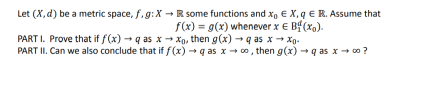 Let (X, d) be a metric space, f,g:X R some functions and xo e X,q E R. Assume that f(x) = g(x) whenever x € Bd (x.). PART I. Prove that if f(x) →q as x → Xo, then g(x) = q as x → Xo. PART II. Can we also conclude that if f(x) = q as x → 00, then g(x) →q as x → 00?
Number Theory 13 and 14 please! 13)) Let n E N, and let ā, x, y E Zn. Prove that if ā + x = ā + y, then x-y. 14. In this exercise, you will prove that the additive inverse of any element of Z, is uni...
 Number Theory
13 and 14 please!
13)) Let n E N, and let ā, x, y E Zn. Prove that if ā + x = ā + y, then x-y. 14. In this exercise, you will prove that the additive inverse of any element of Z, is unique. (In fact, this is true not only in Z, but in any ring, as we prove in the Appendix on the Student Companion Website.) Let n E N, and let aE Z...
Number Theory
13 and 14 please!
13)) Let n E N, and let ā, x, y E Zn. Prove that if ā + x = ā + y, then x-y. 14. In this exercise, you will prove that the additive inverse of any element of Z, is unique. (In fact, this is true not only in Z, but in any ring, as we prove in the Appendix on the Student Companion Website.) Let n E N, and let aE Z...
(8) Given a C1-function f : Rn->M, let M (x, z) E R#x R | z-...
 (8) Given a C1-function f : Rn->M, let M (x, z) E R#x R | z- f(x)) be the graph of f. Let TpM denote the tangent space to M at a point p = (xo, 20) E M. Find TİM and compute its dimension. Hint: draw a picture.
(6 marks) Consider a filtered probability space (2,F,P, Ftte.). a. (2 marks) Let the stochastic p...
 (6 marks) Consider a filtered probability space (2,F,P, Ftte.). a. (2 marks) Let the stochastic process (Xo.7] have independent increments and sat- b. (2 marks) Let eo.] be a stochastic process with Ep[X] Xo for all t E [0,T]. Is c. (2 marks) Let (W be a Brownian motion. Given c 0, and define the stochastic isfies Ep[IXll < oo fort [0,T]. Is the stochastic process {Ztieo.r], where z, = xt-EP[Xt] is a martingale with respect to {Ft}120 ? Explain....
Let f : [a, b] → R and xo e (a,b). Assume that f is continuous...
 Let f : [a, b] → R and xo e (a,b). Assume that f is continuous
on [a,b] \{x0} and lim x approaches too x0 f(x) = L (L is finite)
exists. Show that f is Riemann integrable.
1. (20 pts) Let f : [a, b] R and to € (a,b). Assume that f is continuous on [a, b]\{ro} and limz-ro f (x) = L (L is finite) exists. Show that f is Riemann integrable. Hint: We split it into...
Let f : [a, b] → R and xo e (a,b). Assume that f is continuous
on [a,b] \{x0} and lim x approaches too x0 f(x) = L (L is finite)
exists. Show that f is Riemann integrable.
1. (20 pts) Let f : [a, b] R and to € (a,b). Assume that f is continuous on [a, b]\{ro} and limz-ro f (x) = L (L is finite) exists. Show that f is Riemann integrable. Hint: We split it into...
 Theorem 10.1.15 (Chain rule). Let X, Y be subsets of R, let xo e X be a limit point of X, and let yo e Y be a limit point of Y. Let f : X+Y be a function such that f(xo) = yo, and such that f is differentiable at Xo. Suppose that g:Y + R is a function which is differentiable at yo. Then the function gof:X + R is differentiable at xo, and .. (gºf)'(xo) = g'(yo)...
 Thee part question. Please answer all parts!
Let E be a field of characteristic p > 0 (we proved p must always be prime). Verify that the ring homomorphism X : Z → E determined by sending χ : 1-1 E (the unity in E) ( so x(n)-n 1E wheren1E 1E 1E (n-times), x(-n)- nle for any n 1,2,3,... and X(0) 0E by definition of χ) is in fact a ring homomorphism with ker(X) = pZ. Úse the fundamental homomorphism...
Thee part question. Please answer all parts!
Let E be a field of characteristic p > 0 (we proved p must always be prime). Verify that the ring homomorphism X : Z → E determined by sending χ : 1-1 E (the unity in E) ( so x(n)-n 1E wheren1E 1E 1E (n-times), x(-n)- nle for any n 1,2,3,... and X(0) 0E by definition of χ) is in fact a ring homomorphism with ker(X) = pZ. Úse the fundamental homomorphism...
 This is for Stochastic Processes
Let Xo, Xi,... be a Markov chain whose state space is Z (the integers). Recall the Markov property: P(X, _ in l Xo-to, X1-21, , Xn l-an l)-P(Xn-in l x, i-İn 1), Vn, Vil. Does the following always hold: (lProve if "yes", provide a counterexample if "no")
Let Xo, Xi,... be a Markov chain whose state space is Z (the integers). Recall the Markov property: P(X, _ in l Xo-to, X1-21, , Xn l-an l)-P(Xn-in...
This is for Stochastic Processes
Let Xo, Xi,... be a Markov chain whose state space is Z (the integers). Recall the Markov property: P(X, _ in l Xo-to, X1-21, , Xn l-an l)-P(Xn-in l x, i-İn 1), Vn, Vil. Does the following always hold: (lProve if "yes", provide a counterexample if "no")
Let Xo, Xi,... be a Markov chain whose state space is Z (the integers). Recall the Markov property: P(X, _ in l Xo-to, X1-21, , Xn l-an l)-P(Xn-in...
 Let X0,X1,... be a Markov chain whose state space is Z (the
integers).
Recall the Markov property: P(Xn = in | X0 = i0,X1 = i1,...,Xn−1
= in−1) = P(Xn = in | Xn−1 = in−1), ∀n, ∀it. Does the following
always hold: P(Xn ≥0|X0 ≥0,X1 ≥0,...,Xn−1 ≥0)=P(Xn ≥0|Xn−1 ≥0)
?
(Prove if “yes”, provide a counterexample if “no”)
Let Xo,Xi, be a Markov chain whose state space is Z (the integers). Recall the Markov property: P(X,-'n l Xo-io, Xi...
Let X0,X1,... be a Markov chain whose state space is Z (the
integers).
Recall the Markov property: P(Xn = in | X0 = i0,X1 = i1,...,Xn−1
= in−1) = P(Xn = in | Xn−1 = in−1), ∀n, ∀it. Does the following
always hold: P(Xn ≥0|X0 ≥0,X1 ≥0,...,Xn−1 ≥0)=P(Xn ≥0|Xn−1 ≥0)
?
(Prove if “yes”, provide a counterexample if “no”)
Let Xo,Xi, be a Markov chain whose state space is Z (the integers). Recall the Markov property: P(X,-'n l Xo-io, Xi...
 Let (X, d) be a metric space, f,g:X R some functions and xo e X,q E R. Assume that f(x) = g(x) whenever x € Bd (x.). PART I. Prove that if f(x) →q as x → Xo, then g(x) = q as x → Xo. PART II. Can we also conclude that if f(x) = q as x → 00, then g(x) →q as x → 00?
 Number Theory
13 and 14 please!
13)) Let n E N, and let ā, x, y E Zn. Prove that if ā + x = ā + y, then x-y. 14. In this exercise, you will prove that the additive inverse of any element of Z, is unique. (In fact, this is true not only in Z, but in any ring, as we prove in the Appendix on the Student Companion Website.) Let n E N, and let aE Z...
Number Theory
13 and 14 please!
13)) Let n E N, and let ā, x, y E Zn. Prove that if ā + x = ā + y, then x-y. 14. In this exercise, you will prove that the additive inverse of any element of Z, is unique. (In fact, this is true not only in Z, but in any ring, as we prove in the Appendix on the Student Companion Website.) Let n E N, and let aE Z...
 (8) Given a C1-function f : Rn->M, let M (x, z) E R#x R | z- f(x)) be the graph of f. Let TpM denote the tangent space to M at a point p = (xo, 20) E M. Find TİM and compute its dimension. Hint: draw a picture.
 (6 marks) Consider a filtered probability space (2,F,P, Ftte.). a. (2 marks) Let the stochastic process (Xo.7] have independent increments and sat- b. (2 marks) Let eo.] be a stochastic process with Ep[X] Xo for all t E [0,T]. Is c. (2 marks) Let (W be a Brownian motion. Given c 0, and define the stochastic isfies Ep[IXll < oo fort [0,T]. Is the stochastic process {Ztieo.r], where z, = xt-EP[Xt] is a martingale with respect to {Ft}120 ? Explain....
 Let f : [a, b] → R and xo e (a,b). Assume that f is continuous
on [a,b] \{x0} and lim x approaches too x0 f(x) = L (L is finite)
exists. Show that f is Riemann integrable.
1. (20 pts) Let f : [a, b] R and to € (a,b). Assume that f is continuous on [a, b]\{ro} and limz-ro f (x) = L (L is finite) exists. Show that f is Riemann integrable. Hint: We split it into...
Let f : [a, b] → R and xo e (a,b). Assume that f is continuous
on [a,b] \{x0} and lim x approaches too x0 f(x) = L (L is finite)
exists. Show that f is Riemann integrable.
1. (20 pts) Let f : [a, b] R and to € (a,b). Assume that f is continuous on [a, b]\{ro} and limz-ro f (x) = L (L is finite) exists. Show that f is Riemann integrable. Hint: We split it into...
Most questions answered within 3 hours.
-
Where is the error in this code sequence?
String s1 = "Hello";
String s2 = "ello";...
asked 11 months ago -
Financial data for Joel de Paris, Inc., for last year
follow:
Joel de Paris, Inc.
Balance...
asked 11 months ago -
Consider this reaction:
Al2(SO4)3 (aq)+ BaCl3
(aq) Al2Cl6 (aq)- +
3BaSO4(s) . What is the...
asked 11 months ago -
Suppose that Savneet is considering increasing her
recent random sample from 20 car rentals to 40...
asked 11 months ago -
Trucks arrive at an unloading terminal at an average rate of 120
per hour.
Trucks arrive...
asked 11 months ago -
Why are methanol and ethanol completely soluble in water while
octanol is not very little soluble....
asked 11 months ago -
A facilities manager at a university reads in a research report
that the mean amount of...
asked 11 months ago -
When the CuSO4 is rehydrated by adding water to the anhydrous
compound, is this an endothermic...
asked 11 months ago -
A ray of sunlight is passing from diamond into crown glass; the
angle of incidence is...
asked 11 months ago -
A block of mass 0.249 kg is placed on top of a light, vertical
spring of...
asked 11 months ago -
how do the kidneys compensate in the presences of acidosis
a) trigger hyperventilate
b) reserve acid...
asked 11 months ago -
Question 501 pts
The rental rate of capital to the firm increases. Which of the
following...
asked 11 months ago