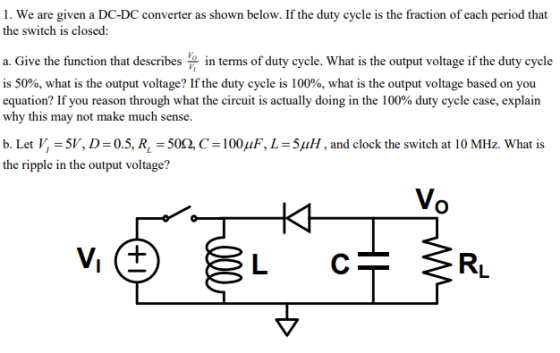
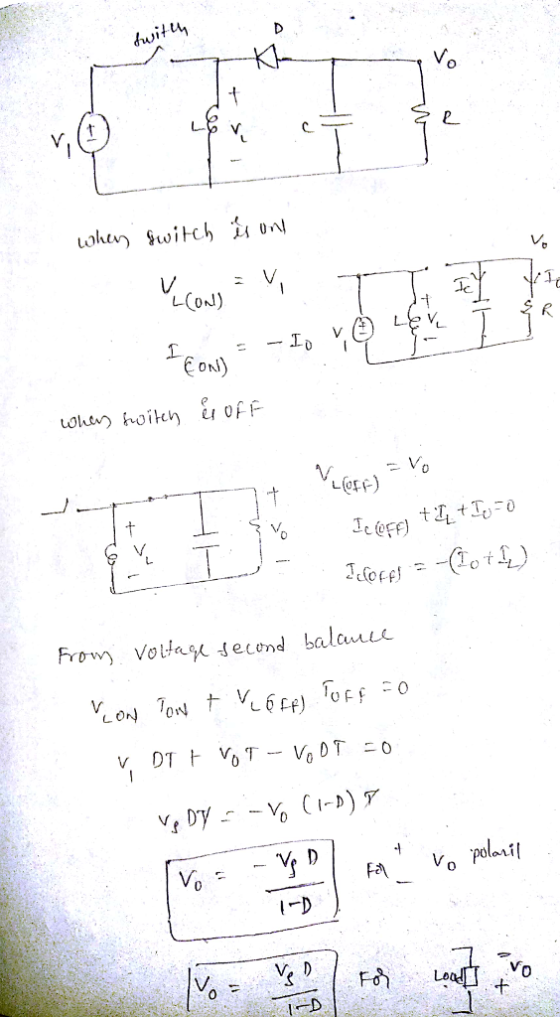
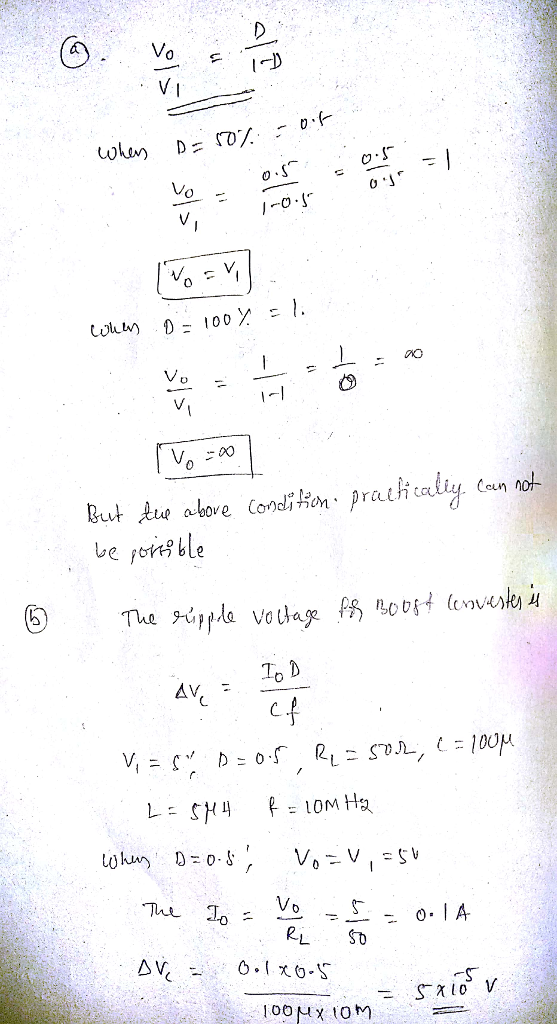
1. We are given a DC-DC converter as shown below. If the duty cycle is the fraction of each period that the switch is closed:
Please answer parts a & b with detail. This problem will help me study for my upcoming exam.
Homework Answers
Add Answer to:
1. We are given a DC-DC converter as shown below. If the duty
cycle is the...
Design a DC-DC boost converter, shown below, that converts an unregulated supply of 12.0 Vak into a load voltage of...
 Design a DC-DC boost converter, shown below, that converts an unregulated supply of 12.0 Vak into a load voltage of 30.0 Ve and load current of 0.25 A. The switching frequency of the transistor is 100 kHz. The transistor has an on-resistance of 0.15 Ω and the diode drops 0.7 V when it is conducting. The voltage ripple (Av) is taken as 20 mVpp The circuit has 80% conversion efficiency. Find the DC input-current (Iden), duty-cycle (D), inductance (L), power-dissipation...
D1 T1 c1 RL 15 3. The flyback converter shown, operates at 250 kHz. The 1 duty ratio ofswitch closed is D = 0.6. Determine: (a) Output voltage. (b) Average, minimum and maximum current in L1 (the mag...
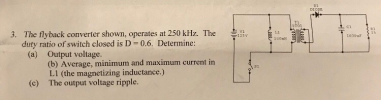 D1 T1 c1 RL 15 3. The flyback converter shown, operates at 250 kHz. The 1 duty ratio ofswitch closed is D = 0.6. Determine: (a) Output voltage. (b) Average, minimum and maximum current in L1 (the magnetizing inductance.) (c) The output voltage ripple. Ll 1030uF 82
D1 T1 c1 RL 15 3. The flyback converter shown, operates at 250 kHz. The 1 duty ratio ofswitch closed is D = 0.6. Determine: (a) Output voltage. (b) Average, minimum and maximum...
D1 T1 c1 RL 15 3. The flyback converter shown, operates at 250 kHz. The 1 duty ratio ofswitch closed is D = 0.6. Determine: (a) Output voltage. (b) Average, minimum and maximum current in L1 (the magnetizing inductance.) (c) The output voltage ripple. Ll 1030uF 82
D1 T1 c1 RL 15 3. The flyback converter shown, operates at 250 kHz. The 1 duty ratio ofswitch closed is D = 0.6. Determine: (a) Output voltage. (b) Average, minimum and maximum...
VI 100 L 100 100 1000uF 3 2. The flyback converter shown, operates at 10 kHz....
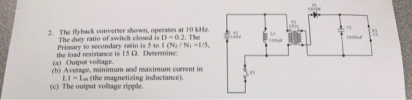 VI 100 L 100 100 1000uF 3 2. The flyback converter shown, operates at 10 kHz. The duty ratio of switch closed is D -0.2. The Primary to secondary ratio is 5 to 1 (N /N, -1/5, the load resistance is 15 . Determine: (a) Output voltage. (b) Average, minimum and maximum current in LI - Lm (the magnetizing inductance). (c) The output voltage ripple.
A buck-boost converter has input voltage of 12V and operates with a duty cycle of 0.6...
A buck-boost converter has input voltage of 12V and operates with a duty cycle of 0.6 at a frequency of 50kHz and a load current of 5A average. Assuming sufficiently large L, and C = 500uF, calculate the peak-peak output voltage ripple and the rms current rating for the capacitor and inductor.
Boost Converter: Theory, schematic, operation, advantages, application, duty cycle, efficiency Design calculation Example: Input voltage:  
Boost Converter: Theory, schematic, operation, advantages, application, duty cycle, efficiency Design calculation Example: Input voltage: min 120V max 175V Output voltage: nominal (regulated) 300V Nominal load current: 3 A max Switching frequency: 20 kHz Output voltage ripple: 25 mV Draw the schematic, find L, C, Diode current, max drain voltage, max and min duty cycle
Buck Converter: Theory, schematic, operation, advantages, application, duty cycle, efficiency Design calculation Example: Input voltage:
Buck Converter: Theory, schematic, operation, advantages, application, duty cycle, efficiency Design calculation Example: Input voltage: min 12V max 17V Output voltage: nominal (regulated) 15V Nominal load current: 3 A Max Switching frequency: 20 kHz Output voltage ripple: 25 mV Draw the schematic, find L, C, Diode current, max drain voltage, max and min duty cycle
The output voltage of a 100 kHz DC converter has 10V maximum value with a duty...
 The output voltage of a 100 kHz DC converter has 10V maximum value with a duty ratio of 0.25. What is the effective value of the output voltage? O2.5V O 20V Question 2 10 pts t converter has an input voltage of 12 V and the duty ratio is adjusted to 0.5 What is the output voltage? O 12 Volt O 48 Volt O 6 Volt O 24 Volt
Following figure shows the circuit diagram for a buck-boost converter for switch off and switch o...
 Following figure shows the circuit diagram for a buck-boost converter for switch off and switch on. The plots for inductor voltage Vl and inductor current iL are also shown. The average value of i, is denoted by I1, average output current is -l and average input current is ld. Similarly, the average value of u1 is denoted by V1, output voltage is-, and input DC voltage is Va. Time period of the switch is Ts 1/f and its duty cycle...
A buck converter is supplied from a 50V battery source. Given L=400μH, C=100μF, R=20Ω, f=20KHz and...
A buck converter is supplied from a 50V battery source. Given L=400μH, C=100μF, R=20Ω, f=20KHz and D=0.4 Calculate: (a) output voltage (b) maximum and minimum inductor current, (c) output voltage ripple, (d) What are the effects on the voltage ripple if the switching frequency is doubled?
Buck Converter Question Q3. A Buck converter is used to produce a regulated 10V, 5A DC...
 Buck Converter Question
Q3. A Buck converter is used to produce a regulated 10V, 5A DC power supply from a variable DC source with an nominal input voltage of Vin = 20V±5V. The Buck converter switches at 250kHz, and operates entirely in the continuous conduction mode. The output filter capacitance is C1.0uF 3.a. Draw the circuit topology for the Buck converter. Ensure that your circuit includes the input DC source, the output load resistance, the switching devices (i.e. MOSFET and...
Buck Converter Question
Q3. A Buck converter is used to produce a regulated 10V, 5A DC power supply from a variable DC source with an nominal input voltage of Vin = 20V±5V. The Buck converter switches at 250kHz, and operates entirely in the continuous conduction mode. The output filter capacitance is C1.0uF 3.a. Draw the circuit topology for the Buck converter. Ensure that your circuit includes the input DC source, the output load resistance, the switching devices (i.e. MOSFET and...
 Design a DC-DC boost converter, shown below, that converts an unregulated supply of 12.0 Vak into a load voltage of 30.0 Ve and load current of 0.25 A. The switching frequency of the transistor is 100 kHz. The transistor has an on-resistance of 0.15 Ω and the diode drops 0.7 V when it is conducting. The voltage ripple (Av) is taken as 20 mVpp The circuit has 80% conversion efficiency. Find the DC input-current (Iden), duty-cycle (D), inductance (L), power-dissipation...
 D1 T1 c1 RL 15 3. The flyback converter shown, operates at 250 kHz. The 1 duty ratio ofswitch closed is D = 0.6. Determine: (a) Output voltage. (b) Average, minimum and maximum current in L1 (the magnetizing inductance.) (c) The output voltage ripple. Ll 1030uF 82
D1 T1 c1 RL 15 3. The flyback converter shown, operates at 250 kHz. The 1 duty ratio ofswitch closed is D = 0.6. Determine: (a) Output voltage. (b) Average, minimum and maximum...
D1 T1 c1 RL 15 3. The flyback converter shown, operates at 250 kHz. The 1 duty ratio ofswitch closed is D = 0.6. Determine: (a) Output voltage. (b) Average, minimum and maximum current in L1 (the magnetizing inductance.) (c) The output voltage ripple. Ll 1030uF 82
D1 T1 c1 RL 15 3. The flyback converter shown, operates at 250 kHz. The 1 duty ratio ofswitch closed is D = 0.6. Determine: (a) Output voltage. (b) Average, minimum and maximum...
 VI 100 L 100 100 1000uF 3 2. The flyback converter shown, operates at 10 kHz. The duty ratio of switch closed is D -0.2. The Primary to secondary ratio is 5 to 1 (N /N, -1/5, the load resistance is 15 . Determine: (a) Output voltage. (b) Average, minimum and maximum current in LI - Lm (the magnetizing inductance). (c) The output voltage ripple.
 The output voltage of a 100 kHz DC converter has 10V maximum value with a duty ratio of 0.25. What is the effective value of the output voltage? O2.5V O 20V Question 2 10 pts t converter has an input voltage of 12 V and the duty ratio is adjusted to 0.5 What is the output voltage? O 12 Volt O 48 Volt O 6 Volt O 24 Volt
 Following figure shows the circuit diagram for a buck-boost converter for switch off and switch on. The plots for inductor voltage Vl and inductor current iL are also shown. The average value of i, is denoted by I1, average output current is -l and average input current is ld. Similarly, the average value of u1 is denoted by V1, output voltage is-, and input DC voltage is Va. Time period of the switch is Ts 1/f and its duty cycle...
 Buck Converter Question
Q3. A Buck converter is used to produce a regulated 10V, 5A DC power supply from a variable DC source with an nominal input voltage of Vin = 20V±5V. The Buck converter switches at 250kHz, and operates entirely in the continuous conduction mode. The output filter capacitance is C1.0uF 3.a. Draw the circuit topology for the Buck converter. Ensure that your circuit includes the input DC source, the output load resistance, the switching devices (i.e. MOSFET and...
Buck Converter Question
Q3. A Buck converter is used to produce a regulated 10V, 5A DC power supply from a variable DC source with an nominal input voltage of Vin = 20V±5V. The Buck converter switches at 250kHz, and operates entirely in the continuous conduction mode. The output filter capacitance is C1.0uF 3.a. Draw the circuit topology for the Buck converter. Ensure that your circuit includes the input DC source, the output load resistance, the switching devices (i.e. MOSFET and...
Most questions answered within 3 hours.
-
Where is the error in this code sequence?
String s1 = "Hello";
String s2 = "ello";...
asked 10 months ago -
Financial data for Joel de Paris, Inc., for last year
follow:
Joel de Paris, Inc.
Balance...
asked 10 months ago -
Consider this reaction:
Al2(SO4)3 (aq)+ BaCl3
(aq) Al2Cl6 (aq)- +
3BaSO4(s) . What is the...
asked 10 months ago -
Suppose that Savneet is considering increasing her
recent random sample from 20 car rentals to 40...
asked 10 months ago -
Trucks arrive at an unloading terminal at an average rate of 120
per hour.
Trucks arrive...
asked 10 months ago -
Why are methanol and ethanol completely soluble in water while
octanol is not very little soluble....
asked 10 months ago -
A facilities manager at a university reads in a research report
that the mean amount of...
asked 10 months ago -
When the CuSO4 is rehydrated by adding water to the anhydrous
compound, is this an endothermic...
asked 10 months ago -
A ray of sunlight is passing from diamond into crown glass; the
angle of incidence is...
asked 10 months ago -
A block of mass 0.249 kg is placed on top of a light, vertical
spring of...
asked 10 months ago -
how do the kidneys compensate in the presences of acidosis
a) trigger hyperventilate
b) reserve acid...
asked 10 months ago -
Question 501 pts
The rental rate of capital to the firm increases. Which of the
following...
asked 10 months ago