![a. Compute the total stiffness matrix [K] of the assemblage shown in Figure 3-1 by superimposing the stiffness matrices of th](http://img.homeworklib.com/questions/19d6b370-1665-11ec-b506-593166909bad.png?x-oss-process=image/resize,w_560)
Homework Answers

Add Answer to:
a. Compute the total stiffness matrix [K] of the assemblage shown in Figure 3-1 by superimposing...
For the spring assemblage shown in Figure 2-13, obtain (a) the global stiffness matrix, (b) the displacements of nodes 2-4, (c) the global nodal forces, and (d) the local element forces.
For the spring assemblage shown in Figure 2-13, obtain (a) the global stiffness matrix, (b) the displacements of nodes 2-4, (c) the global nodal forces, and (d) the local element forces. Node l is fixed while node 5 is given a fixed, known displacement δ= 20.0 mm. The spring constants are all equal to k = 200 kN/m.
For the truss shown in the below figure, determine the stifness matrix for each truss element,...
 For the truss shown in the below figure, determine the stifness
matrix for each truss element, the stiffness matrix for entire
truss, the displacements at nodes 1 through 4, and the force in
elements 1 through 5. Also, determine the force in each element.
Let A = 3 in2, E = 30 x 106
psi for all elements.
8 kips 8 kips 10 ft. 3 4 2 トー-10ft.-*-10 ft.
For the truss shown in the below figure, determine the stifness
matrix for each truss element, the stiffness matrix for entire
truss, the displacements at nodes 1 through 4, and the force in
elements 1 through 5. Also, determine the force in each element.
Let A = 3 in2, E = 30 x 106
psi for all elements.
8 kips 8 kips 10 ft. 3 4 2 トー-10ft.-*-10 ft.
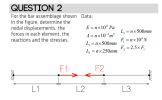
N is 1 QUESTION 2 For the bar assemblage shown Data: in the figure, determine the...
 N is 1
QUESTION 2 For the bar assemblage shown Data: in the figure, determine the nodal displacements, the E =nx10" Pa forces in each element, the A=nx10-?m? reactions and the stresses. L =nx 500mm Ly =n x500mm F=nx104N L2 =nx 250mm F, = 2.5x F, MITT L 1 L2
N is 1
QUESTION 2 For the bar assemblage shown Data: in the figure, determine the nodal displacements, the E =nx10" Pa forces in each element, the A=nx10-?m? reactions and the stresses. L =nx 500mm Ly =n x500mm F=nx104N L2 =nx 250mm F, = 2.5x F, MITT L 1 L2
Using the Stiffness Method procedure identify nodes, elements and degrees of freedom (neglect axial stiffness) for the beam shown below. Form member and structure stiffness matrices and compute displ...
 Using the Stiffness Method procedure identify nodes, elements and degrees of freedom (neglect axial stiffness) for the beam shown below. Form member and structure stiffness matrices and compute displacements, reactions and internal forces developed in the beam Note that there is a hinge at B. Take E = 250 GPa, 1-2000 cm 10 kN 2 kN/m 5 kN-m 10 m
Using the Stiffness Method procedure identify nodes, elements and degrees of freedom (neglect axial stiffness) for the beam shown below....
Using the Stiffness Method procedure identify nodes, elements and degrees of freedom (neglect axial stiffness) for the beam shown below. Form member and structure stiffness matrices and compute displacements, reactions and internal forces developed in the beam Note that there is a hinge at B. Take E = 250 GPa, 1-2000 cm 10 kN 2 kN/m 5 kN-m 10 m
Using the Stiffness Method procedure identify nodes, elements and degrees of freedom (neglect axial stiffness) for the beam shown below....
For the bar assemblage shown Data: in the figure, determine the nodal displacements, the E=nx10" Pa...
 For the bar assemblage shown Data: in the figure, determine the nodal displacements, the E=nx10" Pa forces in each element, the L; =nx 500mm A=nx10-m? 13 reactions and the stresses L =nx 500mm F =nx10*N L = n x 250mm F2 = 2.5x F, F2 12 L
Using the Stiffness Method procedure identify nodes, elements and degrees of freedom (neglect axial stiffness) for the beam shown below. Form member and structure stiffness matrices and compute di...
 Using the Stiffness Method procedure identify nodes, elements and degrees of freedom (neglect axial stiffness) for the beam shown below. Form member and structure stiffness matrices and compute displacements, reactions and internal forces developed in the beam. Note that there is a hinge at B. Take E= 250 G Pa, 1 = 2000 cm- 10 kN 5 kN-m 2 kN/m 10 m
Using the Stiffness Method procedure identify nodes, elements and degrees of freedom (neglect axial stiffness) for the beam...
Using the Stiffness Method procedure identify nodes, elements and degrees of freedom (neglect axial stiffness) for the beam shown below. Form member and structure stiffness matrices and compute displacements, reactions and internal forces developed in the beam. Note that there is a hinge at B. Take E= 250 G Pa, 1 = 2000 cm- 10 kN 5 kN-m 2 kN/m 10 m
Using the Stiffness Method procedure identify nodes, elements and degrees of freedom (neglect axial stiffness) for the beam...
Solve all problems using the finite element stiffness method. For the rigid frame shown in Figure P5-4, determine (1) the nodal displacements and rotation at node 4, (2) the reactions, and (3) the fo...
 Solve all problems using the finite element stiffness method. For the rigid frame shown in Figure P5-4, determine (1) the nodal displacements and rotation at node 4, (2) the reactions, and (3) the forces in each element. Then check equilibrium at node 4 Finally, draw the shear force and bending moment diagrams for each element. Let E 30x 103 ksi, A 8 in2, and I 800 in.4 for all elements. 20 kip 25 ft 25 ft 40 ft Figure P5-4...
For the system shown below, (a) the global stiffness matrix (b)displacements of nodes 2 and 3...
 For the system shown below, (a) the global stiffness
matrix (b)displacements of nodes 2 and 3 (c)the
reaction forces at nodes 1 and 4 (d)the force in the
members
EA TRATAMI 70-400 = 100 x 10 kN/m 0.28 ATT L ( EA k, 100 - 200 = 200 x 10 kN/m 0.1 L (4 EA k, 200.70 =140x10 kN/m 0.1 I (4.2 X tretiet 0.28 2 vyos Imool
For the system shown below, (a) the global stiffness
matrix (b)displacements of nodes 2 and 3 (c)the
reaction forces at nodes 1 and 4 (d)the force in the
members
EA TRATAMI 70-400 = 100 x 10 kN/m 0.28 ATT L ( EA k, 100 - 200 = 200 x 10 kN/m 0.1 L (4 EA k, 200.70 =140x10 kN/m 0.1 I (4.2 X tretiet 0.28 2 vyos Imool
Given the indeterminate beam shown below, use FEM to compute the final stiffness matrix and force...
 Given the indeterminate beam shown below, use FEM to compute the final stiffness matrix and force vector of the Ku f problem using three elements with the lengths prescribed in the figure. Your work should include all boundary conditions. The beam has the properties E 3.0E6 psi and I 4.5 in 30 lb/in Fo-500 q2 20 lb/in 12 in The weak formulation gives the following expressions for the generic element force vector qe and stiffness matrix Ke. 12Eele 6Eel 20...
2 k3 2 3 4 a. (10 points) Obtain the global stiffness matrix K using direct...
 2 k3 2 3 4 a. (10 points) Obtain the global stiffness matrix K using direct stiffness method (k1- 100 1b/in, k2 200 lb/in, k3 3001b/in, P-500 Ib). (10 points) If nodes 1 and 4 are fixed and a force P acts on node 2 in the positive x direction, fin the values for the displacements of nodes 2 and 3. b. c. (10 points) Deter odes 1 and 4
 For the truss shown in the below figure, determine the stifness
matrix for each truss element, the stiffness matrix for entire
truss, the displacements at nodes 1 through 4, and the force in
elements 1 through 5. Also, determine the force in each element.
Let A = 3 in2, E = 30 x 106
psi for all elements.
8 kips 8 kips 10 ft. 3 4 2 トー-10ft.-*-10 ft.
For the truss shown in the below figure, determine the stifness
matrix for each truss element, the stiffness matrix for entire
truss, the displacements at nodes 1 through 4, and the force in
elements 1 through 5. Also, determine the force in each element.
Let A = 3 in2, E = 30 x 106
psi for all elements.
8 kips 8 kips 10 ft. 3 4 2 トー-10ft.-*-10 ft.
 N is 1
QUESTION 2 For the bar assemblage shown Data: in the figure, determine the nodal displacements, the E =nx10" Pa forces in each element, the A=nx10-?m? reactions and the stresses. L =nx 500mm Ly =n x500mm F=nx104N L2 =nx 250mm F, = 2.5x F, MITT L 1 L2
N is 1
QUESTION 2 For the bar assemblage shown Data: in the figure, determine the nodal displacements, the E =nx10" Pa forces in each element, the A=nx10-?m? reactions and the stresses. L =nx 500mm Ly =n x500mm F=nx104N L2 =nx 250mm F, = 2.5x F, MITT L 1 L2
 Using the Stiffness Method procedure identify nodes, elements and degrees of freedom (neglect axial stiffness) for the beam shown below. Form member and structure stiffness matrices and compute displacements, reactions and internal forces developed in the beam Note that there is a hinge at B. Take E = 250 GPa, 1-2000 cm 10 kN 2 kN/m 5 kN-m 10 m
Using the Stiffness Method procedure identify nodes, elements and degrees of freedom (neglect axial stiffness) for the beam shown below....
Using the Stiffness Method procedure identify nodes, elements and degrees of freedom (neglect axial stiffness) for the beam shown below. Form member and structure stiffness matrices and compute displacements, reactions and internal forces developed in the beam Note that there is a hinge at B. Take E = 250 GPa, 1-2000 cm 10 kN 2 kN/m 5 kN-m 10 m
Using the Stiffness Method procedure identify nodes, elements and degrees of freedom (neglect axial stiffness) for the beam shown below....
 For the bar assemblage shown Data: in the figure, determine the nodal displacements, the E=nx10" Pa forces in each element, the L; =nx 500mm A=nx10-m? 13 reactions and the stresses L =nx 500mm F =nx10*N L = n x 250mm F2 = 2.5x F, F2 12 L
 Using the Stiffness Method procedure identify nodes, elements and degrees of freedom (neglect axial stiffness) for the beam shown below. Form member and structure stiffness matrices and compute displacements, reactions and internal forces developed in the beam. Note that there is a hinge at B. Take E= 250 G Pa, 1 = 2000 cm- 10 kN 5 kN-m 2 kN/m 10 m
Using the Stiffness Method procedure identify nodes, elements and degrees of freedom (neglect axial stiffness) for the beam...
Using the Stiffness Method procedure identify nodes, elements and degrees of freedom (neglect axial stiffness) for the beam shown below. Form member and structure stiffness matrices and compute displacements, reactions and internal forces developed in the beam. Note that there is a hinge at B. Take E= 250 G Pa, 1 = 2000 cm- 10 kN 5 kN-m 2 kN/m 10 m
Using the Stiffness Method procedure identify nodes, elements and degrees of freedom (neglect axial stiffness) for the beam...
 Solve all problems using the finite element stiffness method. For the rigid frame shown in Figure P5-4, determine (1) the nodal displacements and rotation at node 4, (2) the reactions, and (3) the forces in each element. Then check equilibrium at node 4 Finally, draw the shear force and bending moment diagrams for each element. Let E 30x 103 ksi, A 8 in2, and I 800 in.4 for all elements. 20 kip 25 ft 25 ft 40 ft Figure P5-4...
 For the system shown below, (a) the global stiffness
matrix (b)displacements of nodes 2 and 3 (c)the
reaction forces at nodes 1 and 4 (d)the force in the
members
EA TRATAMI 70-400 = 100 x 10 kN/m 0.28 ATT L ( EA k, 100 - 200 = 200 x 10 kN/m 0.1 L (4 EA k, 200.70 =140x10 kN/m 0.1 I (4.2 X tretiet 0.28 2 vyos Imool
For the system shown below, (a) the global stiffness
matrix (b)displacements of nodes 2 and 3 (c)the
reaction forces at nodes 1 and 4 (d)the force in the
members
EA TRATAMI 70-400 = 100 x 10 kN/m 0.28 ATT L ( EA k, 100 - 200 = 200 x 10 kN/m 0.1 L (4 EA k, 200.70 =140x10 kN/m 0.1 I (4.2 X tretiet 0.28 2 vyos Imool
 Given the indeterminate beam shown below, use FEM to compute the final stiffness matrix and force vector of the Ku f problem using three elements with the lengths prescribed in the figure. Your work should include all boundary conditions. The beam has the properties E 3.0E6 psi and I 4.5 in 30 lb/in Fo-500 q2 20 lb/in 12 in The weak formulation gives the following expressions for the generic element force vector qe and stiffness matrix Ke. 12Eele 6Eel 20...
 2 k3 2 3 4 a. (10 points) Obtain the global stiffness matrix K using direct stiffness method (k1- 100 1b/in, k2 200 lb/in, k3 3001b/in, P-500 Ib). (10 points) If nodes 1 and 4 are fixed and a force P acts on node 2 in the positive x direction, fin the values for the displacements of nodes 2 and 3. b. c. (10 points) Deter odes 1 and 4
Most questions answered within 3 hours.
-
Where is the error in this code sequence?
String s1 = "Hello";
String s2 = "ello";...
asked 10 months ago -
Financial data for Joel de Paris, Inc., for last year
follow:
Joel de Paris, Inc.
Balance...
asked 10 months ago -
Consider this reaction:
Al2(SO4)3 (aq)+ BaCl3
(aq) Al2Cl6 (aq)- +
3BaSO4(s) . What is the...
asked 10 months ago -
Suppose that Savneet is considering increasing her
recent random sample from 20 car rentals to 40...
asked 10 months ago -
Trucks arrive at an unloading terminal at an average rate of 120
per hour.
Trucks arrive...
asked 10 months ago -
Why are methanol and ethanol completely soluble in water while
octanol is not very little soluble....
asked 10 months ago -
A facilities manager at a university reads in a research report
that the mean amount of...
asked 10 months ago -
When the CuSO4 is rehydrated by adding water to the anhydrous
compound, is this an endothermic...
asked 10 months ago -
A ray of sunlight is passing from diamond into crown glass; the
angle of incidence is...
asked 10 months ago -
A block of mass 0.249 kg is placed on top of a light, vertical
spring of...
asked 10 months ago -
how do the kidneys compensate in the presences of acidosis
a) trigger hyperventilate
b) reserve acid...
asked 10 months ago -
Question 501 pts
The rental rate of capital to the firm increases. Which of the
following...
asked 10 months ago