
Homework Answers


Add Answer to:
The table shows kinetic data for the dimerization of a chemical compound: 2 A rightarrow B...
Consider the reaction X + Y rightarrow Z. From the data in the table, obtained at...
 Consider the reaction X + Y rightarrow Z. From the data in the table, obtained at 360 K. (a) determine the overall order of the reaction. (b) determine the initial rate of disappearance of X when the concentration of X is 0.50 M and of Y is 0.040 M.
4. A study of the rate of dimerization of C4H6 gave the data shown in the...
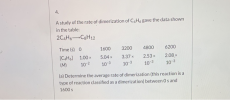 4. A study of the rate of dimerization of C4H6 gave the data shown in the table: 2C4H6-C8H12 3200 6200 Time (s) 0 [C.Hol 1.00 (M) 1600 5.04 4800 2.53 3.37 x 2.08. 10-2 10-3 10-3 10-3 10-3 (a) Determine the average rate of dimerization (this reaction is a type of reaction classified as a dimerization) between 0s and 1600 s
2. Using the data in the table, determine the rate constant of the reaction and select...
2. Using the data in the table, determine the rate constant of the reaction and select the appropriate units. A+2B⟶C+D Trial [A] (M)[A] (M) [B] (M)[B] (M) Rate (M/s) 1 0.340 0.340 0.0127 2 0.340 0.680 0.0127 3 0.680 0.340 0.0508 k= Units 3. The rate constant for this first‑order reaction is 0.480 s−1 at 400 ∘C. A⟶products How long, in seconds, would it take for the concentration of A to decrease from 0.650 M to 0.270 M? 4. After...
Problem 4 (25%) A homogeneous chemical reaction A relationship B is known to follow the kinetic - =kC, where A is t...
 Problem 4 (25%) A homogeneous chemical reaction A relationship B is known to follow the kinetic - =kC, where A is the rate of reaction, k is the rate constant, CA is the concentration of Species A, and n is the exponential factor. Testing provides kinetic data shown in Table 4. Table 4. Kinetic data for a homogeneous reaction. CA (molL) - (mol/Ls) 4 0.398 2.25 1.45 0.2980.238 1.0 0.65 0.1980.158 0.25 0.098 0.006 0.048 (,5%) What type of function...
A study of the rate of dimerization of C4H6 gave the data shown in the table:...
A study of the rate of dimerization of C4H6 gave the data shown in the table: 2 C4H6 ⟶ C8H12 Time (s) [C4H6] (M) 0.0 1.00 × 10⁻² 1600 5.04 × 10⁻³ 3200 3.37 × 10⁻³ 4800 2.53 × 10⁻³ 6200 2.08 × 10⁻³ The average rate of dimerization between 3200 s and 4800 s is _____ M/s.
1. Initial‑rate data at a certain temperature is given in the table for the reaction N2O3(g)⟶NO(g)+NO2(g)...
1. Initial‑rate data at a certain temperature is given in the table for the reaction N2O3(g)⟶NO(g)+NO2(g) [N2O3]0(M) Initial rate (M/s) 0.100 0.510 0.200 1.020 0.300 1.530 Determine the value and units of the rate constant. k= units: 2. Using the data in the table, determine the rate constant of the reaction and select the appropriate units. A+2B⟶C+D Trial [A] (M)[A] (M) [B] (M)[B] (M) Rate (M/s) 1 0.340 0.340 0.0127 2 0.340 0.680 0.0127 3 0.680 0.340 0.0508 k= Units...
3. The following table shows how the concentration of AB varies in the reaction: 2 AB(g)...
3. The following table shows how the concentration of AB varies in the reaction: 2 AB(g) → A2(g) +B2(g). Time (s) 0 1000 2000 3000 4000 [AB] (mol/L) 1.00 0.112 0.061 0.041 0.031 Determine: a) The global reaction order. b) The kinetic constant for the rate of disappearance of AB. c) The kinetic constant for the rate law (independent of the reactant). Use trial end error using excel.
with steps please A study of the rate of dimerization of C4H6 gave the data shown...
 with steps please
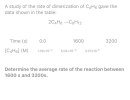
A study of the rate of dimerization of C4H6 gave the data shown in the table: 2C4H6 –C3H12 3200 Time (s) [C4H6] (M) 0.0 1.00x10⁻² 1600 5.04x10⁻³ 3.37x10⁻³ Determine the average rate of the reaction between 1600 s and 3200s.
with steps please
A study of the rate of dimerization of C4H6 gave the data shown in the table: 2C4H6 –C3H12 3200 Time (s) [C4H6] (M) 0.0 1.00x10⁻² 1600 5.04x10⁻³ 3.37x10⁻³ Determine the average rate of the reaction between 1600 s and 3200s.
The following data were collected for a reaction of type: A + B rightarrow Products where...
 The following data were collected for a reaction of type: A + B rightarrow Products where [B] was 0.25 M after the reactant solutions were mixed, i.e. a large excess. Complete the last three columns: Determine the order of the reaction with respect to A and the value of the pseudo rate constant. keff-1. Your answer must include graphs, drawn neatly by hand on graph paper or generated by a computer spreadsheet program as well as a brief explanation. Freehand...
The rate constant for the first-order decomposition of a compound A in the reaction 2A rightarrow...
 The rate constant for the first-order decomposition of a compound A in the reaction 2A rightarrow P is k = 3.6 times 10^-7 s^-1 at 25 degree C. What is the half-life of A? What will be the pressure, initially 33 kPa, at 50s, 20 min after initiation of the reaction?
 Consider the reaction X + Y rightarrow Z. From the data in the table, obtained at 360 K. (a) determine the overall order of the reaction. (b) determine the initial rate of disappearance of X when the concentration of X is 0.50 M and of Y is 0.040 M.
 4. A study of the rate of dimerization of C4H6 gave the data shown in the table: 2C4H6-C8H12 3200 6200 Time (s) 0 [C.Hol 1.00 (M) 1600 5.04 4800 2.53 3.37 x 2.08. 10-2 10-3 10-3 10-3 10-3 (a) Determine the average rate of dimerization (this reaction is a type of reaction classified as a dimerization) between 0s and 1600 s
 Problem 4 (25%) A homogeneous chemical reaction A relationship B is known to follow the kinetic - =kC, where A is the rate of reaction, k is the rate constant, CA is the concentration of Species A, and n is the exponential factor. Testing provides kinetic data shown in Table 4. Table 4. Kinetic data for a homogeneous reaction. CA (molL) - (mol/Ls) 4 0.398 2.25 1.45 0.2980.238 1.0 0.65 0.1980.158 0.25 0.098 0.006 0.048 (,5%) What type of function...
 with steps please
A study of the rate of dimerization of C4H6 gave the data shown in the table: 2C4H6 –C3H12 3200 Time (s) [C4H6] (M) 0.0 1.00x10⁻² 1600 5.04x10⁻³ 3.37x10⁻³ Determine the average rate of the reaction between 1600 s and 3200s.
with steps please
A study of the rate of dimerization of C4H6 gave the data shown in the table: 2C4H6 –C3H12 3200 Time (s) [C4H6] (M) 0.0 1.00x10⁻² 1600 5.04x10⁻³ 3.37x10⁻³ Determine the average rate of the reaction between 1600 s and 3200s.
 The following data were collected for a reaction of type: A + B rightarrow Products where [B] was 0.25 M after the reactant solutions were mixed, i.e. a large excess. Complete the last three columns: Determine the order of the reaction with respect to A and the value of the pseudo rate constant. keff-1. Your answer must include graphs, drawn neatly by hand on graph paper or generated by a computer spreadsheet program as well as a brief explanation. Freehand...
 The rate constant for the first-order decomposition of a compound A in the reaction 2A rightarrow P is k = 3.6 times 10^-7 s^-1 at 25 degree C. What is the half-life of A? What will be the pressure, initially 33 kPa, at 50s, 20 min after initiation of the reaction?
Most questions answered within 3 hours.
-
Where is the error in this code sequence?
String s1 = "Hello";
String s2 = "ello";...
asked 11 months ago -
Financial data for Joel de Paris, Inc., for last year
follow:
Joel de Paris, Inc.
Balance...
asked 11 months ago -
Consider this reaction:
Al2(SO4)3 (aq)+ BaCl3
(aq) Al2Cl6 (aq)- +
3BaSO4(s) . What is the...
asked 11 months ago -
Suppose that Savneet is considering increasing her
recent random sample from 20 car rentals to 40...
asked 11 months ago -
Trucks arrive at an unloading terminal at an average rate of 120
per hour.
Trucks arrive...
asked 11 months ago -
Why are methanol and ethanol completely soluble in water while
octanol is not very little soluble....
asked 11 months ago -
A facilities manager at a university reads in a research report
that the mean amount of...
asked 11 months ago -
When the CuSO4 is rehydrated by adding water to the anhydrous
compound, is this an endothermic...
asked 11 months ago -
A ray of sunlight is passing from diamond into crown glass; the
angle of incidence is...
asked 11 months ago -
A block of mass 0.249 kg is placed on top of a light, vertical
spring of...
asked 11 months ago -
how do the kidneys compensate in the presences of acidosis
a) trigger hyperventilate
b) reserve acid...
asked 11 months ago -
Question 501 pts
The rental rate of capital to the firm increases. Which of the
following...
asked 11 months ago