
Homework Answers
Add Answer to:
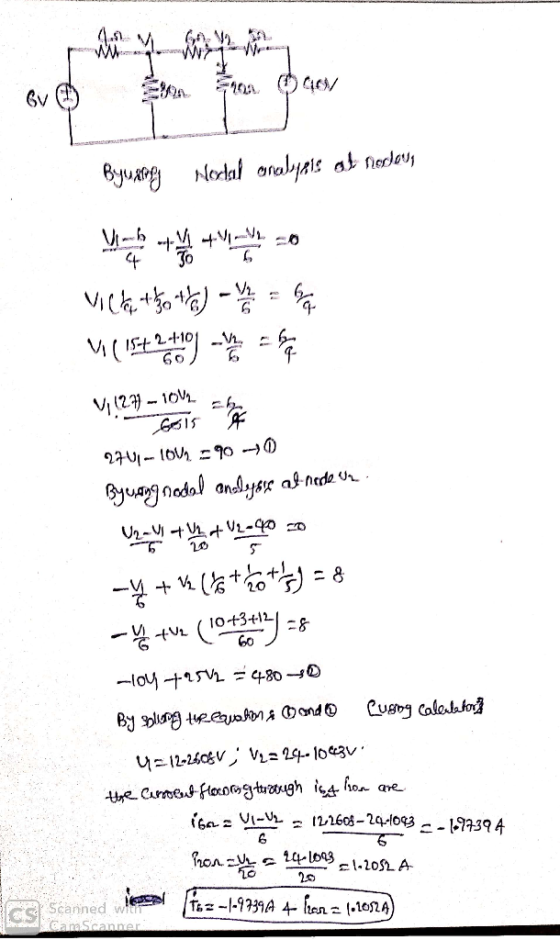
Name and 20 resistors. Employ the noda PROBLEM 2 (20 Points) in the circuit below, find...
Using the Loop Current Method, find all currents through the resistors in the circuit below CET...
 Using the Loop Current Method, find all currents through the
resistors in the circuit below
CET 243 Loop Current Method: Find all currents through the resistors in the circuit below. 3. R1 R2 470Ω 820Ω V2 V1 R3 220Ω 二10V
Using the Loop Current Method, find all currents through the
resistors in the circuit below
CET 243 Loop Current Method: Find all currents through the resistors in the circuit below. 3. R1 R2 470Ω 820Ω V2 V1 R3 220Ω 二10V
problem 2 please Problem 2 (50 points) Consider the circuit below and answer the following questions:...
 problem 2 please
Problem 2 (50 points) Consider the circuit below and answer the following questions: R,-4Ω +Vi 2 V a- [20 Points] Using nodal analysis method, find the voltages VA. VB. Ve and Vo b [12 Points] Calculate the currents I and Is. c- 8 Points] Calculate the voltage Vs across the dependent current source. d- [10 Points] Calculate the power absorbed delivered by each voltage source in the circuit
problem 2 please
Problem 2 (50 points) Consider the circuit below and answer the following questions: R,-4Ω +Vi 2 V a- [20 Points] Using nodal analysis method, find the voltages VA. VB. Ve and Vo b [12 Points] Calculate the currents I and Is. c- 8 Points] Calculate the voltage Vs across the dependent current source. d- [10 Points] Calculate the power absorbed delivered by each voltage source in the circuit
linear circuit 1 Q2. [30 Points) Consider the circuit below and answer the following questions 5A...
 linear circuit 1
Q2. [30 Points) Consider the circuit below and answer the following questions 5A 292 532 389 40 V 20 V + (a) 18 Pts Use loop (Mesh) analysis technique to analyze the circuit and find the mesh currents. (b) [4 Pts) Calculate the voltage Vo. (c) 14 Pts) Calculate the current Ix. (d) [4 Pts Calculate the current ly.
linear circuit 1
Q2. [30 Points) Consider the circuit below and answer the following questions 5A 292 532 389 40 V 20 V + (a) 18 Pts Use loop (Mesh) analysis technique to analyze the circuit and find the mesh currents. (b) [4 Pts) Calculate the voltage Vo. (c) 14 Pts) Calculate the current Ix. (d) [4 Pts Calculate the current ly.
Name: PROBLEM 6 (20 POINTS) Examine the circuit below. What should the value of C be...
 Name: PROBLEM 6 (20 POINTS) Examine the circuit below. What should the value of C be so that the equivalent capacitance of the circuit is 1.33 uF? 0.30 ?F 0.30 ?F
1. Connect the circuit shown in Figure 23. The values of the resistors are given below...
 1. Connect the circuit shown in Figure 23. The values of the resistors are given below in Table and the source voltage (vs) is 20 V. Ri R4 R5 Figure 23 - General Resistive Circuit R 4.7 ko Rz 15 k22 | Rz 10 k R4 22 ke | Rs 6.8 ko Table 6 - Values of Resistors 2. Calculate all the component currents (i, through is), all the component voltages (Vị through vs) using circuit theories you have learned...
Problem 1 In the circuit below, employ the superposition principle to determine: (a) The individual contributions...
 Problem 1 In the circuit below, employ the superposition principle to determine: (a) The individual contributions of each independent source to the 20 points Current iz. (b) What percentage of the total power dissipated in the 2S2 resistor comes from the 6 A source only? 3ig 112 312 12V
Problem 2: In the circuit on Figure P2, BJT NPN Q1 and Q2 emulate a Darlington...
 Problem 2: In the circuit on Figure P2, BJT NPN Q1 and Q2 emulate a Darlington Pair (DP). It should be noted that Q1 and Q2 are such that their current gains are B1 B2 = B = 99. Moreover, capacitors C1 and C2 can be assumed to be very large. Note: The DC analysis of the DP circuit below can be done in a similar fashion as what you do when only dealing with one transistor. Express the current...
2. (2000) Electromagnetics (DC Circuit) Problem a. Calculate the voltages across all resistors and the currents through all the resistors and voltage sources in the following circuit using Kirchhoff&...
 2. (2000) Electromagnetics (DC Circuit) Problem a. Calculate the voltages across all resistors and the currents through all the resistors and voltage sources in the following circuit using Kirchhoff's junction rule (nodal analysis). Show the directions initially assumed for the junction (node) currents. Use the minimum number of junctions (nodes) necessary to accomplish this b. Calculate the power dissipation in each resistor and the sum (or total) of these individual power dissipation values c. Calculate the power associated with each...
4. Find the voltage v(t) fort > 0 in the circuit shown below. (25 points) 20022...
 4. Find the voltage v(t) fort > 0 in the circuit shown below. (25 points) 20022 0.4 H 40 v t=0 X 2002 20 pFv
Analyze the circuit below using any circuit analysis technique of your choice (Nodal / Mesh /...
 Analyze the circuit below using any circuit analysis technique
of your choice (Nodal / Mesh / Source Transformation /
Superposition) to solve for Vo. The bottom node should be
considered as the reference node for your analysis. Write your
final answers in the boxes. Name of Technique used -
[3] (20 points) Analyze the circuit below using any circuit analysis technique of your choice (Nodal /Mesh / Source Transformation/Superposition) to solve for Vo. The bottom node should be considered as...
Analyze the circuit below using any circuit analysis technique
of your choice (Nodal / Mesh / Source Transformation /
Superposition) to solve for Vo. The bottom node should be
considered as the reference node for your analysis. Write your
final answers in the boxes. Name of Technique used -
[3] (20 points) Analyze the circuit below using any circuit analysis technique of your choice (Nodal /Mesh / Source Transformation/Superposition) to solve for Vo. The bottom node should be considered as...
 Using the Loop Current Method, find all currents through the
resistors in the circuit below
CET 243 Loop Current Method: Find all currents through the resistors in the circuit below. 3. R1 R2 470Ω 820Ω V2 V1 R3 220Ω 二10V
Using the Loop Current Method, find all currents through the
resistors in the circuit below
CET 243 Loop Current Method: Find all currents through the resistors in the circuit below. 3. R1 R2 470Ω 820Ω V2 V1 R3 220Ω 二10V
 problem 2 please
Problem 2 (50 points) Consider the circuit below and answer the following questions: R,-4Ω +Vi 2 V a- [20 Points] Using nodal analysis method, find the voltages VA. VB. Ve and Vo b [12 Points] Calculate the currents I and Is. c- 8 Points] Calculate the voltage Vs across the dependent current source. d- [10 Points] Calculate the power absorbed delivered by each voltage source in the circuit
problem 2 please
Problem 2 (50 points) Consider the circuit below and answer the following questions: R,-4Ω +Vi 2 V a- [20 Points] Using nodal analysis method, find the voltages VA. VB. Ve and Vo b [12 Points] Calculate the currents I and Is. c- 8 Points] Calculate the voltage Vs across the dependent current source. d- [10 Points] Calculate the power absorbed delivered by each voltage source in the circuit
 linear circuit 1
Q2. [30 Points) Consider the circuit below and answer the following questions 5A 292 532 389 40 V 20 V + (a) 18 Pts Use loop (Mesh) analysis technique to analyze the circuit and find the mesh currents. (b) [4 Pts) Calculate the voltage Vo. (c) 14 Pts) Calculate the current Ix. (d) [4 Pts Calculate the current ly.
linear circuit 1
Q2. [30 Points) Consider the circuit below and answer the following questions 5A 292 532 389 40 V 20 V + (a) 18 Pts Use loop (Mesh) analysis technique to analyze the circuit and find the mesh currents. (b) [4 Pts) Calculate the voltage Vo. (c) 14 Pts) Calculate the current Ix. (d) [4 Pts Calculate the current ly.
 Name: PROBLEM 6 (20 POINTS) Examine the circuit below. What should the value of C be so that the equivalent capacitance of the circuit is 1.33 uF? 0.30 ?F 0.30 ?F
 1. Connect the circuit shown in Figure 23. The values of the resistors are given below in Table and the source voltage (vs) is 20 V. Ri R4 R5 Figure 23 - General Resistive Circuit R 4.7 ko Rz 15 k22 | Rz 10 k R4 22 ke | Rs 6.8 ko Table 6 - Values of Resistors 2. Calculate all the component currents (i, through is), all the component voltages (Vị through vs) using circuit theories you have learned...
 Problem 1 In the circuit below, employ the superposition principle to determine: (a) The individual contributions of each independent source to the 20 points Current iz. (b) What percentage of the total power dissipated in the 2S2 resistor comes from the 6 A source only? 3ig 112 312 12V
 Problem 2: In the circuit on Figure P2, BJT NPN Q1 and Q2 emulate a Darlington Pair (DP). It should be noted that Q1 and Q2 are such that their current gains are B1 B2 = B = 99. Moreover, capacitors C1 and C2 can be assumed to be very large. Note: The DC analysis of the DP circuit below can be done in a similar fashion as what you do when only dealing with one transistor. Express the current...
 2. (2000) Electromagnetics (DC Circuit) Problem a. Calculate the voltages across all resistors and the currents through all the resistors and voltage sources in the following circuit using Kirchhoff's junction rule (nodal analysis). Show the directions initially assumed for the junction (node) currents. Use the minimum number of junctions (nodes) necessary to accomplish this b. Calculate the power dissipation in each resistor and the sum (or total) of these individual power dissipation values c. Calculate the power associated with each...
 4. Find the voltage v(t) fort > 0 in the circuit shown below. (25 points) 20022 0.4 H 40 v t=0 X 2002 20 pFv
 Analyze the circuit below using any circuit analysis technique
of your choice (Nodal / Mesh / Source Transformation /
Superposition) to solve for Vo. The bottom node should be
considered as the reference node for your analysis. Write your
final answers in the boxes. Name of Technique used -
[3] (20 points) Analyze the circuit below using any circuit analysis technique of your choice (Nodal /Mesh / Source Transformation/Superposition) to solve for Vo. The bottom node should be considered as...
Analyze the circuit below using any circuit analysis technique
of your choice (Nodal / Mesh / Source Transformation /
Superposition) to solve for Vo. The bottom node should be
considered as the reference node for your analysis. Write your
final answers in the boxes. Name of Technique used -
[3] (20 points) Analyze the circuit below using any circuit analysis technique of your choice (Nodal /Mesh / Source Transformation/Superposition) to solve for Vo. The bottom node should be considered as...
Most questions answered within 3 hours.
-
Where is the error in this code sequence?
String s1 = "Hello";
String s2 = "ello";...
asked 10 months ago -
Financial data for Joel de Paris, Inc., for last year
follow:
Joel de Paris, Inc.
Balance...
asked 10 months ago -
Consider this reaction:
Al2(SO4)3 (aq)+ BaCl3
(aq) Al2Cl6 (aq)- +
3BaSO4(s) . What is the...
asked 10 months ago -
Suppose that Savneet is considering increasing her
recent random sample from 20 car rentals to 40...
asked 10 months ago -
Trucks arrive at an unloading terminal at an average rate of 120
per hour.
Trucks arrive...
asked 10 months ago -
Why are methanol and ethanol completely soluble in water while
octanol is not very little soluble....
asked 10 months ago -
A facilities manager at a university reads in a research report
that the mean amount of...
asked 10 months ago -
When the CuSO4 is rehydrated by adding water to the anhydrous
compound, is this an endothermic...
asked 10 months ago -
A ray of sunlight is passing from diamond into crown glass; the
angle of incidence is...
asked 10 months ago -
A block of mass 0.249 kg is placed on top of a light, vertical
spring of...
asked 10 months ago -
how do the kidneys compensate in the presences of acidosis
a) trigger hyperventilate
b) reserve acid...
asked 10 months ago -
Question 501 pts
The rental rate of capital to the firm increases. Which of the
following...
asked 10 months ago