A cylinder of mass (m) and initial volume (V1) that contains (N) number of gaseous argon...
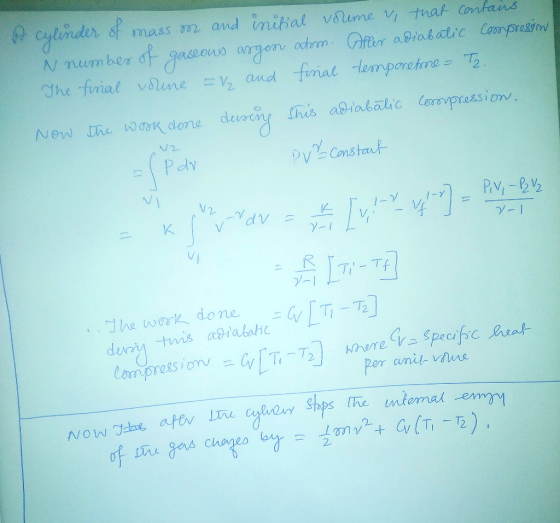
A cylinder of mass (m) and initial volume (V1) that contains (N) number of gaseous argon atoms of temperature (T1) is slid across a frictionless floor at velocity (v) until it collides with a wall. When it collides with the wall the cylinder compresses the gas inside adiabatically to volume (V2). There is no recoil from the collision and the compression continues until the cylinder stops sliding.
1) Calculate the work done on the gas during the adiabatic compression. (Final temperature = T2)
2) Right after the cylinder stops, how much has the internal energy of the gas changed
Homework Answers
Add Answer to:
A cylinder of mass (m) and initial volume (V1) that contains (N) number of
gaseous argon...
Argon is contained within a piston-cylinder assembly with initial state of V1 25 ft3 significant change...
 Argon is contained within a piston-cylinder assembly with initial state of V1 25 ft3 significant change in kinetic or potential energy, undergoes a thermodynamic cycle consisting of three processes as follows: Process 1-2: Adiabatic expansion with P aV + c, where c- 15 in Hg, a constant, and V2 40 ft3 p1 70 in Hg, and with no Process 2-3: Compression with pV-constant, U2 U3. Process 3-1: Constant-volume with AU-0.5 BTU 1. For process 1-2, find the constant a (with...
A cylinder fitted with a frictionless piston contains stops arranged as shown in the following figure....
 A cylinder fitted with a frictionless piston contains stops
arranged as shown in the following figure. When the piston rests on
the lower stops the volume is 0.4m3 ; when it is in contact with
the upper stops the volume is 0.6m3 . If the piston is not in
contact with the stops, it maintains a constant pressure of 200kPa
in the cylinder. Initially, the cylinder contains air at P1=150kPa
with a temperature of T1=300K. The air is then heated...
A cylinder fitted with a frictionless piston contains stops
arranged as shown in the following figure. When the piston rests on
the lower stops the volume is 0.4m3 ; when it is in contact with
the upper stops the volume is 0.6m3 . If the piston is not in
contact with the stops, it maintains a constant pressure of 200kPa
in the cylinder. Initially, the cylinder contains air at P1=150kPa
with a temperature of T1=300K. The air is then heated...
8. Initially, 1 mole of the real gas is contained in a thermally insulated piston-cylinder arrangement...
 8. Initially, 1 mole of the real gas is contained in a thermally insulated piston-cylinder arrangement in an initial state (T1, P1, Vi ). 1 mole of the real gas that is expressed by the following equation of state under the investigation. Now, the gas is expanded so as to fill the final state of (T2, P2, V2 ). Suppose that any possible temperature dependence of Cy is negligibly small and the molar heat capacity is approximately equal to 2"...
1.) A cylinder with a moveable piston contains 0.81 mol of gas and has a volume...
1.) A cylinder with a moveable piston contains 0.81 mol of gas and has a volume of 344 mL. What will its volume be if an additional 0.25 mol of gas is added to the cylinder? (Hint: The final number of moles is the sum of the initial number and the amount added.) 2.)A bag of potato chips contains 595 mL of air at 35.0 ∘C and a pressure of 775mmHg. Assuming the bag does not break, what will be...
A closed gas cylinder of constant volume and initial temperature of 350 K is heated to...
A closed gas cylinder of constant volume and initial temperature of 350 K is heated to 650 K 1 By what factor does the most probable speed change? vmode2/vmode1= 2 By what factor does the average speed change? v2/v1= 3 By what factor does the mean free path change? λ2/λ1= 4 By what factor does the average collision energy change? E2/E1=
A mass of 5.5 kg of saturated liquid-vapor mixture of water is contained in a piston-cylinder...
A mass of 5.5 kg of saturated liquid-vapor mixture of water is contained in a piston-cylinder at 101.325 kPa. Initially, 2.3 kg of the water is in the liquid phase and the rest is in the vapor phase. Heat is now transferred to the water, and the piston, which is resting on a set of stops, starts moving when the pressure inside reaches 300 kPa. Heat transfer continues until the total volume increases by 21 percent. Determine: a) the initial...
 Argon is contained within a piston-cylinder assembly with initial state of V1 25 ft3 significant change in kinetic or potential energy, undergoes a thermodynamic cycle consisting of three processes as follows: Process 1-2: Adiabatic expansion with P aV + c, where c- 15 in Hg, a constant, and V2 40 ft3 p1 70 in Hg, and with no Process 2-3: Compression with pV-constant, U2 U3. Process 3-1: Constant-volume with AU-0.5 BTU 1. For process 1-2, find the constant a (with...
 A cylinder fitted with a frictionless piston contains stops
arranged as shown in the following figure. When the piston rests on
the lower stops the volume is 0.4m3 ; when it is in contact with
the upper stops the volume is 0.6m3 . If the piston is not in
contact with the stops, it maintains a constant pressure of 200kPa
in the cylinder. Initially, the cylinder contains air at P1=150kPa
with a temperature of T1=300K. The air is then heated...
A cylinder fitted with a frictionless piston contains stops
arranged as shown in the following figure. When the piston rests on
the lower stops the volume is 0.4m3 ; when it is in contact with
the upper stops the volume is 0.6m3 . If the piston is not in
contact with the stops, it maintains a constant pressure of 200kPa
in the cylinder. Initially, the cylinder contains air at P1=150kPa
with a temperature of T1=300K. The air is then heated...
 8. Initially, 1 mole of the real gas is contained in a thermally insulated piston-cylinder arrangement in an initial state (T1, P1, Vi ). 1 mole of the real gas that is expressed by the following equation of state under the investigation. Now, the gas is expanded so as to fill the final state of (T2, P2, V2 ). Suppose that any possible temperature dependence of Cy is negligibly small and the molar heat capacity is approximately equal to 2"...
Most questions answered within 3 hours.
-
Where is the error in this code sequence?
String s1 = "Hello";
String s2 = "ello";...
asked 11 months ago -
Financial data for Joel de Paris, Inc., for last year
follow:
Joel de Paris, Inc.
Balance...
asked 11 months ago -
Consider this reaction:
Al2(SO4)3 (aq)+ BaCl3
(aq) Al2Cl6 (aq)- +
3BaSO4(s) . What is the...
asked 11 months ago -
Suppose that Savneet is considering increasing her
recent random sample from 20 car rentals to 40...
asked 11 months ago -
Trucks arrive at an unloading terminal at an average rate of 120
per hour.
Trucks arrive...
asked 11 months ago -
Why are methanol and ethanol completely soluble in water while
octanol is not very little soluble....
asked 11 months ago -
A facilities manager at a university reads in a research report
that the mean amount of...
asked 11 months ago -
When the CuSO4 is rehydrated by adding water to the anhydrous
compound, is this an endothermic...
asked 11 months ago -
A ray of sunlight is passing from diamond into crown glass; the
angle of incidence is...
asked 11 months ago -
A block of mass 0.249 kg is placed on top of a light, vertical
spring of...
asked 11 months ago -
how do the kidneys compensate in the presences of acidosis
a) trigger hyperventilate
b) reserve acid...
asked 11 months ago -
Question 501 pts
The rental rate of capital to the firm increases. Which of the
following...
asked 11 months ago