A closed gas cylinder of constant volume and initial temperature of 350 K is heated to...
A closed gas cylinder of constant volume and initial temperature of 350 K is heated to 650 K
1 By what factor does the most probable speed change?
vmode2/vmode1=
2 By what factor does the average speed change?
v2/v1=
3 By what factor does the mean free path change?
λ2/λ1=
4 By what factor does the average collision energy change?
E2/E1=
Homework Answers

Add Answer to:
A closed gas cylinder of constant volume and initial temperature
of 350 K is heated to...
A cylinder contains 3.5 L of oxygen at 350 K and 2.6 atm . The gas...
A cylinder contains 3.5 L of oxygen at 350 K and 2.6 atm . The gas is heated, causing a piston in the cylinder to move outward. The heating causes the temperature to rise to 650 K and the volume of the cylinder to increase to 9.5 L . a.What is the final gas pressure?
9. When the temperature of a gas is increased at constant volume, how do the following...
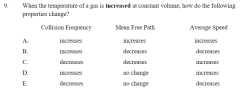 9. When the temperature of a gas is increased at constant volume, how do the following properties change? Collision Frequency Mean Free Path Average Speed increases increases increases increases decreases decreases decreases increases increases decreases no change no change increases decreases decreases
A monatomic gas is adiabatically compressed to 0.125 of its initial volume. How do each of...
A monatomic gas is adiabatically compressed to 0.125 of its initial volume. How do each of the following quantities change? a)By what factor does the rms speed change? b)By what factor does the mean free path change? c)By what factor does the thermal energy of the gas change? d)By what factor does the molar specific heat at constant volume change?
A cylinder of mass (m) and initial volume (V1) that contains (N) number of gaseous argon...
A cylinder of mass (m) and initial volume (V1) that contains (N) number of gaseous argon atoms of temperature (T1) is slid across a frictionless floor at velocity (v) until it collides with a wall. When it collides with the wall the cylinder compresses the gas inside adiabatically to volume (V2). There is no recoil from the collision and the compression continues until the cylinder stops sliding. 1) Calculate the work done on the gas during the adiabatic compression. (Final...
A sample of gas in a balloon has an initial temperature of 7 ∘C and a volume of 1170 L . If the temperature changes to 8...
A sample of gas in a balloon has an initial temperature of 7 ∘C and a volume of 1170 L . If the temperature changes to 83 ∘C , and there is no change of pressure or amount of gas, what is the new volume, V2, of the gas? What Celsius temperature, T2, is required to change the volume of the gas sample in Part A (T1 = 7 ∘C , V1= 1170 L ) to a volume of 2340...
105Pa, initial temperature T-300K, and an initial 1. An ideal gas with initial pressure 2 volume V - 1m3 expands isothermally to a final volume of 2m3. Then, the gas returns to its initial state, fir...
 105Pa, initial temperature T-300K, and an initial 1. An ideal gas with initial pressure 2 volume V - 1m3 expands isothermally to a final volume of 2m3. Then, the gas returns to its initial state, first by constant pressure (isobaric) contraction, and then by a change at constant volume (isochoric) a) Draw a PV diagram of this process. What's the total change in thermal energy of the entire process? b) What's the work done by the environment on the gas?...
A sample of an ideal gas in a cylinder of volume 4.14 L at 298 K...
A sample of an ideal gas in a cylinder of volume 4.14 L at 298 K and 2.24 atm expands to 7.48 L by two different pathways. Path A is an isothermal, reversible expansion. Path B has two steps. In the first step, the gas is cooled at constant volume to 1.38 atm . In the second step, the gas is heated and allowed to expand against a constant external pressure of 1.38 atm until the final volume is 7.48...
A sample of an ideal gas in a cylinder of volume 2.82 L at 298 K...
 A sample of an ideal gas in a cylinder of volume 2.82 L at 298 K and 2.63 atm expands to 8.40 L by two different pathways. Path A is an isothermal, reversible expansion. Path B has two steps. In the first step, the gas is cooled at constant volume to 1.40 atm, In the second step, the gas is heated and allowed to expand against a constant external pressure of 1.40 atm until the final volume is 8.40L. Calculate...
For a certain amount of gas at constant temperature, the pressure and volume have an inverse...
For a certain amount of gas at constant temperature, the pressure and volume have an inverse relationship (Figure 1). This is called Boyle's law: P1V1=P2V2 A. A sample of ideal gas at room temperature occupies a volume of 33.0 L at a pressure of 862 torr . If the pressure changes to 4310 torr , with no change in the temperature or moles of gas, what is the new volume, V2? B. If the volume of the original sample in...
13. Air in a closed cylinder is heated from 25°C to 36°C. If the initial pressure...
 13. Air in a closed cylinder is heated from 25°C to 36°C. If the initial pressure is 3.80 atm, what is the final pressure? 14. A bubble of helium gas has a volume of 0.650 mL near the bottom of a large aquarium where the pressure is 1.54 atm and the temperature is 12°C. Determine the bubble's volume upon rising near the top where the pressure is 1.01 atm and 16°C. 15. At what temperature Celsius will 19.4 g of...
 9. When the temperature of a gas is increased at constant volume, how do the following properties change? Collision Frequency Mean Free Path Average Speed increases increases increases increases decreases decreases decreases increases increases decreases no change no change increases decreases decreases
 105Pa, initial temperature T-300K, and an initial 1. An ideal gas with initial pressure 2 volume V - 1m3 expands isothermally to a final volume of 2m3. Then, the gas returns to its initial state, first by constant pressure (isobaric) contraction, and then by a change at constant volume (isochoric) a) Draw a PV diagram of this process. What's the total change in thermal energy of the entire process? b) What's the work done by the environment on the gas?...
 A sample of an ideal gas in a cylinder of volume 2.82 L at 298 K and 2.63 atm expands to 8.40 L by two different pathways. Path A is an isothermal, reversible expansion. Path B has two steps. In the first step, the gas is cooled at constant volume to 1.40 atm, In the second step, the gas is heated and allowed to expand against a constant external pressure of 1.40 atm until the final volume is 8.40L. Calculate...
 13. Air in a closed cylinder is heated from 25°C to 36°C. If the initial pressure is 3.80 atm, what is the final pressure? 14. A bubble of helium gas has a volume of 0.650 mL near the bottom of a large aquarium where the pressure is 1.54 atm and the temperature is 12°C. Determine the bubble's volume upon rising near the top where the pressure is 1.01 atm and 16°C. 15. At what temperature Celsius will 19.4 g of...
Most questions answered within 3 hours.
-
Where is the error in this code sequence?
String s1 = "Hello";
String s2 = "ello";...
asked 11 months ago -
Financial data for Joel de Paris, Inc., for last year
follow:
Joel de Paris, Inc.
Balance...
asked 11 months ago -
Consider this reaction:
Al2(SO4)3 (aq)+ BaCl3
(aq) Al2Cl6 (aq)- +
3BaSO4(s) . What is the...
asked 11 months ago -
Suppose that Savneet is considering increasing her
recent random sample from 20 car rentals to 40...
asked 11 months ago -
Trucks arrive at an unloading terminal at an average rate of 120
per hour.
Trucks arrive...
asked 11 months ago -
Why are methanol and ethanol completely soluble in water while
octanol is not very little soluble....
asked 11 months ago -
A facilities manager at a university reads in a research report
that the mean amount of...
asked 11 months ago -
When the CuSO4 is rehydrated by adding water to the anhydrous
compound, is this an endothermic...
asked 11 months ago -
A ray of sunlight is passing from diamond into crown glass; the
angle of incidence is...
asked 11 months ago -
A block of mass 0.249 kg is placed on top of a light, vertical
spring of...
asked 11 months ago -
how do the kidneys compensate in the presences of acidosis
a) trigger hyperventilate
b) reserve acid...
asked 11 months ago -
Question 501 pts
The rental rate of capital to the firm increases. Which of the
following...
asked 11 months ago