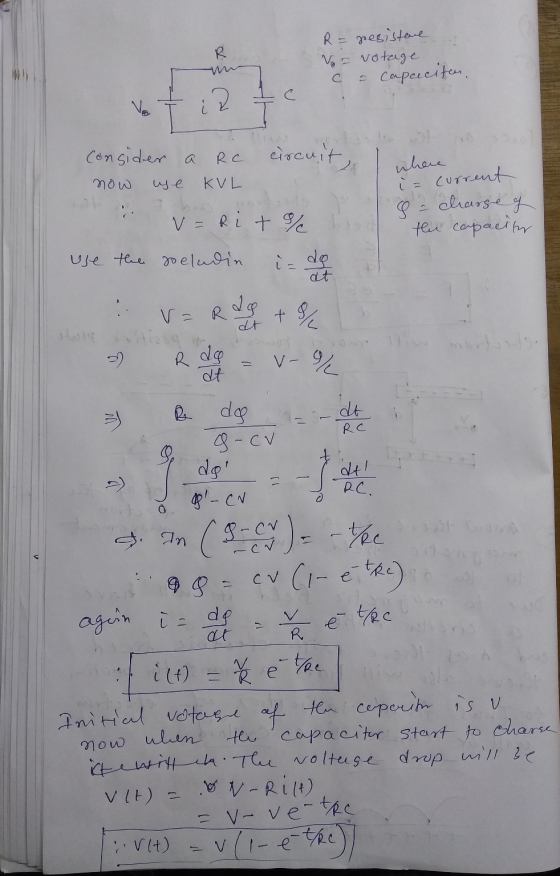
Derive time dependence of voltage and current for a capacitor equation v(t)=V(1-e-t/RC) i(t)=(V/R)(e-t/RC)
Derive time dependence of voltage and current for a capacitor equation
v(t)=V(1-e-t/RC)
i(t)=(V/R)(e-t/RC)
Homework Answers
Add Answer to:
Derive time dependence of voltage and current
for a capacitor equation
v(t)=V(1-e-t/RC)
i(t)=(V/R)(e-t/RC)
3 Capacitor Discharging Current The capacitor voltage versus time in a discharging series RC circuit, as...
 3 Capacitor Discharging Current The capacitor voltage versus time in a discharging series RC circuit, as shown in the Background Information Figure 2, is Vo(t) = V, expl-Roc), +20 (3) where V, is the source voltage in Volts, exp(x) is the exponential functione, Rp is the discharging resistance in Ohms (N), C is the capacitance in Farads. To = Rp is the discharging time constant in seconds. Derive an expression for the capacitor discharging current versus time, .(t), in terms...
electromagnetic 1) RC Circuits: (15 pts) (a) Use Kirchhoff's voltage law (KVL) to obtain an ordinary...
 electromagnetic
1) RC Circuits: (15 pts) (a) Use Kirchhoff's voltage law (KVL) to obtain an ordinary differential equation (ODE) describing the charge vs. time function (1) for a capacitor in the discharging RC circuit shown below. Assume that at time t = 0 (right before the switch is closed) the voltage across the capacitor is V = V.. R R с V(t) С t=0 t>O Fig. 1. Fully charged RC circuit Fig. 2. Discharging RC Circuit (b) Solve the ODE...
electromagnetic
1) RC Circuits: (15 pts) (a) Use Kirchhoff's voltage law (KVL) to obtain an ordinary differential equation (ODE) describing the charge vs. time function (1) for a capacitor in the discharging RC circuit shown below. Assume that at time t = 0 (right before the switch is closed) the voltage across the capacitor is V = V.. R R с V(t) С t=0 t>O Fig. 1. Fully charged RC circuit Fig. 2. Discharging RC Circuit (b) Solve the ODE...
2) (15 points) Consider a voltage signal v(t)Vocos(wt) (a) Consider applying v(t) across a capacitor C (i) What's the current into the capacitor? (ii) Plot the current and the voltage in the time...
 2) (15 points) Consider a voltage signal v(t)Vocos(wt) (a) Consider applying v(t) across a capacitor C (i) What's the current into the capacitor? (ii) Plot the current and the voltage in the time domain and draw their respective phasors in the complex plane. (ii) Does the current lead or lag the voltage? Explain intuitively. (b) Repeat (i), (ii), and (ii) for part (a) but with an inductor, L, instead of a capacitor. (c) Repeat (i), (ii), and (ii) for part...
Part I: Derive the phasor relation for a capacitor starting from the equation that describes the...
 Part I: Derive the phasor relation for a capacitor starting from the equation that describes the current through a capacitor as a function of a voltage on a capacitor. Assume that the capacitance of the capacitor is C. (Hint: Starting from the time- domain relation and using Phasor transformation for current and voltage. prove that the impedance of capacitor is Part II: A parallel RC circuit is given. The circuit is driven by a sinusoidal current generator. Derive the phasor...
The differential equation for voltage across a capacitor in a DC input RC circuit is given...
The differential equation for voltage across a capacitor in a DC input RC circuit is given as: ????+??(?)=?? ???? ?(?)=? a) Solve for the complete solution of the differential equation. b) At what time the voltage v(t) is 5 volts? c) At what time the voltage v(t) is 20 volts? Must Show All Work
12. A series RC circuit is driven by a periodic square wave voltage V(t) with a period T=0.3 sec. V(t) 0 for t<0. A...
 12. A series RC circuit is driven by a periodic square wave voltage V(t) with a period T=0.3 sec. V(t) 0 for t<0. After t=0, the voltage alternates between 15 V and 0 V. Assume that R-40 , C 150 HF. We will call the voltage across the capacitor and the resistor Ve(t) and Vr(t) respectively (c) The capacitor above is now replaced by an inductor whose inductance is 0.24 H. We call the voltage across the inductor VL(t) Calculate...
05. If, for all time t, v(t)-12 V, R-6.C2F, and i(t)-0A, the voltage y(t) (in volts)...
 05. If, for all time t, v(t)-12 V, R-6.C2F, and i(t)-0A, the voltage y(t) (in volts) across the capacitor is 09. If v() 8Vand i. (t) 2 A, the power in watts) being absorbed by the time to 1S 2. -12 3. 2 2. 16 s 0 4. 4 5. -16 5. 144 06. If, for all time t, i.(t) 8A, R-8OL-2H and v(t)-0 V, the current i(t) (in amperes) through the inductor is 10. IfV.-12 V andI.-2 A, the...
Question 4: RC Circuit: a) Charging capacitor: A simple RC circuit is given in Figure 4a....
 Question 4: RC Circuit: a) Charging capacitor: A simple RC circuit is given in Figure 4a. The capacitor is empty initially and switch was open for a long time. 4E, (V) EMF is used to charge the capacitor as switch is closed at t=0s. By using Kirchhoff's voltage law and Ohm's law that you learned so far, analyze this circuit and find the unknowns given below. 1)At t=0s. draw the equivalent circuit and find v. (Os), i. (Os), i (Os),...
1 Show that the discharge of a capacitor obeys the exponential equation q(t) = 2.e-t/RC And...
 1 Show that the discharge of a capacitor obeys the exponential equation q(t) = 2.e-t/RC And that the instantaneous current in the circuit obeys the expression 1 = Q RC e
In the RC circuit shown, the capacitor is initially charged to 10 volts, and the switch...
 In the RC circuit shown, the capacitor is initially charged to 10 volts, and the switch closes at time t=0. The voltage across the capacitor can be described by the equation Vc(t) given below for time t>=0 (greater than, or equal to, O). Determine V_1 and V_2 for this equation. R=100KR C=o.lMF I capacitor initially I charged to 10 volts V(t) = V₂ + (VZ-V4) e ERC for tzo
 3 Capacitor Discharging Current The capacitor voltage versus time in a discharging series RC circuit, as shown in the Background Information Figure 2, is Vo(t) = V, expl-Roc), +20 (3) where V, is the source voltage in Volts, exp(x) is the exponential functione, Rp is the discharging resistance in Ohms (N), C is the capacitance in Farads. To = Rp is the discharging time constant in seconds. Derive an expression for the capacitor discharging current versus time, .(t), in terms...
 electromagnetic
1) RC Circuits: (15 pts) (a) Use Kirchhoff's voltage law (KVL) to obtain an ordinary differential equation (ODE) describing the charge vs. time function (1) for a capacitor in the discharging RC circuit shown below. Assume that at time t = 0 (right before the switch is closed) the voltage across the capacitor is V = V.. R R с V(t) С t=0 t>O Fig. 1. Fully charged RC circuit Fig. 2. Discharging RC Circuit (b) Solve the ODE...
electromagnetic
1) RC Circuits: (15 pts) (a) Use Kirchhoff's voltage law (KVL) to obtain an ordinary differential equation (ODE) describing the charge vs. time function (1) for a capacitor in the discharging RC circuit shown below. Assume that at time t = 0 (right before the switch is closed) the voltage across the capacitor is V = V.. R R с V(t) С t=0 t>O Fig. 1. Fully charged RC circuit Fig. 2. Discharging RC Circuit (b) Solve the ODE...
 2) (15 points) Consider a voltage signal v(t)Vocos(wt) (a) Consider applying v(t) across a capacitor C (i) What's the current into the capacitor? (ii) Plot the current and the voltage in the time domain and draw their respective phasors in the complex plane. (ii) Does the current lead or lag the voltage? Explain intuitively. (b) Repeat (i), (ii), and (ii) for part (a) but with an inductor, L, instead of a capacitor. (c) Repeat (i), (ii), and (ii) for part...
 Part I: Derive the phasor relation for a capacitor starting from the equation that describes the current through a capacitor as a function of a voltage on a capacitor. Assume that the capacitance of the capacitor is C. (Hint: Starting from the time- domain relation and using Phasor transformation for current and voltage. prove that the impedance of capacitor is Part II: A parallel RC circuit is given. The circuit is driven by a sinusoidal current generator. Derive the phasor...
 12. A series RC circuit is driven by a periodic square wave voltage V(t) with a period T=0.3 sec. V(t) 0 for t<0. After t=0, the voltage alternates between 15 V and 0 V. Assume that R-40 , C 150 HF. We will call the voltage across the capacitor and the resistor Ve(t) and Vr(t) respectively (c) The capacitor above is now replaced by an inductor whose inductance is 0.24 H. We call the voltage across the inductor VL(t) Calculate...
 05. If, for all time t, v(t)-12 V, R-6.C2F, and i(t)-0A, the voltage y(t) (in volts) across the capacitor is 09. If v() 8Vand i. (t) 2 A, the power in watts) being absorbed by the time to 1S 2. -12 3. 2 2. 16 s 0 4. 4 5. -16 5. 144 06. If, for all time t, i.(t) 8A, R-8OL-2H and v(t)-0 V, the current i(t) (in amperes) through the inductor is 10. IfV.-12 V andI.-2 A, the...
 Question 4: RC Circuit: a) Charging capacitor: A simple RC circuit is given in Figure 4a. The capacitor is empty initially and switch was open for a long time. 4E, (V) EMF is used to charge the capacitor as switch is closed at t=0s. By using Kirchhoff's voltage law and Ohm's law that you learned so far, analyze this circuit and find the unknowns given below. 1)At t=0s. draw the equivalent circuit and find v. (Os), i. (Os), i (Os),...
 1 Show that the discharge of a capacitor obeys the exponential equation q(t) = 2.e-t/RC And that the instantaneous current in the circuit obeys the expression 1 = Q RC e
 In the RC circuit shown, the capacitor is initially charged to 10 volts, and the switch closes at time t=0. The voltage across the capacitor can be described by the equation Vc(t) given below for time t>=0 (greater than, or equal to, O). Determine V_1 and V_2 for this equation. R=100KR C=o.lMF I capacitor initially I charged to 10 volts V(t) = V₂ + (VZ-V4) e ERC for tzo
Most questions answered within 3 hours.
-
Where is the error in this code sequence?
String s1 = "Hello";
String s2 = "ello";...
asked 10 months ago -
Financial data for Joel de Paris, Inc., for last year
follow:
Joel de Paris, Inc.
Balance...
asked 10 months ago -
Consider this reaction:
Al2(SO4)3 (aq)+ BaCl3
(aq) Al2Cl6 (aq)- +
3BaSO4(s) . What is the...
asked 10 months ago -
Suppose that Savneet is considering increasing her
recent random sample from 20 car rentals to 40...
asked 10 months ago -
Trucks arrive at an unloading terminal at an average rate of 120
per hour.
Trucks arrive...
asked 10 months ago -
Why are methanol and ethanol completely soluble in water while
octanol is not very little soluble....
asked 10 months ago -
A facilities manager at a university reads in a research report
that the mean amount of...
asked 10 months ago -
When the CuSO4 is rehydrated by adding water to the anhydrous
compound, is this an endothermic...
asked 10 months ago -
A ray of sunlight is passing from diamond into crown glass; the
angle of incidence is...
asked 10 months ago -
A block of mass 0.249 kg is placed on top of a light, vertical
spring of...
asked 10 months ago -
how do the kidneys compensate in the presences of acidosis
a) trigger hyperventilate
b) reserve acid...
asked 10 months ago -
Question 501 pts
The rental rate of capital to the firm increases. Which of the
following...
asked 10 months ago