
Homework Answers
Request Answer!
We need at least 10 more requests to produce the answer.
0 / 10 have requested this problem solution
The more requests, the faster the answer.
Add Answer to:
3. Consider the forced but undamped system described by the initial value problem u" +u =...
10. Consider the forced but undamped system described by the initial value prob- lem u" +...
 10. Consider the forced but undamped system described by the initial value prob- lem u" + 25u = sin(wt), (0) = 0, ta (0) =1. a. Find solution for u(t) when w #5. b. Plot the solution u(t) versus t for w = : 4, 4.5, and 4.9. Describe how the response u(t) changes as w varies. What happens when w gets close to 5? Note that the natural frequency of the system is wo = 5. (Hint: Make the...
Consider the forced but undamped system described by the initial value problem 3cosuwt, (0) 0, (0...
 Consider the forced but undamped system described by the initial value problem 3cosuwt, (0) 0, (0 2 (a) Determine the natural frequency of the unforced system (b) Find the solution (t) forw1 (c) Plot the solution x(t) versus t for w = 0.7, 0.8, and 0.9. (Feel free to use technology. MatLab, Mathematica, etc.) Describe how the response (t) changes as w varies in this interval. What happens as w takes values closer and closer to 1? Briefly explain why...
6. Undamped Vibrations: Solve the initial value problem for y(t). y" +y = cos(wt); w2 #1;...
 6. Undamped Vibrations: Solve the initial value problem for y(t). y" +y = cos(wt); w2 #1; y(0) = 0; y'(0) = 0. (8) Plot y(t) versus t, for w= -0.2, 0.9 and 6 to observe beats and resonance.
Problem 1.Consider the harmonically forced undamped oscillator described by the following ODE:mx′′+kx=F0cosωt, k >0, m >0,...
 Problem 1.Consider the harmonically forced
undamped oscillator described by the following ODE:mx′′+kx=F0cosωt,
k >0, m >0, ω >0, F0∈R.
Problem 1. Consider the harmonically forced undamped oscillator described by the following ODE: mx" + kx = Fo cos wt, k > 0, m > 0,w > 0, F0 E R. (1) a) Suppose wa #k/m. Find the general solution of the ODE ). b) Consider the initial value problem of the ODE () with initial conditions x(0) = 0 and...
Problem 1.Consider the harmonically forced
undamped oscillator described by the following ODE:mx′′+kx=F0cosωt,
k >0, m >0, ω >0, F0∈R.
Problem 1. Consider the harmonically forced undamped oscillator described by the following ODE: mx" + kx = Fo cos wt, k > 0, m > 0,w > 0, F0 E R. (1) a) Suppose wa #k/m. Find the general solution of the ODE ). b) Consider the initial value problem of the ODE () with initial conditions x(0) = 0 and...
3) Consider the following vibrating system u" (1/4) 2u 2 cos (wt), u (0) 0, (0) 2 (a) Find transient and steady states of solution (b) Find the amplitude R of the steady state solution in terms o...
 3) Consider the following vibrating system u" (1/4) 2u 2 cos (wt), u (0) 0, (0) 2 (a) Find transient and steady states of solution (b) Find the amplitude R of the steady state solution in terms of w and plot R versus w; (c) Find Rmax and wmax
3) Consider the following vibrating system u" (1/4) 2u 2 cos (wt), u (0) 0, (0) 2 (a) Find transient and steady states of solution (b) Find the amplitude R of...
3) Consider the following vibrating system u" (1/4) 2u 2 cos (wt), u (0) 0, (0) 2 (a) Find transient and steady states of solution (b) Find the amplitude R of the steady state solution in terms of w and plot R versus w; (c) Find Rmax and wmax
3) Consider the following vibrating system u" (1/4) 2u 2 cos (wt), u (0) 0, (0) 2 (a) Find transient and steady states of solution (b) Find the amplitude R of...
3. When an oscillator with natural frequency wo is driven by another oscillator with a different ...
 3. When an oscillator with natural frequency wo is driven by another oscillator with a different natural frequency w, the phenomenon of beats can occur. The existence of beats is very useful when tuning a string instrument by ear. Show that the solution of the undamped oscillator IVP y', +Hy-Asin(wt), y(0)--, wo+w with y(0)-0, leads to beats, by first solving the IVP and then plotting the solution using MATLAB for A w = 1.1 and t є [0, 1001. 1,...
Problem 2. Recall that any undamped spring-mass system is described by an initial value problem of...
 Problem 2. Recall that any undamped spring-mass system is described by an initial value problem of the form m" + ky= 0, (0) = 0, v(0) = to, where m is the mass and k is the spring constant. Since there is no damping, we would expect that no energy is lost as the mass moves. That is, the total energy (potential plus kinetic) in the system at any time I should equal the initial amount of energy in the...
Answer all parts of the question please! Consider the equation one gains from considering forced oscillations...
 Answer all parts of the
question please!
Consider the equation one gains from considering forced oscillations applied to a damped system d2y Fo -y= m c dy k cos(wt) dt2 m dt (a) Show that yp is a particular solution where, Fo - mw2) cos(wt) c sin(wt)). Yp(t) mw2)2 c2w2 - This can be written as Fo cos(wt - n), Ур (t) — where H and n are constants, independent of time. (b) Using this particular solution and the solution...
Answer all parts of the
question please!
Consider the equation one gains from considering forced oscillations applied to a damped system d2y Fo -y= m c dy k cos(wt) dt2 m dt (a) Show that yp is a particular solution where, Fo - mw2) cos(wt) c sin(wt)). Yp(t) mw2)2 c2w2 - This can be written as Fo cos(wt - n), Ур (t) — where H and n are constants, independent of time. (b) Using this particular solution and the solution...
(80). The motion of a periodically driven pendulum (for small amplitudes) may be described by the...
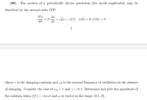 (80). The motion of a periodically driven pendulum (for small amplitudes) may be described by the second order IVP: + 24 + wąu = f(t): u(0) = 0; v'(0) = 0 where y is the camping constant and wo is the natural frequency of Oscillation in the absence of damping. Consider the case of wo = 1 and 1=0.1. Determine and plot the amplitude of the solution when f(t) = cost and w is varied in the range (0.1, 2).
21.6 A,B,C,D result given in part c of this exercise. 21.6. Consider a damped mass/spring system...
 21.6 A,B,C,D
result given in part c of this exercise. 21.6. Consider a damped mass/spring system given by m dy gdy tr dt + ky = Fo cos(nt) where m. y. K and Fo are all positive constants. (This is the same as equation (214) a. Using the method of educated guess, derive the particular solution given by equation ser (21.10) on page 409. genelaidi b. Then show that the solution in the previous part can be rewritten as described...
21.6 A,B,C,D
result given in part c of this exercise. 21.6. Consider a damped mass/spring system given by m dy gdy tr dt + ky = Fo cos(nt) where m. y. K and Fo are all positive constants. (This is the same as equation (214) a. Using the method of educated guess, derive the particular solution given by equation ser (21.10) on page 409. genelaidi b. Then show that the solution in the previous part can be rewritten as described...
 10. Consider the forced but undamped system described by the initial value prob- lem u" + 25u = sin(wt), (0) = 0, ta (0) =1. a. Find solution for u(t) when w #5. b. Plot the solution u(t) versus t for w = : 4, 4.5, and 4.9. Describe how the response u(t) changes as w varies. What happens when w gets close to 5? Note that the natural frequency of the system is wo = 5. (Hint: Make the...
 Consider the forced but undamped system described by the initial value problem 3cosuwt, (0) 0, (0 2 (a) Determine the natural frequency of the unforced system (b) Find the solution (t) forw1 (c) Plot the solution x(t) versus t for w = 0.7, 0.8, and 0.9. (Feel free to use technology. MatLab, Mathematica, etc.) Describe how the response (t) changes as w varies in this interval. What happens as w takes values closer and closer to 1? Briefly explain why...
 6. Undamped Vibrations: Solve the initial value problem for y(t). y" +y = cos(wt); w2 #1; y(0) = 0; y'(0) = 0. (8) Plot y(t) versus t, for w= -0.2, 0.9 and 6 to observe beats and resonance.
 Problem 1.Consider the harmonically forced
undamped oscillator described by the following ODE:mx′′+kx=F0cosωt,
k >0, m >0, ω >0, F0∈R.
Problem 1. Consider the harmonically forced undamped oscillator described by the following ODE: mx" + kx = Fo cos wt, k > 0, m > 0,w > 0, F0 E R. (1) a) Suppose wa #k/m. Find the general solution of the ODE ). b) Consider the initial value problem of the ODE () with initial conditions x(0) = 0 and...
Problem 1.Consider the harmonically forced
undamped oscillator described by the following ODE:mx′′+kx=F0cosωt,
k >0, m >0, ω >0, F0∈R.
Problem 1. Consider the harmonically forced undamped oscillator described by the following ODE: mx" + kx = Fo cos wt, k > 0, m > 0,w > 0, F0 E R. (1) a) Suppose wa #k/m. Find the general solution of the ODE ). b) Consider the initial value problem of the ODE () with initial conditions x(0) = 0 and...
 3) Consider the following vibrating system u" (1/4) 2u 2 cos (wt), u (0) 0, (0) 2 (a) Find transient and steady states of solution (b) Find the amplitude R of the steady state solution in terms of w and plot R versus w; (c) Find Rmax and wmax
3) Consider the following vibrating system u" (1/4) 2u 2 cos (wt), u (0) 0, (0) 2 (a) Find transient and steady states of solution (b) Find the amplitude R of...
3) Consider the following vibrating system u" (1/4) 2u 2 cos (wt), u (0) 0, (0) 2 (a) Find transient and steady states of solution (b) Find the amplitude R of the steady state solution in terms of w and plot R versus w; (c) Find Rmax and wmax
3) Consider the following vibrating system u" (1/4) 2u 2 cos (wt), u (0) 0, (0) 2 (a) Find transient and steady states of solution (b) Find the amplitude R of...
 3. When an oscillator with natural frequency wo is driven by another oscillator with a different natural frequency w, the phenomenon of beats can occur. The existence of beats is very useful when tuning a string instrument by ear. Show that the solution of the undamped oscillator IVP y', +Hy-Asin(wt), y(0)--, wo+w with y(0)-0, leads to beats, by first solving the IVP and then plotting the solution using MATLAB for A w = 1.1 and t є [0, 1001. 1,...
 Problem 2. Recall that any undamped spring-mass system is described by an initial value problem of the form m" + ky= 0, (0) = 0, v(0) = to, where m is the mass and k is the spring constant. Since there is no damping, we would expect that no energy is lost as the mass moves. That is, the total energy (potential plus kinetic) in the system at any time I should equal the initial amount of energy in the...
 Answer all parts of the
question please!
Consider the equation one gains from considering forced oscillations applied to a damped system d2y Fo -y= m c dy k cos(wt) dt2 m dt (a) Show that yp is a particular solution where, Fo - mw2) cos(wt) c sin(wt)). Yp(t) mw2)2 c2w2 - This can be written as Fo cos(wt - n), Ур (t) — where H and n are constants, independent of time. (b) Using this particular solution and the solution...
Answer all parts of the
question please!
Consider the equation one gains from considering forced oscillations applied to a damped system d2y Fo -y= m c dy k cos(wt) dt2 m dt (a) Show that yp is a particular solution where, Fo - mw2) cos(wt) c sin(wt)). Yp(t) mw2)2 c2w2 - This can be written as Fo cos(wt - n), Ур (t) — where H and n are constants, independent of time. (b) Using this particular solution and the solution...
 (80). The motion of a periodically driven pendulum (for small amplitudes) may be described by the second order IVP: + 24 + wąu = f(t): u(0) = 0; v'(0) = 0 where y is the camping constant and wo is the natural frequency of Oscillation in the absence of damping. Consider the case of wo = 1 and 1=0.1. Determine and plot the amplitude of the solution when f(t) = cost and w is varied in the range (0.1, 2).
 21.6 A,B,C,D
result given in part c of this exercise. 21.6. Consider a damped mass/spring system given by m dy gdy tr dt + ky = Fo cos(nt) where m. y. K and Fo are all positive constants. (This is the same as equation (214) a. Using the method of educated guess, derive the particular solution given by equation ser (21.10) on page 409. genelaidi b. Then show that the solution in the previous part can be rewritten as described...
21.6 A,B,C,D
result given in part c of this exercise. 21.6. Consider a damped mass/spring system given by m dy gdy tr dt + ky = Fo cos(nt) where m. y. K and Fo are all positive constants. (This is the same as equation (214) a. Using the method of educated guess, derive the particular solution given by equation ser (21.10) on page 409. genelaidi b. Then show that the solution in the previous part can be rewritten as described...
Most questions answered within 3 hours.
-
Where is the error in this code sequence?
String s1 = "Hello";
String s2 = "ello";...
asked 10 months ago -
Financial data for Joel de Paris, Inc., for last year
follow:
Joel de Paris, Inc.
Balance...
asked 10 months ago -
Consider this reaction:
Al2(SO4)3 (aq)+ BaCl3
(aq) Al2Cl6 (aq)- +
3BaSO4(s) . What is the...
asked 10 months ago -
Suppose that Savneet is considering increasing her
recent random sample from 20 car rentals to 40...
asked 10 months ago -
Trucks arrive at an unloading terminal at an average rate of 120
per hour.
Trucks arrive...
asked 10 months ago -
Why are methanol and ethanol completely soluble in water while
octanol is not very little soluble....
asked 10 months ago -
A facilities manager at a university reads in a research report
that the mean amount of...
asked 10 months ago -
When the CuSO4 is rehydrated by adding water to the anhydrous
compound, is this an endothermic...
asked 10 months ago -
A ray of sunlight is passing from diamond into crown glass; the
angle of incidence is...
asked 10 months ago -
A block of mass 0.249 kg is placed on top of a light, vertical
spring of...
asked 10 months ago -
how do the kidneys compensate in the presences of acidosis
a) trigger hyperventilate
b) reserve acid...
asked 10 months ago -
Question 501 pts
The rental rate of capital to the firm increases. Which of the
following...
asked 10 months ago