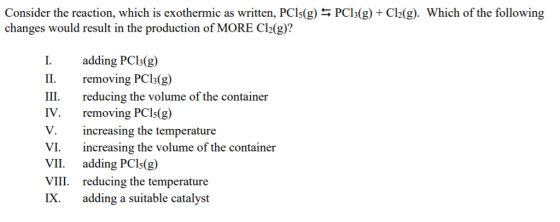
Please it's necessary to answer this question based on the steps down below
1- What is this Question Classification?
2- Solve the problem
3- Provide and explain the "Final Answer"
Please make your answer keyboard typing NOT Hand writting Thanks
Homework Answers
This question is based on the le Chataliers principle
According to which whenever a system is in equilibrium is disturbed
I will adjust itself in a way that the effect of the change will be cancelled or moderated.
a. In the above reaction if we add pcl3 (g) then according to le Chataliers principle eqillibrium will shifts toward left. And will decrease the production of cl2.
b. If pcl3 is removed then equilibrium will shifts towards right and production of cl2 will increase.
C. As we reduce the volume of the container then pressure will increase and shifts the equilibrium in the direction having less no. Of moles i.e. towards left and decrease the production of cl2.
D. On removing pcl5 the equilibrium will shifts towards left and decrease the production of cl2.
E. As it is an exothermic reaction which os favoured at low temperatures. On increasing the temperature production of cl2 will decrease. As equilibrium will shifts towards left.
F.As volume is increased of the container it means pressure is reduced and eqillibrium will shift in the direction having more number of moles of gases i.e. towards right. And increase the production of cl2.
G.On adding pcl5 equilibrium will shifts towards right, as pcl5 is consumed this side. Which will lead to the production of more cl2.
H. It is an exothermic reaction so on reducing the temperature equilibrium will shifts towards right and production of cl2 will increase.
I. Catalyst doesn't affects the equilibrium ,it only increases the speed of the reaction.
Thus 2,6,7,8 will increase the production of cl2.
Add Answer to:
Please it's necessary to answer this question based on the steps
down below
1- What is...
Consider the reaction, which is exothermic as written, 2H2(g) + X2(g) =2H2X(g). Which of the following...
 Consider the reaction, which is exothermic as written, 2H2(g) + X2(g) =2H2X(g). Which of the following changes would result in the production of more H2X(g)? I. adding H2(g) II. removing H2(g) III. reducing the volume of the container IV. removing X2(g) V. increasing the temperature VI. increasing the volume of the container VII. adding X2(8) VIII. reducing the temperature IX adding a suitable catalyst a) 1, II, VI, VIII Ob) I, III, VII, VIII OC) 1, III, VII, VIII, IX...
Consider the reaction, which is exothermic as written, 2H2(g) + X2(8)=2H2X(g). Which of the following changes...
 Consider the reaction, which is exothermic as written, 2H2(g) + X2(8)=2H2X(g). Which of the following changes would result in the production of more H2X(g)? 1. adding H2(8) II. removing H2(8) III. reducing the volume of the container IV. removing X2(8) V. increasing the temperature VI. increasing the volume of the container VII. adding X2(g) VIII. reducing the temperature IX. adding a suitable catalyst
Answer the questions about the following reaction below. The equilibrium constant for the decomposition of PCls...
 Answer the questions about the following reaction below. The equilibrium constant for the decomposition of PCls at 250°C is 0.041 ΔH is positive; reactants and products are gases at 250°C. Refer to your textbook. 1. Is the reaction above exothermic or endothermic? 2. What happens to the concentrations of PCls and Cl if more PCls is added once the reaction reaches equilibrium? (increases, decreases) PC1s Cl2 3. What happens to the moles of PCIs, PCls and Cl in the container...
PLEASE do a step by step guide on how you get the answer in the most...
 PLEASE do a step by step guide on how you get the answer in the
most detailed way possible! WITH a a final explanation please. You
will get the biggest thumbs up ever.
26. Consider the following system at equilibrium: N2(g) + 3H2(g) = 2NH3(g) + 92.94 kJ Which of the following changes will shift the equilibrium to the right? I. increasing the temperature II. decreasing the temperature III. increasing the volume decreasing the volume V. removing some NH3 adding...
PLEASE do a step by step guide on how you get the answer in the
most detailed way possible! WITH a a final explanation please. You
will get the biggest thumbs up ever.
26. Consider the following system at equilibrium: N2(g) + 3H2(g) = 2NH3(g) + 92.94 kJ Which of the following changes will shift the equilibrium to the right? I. increasing the temperature II. decreasing the temperature III. increasing the volume decreasing the volume V. removing some NH3 adding...
1. Consider the reaction below. N2(g) + 3 H2(g) ⇋ 2 NH3(g) Which of the following...
1. Consider the reaction below. N2(g) + 3 H2(g) ⇋ 2 NH3(g) Which of the following changes would cause less NH3 to be produced? decreasing the volume adding N2 increasing the volume adding H2 2. Consider the following reaction. N2(g) + 3 H2(g) ⇋ 2 NH3(g) The forward reaction is exothermic. Which of the following changes would cause less NH3 to be produced? decreasing the temperature adding H2 increasing the temperature adding N2 3. What is the effect of a...
Consider the reaction: heat + CaSO3 (s) ⇌ CaO (s) + SO2 (g) what change will...
Consider the reaction: heat + CaSO3 (s) ⇌ CaO (s) + SO2 (g) what change will cause an increase in the pressure of SO2 (g) when equilibrium is re-established? (A) Increasing the reaction temperature (B) Decreasing the volume of the container (C) Adding some CaSO3 (D) Removing some of the CaO (s) The answer should be B, please explain why!
1) Determine the effect of each of the following changes on the equilibrium mixture for the...
 1) Determine the effect of each of the following changes on the equilibrium mixture for the following reaction: N2(g) + O2(g) + 90.2 kJ + 2NO(g) Circle an answer for each change. a. Increasing the temperature Shift to reactants No change Shift to products b. Adding a catalyst Shift to reactants No change Shift to products c. Removing nitrogen monoxide gas Shift to reactants No change Shift to products d. Decreasing the volume of the container Shift to reactants No...
Question 7 (5 points) Consider the equilibrium below: CO(g) + H2O(g) = CO2(g) + H2(g) Kc...
 Question 7 (5 points) Consider the equilibrium below: CO(g) + H2O(g) = CO2(g) + H2(g) Kc = 0.0611 at 2000 K If Pco and PH20 are both initially 2.95 atm, what will be the equilibrium partial pressure of H2? Express your answer in decimal format to 3 significant figures. Your Answer: N. Answer Coal, which is primarily carbon, can be converted to natural gas (primarily methane, CH4) by the following exothermic reaction: + C(s) 2H2(g) CH4(g) Which of the following...
please answer all parts asap! this is all one question so i could not post separately....
 please answer all parts asap! this is all one question so i
could not post separately. will give thumbs up! thanks!
0.175 g of solid PCI, is sealed inside a 100. mL container from which all the air has been removed. The container is heated to 250 °C. At this temperature, the entire sample vaporizes and the resulting gaseous PCls undergoes the following reaction. PC15 (9) = PC13(9) + C12(g) After the reaction reaches equilibrium, the total pressure inside the...
please answer all parts asap! this is all one question so i
could not post separately. will give thumbs up! thanks!
0.175 g of solid PCI, is sealed inside a 100. mL container from which all the air has been removed. The container is heated to 250 °C. At this temperature, the entire sample vaporizes and the resulting gaseous PCls undergoes the following reaction. PC15 (9) = PC13(9) + C12(g) After the reaction reaches equilibrium, the total pressure inside the...
i need help with everything please!! WWLWUNA HOSILNILNIUSPRING 2020) Chapter #14 The following practice problems from...
 i need help with everything please!!
WWLWUNA HOSILNILNIUSPRING 2020) Chapter #14 The following practice problems from Chang's text are not to be submitted. The numbers in brackets refer to problems appearing at the end of the chapter. Equilibrium Constant Expressions (14.8, 14.9) Calculating Equilibrium Constants (14.13 to 14.24: Do as many as you can) Multiple Equilibria (14.29, 14.31) Kinetics and Chemical Equilibrium (14.35, 14.36) Calc. of Equilibrium Conc. (14.39 - 14.48) Do as many as you can. LeChatlier's Principle (14.54,...
i need help with everything please!!
WWLWUNA HOSILNILNIUSPRING 2020) Chapter #14 The following practice problems from Chang's text are not to be submitted. The numbers in brackets refer to problems appearing at the end of the chapter. Equilibrium Constant Expressions (14.8, 14.9) Calculating Equilibrium Constants (14.13 to 14.24: Do as many as you can) Multiple Equilibria (14.29, 14.31) Kinetics and Chemical Equilibrium (14.35, 14.36) Calc. of Equilibrium Conc. (14.39 - 14.48) Do as many as you can. LeChatlier's Principle (14.54,...
 Consider the reaction, which is exothermic as written, 2H2(g) + X2(g) =2H2X(g). Which of the following changes would result in the production of more H2X(g)? I. adding H2(g) II. removing H2(g) III. reducing the volume of the container IV. removing X2(g) V. increasing the temperature VI. increasing the volume of the container VII. adding X2(8) VIII. reducing the temperature IX adding a suitable catalyst a) 1, II, VI, VIII Ob) I, III, VII, VIII OC) 1, III, VII, VIII, IX...
 Consider the reaction, which is exothermic as written, 2H2(g) + X2(8)=2H2X(g). Which of the following changes would result in the production of more H2X(g)? 1. adding H2(8) II. removing H2(8) III. reducing the volume of the container IV. removing X2(8) V. increasing the temperature VI. increasing the volume of the container VII. adding X2(g) VIII. reducing the temperature IX. adding a suitable catalyst
 Answer the questions about the following reaction below. The equilibrium constant for the decomposition of PCls at 250°C is 0.041 ΔH is positive; reactants and products are gases at 250°C. Refer to your textbook. 1. Is the reaction above exothermic or endothermic? 2. What happens to the concentrations of PCls and Cl if more PCls is added once the reaction reaches equilibrium? (increases, decreases) PC1s Cl2 3. What happens to the moles of PCIs, PCls and Cl in the container...
 PLEASE do a step by step guide on how you get the answer in the
most detailed way possible! WITH a a final explanation please. You
will get the biggest thumbs up ever.
26. Consider the following system at equilibrium: N2(g) + 3H2(g) = 2NH3(g) + 92.94 kJ Which of the following changes will shift the equilibrium to the right? I. increasing the temperature II. decreasing the temperature III. increasing the volume decreasing the volume V. removing some NH3 adding...
PLEASE do a step by step guide on how you get the answer in the
most detailed way possible! WITH a a final explanation please. You
will get the biggest thumbs up ever.
26. Consider the following system at equilibrium: N2(g) + 3H2(g) = 2NH3(g) + 92.94 kJ Which of the following changes will shift the equilibrium to the right? I. increasing the temperature II. decreasing the temperature III. increasing the volume decreasing the volume V. removing some NH3 adding...
 1) Determine the effect of each of the following changes on the equilibrium mixture for the following reaction: N2(g) + O2(g) + 90.2 kJ + 2NO(g) Circle an answer for each change. a. Increasing the temperature Shift to reactants No change Shift to products b. Adding a catalyst Shift to reactants No change Shift to products c. Removing nitrogen monoxide gas Shift to reactants No change Shift to products d. Decreasing the volume of the container Shift to reactants No...
 Question 7 (5 points) Consider the equilibrium below: CO(g) + H2O(g) = CO2(g) + H2(g) Kc = 0.0611 at 2000 K If Pco and PH20 are both initially 2.95 atm, what will be the equilibrium partial pressure of H2? Express your answer in decimal format to 3 significant figures. Your Answer: N. Answer Coal, which is primarily carbon, can be converted to natural gas (primarily methane, CH4) by the following exothermic reaction: + C(s) 2H2(g) CH4(g) Which of the following...
 please answer all parts asap! this is all one question so i
could not post separately. will give thumbs up! thanks!
0.175 g of solid PCI, is sealed inside a 100. mL container from which all the air has been removed. The container is heated to 250 °C. At this temperature, the entire sample vaporizes and the resulting gaseous PCls undergoes the following reaction. PC15 (9) = PC13(9) + C12(g) After the reaction reaches equilibrium, the total pressure inside the...
please answer all parts asap! this is all one question so i
could not post separately. will give thumbs up! thanks!
0.175 g of solid PCI, is sealed inside a 100. mL container from which all the air has been removed. The container is heated to 250 °C. At this temperature, the entire sample vaporizes and the resulting gaseous PCls undergoes the following reaction. PC15 (9) = PC13(9) + C12(g) After the reaction reaches equilibrium, the total pressure inside the...
 i need help with everything please!!
WWLWUNA HOSILNILNIUSPRING 2020) Chapter #14 The following practice problems from Chang's text are not to be submitted. The numbers in brackets refer to problems appearing at the end of the chapter. Equilibrium Constant Expressions (14.8, 14.9) Calculating Equilibrium Constants (14.13 to 14.24: Do as many as you can) Multiple Equilibria (14.29, 14.31) Kinetics and Chemical Equilibrium (14.35, 14.36) Calc. of Equilibrium Conc. (14.39 - 14.48) Do as many as you can. LeChatlier's Principle (14.54,...
i need help with everything please!!
WWLWUNA HOSILNILNIUSPRING 2020) Chapter #14 The following practice problems from Chang's text are not to be submitted. The numbers in brackets refer to problems appearing at the end of the chapter. Equilibrium Constant Expressions (14.8, 14.9) Calculating Equilibrium Constants (14.13 to 14.24: Do as many as you can) Multiple Equilibria (14.29, 14.31) Kinetics and Chemical Equilibrium (14.35, 14.36) Calc. of Equilibrium Conc. (14.39 - 14.48) Do as many as you can. LeChatlier's Principle (14.54,...
Most questions answered within 3 hours.
-
Where is the error in this code sequence?
String s1 = "Hello";
String s2 = "ello";...
asked 11 months ago -
Financial data for Joel de Paris, Inc., for last year
follow:
Joel de Paris, Inc.
Balance...
asked 11 months ago -
Consider this reaction:
Al2(SO4)3 (aq)+ BaCl3
(aq) Al2Cl6 (aq)- +
3BaSO4(s) . What is the...
asked 11 months ago -
Suppose that Savneet is considering increasing her
recent random sample from 20 car rentals to 40...
asked 11 months ago -
Trucks arrive at an unloading terminal at an average rate of 120
per hour.
Trucks arrive...
asked 11 months ago -
Why are methanol and ethanol completely soluble in water while
octanol is not very little soluble....
asked 11 months ago -
A facilities manager at a university reads in a research report
that the mean amount of...
asked 11 months ago -
When the CuSO4 is rehydrated by adding water to the anhydrous
compound, is this an endothermic...
asked 11 months ago -
A ray of sunlight is passing from diamond into crown glass; the
angle of incidence is...
asked 11 months ago -
A block of mass 0.249 kg is placed on top of a light, vertical
spring of...
asked 11 months ago -
how do the kidneys compensate in the presences of acidosis
a) trigger hyperventilate
b) reserve acid...
asked 11 months ago -
Question 501 pts
The rental rate of capital to the firm increases. Which of the
following...
asked 11 months ago