
Homework Answers
Add Answer to:
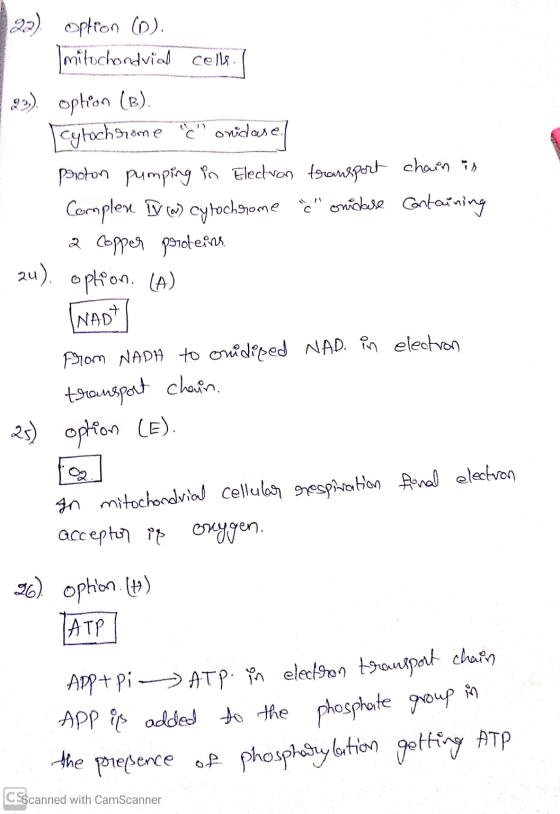
22. Urea cycle takes place primarily in what cell types: A) Kidney cells B) Pancreatic cells...
Matching A. glycolysis B. Krebs cycle C. electron transport system also known as cytochrome system D....
Matching A. glycolysis B. Krebs cycle C. electron transport system also known as cytochrome system D. glycolysis and Krebs cycle E. glycolysis and electron transport chain F. Krebs cycle and electron transport chain G. glycolysis and Krebs cycle and electron transport chain H. none of the above 1. PGAL 2. Pyruvate 3. Alpha ketoglutaric acid 4. Cytochromes 5.Succine Acid 6. Citric acid 7. Malic acid 8. Fumaric acid 9. NADH -> NAD 10. FADH->FAD 11. FAD->FADH 12. Oxaloacelic acid 13....
Place the name of the molecule in the proper location within the electron transport chain. Place...
 Place the name of the molecule in the proper location within the
electron transport chain.
Place the name of the molecule in the proper location within the electron transport chain. H20 NAD- 2H+ + 1/2 02 NADH NADH dehydrogenase H Ubiquinone III Cytochrome b-cy Free energy per electron (kcal/mol) Cytochrome c Cytochrome oxidase Direction of electron flow-
Place the name of the molecule in the proper location within the
electron transport chain.
Place the name of the molecule in the proper location within the electron transport chain. H20 NAD- 2H+ + 1/2 02 NADH NADH dehydrogenase H Ubiquinone III Cytochrome b-cy Free energy per electron (kcal/mol) Cytochrome c Cytochrome oxidase Direction of electron flow-
i am unsure of the answer for #2 e 1. An intermediate electron acceptor for oxidations...
 i am unsure of the answer for #2
e 1. An intermediate electron acceptor for oxidations that occur in both glycolysis and m cycle reactions (A) Cytochrome (B) FADH2 (C)NAD+ (D) NADP+ (E) Oxygen (02) 2.Coenzyme that transfers electrons from the Krebs cycle to the mitochondrial electron-transport chain at a lower energy level than that of electrons entering at the beginning the chain (A) Cytochrome (B) FADH2 (C) NAD+ (D) NADP+ (E) Oxygen (02) 3.During respiration, most ATP is formed...
i am unsure of the answer for #2
e 1. An intermediate electron acceptor for oxidations that occur in both glycolysis and m cycle reactions (A) Cytochrome (B) FADH2 (C)NAD+ (D) NADP+ (E) Oxygen (02) 2.Coenzyme that transfers electrons from the Krebs cycle to the mitochondrial electron-transport chain at a lower energy level than that of electrons entering at the beginning the chain (A) Cytochrome (B) FADH2 (C) NAD+ (D) NADP+ (E) Oxygen (02) 3.During respiration, most ATP is formed...
Which complex in the electron transport chain does not contribute to the proton gradient across the...
Which complex in the electron transport chain does not contribute to the proton gradient across the mitochondrial membrane? A. Complex I B. Complex IV C. Complex II D. Complex III Which statement regarding the mitochondrial electron transport chain and oxidative phosphorylation is true? A. Ubiquinone and the F zero subunit of ATP synthase are peripheral membrane proteins. B. Complexes I, II, III, and IV all are proton pumps. C. The final electron acceptor is water. D. Complex II is considered...
1. The fluid mosaic model describes cell membranes as consisting of A) a phospholipid bilayer with...
1. The fluid mosaic model describes cell membranes as consisting of A) a phospholipid bilayer with embedded carbohydrates B) two layers of phospholipids with protein sandwiched between them C) a protein bilayer with embedded phospholipids D) carbohydrates, proteins, and phospholipids that can drift in the membrane E) individual proteins that can drift in a phospholipid bilayer 2. When a poison, such as Paraderil found in flea dip, blocks the electron transport chain, the citric acid cycle soon grinds to a...
1. Select the TRUE statement about the citric acid cycle. A. Isocitrate dehydrogenase is a multienzyme...
1. Select the TRUE statement about the citric acid cycle. A. Isocitrate dehydrogenase is a multienzyme complex that is very similar to the pyruvate dehydrogenase complex B. The two decarboxylation steps occur right after each other, first via oxidative alpha- decarboxylation, then via oxidative beta- decarboxylation. C. In one turn of the cycle, the two carbons that enter the cycle as acetyl CoA are the same two carbons that are released as CO2. D. A flavin containing dehydrogenase enzymes oxidizes...
As pyruvate is completely broken down in the TCA (Krebs) cycle, some of its energy is...
As pyruvate is completely broken down in the TCA (Krebs) cycle, some of its energy is A) conserved in the water molecules resulting from reduction of oxygen. B) conserved in the carbon dioxide molecules released by the processes. C) conserved in FAD and NAD+. D) conserved in NADH + H+ and FADH2. E) found in the oxygen used in the electron transport chain.
12. Which enzyme catalyzes the reaction shown? Oo 9% a. succinyl-CoA synthetase b. succinate dehydrogenase c....
 12. Which enzyme catalyzes the reaction shown? Oo 9% a. succinyl-CoA synthetase b. succinate dehydrogenase c. pyruvate dehydrogenase d、a-ketoglutarate dehydrogenase 13. Which of the reactions of the citric acid cycle requires FAD as a coenzyme? a. the conversion of isocitrate to a-ketoglutarate b. the conversion of citrate to isocitrate c. the conversion of succinate to fumarate d. the conversion of malate to oxaloacetate 14. Another name for Complex I in the electron transport chain is a. cytochrome c oxidase. b....
The common molecule produced from all foods at the second stage of catabolism is A) ADP. B acetyl...
 just checking my answers, except for number 10.
The common molecule produced from all foods at the second stage of catabolism is A) ADP. B acetyl-CoA. C) glucose. D) citric acid. Which group of compounds includes only low-energy molecules? 1. 2. Hih A)ATP; acetyl-CoA; NADH; FADH2 C) ADP: CO2; NADH; FADH2 DONO BADP: acetyl-CoA; NAD+:FAD-mau ADP: CO2: NAD+, FAD After O2 has been reduced in the electron transport chain, the oxygen atoms are part of what molecules? A) ATP 3....
just checking my answers, except for number 10.
The common molecule produced from all foods at the second stage of catabolism is A) ADP. B acetyl-CoA. C) glucose. D) citric acid. Which group of compounds includes only low-energy molecules? 1. 2. Hih A)ATP; acetyl-CoA; NADH; FADH2 C) ADP: CO2; NADH; FADH2 DONO BADP: acetyl-CoA; NAD+:FAD-mau ADP: CO2: NAD+, FAD After O2 has been reduced in the electron transport chain, the oxygen atoms are part of what molecules? A) ATP 3....
tospan Student Name: Grader Name Instruction: Starting with a single glucose in a yeast cell, please...
 tospan Student Name: Grader Name Instruction: Starting with a single glucose in a yeast cell, please fill in the following table according to what happened during aerobic cellular respiration or fermentation. Make sure that you includes proper numbers of each chemical used or produced from a single glucose molecule 02 Chemicals Used or Produced FAD+/FADH2 NADP+/NADPH X х CO2 Location Cytoplasm H2O Starting Ending ADP/ATP NAD+/NADH 1 Glucose 2 Pyruvate 2ATPs->4ATP 2 NAD+->2NADH х х Pathways Glycolysis Transition Step (Connecting...
 Place the name of the molecule in the proper location within the
electron transport chain.
Place the name of the molecule in the proper location within the electron transport chain. H20 NAD- 2H+ + 1/2 02 NADH NADH dehydrogenase H Ubiquinone III Cytochrome b-cy Free energy per electron (kcal/mol) Cytochrome c Cytochrome oxidase Direction of electron flow-
Place the name of the molecule in the proper location within the
electron transport chain.
Place the name of the molecule in the proper location within the electron transport chain. H20 NAD- 2H+ + 1/2 02 NADH NADH dehydrogenase H Ubiquinone III Cytochrome b-cy Free energy per electron (kcal/mol) Cytochrome c Cytochrome oxidase Direction of electron flow-
 i am unsure of the answer for #2
e 1. An intermediate electron acceptor for oxidations that occur in both glycolysis and m cycle reactions (A) Cytochrome (B) FADH2 (C)NAD+ (D) NADP+ (E) Oxygen (02) 2.Coenzyme that transfers electrons from the Krebs cycle to the mitochondrial electron-transport chain at a lower energy level than that of electrons entering at the beginning the chain (A) Cytochrome (B) FADH2 (C) NAD+ (D) NADP+ (E) Oxygen (02) 3.During respiration, most ATP is formed...
i am unsure of the answer for #2
e 1. An intermediate electron acceptor for oxidations that occur in both glycolysis and m cycle reactions (A) Cytochrome (B) FADH2 (C)NAD+ (D) NADP+ (E) Oxygen (02) 2.Coenzyme that transfers electrons from the Krebs cycle to the mitochondrial electron-transport chain at a lower energy level than that of electrons entering at the beginning the chain (A) Cytochrome (B) FADH2 (C) NAD+ (D) NADP+ (E) Oxygen (02) 3.During respiration, most ATP is formed...
 12. Which enzyme catalyzes the reaction shown? Oo 9% a. succinyl-CoA synthetase b. succinate dehydrogenase c. pyruvate dehydrogenase d、a-ketoglutarate dehydrogenase 13. Which of the reactions of the citric acid cycle requires FAD as a coenzyme? a. the conversion of isocitrate to a-ketoglutarate b. the conversion of citrate to isocitrate c. the conversion of succinate to fumarate d. the conversion of malate to oxaloacetate 14. Another name for Complex I in the electron transport chain is a. cytochrome c oxidase. b....
 just checking my answers, except for number 10.
The common molecule produced from all foods at the second stage of catabolism is A) ADP. B acetyl-CoA. C) glucose. D) citric acid. Which group of compounds includes only low-energy molecules? 1. 2. Hih A)ATP; acetyl-CoA; NADH; FADH2 C) ADP: CO2; NADH; FADH2 DONO BADP: acetyl-CoA; NAD+:FAD-mau ADP: CO2: NAD+, FAD After O2 has been reduced in the electron transport chain, the oxygen atoms are part of what molecules? A) ATP 3....
just checking my answers, except for number 10.
The common molecule produced from all foods at the second stage of catabolism is A) ADP. B acetyl-CoA. C) glucose. D) citric acid. Which group of compounds includes only low-energy molecules? 1. 2. Hih A)ATP; acetyl-CoA; NADH; FADH2 C) ADP: CO2; NADH; FADH2 DONO BADP: acetyl-CoA; NAD+:FAD-mau ADP: CO2: NAD+, FAD After O2 has been reduced in the electron transport chain, the oxygen atoms are part of what molecules? A) ATP 3....
 tospan Student Name: Grader Name Instruction: Starting with a single glucose in a yeast cell, please fill in the following table according to what happened during aerobic cellular respiration or fermentation. Make sure that you includes proper numbers of each chemical used or produced from a single glucose molecule 02 Chemicals Used or Produced FAD+/FADH2 NADP+/NADPH X х CO2 Location Cytoplasm H2O Starting Ending ADP/ATP NAD+/NADH 1 Glucose 2 Pyruvate 2ATPs->4ATP 2 NAD+->2NADH х х Pathways Glycolysis Transition Step (Connecting...
Most questions answered within 3 hours.
-
Where is the error in this code sequence?
String s1 = "Hello";
String s2 = "ello";...
asked 10 months ago -
Financial data for Joel de Paris, Inc., for last year
follow:
Joel de Paris, Inc.
Balance...
asked 10 months ago -
Consider this reaction:
Al2(SO4)3 (aq)+ BaCl3
(aq) Al2Cl6 (aq)- +
3BaSO4(s) . What is the...
asked 10 months ago -
Suppose that Savneet is considering increasing her
recent random sample from 20 car rentals to 40...
asked 10 months ago -
Trucks arrive at an unloading terminal at an average rate of 120
per hour.
Trucks arrive...
asked 10 months ago -
Why are methanol and ethanol completely soluble in water while
octanol is not very little soluble....
asked 10 months ago -
A facilities manager at a university reads in a research report
that the mean amount of...
asked 10 months ago -
When the CuSO4 is rehydrated by adding water to the anhydrous
compound, is this an endothermic...
asked 10 months ago -
A ray of sunlight is passing from diamond into crown glass; the
angle of incidence is...
asked 10 months ago -
A block of mass 0.249 kg is placed on top of a light, vertical
spring of...
asked 10 months ago -
how do the kidneys compensate in the presences of acidosis
a) trigger hyperventilate
b) reserve acid...
asked 10 months ago -
Question 501 pts
The rental rate of capital to the firm increases. Which of the
following...
asked 10 months ago