
Homework Answers
Add Answer to:
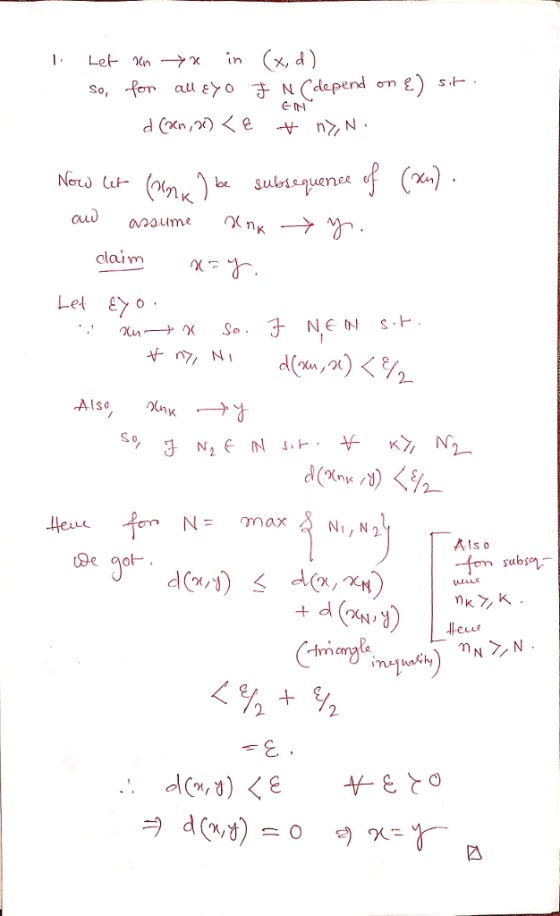
Exercise 5 (based on Tao). Let (X,d) be an arbitrary metric space. Prove the following statements...
Carefully and rigorously prove the following. Let X be a metric space. Show X is compact...
 Carefully and rigorously prove the following.
Let X be a metric space. Show X is compact if and only if every sequence contains a convergent subse- quence. Hint for (): Argue by contradiction. If there was a sequence with no convergent subsequence, use that sequence to construct an open cover of X, such that every set in the cover contains only a finite number of elements of the sequence. Then use compactness to get a contradiction. Hint for (): Let...
Carefully and rigorously prove the following.
Let X be a metric space. Show X is compact if and only if every sequence contains a convergent subse- quence. Hint for (): Argue by contradiction. If there was a sequence with no convergent subsequence, use that sequence to construct an open cover of X, such that every set in the cover contains only a finite number of elements of the sequence. Then use compactness to get a contradiction. Hint for (): Let...
Let (X, d) be an infinite discrete metric space. Prove that any infinite subset of X...
Let (X, d) be an infinite discrete metric space. Prove that any infinite subset of X is closed and bounded but NOT compact
In the following, (X,d) is an arbitrary metric space and (X,d,μ) is an arbitrary metric measure...
 In the following, (X,d) is an arbitrary metric space and (X,d,μ)
is an arbitrary metric measure space.
(6) Recall the definition of bounded set: The set A C (X, d) is bounded if δ(A) < 00 where 6(A)p d(a,a). (X,d) with ACBand B is bounded then A is bounded (a) Show that if A, B (b) Fix a set A. I B - (r), a single point, show that D(A, B)-0 if and only f (c) Prove that the function...
In the following, (X,d) is an arbitrary metric space and (X,d,μ)
is an arbitrary metric measure space.
(6) Recall the definition of bounded set: The set A C (X, d) is bounded if δ(A) < 00 where 6(A)p d(a,a). (X,d) with ACBand B is bounded then A is bounded (a) Show that if A, B (b) Fix a set A. I B - (r), a single point, show that D(A, B)-0 if and only f (c) Prove that the function...
B2. (a) Let I denote the interval 0,1 and let C denote the space of continuous functions I-R. Def...
 B2. (a) Let I denote the interval 0,1 and let C denote the space of continuous functions I-R. Define dsup(f,g)-sup |f(t)-g(t) and di(f.g)f (t)- g(t)ldt (f,g E C) tEI (i) Prove that dsup is a metric on C (ii) Prove that di is a metric on C. (You may use any standard properties of continuous functions and integrals, provided you make your reasoning clear.) 6 i) Let 1 denote the constant function on I with value 1. Give an explicit...
A subset D of a metric space (X, d) is dense if every member of X...
 A subset D of a metric space (X, d) is dense if every member of
X is a limit of a sequence of elements from D.
Suppose (X,d) and (Y,ρ) are metric spaces and D is a dense
subset of X.
1. Prove that if f : D -» Y is uniformly continuous then there exists an extension15 of f to a if dn (E D) e X define 7(x) lim f(d,) uniformly continuous function f:X * Y. Hint: 2....
A subset D of a metric space (X, d) is dense if every member of
X is a limit of a sequence of elements from D.
Suppose (X,d) and (Y,ρ) are metric spaces and D is a dense
subset of X.
1. Prove that if f : D -» Y is uniformly continuous then there exists an extension15 of f to a if dn (E D) e X define 7(x) lim f(d,) uniformly continuous function f:X * Y. Hint: 2....
1.5.7 Prove the following separately Theorem 1.5.10. Let (X,d) be a metric space. (a) IfY is...
 1.5.7 Prove the following separately Theorem 1.5.10. Let (X,d) be a metric space. (a) IfY is a compact subset of X, and Z C Y, then Z is compact if and only if Z is closed (b) IfY. Y are a finite collection of compact subsets of X, then their union Y1 U...UYn is also compact. (c) Every finite subset of X (including the empty set) is compact.
Topology 3. Either prove or disprove each of the following statements: (a) If d and p...
 Topology
3. Either prove or disprove each of the following statements: (a) If d and p map (X, d) X, then the identity topologically equivalent metrics (X, p) and its inverse are both continuous are two on (b) Any totally bounded metric space is compact. (c) The open interval (-r/2, n/2) is homeomorphic to R (d) If X and Y are homeomorphic metric spaces, then X is complete if and only if Y is complete (e) Let X and Y...
Topology
3. Either prove or disprove each of the following statements: (a) If d and p map (X, d) X, then the identity topologically equivalent metrics (X, p) and its inverse are both continuous are two on (b) Any totally bounded metric space is compact. (c) The open interval (-r/2, n/2) is homeomorphic to R (d) If X and Y are homeomorphic metric spaces, then X is complete if and only if Y is complete (e) Let X and Y...
Problem 1. Let (X, d) be a metric space and t the metric topology on X....
 Problem 1. Let (X, d) be a metric space and t the metric topology on X. (a) Fix a E X. Prove that the map f :(X, T) + R defined by f(x) = d(a, x) is continuous. (b) If {x'n} and {yn} are Cauchy sequences, prove that {d(In, Yn)} is a Cauchy sequence in R.
Problem 2: For any x, y e R let d(x,y):-arctan(y) - arctan(x). Do the following: (1) Prove that d...
 Problem 2: For any x, y e R let d(x,y):-arctan(y) - arctan(x). Do the following: (1) Prove that d is a metric on R. (2) Letting xnn, prove that {xnJnE is a Cauchy sequence with no limit in R (Note that {xn)nen is NOT Cauchy under the Euclidean metric and that all Cauchy sequences in the Euclidean metric have a limit in R.)
Problem 2: For any x, y e R let d(x,y):-arctan(y) - arctan(x). Do the following: (1) Prove...
Problem 2: For any x, y e R let d(x,y):-arctan(y) - arctan(x). Do the following: (1) Prove that d is a metric on R. (2) Letting xnn, prove that {xnJnE is a Cauchy sequence with no limit in R (Note that {xn)nen is NOT Cauchy under the Euclidean metric and that all Cauchy sequences in the Euclidean metric have a limit in R.)
Problem 2: For any x, y e R let d(x,y):-arctan(y) - arctan(x). Do the following: (1) Prove...
3. (a) Prove the following: Cantor's Intersection Theorem: Let (X, d) be a complete metric space...
 3. (a) Prove the following: Cantor's Intersection Theorem: Let (X, d) be a complete metric space and {Anymore a nested sequence of non-empty closed sets whose diameters D(An) have limit 0. Then An has exactly one member. csc'anno proach onsdelered. c) Show that, in part (a), n A, may be empty if the requirement that the diameters
 Carefully and rigorously prove the following.
Let X be a metric space. Show X is compact if and only if every sequence contains a convergent subse- quence. Hint for (): Argue by contradiction. If there was a sequence with no convergent subsequence, use that sequence to construct an open cover of X, such that every set in the cover contains only a finite number of elements of the sequence. Then use compactness to get a contradiction. Hint for (): Let...
Carefully and rigorously prove the following.
Let X be a metric space. Show X is compact if and only if every sequence contains a convergent subse- quence. Hint for (): Argue by contradiction. If there was a sequence with no convergent subsequence, use that sequence to construct an open cover of X, such that every set in the cover contains only a finite number of elements of the sequence. Then use compactness to get a contradiction. Hint for (): Let...
 In the following, (X,d) is an arbitrary metric space and (X,d,μ)
is an arbitrary metric measure space.
(6) Recall the definition of bounded set: The set A C (X, d) is bounded if δ(A) < 00 where 6(A)p d(a,a). (X,d) with ACBand B is bounded then A is bounded (a) Show that if A, B (b) Fix a set A. I B - (r), a single point, show that D(A, B)-0 if and only f (c) Prove that the function...
In the following, (X,d) is an arbitrary metric space and (X,d,μ)
is an arbitrary metric measure space.
(6) Recall the definition of bounded set: The set A C (X, d) is bounded if δ(A) < 00 where 6(A)p d(a,a). (X,d) with ACBand B is bounded then A is bounded (a) Show that if A, B (b) Fix a set A. I B - (r), a single point, show that D(A, B)-0 if and only f (c) Prove that the function...
 B2. (a) Let I denote the interval 0,1 and let C denote the space of continuous functions I-R. Define dsup(f,g)-sup |f(t)-g(t) and di(f.g)f (t)- g(t)ldt (f,g E C) tEI (i) Prove that dsup is a metric on C (ii) Prove that di is a metric on C. (You may use any standard properties of continuous functions and integrals, provided you make your reasoning clear.) 6 i) Let 1 denote the constant function on I with value 1. Give an explicit...
 A subset D of a metric space (X, d) is dense if every member of
X is a limit of a sequence of elements from D.
Suppose (X,d) and (Y,ρ) are metric spaces and D is a dense
subset of X.
1. Prove that if f : D -» Y is uniformly continuous then there exists an extension15 of f to a if dn (E D) e X define 7(x) lim f(d,) uniformly continuous function f:X * Y. Hint: 2....
A subset D of a metric space (X, d) is dense if every member of
X is a limit of a sequence of elements from D.
Suppose (X,d) and (Y,ρ) are metric spaces and D is a dense
subset of X.
1. Prove that if f : D -» Y is uniformly continuous then there exists an extension15 of f to a if dn (E D) e X define 7(x) lim f(d,) uniformly continuous function f:X * Y. Hint: 2....
 1.5.7 Prove the following separately Theorem 1.5.10. Let (X,d) be a metric space. (a) IfY is a compact subset of X, and Z C Y, then Z is compact if and only if Z is closed (b) IfY. Y are a finite collection of compact subsets of X, then their union Y1 U...UYn is also compact. (c) Every finite subset of X (including the empty set) is compact.
 Topology
3. Either prove or disprove each of the following statements: (a) If d and p map (X, d) X, then the identity topologically equivalent metrics (X, p) and its inverse are both continuous are two on (b) Any totally bounded metric space is compact. (c) The open interval (-r/2, n/2) is homeomorphic to R (d) If X and Y are homeomorphic metric spaces, then X is complete if and only if Y is complete (e) Let X and Y...
Topology
3. Either prove or disprove each of the following statements: (a) If d and p map (X, d) X, then the identity topologically equivalent metrics (X, p) and its inverse are both continuous are two on (b) Any totally bounded metric space is compact. (c) The open interval (-r/2, n/2) is homeomorphic to R (d) If X and Y are homeomorphic metric spaces, then X is complete if and only if Y is complete (e) Let X and Y...
 Problem 1. Let (X, d) be a metric space and t the metric topology on X. (a) Fix a E X. Prove that the map f :(X, T) + R defined by f(x) = d(a, x) is continuous. (b) If {x'n} and {yn} are Cauchy sequences, prove that {d(In, Yn)} is a Cauchy sequence in R.
 Problem 2: For any x, y e R let d(x,y):-arctan(y) - arctan(x). Do the following: (1) Prove that d is a metric on R. (2) Letting xnn, prove that {xnJnE is a Cauchy sequence with no limit in R (Note that {xn)nen is NOT Cauchy under the Euclidean metric and that all Cauchy sequences in the Euclidean metric have a limit in R.)
Problem 2: For any x, y e R let d(x,y):-arctan(y) - arctan(x). Do the following: (1) Prove...
Problem 2: For any x, y e R let d(x,y):-arctan(y) - arctan(x). Do the following: (1) Prove that d is a metric on R. (2) Letting xnn, prove that {xnJnE is a Cauchy sequence with no limit in R (Note that {xn)nen is NOT Cauchy under the Euclidean metric and that all Cauchy sequences in the Euclidean metric have a limit in R.)
Problem 2: For any x, y e R let d(x,y):-arctan(y) - arctan(x). Do the following: (1) Prove...
 3. (a) Prove the following: Cantor's Intersection Theorem: Let (X, d) be a complete metric space and {Anymore a nested sequence of non-empty closed sets whose diameters D(An) have limit 0. Then An has exactly one member. csc'anno proach onsdelered. c) Show that, in part (a), n A, may be empty if the requirement that the diameters
Most questions answered within 3 hours.
-
Where is the error in this code sequence?
String s1 = "Hello";
String s2 = "ello";...
asked 10 months ago -
Financial data for Joel de Paris, Inc., for last year
follow:
Joel de Paris, Inc.
Balance...
asked 10 months ago -
Consider this reaction:
Al2(SO4)3 (aq)+ BaCl3
(aq) Al2Cl6 (aq)- +
3BaSO4(s) . What is the...
asked 10 months ago -
Suppose that Savneet is considering increasing her
recent random sample from 20 car rentals to 40...
asked 10 months ago -
Trucks arrive at an unloading terminal at an average rate of 120
per hour.
Trucks arrive...
asked 10 months ago -
Why are methanol and ethanol completely soluble in water while
octanol is not very little soluble....
asked 10 months ago -
A facilities manager at a university reads in a research report
that the mean amount of...
asked 10 months ago -
When the CuSO4 is rehydrated by adding water to the anhydrous
compound, is this an endothermic...
asked 10 months ago -
A ray of sunlight is passing from diamond into crown glass; the
angle of incidence is...
asked 10 months ago -
A block of mass 0.249 kg is placed on top of a light, vertical
spring of...
asked 10 months ago -
how do the kidneys compensate in the presences of acidosis
a) trigger hyperventilate
b) reserve acid...
asked 10 months ago -
Question 501 pts
The rental rate of capital to the firm increases. Which of the
following...
asked 10 months ago