
Homework Answers


![at mumber v〉 나 X: Co.l] 아 a real lius with the usual ut is a cauchy sea unx . aqナハ mnvu d is the suat mernic n IR . ram R is](http://img.homeworklib.com/images/33a8603c-1178-4586-9118-71a8cf586669.png?x-oss-process=image/resize,w_560)
Add Answer to:
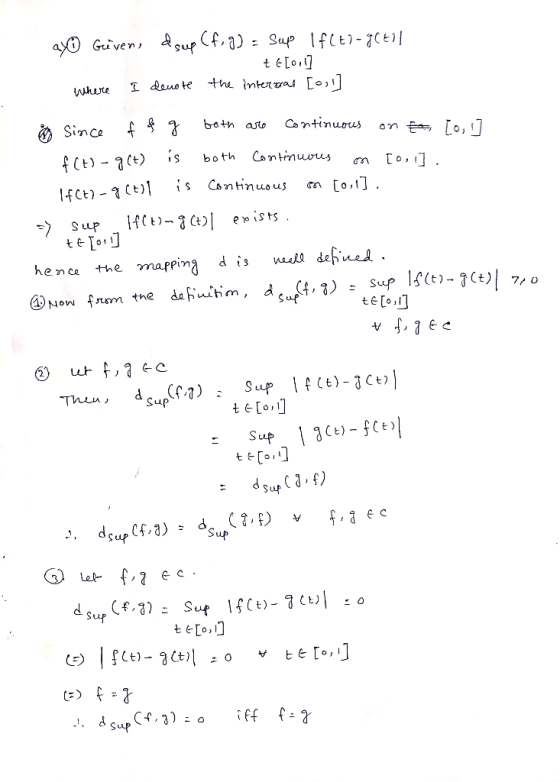
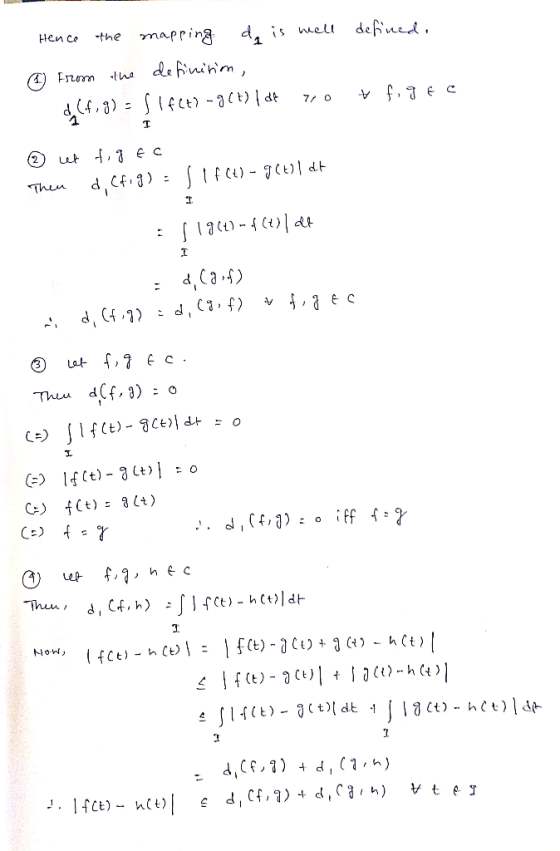
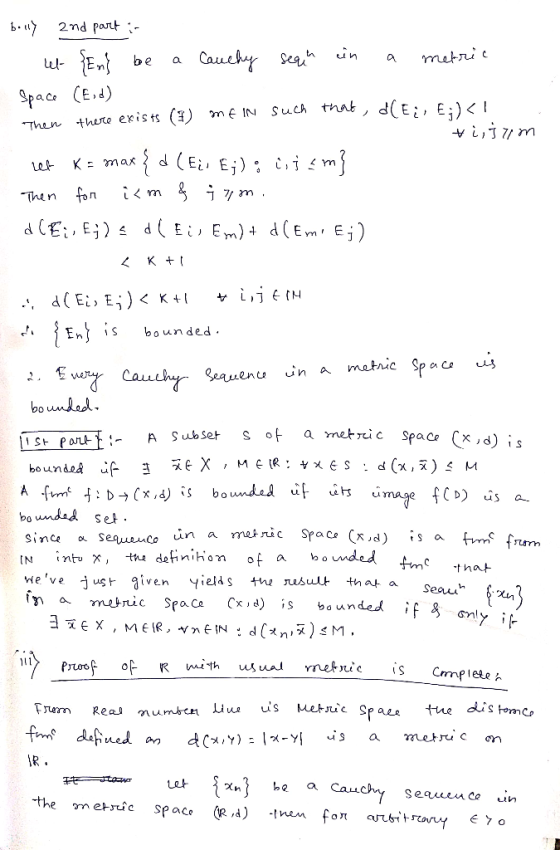
B2. (a) Let I denote the interval 0,1 and let C denote the space of continuous functions I-R. Def...
- Let V be the vector space of continuous functions defined f : [0,1] → R...
 - Let V be the vector space of continuous functions defined f : [0,1] → R and a : [0, 1] →R a positive continuous function. Let < f, g >a= Soa(x)f(x)g(x)dx. a) Prove that <, >a defines an inner product in V. b) For f,gE V let < f,g >= So f(x)g(x)dx. Prove that {xn} is a Cauchy sequence in the metric defined by <, >a if and only if it a Cauchy sequence in the metric defined by...
Question 3. (4 marks) Let C([a, b]; R) be the space of all continuous functions on...
 Question 3. (4 marks) Let C([a, b]; R) be the space of all continuous functions on [a, b], 0 <a<b with the metric || f – 9|| = maxasaso \f (x) – g(x)]. For each f e C([a, b]; R), define a map F(f) by F(f)(x) = x5 + Vx € (a,b]. (65 – a5) Prove that there is a unique fixed point of F in the space C([a, b]; R); i.e. there is a unique fe C([a,b); R) such...
4. Let XC((0. 1) be the space of contimuous real valued functions on interval 0, 1...
 4. Let XC((0. 1) be the space of contimuous real valued functions on interval 0, 1 with metric di(f.g) S()-9(t0ldt. R defined by Show that the function p X PS)=max(f(t)|:t€ (0.1]} is not continuous at fo E X which is the identically zero function, folt) Hint: take e= 0 for all t e0, 1. 1 and for any d>0 find a function g EX with p(g)-1 and di(fo- 9) < 6.
(1) Let C[a, b] denote the set of functions that are continuous on (a,b). Define a...
 (1) Let C[a, b] denote the set of functions that are continuous on (a,b). Define a function on pairs of function fig E C[a, b] by dı(,9) = /\f(x) – 9(2)| dx. Prove that (C[a,b], du) is a metric space.
(5) Let f: [0, 1 R. We say that f is Hölder continuous of order a e (0,1) if \f(x) -- f(y)| . , y sup [0, 1] with 2 # 1...
 (5) Let f: [0, 1 R. We say that f is Hölder continuous of order a e (0,1) if \f(x) -- f(y)| . , y sup [0, 1] with 2 # 1£l\c° sup is finite. We define Co ((0, 1]) f: [0, 1] -R: f is Hölder continuous of order a}. = (a) For f,gE C ([0, 1]) define da(f,g) = ||f-9||c«. Prove that da is a well-defined metric Ca((0, 1) (b) Prove that (C ([0, 1]), da) is complete...
Problem 1. Let (X, d) be a metric space and t the metric topology on X....
 Problem 1. Let (X, d) be a metric space and t the metric topology on X. (a) Fix a E X. Prove that the map f :(X, T) + R defined by f(x) = d(a, x) is continuous. (b) If {x'n} and {yn} are Cauchy sequences, prove that {d(In, Yn)} is a Cauchy sequence in R.
(TOPOLOGY) Prove the following using the defintion: Exercise 56. Let (M, d) be a metric space...
 (TOPOLOGY) Prove the following using the defintion:
Exercise 56. Let (M, d) be a metric space and let k be a positive real number. We have shown that the function dk defined by dx(x, y) = kd(x,y) is a metric on M. Let Me denote M with metric d and let M denote M with metric dk. 1. Let f: Md+Mk be defined by f(x) = r. Show that f is continuous. 2. Let g: Mx + Md be defined...
(TOPOLOGY) Prove the following using the defintion:
Exercise 56. Let (M, d) be a metric space and let k be a positive real number. We have shown that the function dk defined by dx(x, y) = kd(x,y) is a metric on M. Let Me denote M with metric d and let M denote M with metric dk. 1. Let f: Md+Mk be defined by f(x) = r. Show that f is continuous. 2. Let g: Mx + Md be defined...
2. Let f:R + R and g: R + R be functions both continuous at a...
 2. Let f:R + R and g: R + R be functions both continuous at a point ceR. (a) Using the e-8 definition of continuity, prove that the function f g defined by (f.g)(x) = f(x) g(x) is continuous at c. (b) Using the characterization of continuity by sequences and related theorems, prove that the function fºg defined by (f.g)(x) = f(x) · g(x) is continuous at c. (Hint for (a): try to use the same trick we used to...
Problem 2. Let C[0, 1] be the set of all continuous functions from [0, 1] to R. For any f, g є Cl...
 I do not need the two metrics to be proved (that they are a
metric).
Problem 2. Let C[0, 1] be the set of all continuous functions from [0, 1] to R. For any f, g є Cl0, 11 define - max f(x) - g(z) and di(f,g)-If(x) - g(x)d. a) Prove that for any n 2 1, one can find n points in C[O, 1 such that, in daup metric, the distance between any two points is equai to 1....
I do not need the two metrics to be proved (that they are a
metric).
Problem 2. Let C[0, 1] be the set of all continuous functions from [0, 1] to R. For any f, g є Cl0, 11 define - max f(x) - g(z) and di(f,g)-If(x) - g(x)d. a) Prove that for any n 2 1, one can find n points in C[O, 1 such that, in daup metric, the distance between any two points is equai to 1....
Problem 6. Let Coo(R) denote the vector space of functions f : R → R such...
 Problem 6. Let Coo(R) denote the vector space of functions f : R → R such that f is infinitely differentiable. Define a function T: C (RCo0 (R) by Tf-f -f" a) Prove that T is a linear map b) Find a two-dimensional subspace of null(T).
 - Let V be the vector space of continuous functions defined f : [0,1] → R and a : [0, 1] →R a positive continuous function. Let < f, g >a= Soa(x)f(x)g(x)dx. a) Prove that <, >a defines an inner product in V. b) For f,gE V let < f,g >= So f(x)g(x)dx. Prove that {xn} is a Cauchy sequence in the metric defined by <, >a if and only if it a Cauchy sequence in the metric defined by...
 Question 3. (4 marks) Let C([a, b]; R) be the space of all continuous functions on [a, b], 0 <a<b with the metric || f – 9|| = maxasaso \f (x) – g(x)]. For each f e C([a, b]; R), define a map F(f) by F(f)(x) = x5 + Vx € (a,b]. (65 – a5) Prove that there is a unique fixed point of F in the space C([a, b]; R); i.e. there is a unique fe C([a,b); R) such...
 4. Let XC((0. 1) be the space of contimuous real valued functions on interval 0, 1 with metric di(f.g) S()-9(t0ldt. R defined by Show that the function p X PS)=max(f(t)|:t€ (0.1]} is not continuous at fo E X which is the identically zero function, folt) Hint: take e= 0 for all t e0, 1. 1 and for any d>0 find a function g EX with p(g)-1 and di(fo- 9) < 6.
 (1) Let C[a, b] denote the set of functions that are continuous on (a,b). Define a function on pairs of function fig E C[a, b] by dı(,9) = /\f(x) – 9(2)| dx. Prove that (C[a,b], du) is a metric space.
 (5) Let f: [0, 1 R. We say that f is Hölder continuous of order a e (0,1) if \f(x) -- f(y)| . , y sup [0, 1] with 2 # 1£l\c° sup is finite. We define Co ((0, 1]) f: [0, 1] -R: f is Hölder continuous of order a}. = (a) For f,gE C ([0, 1]) define da(f,g) = ||f-9||c«. Prove that da is a well-defined metric Ca((0, 1) (b) Prove that (C ([0, 1]), da) is complete...
 Problem 1. Let (X, d) be a metric space and t the metric topology on X. (a) Fix a E X. Prove that the map f :(X, T) + R defined by f(x) = d(a, x) is continuous. (b) If {x'n} and {yn} are Cauchy sequences, prove that {d(In, Yn)} is a Cauchy sequence in R.
 (TOPOLOGY) Prove the following using the defintion:
Exercise 56. Let (M, d) be a metric space and let k be a positive real number. We have shown that the function dk defined by dx(x, y) = kd(x,y) is a metric on M. Let Me denote M with metric d and let M denote M with metric dk. 1. Let f: Md+Mk be defined by f(x) = r. Show that f is continuous. 2. Let g: Mx + Md be defined...
(TOPOLOGY) Prove the following using the defintion:
Exercise 56. Let (M, d) be a metric space and let k be a positive real number. We have shown that the function dk defined by dx(x, y) = kd(x,y) is a metric on M. Let Me denote M with metric d and let M denote M with metric dk. 1. Let f: Md+Mk be defined by f(x) = r. Show that f is continuous. 2. Let g: Mx + Md be defined...
 2. Let f:R + R and g: R + R be functions both continuous at a point ceR. (a) Using the e-8 definition of continuity, prove that the function f g defined by (f.g)(x) = f(x) g(x) is continuous at c. (b) Using the characterization of continuity by sequences and related theorems, prove that the function fºg defined by (f.g)(x) = f(x) · g(x) is continuous at c. (Hint for (a): try to use the same trick we used to...
 I do not need the two metrics to be proved (that they are a
metric).
Problem 2. Let C[0, 1] be the set of all continuous functions from [0, 1] to R. For any f, g є Cl0, 11 define - max f(x) - g(z) and di(f,g)-If(x) - g(x)d. a) Prove that for any n 2 1, one can find n points in C[O, 1 such that, in daup metric, the distance between any two points is equai to 1....
I do not need the two metrics to be proved (that they are a
metric).
Problem 2. Let C[0, 1] be the set of all continuous functions from [0, 1] to R. For any f, g є Cl0, 11 define - max f(x) - g(z) and di(f,g)-If(x) - g(x)d. a) Prove that for any n 2 1, one can find n points in C[O, 1 such that, in daup metric, the distance between any two points is equai to 1....
 Problem 6. Let Coo(R) denote the vector space of functions f : R → R such that f is infinitely differentiable. Define a function T: C (RCo0 (R) by Tf-f -f" a) Prove that T is a linear map b) Find a two-dimensional subspace of null(T).
Most questions answered within 3 hours.
-
Where is the error in this code sequence?
String s1 = "Hello";
String s2 = "ello";...
asked 10 months ago -
Financial data for Joel de Paris, Inc., for last year
follow:
Joel de Paris, Inc.
Balance...
asked 10 months ago -
Consider this reaction:
Al2(SO4)3 (aq)+ BaCl3
(aq) Al2Cl6 (aq)- +
3BaSO4(s) . What is the...
asked 10 months ago -
Suppose that Savneet is considering increasing her
recent random sample from 20 car rentals to 40...
asked 10 months ago -
Trucks arrive at an unloading terminal at an average rate of 120
per hour.
Trucks arrive...
asked 10 months ago -
Why are methanol and ethanol completely soluble in water while
octanol is not very little soluble....
asked 10 months ago -
A facilities manager at a university reads in a research report
that the mean amount of...
asked 10 months ago -
When the CuSO4 is rehydrated by adding water to the anhydrous
compound, is this an endothermic...
asked 10 months ago -
A ray of sunlight is passing from diamond into crown glass; the
angle of incidence is...
asked 10 months ago -
A block of mass 0.249 kg is placed on top of a light, vertical
spring of...
asked 10 months ago -
how do the kidneys compensate in the presences of acidosis
a) trigger hyperventilate
b) reserve acid...
asked 10 months ago -
Question 501 pts
The rental rate of capital to the firm increases. Which of the
following...
asked 10 months ago