Describe a situation where a person may be breathing in a way that lowers their blood...
Describe a situation where a person may be breathing in a way that lowers their blood pH, describe the eaffect on CO2 levels, and describe a remedy to reestablish normal blood pH and breathing.
Homework Answers
Blood pH is tightly regulated by a system of buffers that continuously maintain it in a normal range of 7.35 to 7.45 (slightly alkaline). Blood pH drop below 7 can lead to a coma and even death due to severe acidosis. This causes depression of the central nervous system. High blood pH (above 7.45) is called alkalosis. Severe alkalosis (when blood pH is more than 8) can also lead to death, as it often happens during last days or hours of life in most people who are chronically and terminally ill.
Hyperventilation is the most common cause of respiratory alkalosis. Note that overbreathing is exceptionally common in people with chronic diseases (for clinical studies, see the Homepage of this site).
The main mechanisms for blood pH maintenance and control
 - Carbonic
Acid-Bicarbonate Buffer System
- Carbonic
Acid-Bicarbonate Buffer System
- Protein Buffer System
- Phosphate Buffer System
- Elimination of Hydrogen Ions via Kidneys
Carbon dioxide plays one of the central roles in respiratory alkalosis. Note, however, that tissue hypoxia due to critically-low carbon dioxide level in the alveoli is usually the main life-threatening factor in the severely sick. As we discussed before, CO2 is crucial for vasodilation and the Bohr effect.
Respiratory alkalosis caused by low CO2 in the arterial blood
|
This YouTube video clip "Hypocapnia, Respiratory Alkalosis: Key Causes of Deaths In the Most Sick" summarizes numerous epidemiological studies related to ineffective breathing in the severely sick and critically ill people. Their breathing is very fast and deep, while oxygenation of cells is critical. This is the reason why, regardless of the health condition, critically Many people believe that if you eat certain foods, it can cause your blood to become more alkaline or acidic. Medical research studies have clearly shown that breathing and blood carbon dioxide and bicarbonate ions levels are more significant factors in blood-pH control. Alveolar hyperventilation that is common in the sick reduces cell oxygenation, increases resting blood lactate levels, intensifies production of free radicals due to tissue hypoxia (cells are deprived of oxygen), causes diabetic ketoacidosis in the genetically predisposed patients, and suppresses the immune system and main blood-pH buffer systems of the human organism.
CO2 gas, when dissolved in blood, is the second largest group of negative ions of blood plasma. Hence, breathing directly affects blood pH. In its turn, blood pH is tightly monitored within a very narrow range (from about 7.3 to 7.5) by the group of nerve cells located in the medulla oblongata in order to have normal-body biochemistry. The same nerve cells control breathing through several independent mechanisms, including peripheral and central CO2 and O2 chemoreceptors. Hence, arterial CO2, carbon dioxide, through several independent biochemical mechanisms, can influence blood pH and cause respiratory alkalosis in patients with chronic diseases. CO2, hypocapnia and viscosity of blood
pH of urine and saliva are mainly controlled by breathing Dr. KP Buteyko and over 180 of his medical colleagues also found that CO2 controls and regulates composition and properties of all other bodily fluids, including secretions of the stomach, composition and properties of saliva and mucus, pH of the urine. For example, for most people, in conditions of hyperventilation, stomach and urinary pH become too low (too acidic), promoting development of gastritis and ulcers, or urinary stones. pH of saliva can be also out of norms for people with low body oxygen levels, especially with less than 20 seconds for the body oxygen test. Millions of people try to improve their urinary or salivary pH using foods and supplements, usually without much success. But the answer is literally under your nose. You can find out how the results of the CP test in seconds relate to pH normalization in urine and saliva below in your bonus content. ill patients are often provided with pure oxygen. |
 Changes in carbon
dioxide and breathing cause immediate and long-term effects of
blood pH. They are not necessary the same. The immediate effects
are simple: higher-CO2 content causes blood acidification and pH
decrease, while reduced carbon dioxide levels increase blood pH,
often causing death in the critically ill (see a review of medical
studies below). Long-term effects depend on the direction of change
(moving closer to normal breathing or not), genetic factors,
existing pathologies, diet, physical exercise, thermoregulation,
and many other parameters.
Changes in carbon
dioxide and breathing cause immediate and long-term effects of
blood pH. They are not necessary the same. The immediate effects
are simple: higher-CO2 content causes blood acidification and pH
decrease, while reduced carbon dioxide levels increase blood pH,
often causing death in the critically ill (see a review of medical
studies below). Long-term effects depend on the direction of change
(moving closer to normal breathing or not), genetic factors,
existing pathologies, diet, physical exercise, thermoregulation,
and many other parameters. CO2 also influences
viscosity of blood. Acute hyperventilation and arterial hypocapnia
makes blood more viscous. This effect is a part of the
fight-and-flight response (an immediate reaction to stress). While
useful in a short run to prevent blood losses due to bleeding,
increased blood viscosity produces a large strain on the heart
muscle and causes other negative effects leading to, for example,
thrombosis (formation of a blood clot).
CO2 also influences
viscosity of blood. Acute hyperventilation and arterial hypocapnia
makes blood more viscous. This effect is a part of the
fight-and-flight response (an immediate reaction to stress). While
useful in a short run to prevent blood losses due to bleeding,
increased blood viscosity produces a large strain on the heart
muscle and causes other negative effects leading to, for example,
thrombosis (formation of a blood clot).Add Answer to:
Describe a situation where a person may be breathing in a way
that lowers their blood...
9. The partial pressure of CO2 in the lungs changes with breathing rate. For example, a...
 9. The partial pressure of CO2 in the lungs changes with breathing rate. For example, a common remedy for hiccups is to hold the breath. Under these conditions, pCO2 in the lungs rises above normal a) Explain the effect of this procedure on blood pH. b) Sprinters will often hyperventilate (breathe rapidly and deeply) to remove CO2 from the lungs prior to a race. Blood pH can rise to 7.6 during this practice. Why does blood pH increase? Write the...
34. When a person is hyperventilating, a home remedy is to have the person breathe deeply...
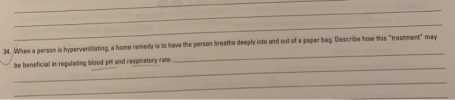 34. When a person is hyperventilating, a home remedy is to have the person breathe deeply into and out of a paper bag. Describe how this "treatment" may be beneficial in regulating blood pH and respiratory rate.
PL69 Homework • Unanswered You witness a person hyperventilate for a period of time before someone...
 PL69 Homework • Unanswered You witness a person hyperventilate for a period of time before someone hands them a brown paper bag to breathe into. After taking some breaths into the bag, their breathing rate begins to normalize. Which of the following is NOT true of this scenario? O A The brown paper bag increased the amount of CO2 that the person was breathing into the body 0 B The kidneys began to increase bicarbonate levels in the body to...
Identify and describe a news article that involves a situation of moral significance where a person...
Identify and describe a news article that involves a situation of moral significance where a person or institution intended one kind of consequence or result of an action but a completely different unanticipated consequence occurred. In your initial input, describe and analyze the situation using consequentialist theory.
Vi Lonstants During stress or trauma, a person can start to hyperventilato The person may then...
 Vi Lonstants During stress or trauma, a person can start to hyperventilato The person may then be instructed to breathe into a paper bag to avoid tainting CO (8) + 2H (1) Ma H5O" (sq) + HCO3 (aq) Part A How dom blood pH change during hyperventilation? O Hyperventilation will increase the CO, level in the blood, which increases the H,O and decreases the blood pH. Hyperventilation wil lower the CO, level in the blood, which decreases the H.O and...
Describe a situation where a for loop would be preferred over a while loop. Describe a...
Describe a situation where a for loop would be preferred over a while loop. Describe a situation where a while loop would be preferred over a for loop. How is a for loop similar to a while loop? In what way or ways are for and while loops different?
In an emergency situation a person has lost a lot of blood and an emergency crew...
In an emergency situation a person has lost a lot of blood and an emergency crew has run out of Normal Saline Solution to give intravenous fluid. However, they were by the ocean and sea water was available. They mix it with pure water which saved the persons life by adding water to a measured amount of sea water in a 1 liter bag. a) How much sea water did they measure to add?
104 Homework 6 4. (15 points): Hemoglobin (Hb) is the main oxygen transport protein in the blood....
 104 Homework 6 4. (15 points): Hemoglobin (Hb) is the main oxygen transport protein in the blood. Each hemoglobin molecule can transport four oxygen atoms at a time, one at each of its four iron-based binding sites. The binding of O2 to hemoglobin is a pH-dependent equilibrium, simplified as: Use Le Chatelier's Principle to answer the following questions: a) What form of hemoglobin, HbH" or Hb(Ojle, would be favored in the lungs? What form would be favored in the cells...
Describe a situation in a job you’ve had where there was potential for fraud. Include in...
Describe a situation in a job you’ve had where there was potential for fraud. Include in your discussion the elements of the fraud triangle. You are not (hopefully) describing an actual fraud, but rather putting yourself in a position where you’ll better understand the implications of fraud. If you cannot associate the question to a job you’ve actually had, you may use an imagined scenario to answer the question (not too outlandish though! Make it realistic.)
A Case of Respiratory Distress Pre-Case Questions 1. In your own words, describe Le Chatelier's principle....
 A Case of Respiratory Distress Pre-Case Questions 1. In your own words, describe Le Chatelier's principle. 2. What is PH? How do pH values change with increasing or decreasing H' content? Case A 68 year old woman, with no history of smoking presents to the ER for evaluation of dyspnea of greater than 1 hour in duration. Dyspnea or "air hunger" is considered normal when associated with heavy exertion; however this patient assured hospital staff she hasn't done anything which...
 9. The partial pressure of CO2 in the lungs changes with breathing rate. For example, a common remedy for hiccups is to hold the breath. Under these conditions, pCO2 in the lungs rises above normal a) Explain the effect of this procedure on blood pH. b) Sprinters will often hyperventilate (breathe rapidly and deeply) to remove CO2 from the lungs prior to a race. Blood pH can rise to 7.6 during this practice. Why does blood pH increase? Write the...
 34. When a person is hyperventilating, a home remedy is to have the person breathe deeply into and out of a paper bag. Describe how this "treatment" may be beneficial in regulating blood pH and respiratory rate.
 PL69 Homework • Unanswered You witness a person hyperventilate for a period of time before someone hands them a brown paper bag to breathe into. After taking some breaths into the bag, their breathing rate begins to normalize. Which of the following is NOT true of this scenario? O A The brown paper bag increased the amount of CO2 that the person was breathing into the body 0 B The kidneys began to increase bicarbonate levels in the body to...
 Vi Lonstants During stress or trauma, a person can start to hyperventilato The person may then be instructed to breathe into a paper bag to avoid tainting CO (8) + 2H (1) Ma H5O" (sq) + HCO3 (aq) Part A How dom blood pH change during hyperventilation? O Hyperventilation will increase the CO, level in the blood, which increases the H,O and decreases the blood pH. Hyperventilation wil lower the CO, level in the blood, which decreases the H.O and...
 104 Homework 6 4. (15 points): Hemoglobin (Hb) is the main oxygen transport protein in the blood. Each hemoglobin molecule can transport four oxygen atoms at a time, one at each of its four iron-based binding sites. The binding of O2 to hemoglobin is a pH-dependent equilibrium, simplified as: Use Le Chatelier's Principle to answer the following questions: a) What form of hemoglobin, HbH" or Hb(Ojle, would be favored in the lungs? What form would be favored in the cells...
 A Case of Respiratory Distress Pre-Case Questions 1. In your own words, describe Le Chatelier's principle. 2. What is PH? How do pH values change with increasing or decreasing H' content? Case A 68 year old woman, with no history of smoking presents to the ER for evaluation of dyspnea of greater than 1 hour in duration. Dyspnea or "air hunger" is considered normal when associated with heavy exertion; however this patient assured hospital staff she hasn't done anything which...
Most questions answered within 3 hours.
-
Where is the error in this code sequence?
String s1 = "Hello";
String s2 = "ello";...
asked 10 months ago -
Financial data for Joel de Paris, Inc., for last year
follow:
Joel de Paris, Inc.
Balance...
asked 10 months ago -
Consider this reaction:
Al2(SO4)3 (aq)+ BaCl3
(aq) Al2Cl6 (aq)- +
3BaSO4(s) . What is the...
asked 10 months ago -
Suppose that Savneet is considering increasing her
recent random sample from 20 car rentals to 40...
asked 10 months ago -
Trucks arrive at an unloading terminal at an average rate of 120
per hour.
Trucks arrive...
asked 10 months ago -
Why are methanol and ethanol completely soluble in water while
octanol is not very little soluble....
asked 10 months ago -
A facilities manager at a university reads in a research report
that the mean amount of...
asked 10 months ago -
When the CuSO4 is rehydrated by adding water to the anhydrous
compound, is this an endothermic...
asked 10 months ago -
A ray of sunlight is passing from diamond into crown glass; the
angle of incidence is...
asked 10 months ago -
A block of mass 0.249 kg is placed on top of a light, vertical
spring of...
asked 10 months ago -
how do the kidneys compensate in the presences of acidosis
a) trigger hyperventilate
b) reserve acid...
asked 10 months ago -
Question 501 pts
The rental rate of capital to the firm increases. Which of the
following...
asked 10 months ago