Each experiment requires us to measure the force on the wire, however we do not have a direct way to do so. Using our knowledge of Newton’s Laws, we can infer the magnitude of the force. Question 4. Assuming the current and magnetic field are as shown in Fig. 2, use the right-hand rule to determine the direction of the predicted force of the magnet on the wire.
[INEED HELP WITH NUMBER 5. I ALREADY DID NUMBER 4]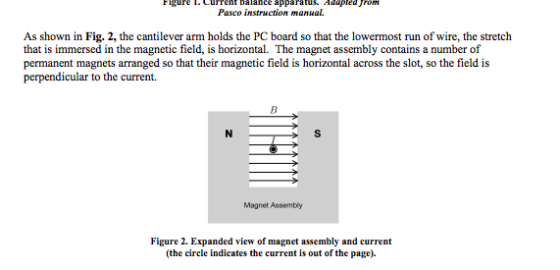
Question 5. (cont’d from Q4) According to Newton’s third law and your answer to Question 4, what must the force of the wire on the magnet be? (Make sure you understand the difference between what Question 4 and 5 are asking.)
Homework Answers
The force on magnet due to wire is equal to the force on wire due to magnetic field. This is in accordance with Newton third law which states that for every action there is equal and opposite reaction. A pair of action reaction force act always on any kind of physical interaction, either in contact or non-contact cases.
The answer to question 5 is same as answer 4, but the direction of force only change, becomes opposite.
Add Answer to:
Each experiment requires us to measure the force on the wire,
however we do not have...
In Explorations 1 and 2, we have been focusing on the direction of the force on...
 In Explorations 1 and 2, we have been focusing on the direction of the force on a current- carrying wire. It is obtained by using a right hand rule. Make sure you understand the right hand rule and how to use it to determine the direction of the force on a current- carrying wire when the direction of the magnetic field and the current are known. The magnitude of the force on a current-carrying wire is given by F =...
Question 2 3 pts Lorentz Force Changing the current through the wire would have changed the...
 Question 2 3 pts Lorentz Force Changing the current through the wire would have changed the magnetic force on the wire. True False Question 3 3 pts Lorentz Force If the balance reads a value lower than the true mass of the magnet, the force on the loop is No answer text provided. downward upward zero Question 4 3 pts Lorentz Force Changing the current through the wire would have changed normal force on the magnet. True False Question 5...
27C-Experiment: Magnetic Force on a Current It is possible, using basic lab equipment, to observe the...
 27C-Experiment: Magnetic Force on a Current It is possible, using basic lab equipment, to observe the force that a magnet exerts on current in a wire. Equipment:DC Power Supply (3A preferred), Long Barana wire, Large Pasco C Magnet, 1 gm sensitivity food scale. (Thero will only be a few systems set up. Your TA's will direct you in sharing their use.) Theory: The force due to a magnetic field on a straight wire carrying a current in a uniform B...
a) The force on a wire is a maximum of 8.50×10⁻² N when placed between the...
a) The force on a wire is a maximum of 8.50×10⁻² N when placed between the pole faces of a magnet. The current flows horizontally to the right and the magnetic field is vertical. The wire is observed to "jump" toward the observer when the current is turned on. If the pole faces have a diameter of 19.0 cm , estimate the current in the wire if the field is 0.460 T . If the wire is tipped so that...
The force on a wire is a maximum of 5.20 N when placed between the pole...
The force on a wire is a maximum of 5.20 N when placed between the pole faces of a magnet. The current flows horizontally to the right and the magnetic field is vertical. The wire is observed to "jump" toward the observer when the current is turned on. If the pole faces have a diameter of 14.0 cm, estimate the current in the wire if the field is 0.112 T. If the wire is tipped so that it now makes...
The force on a wire is a maximum of 5.86 N when placed between the pole...
The force on a wire is a maximum of 5.86 N when placed between the pole faces of a magnet. The current flows horizontally to the right and the magnetic field is vertical. The wire is observed to "jump" toward the observer when the current is turned on. If the pole faces have a diameter of 15.0 cm, estimate the current in the wire if the field is 0.112 T. If the wire is tipped so that it now makes...
The force on a wire is a maximum of 3.50x10^-2 N when placed between the pole...
The force on a wire is a maximum of 3.50x10^-2 N when placed between the pole faces of a magnet. The current flows horizontally to the right and the magnetic field is vertical. The wire is observed to "jump" toward the observer when the current is turned on. If the pole faces have a diameter of 10.0 cm, estimate the current in the wire if the field is 0.22 T. Answer in A If the wire is tipped so that...
Equipment: 1 current-carrying wire set-up 1 power supply 1 ammeter Exploration 2: Direction of force on...
 Equipment: 1 current-carrying wire set-up 1 power supply 1 ammeter Exploration 2: Direction of force on a current-carrying wire II Exploration 2.1 At your table, is the main unit you will be using today, mounted on lab stand. It is shown in the picture below. Place one of the current loops into the end of the main unit, with the foil extending down into the magnet assembly and position the lab stand with the Current Loop down between the poles...
Accessory Unit Arm Magnet Assembly Main Unit 121 のの のの Equipment: 1 current-carrying wire set-up 1...
 Accessory Unit Arm Magnet Assembly Main Unit 121 のの のの Equipment: 1 current-carrying wire set-up 1 power supply 1 ammeter Investigation 3: Relationship between force and angle between the current through a current-carrying wire and the magnetic field In this section we will explore the relationship between the force on a current-carrying wire and the angle between the current and the magnetic field. a. Predict the dependence of the force on the angle between the current and the magnetic field....
Need help with this problem, its not fcostheta The force on a wire is a maximum...
 Need help with this problem, its not fcostheta
The force on a wire is a maximum of 4.32 N when placed between the pole faces of a magnet. The current flows horizontally to the right and the magnetic field is vertical. The wire is observed to "jump" toward the observer when the current is turned on. If the pole faces have a diameter of 11.5 cm, estimate the current in the wire if the field is 0.140 T. 2.68x10² A...
Need help with this problem, its not fcostheta
The force on a wire is a maximum of 4.32 N when placed between the pole faces of a magnet. The current flows horizontally to the right and the magnetic field is vertical. The wire is observed to "jump" toward the observer when the current is turned on. If the pole faces have a diameter of 11.5 cm, estimate the current in the wire if the field is 0.140 T. 2.68x10² A...
 In Explorations 1 and 2, we have been focusing on the direction of the force on a current- carrying wire. It is obtained by using a right hand rule. Make sure you understand the right hand rule and how to use it to determine the direction of the force on a current- carrying wire when the direction of the magnetic field and the current are known. The magnitude of the force on a current-carrying wire is given by F =...
 Question 2 3 pts Lorentz Force Changing the current through the wire would have changed the magnetic force on the wire. True False Question 3 3 pts Lorentz Force If the balance reads a value lower than the true mass of the magnet, the force on the loop is No answer text provided. downward upward zero Question 4 3 pts Lorentz Force Changing the current through the wire would have changed normal force on the magnet. True False Question 5...
 27C-Experiment: Magnetic Force on a Current It is possible, using basic lab equipment, to observe the force that a magnet exerts on current in a wire. Equipment:DC Power Supply (3A preferred), Long Barana wire, Large Pasco C Magnet, 1 gm sensitivity food scale. (Thero will only be a few systems set up. Your TA's will direct you in sharing their use.) Theory: The force due to a magnetic field on a straight wire carrying a current in a uniform B...
 Equipment: 1 current-carrying wire set-up 1 power supply 1 ammeter Exploration 2: Direction of force on a current-carrying wire II Exploration 2.1 At your table, is the main unit you will be using today, mounted on lab stand. It is shown in the picture below. Place one of the current loops into the end of the main unit, with the foil extending down into the magnet assembly and position the lab stand with the Current Loop down between the poles...
 Accessory Unit Arm Magnet Assembly Main Unit 121 のの のの Equipment: 1 current-carrying wire set-up 1 power supply 1 ammeter Investigation 3: Relationship between force and angle between the current through a current-carrying wire and the magnetic field In this section we will explore the relationship between the force on a current-carrying wire and the angle between the current and the magnetic field. a. Predict the dependence of the force on the angle between the current and the magnetic field....
 Need help with this problem, its not fcostheta
The force on a wire is a maximum of 4.32 N when placed between the pole faces of a magnet. The current flows horizontally to the right and the magnetic field is vertical. The wire is observed to "jump" toward the observer when the current is turned on. If the pole faces have a diameter of 11.5 cm, estimate the current in the wire if the field is 0.140 T. 2.68x10² A...
Need help with this problem, its not fcostheta
The force on a wire is a maximum of 4.32 N when placed between the pole faces of a magnet. The current flows horizontally to the right and the magnetic field is vertical. The wire is observed to "jump" toward the observer when the current is turned on. If the pole faces have a diameter of 11.5 cm, estimate the current in the wire if the field is 0.140 T. 2.68x10² A...
Most questions answered within 3 hours.
-
Where is the error in this code sequence?
String s1 = "Hello";
String s2 = "ello";...
asked 10 months ago -
Financial data for Joel de Paris, Inc., for last year
follow:
Joel de Paris, Inc.
Balance...
asked 10 months ago -
Consider this reaction:
Al2(SO4)3 (aq)+ BaCl3
(aq) Al2Cl6 (aq)- +
3BaSO4(s) . What is the...
asked 10 months ago -
Suppose that Savneet is considering increasing her
recent random sample from 20 car rentals to 40...
asked 10 months ago -
Trucks arrive at an unloading terminal at an average rate of 120
per hour.
Trucks arrive...
asked 10 months ago -
Why are methanol and ethanol completely soluble in water while
octanol is not very little soluble....
asked 10 months ago -
A facilities manager at a university reads in a research report
that the mean amount of...
asked 10 months ago -
When the CuSO4 is rehydrated by adding water to the anhydrous
compound, is this an endothermic...
asked 10 months ago -
A ray of sunlight is passing from diamond into crown glass; the
angle of incidence is...
asked 10 months ago -
A block of mass 0.249 kg is placed on top of a light, vertical
spring of...
asked 10 months ago -
how do the kidneys compensate in the presences of acidosis
a) trigger hyperventilate
b) reserve acid...
asked 10 months ago -
Question 501 pts
The rental rate of capital to the firm increases. Which of the
following...
asked 10 months ago