
Homework Answers

Add Answer to:
SULLIVIT Question 4 Ped the place transform of the following function for n = 0 and...
Question 1: Find the Laplace Transform of the following time function (10pts) (0) 0 2 4...
 Question 1: Find the Laplace Transform of the following time function (10pts) (0) 0 2 4 6 8 t (sec)
Consider the function: 2) g(t) = tet"sin (et a)ls g(t) continuos at [0,°°] and of exponential order? b)Show that Laplace transform exist fot Re(s)>0 Consider the function: 2) g(t) = tet&#...
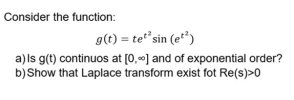 Consider the function: 2) g(t) = tet"sin (et a)ls g(t) continuos at [0,°°] and of exponential order? b)Show that Laplace transform exist fot Re(s)>0
Consider the function: 2) g(t) = tet"sin (et a)ls g(t) continuos at [0,°°] and of exponential order? b)Show that Laplace transform exist fot Re(s)>0
Consider the function: 2) g(t) = tet"sin (et a)ls g(t) continuos at [0,°°] and of exponential order? b)Show that Laplace transform exist fot Re(s)>0
Question 1: (35 points: Consider the following sequences: x[n] = u[n] + 4" u[-n- 1] y[n]...
 Question 1: (35 points: Consider the following sequences: x[n] = u[n] + 4" u[-n- 1] y[n] = x[n - 5) a) [10 points| Determine the Z-transform X(z) b) [10 points| Determine and draw the Region of Convergence (ROC) of x(n) c) [10 points] Determine the z-transform Y(z) d) [05 points) Determine the transfer function H(z)=Y(z)/X(z)
Question 1 10 points Using the definition of the transform, determine the transforms for each of...
 Question 1 10 points Using the definition of the transform, determine the transforms for each of the following signals. Sketch the pole-zero plot and indicate the region of convergence. (a) (5 points) (-3)"[n-2 () (5 points) "0(9) 15 points transforms for each of Question 2... Using 3-transform pairs and properties tables, determine the the following signals. (a) (5 points) un-un-2 (b) (5 points) -- [n - 2 (e) (5 points) nyin-1 ... 10 points Question 3 Find the inverse (a)...
Question 2: (26 marks) 2.1 Find the The Laplace transform of the following function t, if...
 Question 2: (26 marks) 2.1 Find the The Laplace transform of the following function t, if 03t<1 2t, if t1 [3] 2.2 Find the inverse Laplace transform of 10e 2 52 - 53 +632 - 25 + 5 (10] 2.3 Find y(4) if y(t) = u(t){t - 2)2 - us(t)/(t - 3) - 2) - us(t)e' (51 2.4 Solve the following initial value problem given by y" + 4y = 28.(t) (0)=1/(0) = 0 181 Question 3: (17 marks) Let...
Matlab Question#1: Determine the discrete-time Fourier transform of x(n) (0.8y'n u(n)+(0.1)'n u(n) Evaluate Xei) at 501 equispaced. points between [0,pi] and plot its magnitude, angle, re...
 Matlab Question#1: Determine the discrete-time Fourier transform of x(n) (0.8y'n u(n)+(0.1)'n u(n) Evaluate Xei) at 501 equispaced. points between [0,pi] and plot its magnitude, angle, real, and imaginary parts Matlab Question#2: Determine the discrete-time Fourier transform of Evaluate Xei) at 1001 equispaced points between [0pi] and plot its magnitude, angle, real, and imaginary parts. Matlab Question#3: Compute the FT values at the prescribed frequency points and plot the real and imaginary parts and the magnitude and phase spectrums. The FT...
Question 11 pts x(t) is a time domain function. The laplace transform of x(t) is in...
Question 11 pts x(t) is a time domain function. The laplace transform of x(t) is in what domain: s domain none of the above f domain time domain Flag this Question Question 21 pts if X(s) is the Laplace transform of x(t), then 's' is a : real number integer complex number rational number Flag this Question Question 31 pts In a unilateral Laplace transform the integral, the start time is just after origin (0+) just before origin (0-) origin...
A discrete-time signal x_d[n] has a Fourier transform X_d(e^j omega)with the property that X_d(e-j omega) =...
 A discrete-time signal x_d[n] has a Fourier transform X_d(e^j omega)with the property that X_d(e-j omega) = 0 for 3 pi/4 lessthanorequalto |omega| lessthanorequalto pi The signal is convened into a continuous-time signal x_c(t) = T sigma^infinity _n = -infinity X_d[n] sin pi/T (t - nT)/pi (t - nT), Where T = 10^-3 Determine the value of omega for which the Fourier transform X_c(j omega) of x_c(t) is guaranteed to be zero.
QUESTION 3 After use Laplace Transform to transform the following initial value problem X" +x=e-t, x(0)...
 QUESTION 3 After use Laplace Transform to transform the following initial value problem X" +x=e-t, x(0) = 1,x'(0) = 1, S-2 you should get X(s)= (write fraction as (S-2)/(5-4)(8+6) for -). Then, find (s-4)(8+6) x(t)= L-?{X(s)}= (write 5/6 by 5 -30 6' e^{-3t} by e and sin(2t) or cos(3t) by sin(2t) or cos(3t)).
D Question 5 D Question 7 20 pts Find the Laplace transform. £{/0) of the following...
 D Question 5 D Question 7 20 pts Find the Laplace transform. £{/0) of the following function: Solve the following Initial Value Problem: " + 4y = sint - Ul(t - 2) sin(t - 2n), y(0) -0,(0) = 0 * (+64 +5) +ed (cos(36) + sin(5t)) None of the given answers is correct Owt) --sint + sin(2t) - (t - 2x)} sin(t - 2x) - sin(21 – 2*))] (t) = sint - sin(2) - 11(- 21) sin(-2) - sin(2t -...
 Question 1: Find the Laplace Transform of the following time function (10pts) (0) 0 2 4 6 8 t (sec)
 Consider the function: 2) g(t) = tet"sin (et a)ls g(t) continuos at [0,°°] and of exponential order? b)Show that Laplace transform exist fot Re(s)>0
Consider the function: 2) g(t) = tet"sin (et a)ls g(t) continuos at [0,°°] and of exponential order? b)Show that Laplace transform exist fot Re(s)>0
Consider the function: 2) g(t) = tet"sin (et a)ls g(t) continuos at [0,°°] and of exponential order? b)Show that Laplace transform exist fot Re(s)>0
 Question 1: (35 points: Consider the following sequences: x[n] = u[n] + 4" u[-n- 1] y[n] = x[n - 5) a) [10 points| Determine the Z-transform X(z) b) [10 points| Determine and draw the Region of Convergence (ROC) of x(n) c) [10 points] Determine the z-transform Y(z) d) [05 points) Determine the transfer function H(z)=Y(z)/X(z)
 Question 1 10 points Using the definition of the transform, determine the transforms for each of the following signals. Sketch the pole-zero plot and indicate the region of convergence. (a) (5 points) (-3)"[n-2 () (5 points) "0(9) 15 points transforms for each of Question 2... Using 3-transform pairs and properties tables, determine the the following signals. (a) (5 points) un-un-2 (b) (5 points) -- [n - 2 (e) (5 points) nyin-1 ... 10 points Question 3 Find the inverse (a)...
 Question 2: (26 marks) 2.1 Find the The Laplace transform of the following function t, if 03t<1 2t, if t1 [3] 2.2 Find the inverse Laplace transform of 10e 2 52 - 53 +632 - 25 + 5 (10] 2.3 Find y(4) if y(t) = u(t){t - 2)2 - us(t)/(t - 3) - 2) - us(t)e' (51 2.4 Solve the following initial value problem given by y" + 4y = 28.(t) (0)=1/(0) = 0 181 Question 3: (17 marks) Let...
 Matlab Question#1: Determine the discrete-time Fourier transform of x(n) (0.8y'n u(n)+(0.1)'n u(n) Evaluate Xei) at 501 equispaced. points between [0,pi] and plot its magnitude, angle, real, and imaginary parts Matlab Question#2: Determine the discrete-time Fourier transform of Evaluate Xei) at 1001 equispaced points between [0pi] and plot its magnitude, angle, real, and imaginary parts. Matlab Question#3: Compute the FT values at the prescribed frequency points and plot the real and imaginary parts and the magnitude and phase spectrums. The FT...
 A discrete-time signal x_d[n] has a Fourier transform X_d(e^j omega)with the property that X_d(e-j omega) = 0 for 3 pi/4 lessthanorequalto |omega| lessthanorequalto pi The signal is convened into a continuous-time signal x_c(t) = T sigma^infinity _n = -infinity X_d[n] sin pi/T (t - nT)/pi (t - nT), Where T = 10^-3 Determine the value of omega for which the Fourier transform X_c(j omega) of x_c(t) is guaranteed to be zero.
 QUESTION 3 After use Laplace Transform to transform the following initial value problem X" +x=e-t, x(0) = 1,x'(0) = 1, S-2 you should get X(s)= (write fraction as (S-2)/(5-4)(8+6) for -). Then, find (s-4)(8+6) x(t)= L-?{X(s)}= (write 5/6 by 5 -30 6' e^{-3t} by e and sin(2t) or cos(3t) by sin(2t) or cos(3t)).
 D Question 5 D Question 7 20 pts Find the Laplace transform. £{/0) of the following function: Solve the following Initial Value Problem: " + 4y = sint - Ul(t - 2) sin(t - 2n), y(0) -0,(0) = 0 * (+64 +5) +ed (cos(36) + sin(5t)) None of the given answers is correct Owt) --sint + sin(2t) - (t - 2x)} sin(t - 2x) - sin(21 – 2*))] (t) = sint - sin(2) - 11(- 21) sin(-2) - sin(2t -...
Most questions answered within 3 hours.
-
Where is the error in this code sequence?
String s1 = "Hello";
String s2 = "ello";...
asked 10 months ago -
Financial data for Joel de Paris, Inc., for last year
follow:
Joel de Paris, Inc.
Balance...
asked 10 months ago -
Consider this reaction:
Al2(SO4)3 (aq)+ BaCl3
(aq) Al2Cl6 (aq)- +
3BaSO4(s) . What is the...
asked 10 months ago -
Suppose that Savneet is considering increasing her
recent random sample from 20 car rentals to 40...
asked 10 months ago -
Trucks arrive at an unloading terminal at an average rate of 120
per hour.
Trucks arrive...
asked 10 months ago -
Why are methanol and ethanol completely soluble in water while
octanol is not very little soluble....
asked 10 months ago -
A facilities manager at a university reads in a research report
that the mean amount of...
asked 10 months ago -
When the CuSO4 is rehydrated by adding water to the anhydrous
compound, is this an endothermic...
asked 10 months ago -
A ray of sunlight is passing from diamond into crown glass; the
angle of incidence is...
asked 10 months ago -
A block of mass 0.249 kg is placed on top of a light, vertical
spring of...
asked 10 months ago -
how do the kidneys compensate in the presences of acidosis
a) trigger hyperventilate
b) reserve acid...
asked 10 months ago -
Question 501 pts
The rental rate of capital to the firm increases. Which of the
following...
asked 10 months ago