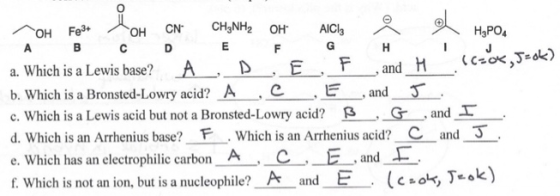
Select the appropriate compound(s) for the following using the letter codes
Select the appropriate compound(s) for the following using the letter codes. Some compounds may be used more than once some may not be used. If no substance is correct write none in the blank.
Homework Answers


Add Answer to:
Select the appropriate compound(s) for the following using the letter codes
Please help I need to fill in the blanks by using the compounds and producers below the picture. Thanks! 422 (4 pts) Using the flow-chart below, outline a separation of Benzoic acid (s) (1), benzyl...
 Please help I need to fill in the blanks by using the compounds
and producers below the picture. Thanks!
422 (4 pts) Using the flow-chart below, outline a separation of Benzoic acid (s) (1), benzyl amine d) (2), and Naphthalene (s) (3). From the list of procedural steps below, write the letter corresponding to each procedure in the appropriate Ellipse boxes. Each procedure ma once, more than once or not at all. Usi corresponding to each structure in the appropriate...
Please help I need to fill in the blanks by using the compounds
and producers below the picture. Thanks!
422 (4 pts) Using the flow-chart below, outline a separation of Benzoic acid (s) (1), benzyl amine d) (2), and Naphthalene (s) (3). From the list of procedural steps below, write the letter corresponding to each procedure in the appropriate Ellipse boxes. Each procedure ma once, more than once or not at all. Usi corresponding to each structure in the appropriate...
Using twotwo of the letters of the alphabet, how many fourfour-letter codes can we form if...
Using twotwo of the letters of the alphabet, how many fourfour-letter codes can we form if we are allowed to use the same letter more than once?
1. The structures of six organic compounds are shown below. NHE (i) Give the name(s) of...
 1. The structures of six organic compounds are shown below. NHE (i) Give the name(s) of the functional group(s) in each compound. All compounds have at least one functional group; some ha ve more than one. (ii) Give the letter(s) of the compound(s) that are aromatic. Write "None" if there are no aromatic compounds. (iii) Give the letter(s) of the compound(s) that have optical isomers. Write "None" if no compound has optical isomers. (iv) What is the molecular formula of...
46. How many different four-letter codes are there if only the letters A, B, C, D,...
 46. How many different four-letter codes are there if only the letters A, B, C, D, E, and F can be used and no letter can be used more than once?
3) Devise a synthesis of the following compound using the given compounds (you may use each...
 3) Devise a synthesis of the following compound using the given compounds (you may use each one more than once if needed). You may also use any needed inorganic or organic reagents but all of the carbons in the target molecule must come from the given starting materials. Hint: this synthesis will require you to use ozonolysis and a reaction that starts with the letter DI
describe the relationship between each pair of compounds. Use the following set of terms to describe...
 describe the relationship between each pair of compounds.
Use the following set of terms to describe the relationship(s) between each pair of compounds by placing the correct letter(s) on each line. Terms may be used more than once or not at all. Each pair of compounds may have more than one relationship, or they may have no relationship (option F). Circle any meso compounds in questions 1-4. A. stereoisomers D. diastereomers B. constitutional isomers E. enantiomers institutional isomers C. identical...
describe the relationship between each pair of compounds.
Use the following set of terms to describe the relationship(s) between each pair of compounds by placing the correct letter(s) on each line. Terms may be used more than once or not at all. Each pair of compounds may have more than one relationship, or they may have no relationship (option F). Circle any meso compounds in questions 1-4. A. stereoisomers D. diastereomers B. constitutional isomers E. enantiomers institutional isomers C. identical...
Devise a synthesis of the following compound using the given compounds
 Devise a synthesis of the following compound using the given compounds (you may use each one more than once if needed). You may also use any needed inorganic or organic reagents but all of the carbons in the target molecule must come from the given starting materials.
Look at the given reaction and use the letter code corresponding to each compound in the...
 Look at the given reaction and use the letter code corresponding to each compound in the blank to indicate the expected product(s), or fill in the blank with the appropriate vocabulary word or phrase. If a specific stereoisomer (e.g., single enantiomer) is formed, select that isomer only. If a mixture of stereoisomers (e.g. racemic or diastereomers) is formed, select the single structure that shows the appropriate mixture (e.g. lines not dashes). The specific functional group in the starting material is...
1.The structures of six organic compounds are shown below H2 0 он functional group compounds. has...
 1.The structures of six organic compounds are shown below H2 0 он functional group compounds. has optical isomers. (i) Give the name(s) of the functional group s) in each compound. All compounds have at least one (ii) Give the letter(s) of the compound(s) that are aromatic. Write "None" if there are no aromatic (iii) Give the letter(s) of the compound(s) that have optical isomers. Write "None" if no compound (iv) What is the molecular formula of (c)? : some hav...
1. The structures of six organic compounds are shown below. HEH (6) 9 NHE (d) (e)...
 1. The structures of six organic compounds are shown below. HEH (6) 9 NHE (d) (e) ( nów (i) Give the name(s) of the functional group(s) in each compound. All compounds have at least one functional group; some ha ve more than one. (ii) Give the letter(s) of the compound(s) that are aromatic. Write "None" if there are no aromatic compounds. (iii) Give the letter(s) of the compound(s) that have optical isomers. Write "None" if no compound has optical isomers....
 Please help I need to fill in the blanks by using the compounds
and producers below the picture. Thanks!
422 (4 pts) Using the flow-chart below, outline a separation of Benzoic acid (s) (1), benzyl amine d) (2), and Naphthalene (s) (3). From the list of procedural steps below, write the letter corresponding to each procedure in the appropriate Ellipse boxes. Each procedure ma once, more than once or not at all. Usi corresponding to each structure in the appropriate...
Please help I need to fill in the blanks by using the compounds
and producers below the picture. Thanks!
422 (4 pts) Using the flow-chart below, outline a separation of Benzoic acid (s) (1), benzyl amine d) (2), and Naphthalene (s) (3). From the list of procedural steps below, write the letter corresponding to each procedure in the appropriate Ellipse boxes. Each procedure ma once, more than once or not at all. Usi corresponding to each structure in the appropriate...
 1. The structures of six organic compounds are shown below. NHE (i) Give the name(s) of the functional group(s) in each compound. All compounds have at least one functional group; some ha ve more than one. (ii) Give the letter(s) of the compound(s) that are aromatic. Write "None" if there are no aromatic compounds. (iii) Give the letter(s) of the compound(s) that have optical isomers. Write "None" if no compound has optical isomers. (iv) What is the molecular formula of...
 46. How many different four-letter codes are there if only the letters A, B, C, D, E, and F can be used and no letter can be used more than once?
 3) Devise a synthesis of the following compound using the given compounds (you may use each one more than once if needed). You may also use any needed inorganic or organic reagents but all of the carbons in the target molecule must come from the given starting materials. Hint: this synthesis will require you to use ozonolysis and a reaction that starts with the letter DI
 describe the relationship between each pair of compounds.
Use the following set of terms to describe the relationship(s) between each pair of compounds by placing the correct letter(s) on each line. Terms may be used more than once or not at all. Each pair of compounds may have more than one relationship, or they may have no relationship (option F). Circle any meso compounds in questions 1-4. A. stereoisomers D. diastereomers B. constitutional isomers E. enantiomers institutional isomers C. identical...
describe the relationship between each pair of compounds.
Use the following set of terms to describe the relationship(s) between each pair of compounds by placing the correct letter(s) on each line. Terms may be used more than once or not at all. Each pair of compounds may have more than one relationship, or they may have no relationship (option F). Circle any meso compounds in questions 1-4. A. stereoisomers D. diastereomers B. constitutional isomers E. enantiomers institutional isomers C. identical...
 Look at the given reaction and use the letter code corresponding to each compound in the blank to indicate the expected product(s), or fill in the blank with the appropriate vocabulary word or phrase. If a specific stereoisomer (e.g., single enantiomer) is formed, select that isomer only. If a mixture of stereoisomers (e.g. racemic or diastereomers) is formed, select the single structure that shows the appropriate mixture (e.g. lines not dashes). The specific functional group in the starting material is...
 1.The structures of six organic compounds are shown below H2 0 он functional group compounds. has optical isomers. (i) Give the name(s) of the functional group s) in each compound. All compounds have at least one (ii) Give the letter(s) of the compound(s) that are aromatic. Write "None" if there are no aromatic (iii) Give the letter(s) of the compound(s) that have optical isomers. Write "None" if no compound (iv) What is the molecular formula of (c)? : some hav...
 1. The structures of six organic compounds are shown below. HEH (6) 9 NHE (d) (e) ( nów (i) Give the name(s) of the functional group(s) in each compound. All compounds have at least one functional group; some ha ve more than one. (ii) Give the letter(s) of the compound(s) that are aromatic. Write "None" if there are no aromatic compounds. (iii) Give the letter(s) of the compound(s) that have optical isomers. Write "None" if no compound has optical isomers....
Most questions answered within 3 hours.
-
Where is the error in this code sequence?
String s1 = "Hello";
String s2 = "ello";...
asked 11 months ago -
Financial data for Joel de Paris, Inc., for last year
follow:
Joel de Paris, Inc.
Balance...
asked 11 months ago -
Consider this reaction:
Al2(SO4)3 (aq)+ BaCl3
(aq) Al2Cl6 (aq)- +
3BaSO4(s) . What is the...
asked 11 months ago -
Suppose that Savneet is considering increasing her
recent random sample from 20 car rentals to 40...
asked 11 months ago -
Trucks arrive at an unloading terminal at an average rate of 120
per hour.
Trucks arrive...
asked 11 months ago -
Why are methanol and ethanol completely soluble in water while
octanol is not very little soluble....
asked 11 months ago -
A facilities manager at a university reads in a research report
that the mean amount of...
asked 11 months ago -
When the CuSO4 is rehydrated by adding water to the anhydrous
compound, is this an endothermic...
asked 11 months ago -
A ray of sunlight is passing from diamond into crown glass; the
angle of incidence is...
asked 11 months ago -
A block of mass 0.249 kg is placed on top of a light, vertical
spring of...
asked 11 months ago -
how do the kidneys compensate in the presences of acidosis
a) trigger hyperventilate
b) reserve acid...
asked 11 months ago -
Question 501 pts
The rental rate of capital to the firm increases. Which of the
following...
asked 11 months ago