The manufacturer of high-quality flatbed scanners is trying to decide what price to set for its...
The manufacturer of high-quality flatbed scanners is trying to decide what price to set for its product. The costs of production and the demand for the product are assumed to be as follows:
TC = 500,000 + 0.85Q + 0.015Q 2
Q = 14,166 - 16.6P
a. Determine the short-run profit-maximizing price.
b. Explain why the demand curve facing a monopolist is less elastic than one facing a firm that operates in a monopolistically competitive market (all other factors held constant).
Homework Answers
a. Profit maximizing price is determined where MR = MC
MC = d(TC)/dQ = 0.85 + 2(0.015Q) = 0.85 + 0.03Q
Q = 14,166 - 16.6P
So, 16.6P = 14,166 - Q
So, P = (14,166/16.6) - (Q/16.6)
TR = P*Q = [(14,166/16.6) - (Q/16.6)]*Q = (14,166Q/16.6) -
(Q2/16.6)
MR = d(TR)/dQ = (14,166/16.6) - (2Q/16.6) = (14,166 - 2Q)/16.6
So, MR = MC gives,
(14,166 - 2Q)/16.6 = 0.85 + 0.03Q
So, 14,166 - 2Q = 16.6*(0.85 + 0.03Q)
So, 14,166 - 2Q = 14.11 + 0.498Q
So, 2Q + 0.498Q = 2.498Q = 14,166 - 14.11 = 14,151.89
So, Q = 14,151.89/2.498
So, Q = 5,665.29
P = (14,166/16.6) - (Q/16.6) = (14,166-Q)/16.6 =
(14,166-5665.29)/16.6 = 8500.71/16.6
So, P = 512.09
b. Demand curve facing a monopolist is less elastic than one facing a firm that operates in a monopolistically competitive market because a monopolist is the only seller so he can raise price without losing customers because there are no substitutes for his product. Thus demand is inelastic. While under monopolistic competition, there are many sellers. Such a firm can also increase price without losing all of its customers but there are substitutes available for his product so demand is elastic.
Add Answer to:
The manufacturer of high-quality flatbed scanners is trying to
decide what price to set for its...
6. The manufacturer of high-quality flatbed scanners is trying to decide what price to set for...
6. The manufacturer of high-quality flatbed scanners is trying to decide what price to set for its product. The costs of production and the demand for the product are assumed to be as follows: TC = 500,000 + 0.85Q + (0.015Q)(0.015Q) Q = 14,166 - 16.6P a. Determine the short-run profit-maximizing price. b. Plot this information on a graph showing AC, AVC, MC, P, and MR.
7. The manufacturer of high-quality flatbed scanners is trying to decide whether or not they have...
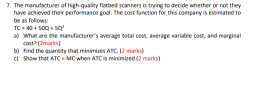 7. The manufacturer of high-quality flatbed scanners is trying to decide whether or not they have achieved their performance goal. The cost function for this company is estimated to be as follows: TC 4050Q5Q2 a) What are the manufacturer's average total cost, average variable cost, and marginal cost? (2marks) b) Find the quantity that minimizes ATC. (2 marks) c) Show that ATC MC when ATC is minimized (2 marks)
1. Which of the following is NOT a characteristic of a monopolistically competitive market?
1. Which of the following is NOT a characteristic of a monopolistically competitive market?A. many sellers.B. differentiated products.C. long-run economic profits.D. free entry and exit.2. Which of the following products is likely to be sold in a monopolistically competitive market?A. video games.B. breakfast cereal.E. beer.D. all of the above.3. Which of the following is true regarding the similarities and differences in monopolistic competition and monopoly?A. The monopolist faces a downward-sloping demand curve while the monopolistic competitor faces an elastic demand...
1. What is a monopoly? Name 2 differences between a monopoly and a perfectly competitive market....
 1. What is a monopoly? Name 2 differences between a monopoly and a perfectly competitive market. 2. What is the profit maximizing condition for a price-setting monopoly? 3. Show that MR follows the notion "same intercept, twice the slope" of demand. 4. Is a monopoly the most socially optimal market? How does a monopoly differ from a perfectly competitive market? Explain and show in a graph. What is the difference in welfare? 5. At what point would a monopoly decide...
36) When a monopolist sells the same product at different prices and the prices are not related to cost differences, we have B) price differentiation. D) monopoly pricing A) price discrimination...
 36) When a monopolist sells the same product at different prices and the prices are not related to cost differences, we have B) price differentiation. D) monopoly pricing A) price discrimination C) marginal cost pricing. 37) 37) Monopolies misallocate resources because A) price does not equal marginal cost B) profits are usually positive. C) marginal cost does not equal average total cost. D) price does not equal average total cost. 38) 38) Which of the following assumptions is true about...
b) (4 points) Graph demand, marginal revenue, marginal cost and average total cost (ATC) below. Mark...
 b) (4 points) Graph demand, marginal revenue, marginal cost and
average total cost (ATC) below. Mark Q*, P*, ATC* (you’ll have to
calculate it) and the endpoints to all of the curves.
c) (2 points) Given your answers above, explain which curve(s)
will shift in the long run and why.
d) (4 points) Draw the graph that represents this firm in the
long-run. Label the profit-maximizing price and quantity as P* and
Q*, respectively. No numbers are necessary, but be...
b) (4 points) Graph demand, marginal revenue, marginal cost and
average total cost (ATC) below. Mark Q*, P*, ATC* (you’ll have to
calculate it) and the endpoints to all of the curves.
c) (2 points) Given your answers above, explain which curve(s)
will shift in the long run and why.
d) (4 points) Draw the graph that represents this firm in the
long-run. Label the profit-maximizing price and quantity as P* and
Q*, respectively. No numbers are necessary, but be...
TU) UdlIT IS. In a perfectly competitive market: each firm produces a unique product and chooses a price that maximize...
 TU) UdlIT IS. In a perfectly competitive market: each firm produces a unique product and chooses a price that maximize there are very few firms, and each controls a large segment of the market. entry into the industry is restricted in the long run. there are many relatively small firms, and each firm is a price-taker. c. t If a firm is a price-taker, it: sells its product at the price determined by the market. sells its product at the...
1. A cartel is a group of firms that attempts to a. maximize joint revenue. b....
1. A cartel is a group of firms that attempts to a. maximize joint revenue. b. increase competition. c. behave independently. d. maximize joint profit. 2. If a firm's product loses brand loyalty, then the demand curve will: a. Become less price elastic. b. Shift to the right. c. Become more price elastic. d. Shift to the left. 3. Assume a monopoly confronts the same costs and demand as a competitive industry. In this case, the monopolist produces: a. Less...
The market demand curve of a local pizza is QD= 100 − 4P. The total cost...
The market demand curve of a local pizza is QD= 100 − 4P. The total cost curve of Pat’s Pizza Kitchen is TC = 0.5Q2 + Q+5. Assuming Pat’s Pizza is doing business in a competitive industry and the price of the pizza is $10 for all firms. Using Excel to calculate the firm’s total revenue, total cost, and profit for q = 1 to q = 25 in increments of 1. (Note: your answers should be rounding decimals to...
18. In a perfectly competitive market, individual firms set: A) prices and quantities B) neither prices...
 18. In a perfectly competitive market, individual firms set: A) prices and quantities B) neither prices nor quantities. C) quantiies but not prices D) prices but not quantities 19. The perfectly competitive firm faces a perfectly elastic demand curve because A) t has the ability to set the price and force everyone to buy at that price. it has no ability to control price. B) C) t doesn't; it faces a perfectly inelastic demand curve D) it doesn't; everyone knows...
 7. The manufacturer of high-quality flatbed scanners is trying to decide whether or not they have achieved their performance goal. The cost function for this company is estimated to be as follows: TC 4050Q5Q2 a) What are the manufacturer's average total cost, average variable cost, and marginal cost? (2marks) b) Find the quantity that minimizes ATC. (2 marks) c) Show that ATC MC when ATC is minimized (2 marks)
 1. What is a monopoly? Name 2 differences between a monopoly and a perfectly competitive market. 2. What is the profit maximizing condition for a price-setting monopoly? 3. Show that MR follows the notion "same intercept, twice the slope" of demand. 4. Is a monopoly the most socially optimal market? How does a monopoly differ from a perfectly competitive market? Explain and show in a graph. What is the difference in welfare? 5. At what point would a monopoly decide...
 36) When a monopolist sells the same product at different prices and the prices are not related to cost differences, we have B) price differentiation. D) monopoly pricing A) price discrimination C) marginal cost pricing. 37) 37) Monopolies misallocate resources because A) price does not equal marginal cost B) profits are usually positive. C) marginal cost does not equal average total cost. D) price does not equal average total cost. 38) 38) Which of the following assumptions is true about...
 b) (4 points) Graph demand, marginal revenue, marginal cost and
average total cost (ATC) below. Mark Q*, P*, ATC* (you’ll have to
calculate it) and the endpoints to all of the curves.
c) (2 points) Given your answers above, explain which curve(s)
will shift in the long run and why.
d) (4 points) Draw the graph that represents this firm in the
long-run. Label the profit-maximizing price and quantity as P* and
Q*, respectively. No numbers are necessary, but be...
b) (4 points) Graph demand, marginal revenue, marginal cost and
average total cost (ATC) below. Mark Q*, P*, ATC* (you’ll have to
calculate it) and the endpoints to all of the curves.
c) (2 points) Given your answers above, explain which curve(s)
will shift in the long run and why.
d) (4 points) Draw the graph that represents this firm in the
long-run. Label the profit-maximizing price and quantity as P* and
Q*, respectively. No numbers are necessary, but be...
 TU) UdlIT IS. In a perfectly competitive market: each firm produces a unique product and chooses a price that maximize there are very few firms, and each controls a large segment of the market. entry into the industry is restricted in the long run. there are many relatively small firms, and each firm is a price-taker. c. t If a firm is a price-taker, it: sells its product at the price determined by the market. sells its product at the...
 18. In a perfectly competitive market, individual firms set: A) prices and quantities B) neither prices nor quantities. C) quantiies but not prices D) prices but not quantities 19. The perfectly competitive firm faces a perfectly elastic demand curve because A) t has the ability to set the price and force everyone to buy at that price. it has no ability to control price. B) C) t doesn't; it faces a perfectly inelastic demand curve D) it doesn't; everyone knows...
Most questions answered within 3 hours.
-
Where is the error in this code sequence?
String s1 = "Hello";
String s2 = "ello";...
asked 11 months ago -
Financial data for Joel de Paris, Inc., for last year
follow:
Joel de Paris, Inc.
Balance...
asked 11 months ago -
Consider this reaction:
Al2(SO4)3 (aq)+ BaCl3
(aq) Al2Cl6 (aq)- +
3BaSO4(s) . What is the...
asked 11 months ago -
Suppose that Savneet is considering increasing her
recent random sample from 20 car rentals to 40...
asked 11 months ago -
Trucks arrive at an unloading terminal at an average rate of 120
per hour.
Trucks arrive...
asked 11 months ago -
Why are methanol and ethanol completely soluble in water while
octanol is not very little soluble....
asked 11 months ago -
A facilities manager at a university reads in a research report
that the mean amount of...
asked 11 months ago -
When the CuSO4 is rehydrated by adding water to the anhydrous
compound, is this an endothermic...
asked 11 months ago -
A ray of sunlight is passing from diamond into crown glass; the
angle of incidence is...
asked 11 months ago -
A block of mass 0.249 kg is placed on top of a light, vertical
spring of...
asked 11 months ago -
how do the kidneys compensate in the presences of acidosis
a) trigger hyperventilate
b) reserve acid...
asked 11 months ago -
Question 501 pts
The rental rate of capital to the firm increases. Which of the
following...
asked 11 months ago