![Problem 6, 15 Points. Let ~ ?(A), the exponential distribution. Determine and identify the probability distribution of the random variable [x], where fz] denotes the ceiling function, the smallest integer greater than or equal to z. Remark. Note that the new random variable is discrete random variable.](http://img.homeworklib.com/questions/3673c680-19b0-11ec-943b-cd5c731d4de2.png?x-oss-process=image/resize,w_560)
Homework Answers
Since, X ~ Exponential( )
=> X > 0
)
=> X > 0
Now, we observe that :

Thus, the support of  is {1,2,3,...}
Now, we see that :

Thus, the probability mass function of
is given by :

Now, we are left with the task of identifying the distribution
of
. To do so, we observe that :

Now, from the last equation the distribution of
can be identified as the Geometric distribtuion with paramater
 .
.
Thus, 
For any queries with the solution provided, feel free to comment and ask.
If the solution was helpful to you, don't forget to give it a thumbs up.
Add Answer to:
Problem 6, 15 Points. Let ~ ?(A), the exponential distribution. Determine and identify the probability distribution...
Let X be an exponential random variable with mean μ=2.0. Define the event A to be...
 Let X be an exponential random variable with mean μ=2.0. Define the event A to be FXM(x/Ac) conditional probability distribution function fx /バ(x/ Ac ) , function and conditional density where A denotes the complement of the event A. [15 points] X/A
(3.4) This question is about a continuous probability dis- tribution known as the exponential distribution Let...
 (3.4) This question is about a continuous probability dis- tribution known as the exponential distribution Let x be a continuous random variable that can take any value x 20. A quantity is said to be exponen- tially distributed if it takes values between r and r + dr with probability where A and A are constants. (a) Find the value of A that makes P() a well- defined continuous probability distribution so that Jo o P(x) dx = 1 (b)...
6. (15 points) Let X be an exponential random variable with mean 3. Answer the following:...
 6. (15 points) Let X be an exponential random variable with mean 3. Answer the following: (a) Find the probability density function f(x). (b) Compute the probabilities P(2 < X < 6) and P(X 24). (c) Find the variance.
Problem 5. Let X be a continuous random variable with a 2-paameter exponential distribution with ...
 Problem 5. Let X be a continuous random variable with a 2-paameter exponential distribution with parameters α = 0.4 and xo = 0.45, ie, ;x 2 0.45 x 〈 0.45 f(x) = (2.5e-2.5 (-0.45) Variable Y is a function of X: a) Find the first order approximation for the expected value and variance of Y b) Find the probability density function (PDF) of Y. c) Find the expected value and variance of Y from its PDF
Problem 5. Let X...
Problem 5. Let X be a continuous random variable with a 2-paameter exponential distribution with parameters α = 0.4 and xo = 0.45, ie, ;x 2 0.45 x 〈 0.45 f(x) = (2.5e-2.5 (-0.45) Variable Y is a function of X: a) Find the first order approximation for the expected value and variance of Y b) Find the probability density function (PDF) of Y. c) Find the expected value and variance of Y from its PDF
Problem 5. Let X...
Problem 3. Let X be a discrete random variable, with probability distribution Determine x1 and X2...
 Problem 3. Let X be a discrete random variable, with probability distribution Determine x1 and X2 such that E(X-0 and ơ2(X-7.
Problem 7 (15 points). Let X be random variable with the binomial distribution with parameters n...
 Problem 7 (15 points). Let X be random variable with the binomial distribution with parameters n and 0 <p<1. (1) Show that **- 1 = 2* for any 1 Sxsn. (2) Show that when 0 < x < (n + 1)p, P(X = x) is an increasing function x and for (n + 1)p <x Sn, P(X = x) is a decreasing function x. (3) A certain basketball player makes a foul shot with probability 0.80. Determine for whal value...
Problem 3 [5 points) (a) [2 points] Let X be an exponential random variable with parameter...
 Problem 3 [5 points) (a) [2 points] Let X be an exponential random variable with parameter 1 =1. find the conditional probability P{X>3|X>1). (b) [3 points] Given unit Gaussian CDF (x). For Gaussian random variable Y - N(u,02), write down its Probability Density Function (PDF) [1 point], and express P{Y>u+30} in terms of (x) [2 points)
2) (Difficult problem: i don't expect that people can solve it) Let X be a exponential variable w...
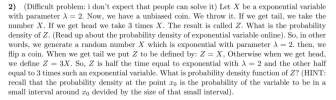 2) (Difficult problem: i don't expect that people can solve it) Let X be a exponential variable with parameter λ 2, Now, we have a unbiased coin. We throw it. If we get tall, we take the number X. If we get head we take 3 times X. The result is called Z. What is the probability density of Z. (Read up about the probability density of exponential variable online). So, in other words, we generate a random number X...
2. 20 greater tildll 20! Consider the following discrete probability distribution. -25 -15 10 20 PIX=x)...
 2. 20 greater tildll 20! Consider the following discrete probability distribution. -25 -15 10 20 PIX=x) 0.35 0.10 0.10 a. Complete the probability distribution. b. Graphically depict the probability distribution and comment on the symmetry of the distribution. C. What is the probability that the random variable X is negative? d. What is the probability that the random variable X is greater than -20? e. What is the probability that the random variable X is less than 20?
1. (15 points) Let X be a continuous random variable with probability density function f (x) c(1-), 0 < 1, where...
 1. (15 points) Let X be a continuous random variable with probability density function f (x) c(1-), 0 < 1, where c is a constant. i) Find the constant c ii) What is the distribution function of X? ii) Let Y 1x<0.5 Find the conditional expectation E(X|Y).
1. (15 points) Let X be a continuous random variable with probability density function f (x) c(1-), 0
1. (15 points) Let X be a continuous random variable with probability density function f (x) c(1-), 0 < 1, where c is a constant. i) Find the constant c ii) What is the distribution function of X? ii) Let Y 1x<0.5 Find the conditional expectation E(X|Y).
1. (15 points) Let X be a continuous random variable with probability density function f (x) c(1-), 0
 Let X be an exponential random variable with mean μ=2.0. Define the event A to be FXM(x/Ac) conditional probability distribution function fx /バ(x/ Ac ) , function and conditional density where A denotes the complement of the event A. [15 points] X/A
 (3.4) This question is about a continuous probability dis- tribution known as the exponential distribution Let x be a continuous random variable that can take any value x 20. A quantity is said to be exponen- tially distributed if it takes values between r and r + dr with probability where A and A are constants. (a) Find the value of A that makes P() a well- defined continuous probability distribution so that Jo o P(x) dx = 1 (b)...
 6. (15 points) Let X be an exponential random variable with mean 3. Answer the following: (a) Find the probability density function f(x). (b) Compute the probabilities P(2 < X < 6) and P(X 24). (c) Find the variance.
 Problem 5. Let X be a continuous random variable with a 2-paameter exponential distribution with parameters α = 0.4 and xo = 0.45, ie, ;x 2 0.45 x 〈 0.45 f(x) = (2.5e-2.5 (-0.45) Variable Y is a function of X: a) Find the first order approximation for the expected value and variance of Y b) Find the probability density function (PDF) of Y. c) Find the expected value and variance of Y from its PDF
Problem 5. Let X...
Problem 5. Let X be a continuous random variable with a 2-paameter exponential distribution with parameters α = 0.4 and xo = 0.45, ie, ;x 2 0.45 x 〈 0.45 f(x) = (2.5e-2.5 (-0.45) Variable Y is a function of X: a) Find the first order approximation for the expected value and variance of Y b) Find the probability density function (PDF) of Y. c) Find the expected value and variance of Y from its PDF
Problem 5. Let X...
 Problem 3. Let X be a discrete random variable, with probability distribution Determine x1 and X2 such that E(X-0 and ơ2(X-7.
 Problem 7 (15 points). Let X be random variable with the binomial distribution with parameters n and 0 <p<1. (1) Show that **- 1 = 2* for any 1 Sxsn. (2) Show that when 0 < x < (n + 1)p, P(X = x) is an increasing function x and for (n + 1)p <x Sn, P(X = x) is a decreasing function x. (3) A certain basketball player makes a foul shot with probability 0.80. Determine for whal value...
 Problem 3 [5 points) (a) [2 points] Let X be an exponential random variable with parameter 1 =1. find the conditional probability P{X>3|X>1). (b) [3 points] Given unit Gaussian CDF (x). For Gaussian random variable Y - N(u,02), write down its Probability Density Function (PDF) [1 point], and express P{Y>u+30} in terms of (x) [2 points)
 2) (Difficult problem: i don't expect that people can solve it) Let X be a exponential variable with parameter λ 2, Now, we have a unbiased coin. We throw it. If we get tall, we take the number X. If we get head we take 3 times X. The result is called Z. What is the probability density of Z. (Read up about the probability density of exponential variable online). So, in other words, we generate a random number X...
 2. 20 greater tildll 20! Consider the following discrete probability distribution. -25 -15 10 20 PIX=x) 0.35 0.10 0.10 a. Complete the probability distribution. b. Graphically depict the probability distribution and comment on the symmetry of the distribution. C. What is the probability that the random variable X is negative? d. What is the probability that the random variable X is greater than -20? e. What is the probability that the random variable X is less than 20?
 1. (15 points) Let X be a continuous random variable with probability density function f (x) c(1-), 0 < 1, where c is a constant. i) Find the constant c ii) What is the distribution function of X? ii) Let Y 1x<0.5 Find the conditional expectation E(X|Y).
1. (15 points) Let X be a continuous random variable with probability density function f (x) c(1-), 0
1. (15 points) Let X be a continuous random variable with probability density function f (x) c(1-), 0 < 1, where c is a constant. i) Find the constant c ii) What is the distribution function of X? ii) Let Y 1x<0.5 Find the conditional expectation E(X|Y).
1. (15 points) Let X be a continuous random variable with probability density function f (x) c(1-), 0
Most questions answered within 3 hours.
-
Where is the error in this code sequence?
String s1 = "Hello";
String s2 = "ello";...
asked 10 months ago -
Financial data for Joel de Paris, Inc., for last year
follow:
Joel de Paris, Inc.
Balance...
asked 10 months ago -
Consider this reaction:
Al2(SO4)3 (aq)+ BaCl3
(aq) Al2Cl6 (aq)- +
3BaSO4(s) . What is the...
asked 10 months ago -
Suppose that Savneet is considering increasing her
recent random sample from 20 car rentals to 40...
asked 10 months ago -
Trucks arrive at an unloading terminal at an average rate of 120
per hour.
Trucks arrive...
asked 10 months ago -
Why are methanol and ethanol completely soluble in water while
octanol is not very little soluble....
asked 10 months ago -
A facilities manager at a university reads in a research report
that the mean amount of...
asked 10 months ago -
When the CuSO4 is rehydrated by adding water to the anhydrous
compound, is this an endothermic...
asked 10 months ago -
A ray of sunlight is passing from diamond into crown glass; the
angle of incidence is...
asked 10 months ago -
A block of mass 0.249 kg is placed on top of a light, vertical
spring of...
asked 10 months ago -
how do the kidneys compensate in the presences of acidosis
a) trigger hyperventilate
b) reserve acid...
asked 10 months ago -
Question 501 pts
The rental rate of capital to the firm increases. Which of the
following...
asked 10 months ago