
Homework Answers
Add Answer to:
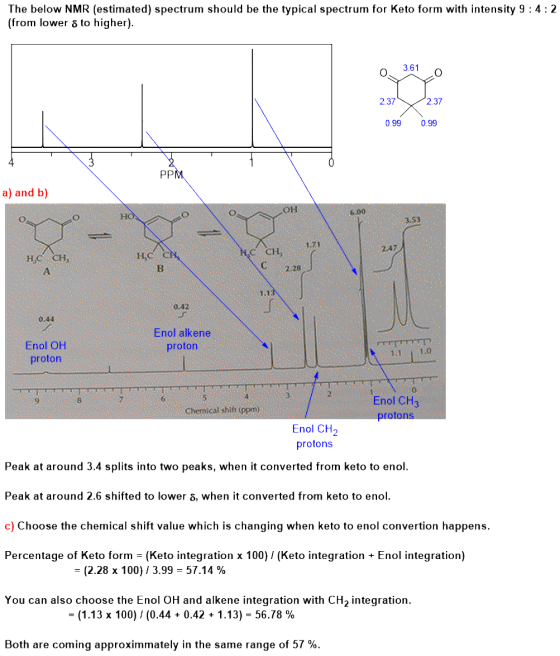
In solution, dimedone (5,5-dimethylcyclohexan-1,3-dione) is a mixture of keto (A) and enol (B & C) isomers...
CLH Pre-laboratory Questions and Problems 1. Dimedone can exist in either the keto (1) or enol...
 CLH Pre-laboratory Questions and Problems 1. Dimedone can exist in either the keto (1) or enol (2) tautomeric form. OH с HCl - H3C. C HẠC | 0 PHỤCo 2 Predict the 'H NMR and IR spectra of 1 and 2. Answer must include functional groups and wave numbers in cm for IR spectrum. For NMR spectrum, mark and label proton(s) on the structure and then include in answer type of proton(s),? multiplicity and number of each type of proton(s)....
7. (3 pts.) Shown below is the 'HNMR spectrum of curcumin in solution. In solution, curcumin...
 7. (3 pts.) Shown below is the 'HNMR spectrum of curcumin in solution. In solution, curcumin could exist in diketone form or enol form, or as a mixture of the two. We can determine if the spectrum corresponds to the keto form or the enol form or a mixture of the two forms. If the spectrum corresponds to both the keto and enol form we should see the peaks for Ha protons in the keto form and the Hb proton...
NEED HELP WITH B) C) D) E) F) and G) that apply to the spectra below....
 NEED HELP WITH B) C) D) E) F) and G) that apply to the
spectra below.
OTHER ANSWERS ARE THERE TO SUPPLEMENT
Thank you!
5. Using the GC mentioned in question 4 and the values listed on
the chromatogram for the height and width (at half height) of each
peak, calculate the percent composition for each product (A, B and
C). Be sure to show your work.
Area of peak A = 125 x 8 =
1000mm2
Area of peak...
NEED HELP WITH B) C) D) E) F) and G) that apply to the
spectra below.
OTHER ANSWERS ARE THERE TO SUPPLEMENT
Thank you!
5. Using the GC mentioned in question 4 and the values listed on
the chromatogram for the height and width (at half height) of each
peak, calculate the percent composition for each product (A, B and
C). Be sure to show your work.
Area of peak A = 125 x 8 =
1000mm2
Area of peak...
Synthesis of dimedone This lab exercise will give you practical experience with the generation of...
 Synthesis of dimedone This lab exercise will give you practical experience with the generation of a malonic ester enolate and subsequent reaction with an a,p-unsaturated carbonyl compound. This sequence is known as the Michael reaction. In the presence of sodium methoxide, dimethyl propanedioate (malonic ester/dimethyl malonate) is converted to the corresponding enolate anion and reaction with 4-methylpent-3-en-2-one (mesityl oxide) affords the Michael adduct 1, as shown in the reaction sequence below. Under the basic reaction conditions, the Michael adduct 1...
Synthesis of dimedone This lab exercise will give you practical experience with the generation of...
 Synthesis of dimedone This lab exercise will give you practical experience with the generation of a malonic ester enolate and subsequent reaction with an a,p-unsaturated carbonyl compound. This sequence is known as the Michael reaction. In the presence of sodium methoxide, dimethyl propanedioate (malonic ester/dimethyl malonate) is converted to the corresponding enolate anion and reaction with 4-methylpent-3-en-2-one (mesityl oxide) affords the Michael adduct 1, as shown in the reaction sequence below. Under the basic reaction conditions, the Michael adduct 1...
Question to answer from the lab: What aspect(s) of the approach taken is/are NOT especially green?...
Question to answer from the lab: What aspect(s) of the approach taken is/are NOT especially green? What changes might be made to make the overall process greener? The Lab Experiment Summary Polyethylene glycols such as PEG-400 are currently of great interest to organic chemists, since their application as reaction solvents is very intriguing (1). PEG-400 is non-volatile and nonflammable in nature, and also possesses important properties such as recyclability, ease of work-up, thermal stability and economical cost. In addition, the...
 CLH Pre-laboratory Questions and Problems 1. Dimedone can exist in either the keto (1) or enol (2) tautomeric form. OH с HCl - H3C. C HẠC | 0 PHỤCo 2 Predict the 'H NMR and IR spectra of 1 and 2. Answer must include functional groups and wave numbers in cm for IR spectrum. For NMR spectrum, mark and label proton(s) on the structure and then include in answer type of proton(s),? multiplicity and number of each type of proton(s)....
 7. (3 pts.) Shown below is the 'HNMR spectrum of curcumin in solution. In solution, curcumin could exist in diketone form or enol form, or as a mixture of the two. We can determine if the spectrum corresponds to the keto form or the enol form or a mixture of the two forms. If the spectrum corresponds to both the keto and enol form we should see the peaks for Ha protons in the keto form and the Hb proton...
 NEED HELP WITH B) C) D) E) F) and G) that apply to the
spectra below.
OTHER ANSWERS ARE THERE TO SUPPLEMENT
Thank you!
5. Using the GC mentioned in question 4 and the values listed on
the chromatogram for the height and width (at half height) of each
peak, calculate the percent composition for each product (A, B and
C). Be sure to show your work.
Area of peak A = 125 x 8 =
1000mm2
Area of peak...
NEED HELP WITH B) C) D) E) F) and G) that apply to the
spectra below.
OTHER ANSWERS ARE THERE TO SUPPLEMENT
Thank you!
5. Using the GC mentioned in question 4 and the values listed on
the chromatogram for the height and width (at half height) of each
peak, calculate the percent composition for each product (A, B and
C). Be sure to show your work.
Area of peak A = 125 x 8 =
1000mm2
Area of peak...
 Synthesis of dimedone This lab exercise will give you practical experience with the generation of a malonic ester enolate and subsequent reaction with an a,p-unsaturated carbonyl compound. This sequence is known as the Michael reaction. In the presence of sodium methoxide, dimethyl propanedioate (malonic ester/dimethyl malonate) is converted to the corresponding enolate anion and reaction with 4-methylpent-3-en-2-one (mesityl oxide) affords the Michael adduct 1, as shown in the reaction sequence below. Under the basic reaction conditions, the Michael adduct 1...
 Synthesis of dimedone This lab exercise will give you practical experience with the generation of a malonic ester enolate and subsequent reaction with an a,p-unsaturated carbonyl compound. This sequence is known as the Michael reaction. In the presence of sodium methoxide, dimethyl propanedioate (malonic ester/dimethyl malonate) is converted to the corresponding enolate anion and reaction with 4-methylpent-3-en-2-one (mesityl oxide) affords the Michael adduct 1, as shown in the reaction sequence below. Under the basic reaction conditions, the Michael adduct 1...
Most questions answered within 3 hours.
-
Where is the error in this code sequence?
String s1 = "Hello";
String s2 = "ello";...
asked 10 months ago -
Financial data for Joel de Paris, Inc., for last year
follow:
Joel de Paris, Inc.
Balance...
asked 10 months ago -
Consider this reaction:
Al2(SO4)3 (aq)+ BaCl3
(aq) Al2Cl6 (aq)- +
3BaSO4(s) . What is the...
asked 10 months ago -
Suppose that Savneet is considering increasing her
recent random sample from 20 car rentals to 40...
asked 10 months ago -
Trucks arrive at an unloading terminal at an average rate of 120
per hour.
Trucks arrive...
asked 10 months ago -
Why are methanol and ethanol completely soluble in water while
octanol is not very little soluble....
asked 10 months ago -
A facilities manager at a university reads in a research report
that the mean amount of...
asked 10 months ago -
When the CuSO4 is rehydrated by adding water to the anhydrous
compound, is this an endothermic...
asked 10 months ago -
A ray of sunlight is passing from diamond into crown glass; the
angle of incidence is...
asked 10 months ago -
A block of mass 0.249 kg is placed on top of a light, vertical
spring of...
asked 10 months ago -
how do the kidneys compensate in the presences of acidosis
a) trigger hyperventilate
b) reserve acid...
asked 10 months ago -
Question 501 pts
The rental rate of capital to the firm increases. Which of the
following...
asked 10 months ago