
Homework Answers
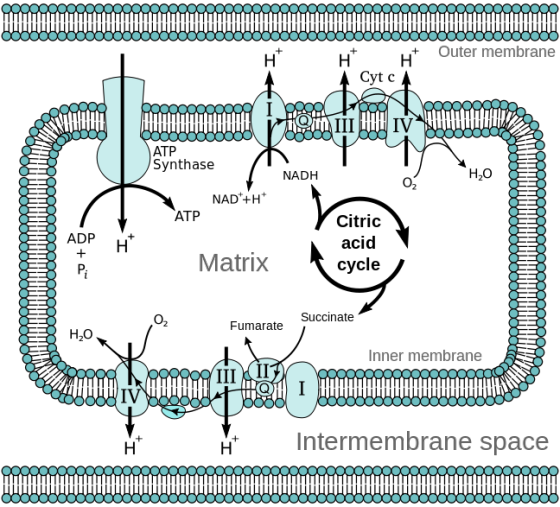
Electron transport chain (ETC) is a series of proteins and organic molecules which are located in the inner membrane of the mitochondria. In ETC electrons are passed from donor Molecule to other carrier molecule in a series of redox reactions and energy is released in form of ATP.
ETC has four electron carrier complexes as follows:
1. Complex I – It is called NADH dehydrogenase, it is composed of polypeptide chains and has several Fe-S centers.
2. Complex II: Succinate Dehydrogenase, It Transfers 2 electrons from succinate to coenzyme Q, It has 4 different protein subunits
3. Complex III: Ubiquinone Cytochrome C Oxidoreductase, which is made up of heme groups and Fe-S centers.
4. Complex IV: Cytochrome C Oxidase, It is made up of cytochromes and Fe-S centers.
ETC initiates as Complex I accepts electrons from NADH and transfers an electron. Complex II includes succinate dehydrogenase is also link between the citric acid cycle and the electron transport chain, Complexes I and II both reduced coenzyme Q,CoQH2 which is the substrate for Complex III. Complex III transfers the electrons from CoQH2 and reduces cytochrome c which is the substrate for Complex IV. Complex IV transfers the electrons from cytochrome c and reduces molecular oxygen into water.
Molecules involved in ETC:
- NADH: It’s an electron donor and can initiate redox reaction. It transfers an electrons to complex I and forms NAD+.As electrons passes through complex I energy is released, this energy is utilized to pump protons (H+) from the matrix into the intermembrane space of mitochondria.
- FADH: it helps to transfer electrons into the transport chain through complex II. They can accept or donate electrons
- Coenzyme Q (CoQ): CoQ has repeating isoprene subunits, Coenzyme Q is an electron carrier when it’s in the hydrophobic bilipid layer of the mitochondria. They can be donate or accept electrons.
- Cytochromes: They are proteins that contain heme prosthetic groups which function as one electron carriers. The heme iron is involved in one electron transfers involving the Fe2+ and Fe3+ oxidation states. Cytochromes are a, a3, b and c depending on their porphyrin structure.
- Iron-Sulfur Proteins: These proteins which participates in ETC are always present in Fe2+ and Fe3+ oxidation states.
- Copper Proteins Copper bound proteins: they are present in the Cu+ and Cu2+ oxidation states.
Add Answer to:
What are the names of the four complexes in the electron transport chain? What molecules/electron carriers...
Which complex in the electron transport chain does not contribute to the proton gradient across the...
Which complex in the electron transport chain does not contribute to the proton gradient across the mitochondrial membrane? A. Complex I B. Complex IV C. Complex II D. Complex III Which statement regarding the mitochondrial electron transport chain and oxidative phosphorylation is true? A. Ubiquinone and the F zero subunit of ATP synthase are peripheral membrane proteins. B. Complexes I, II, III, and IV all are proton pumps. C. The final electron acceptor is water. D. Complex II is considered...
Which electron carrier brings electrons to the electron transport chain via complex II? Which electron carrier...
 Which electron carrier brings
electrons to the electron transport chain via complex II?
Which electron carrier brings electrons to the electron transport chain via Complex II? FADH_2 FAD NADH NAD^+ Which electron carrier brings electrons to the electron transport chain via Complex I? FADH_2 FAD NADH NAD^+ As the electron transport chain proceeds, electrons H^+ ions water CO_2 molecules are pumped into the intermembrane space cytoplasm matrix nucleus
Which electron carrier brings
electrons to the electron transport chain via complex II?
Which electron carrier brings electrons to the electron transport chain via Complex II? FADH_2 FAD NADH NAD^+ Which electron carrier brings electrons to the electron transport chain via Complex I? FADH_2 FAD NADH NAD^+ As the electron transport chain proceeds, electrons H^+ ions water CO_2 molecules are pumped into the intermembrane space cytoplasm matrix nucleus
The electron transport chain(ETC), or respiratory chain, is linked to proton movement and ATPsynthesis....
The electron transport chain (ETC), or respiratory chain, is linked to proton movement and ATP synthesis. Select the statements that accurately describe the electron transport chain. Choose all that apply.Prosthetic groups, such as iron-sulfur centers, are directly involved with electron transfer. The reactions of the ETC take place in the outer membrane of mitochondria. Electron carriers in the mitochondrial matrix include ubiquinone (coenzyme Q), FMN, and cytochrome c. The outer membrane of mitochondria is readily permeable to small molecules and hydrogen ions. Electrons generated...
B. The electron transport chain (ETC) consists of four protein complexes as shown in the following...
 B. The electron transport chain (ETC) consists of four protein
complexes as shown in the following figure.
1. Name the complex(es) where electrons enter the ETC:
2. How many electrons are accepted at the entry point(s) per
cycle?
The Electron Transport Chain showing the four complexes embedded
in the inner mitochondrial membrane. Barbiturates inhibits Complex
I and cyanide inhibits Complex IV.
3. Barbiturates, a class of drugs, interrupt the flow of
electrons in the chain by inhibiting Complex I. Cyanide,...
B. The electron transport chain (ETC) consists of four protein
complexes as shown in the following figure.
1. Name the complex(es) where electrons enter the ETC:
2. How many electrons are accepted at the entry point(s) per
cycle?
The Electron Transport Chain showing the four complexes embedded
in the inner mitochondrial membrane. Barbiturates inhibits Complex
I and cyanide inhibits Complex IV.
3. Barbiturates, a class of drugs, interrupt the flow of
electrons in the chain by inhibiting Complex I. Cyanide,...
What is the function of cytochrome c in the electron transport chain? Question 3 of 4...
 What is the function of cytochrome c in the electron
transport chain?
Question 3 of 4 To answer this question, you may reference the Metabolic Map. What is the function of cytochrome c in the electron transport chain? o It reduces two molecules of Q to QH2. It oxidizes NADH to NAD+. It oxidizes FADH2 to FAD. It transports two electrons from NADH or FADH to complex III. It transports an electron from complex III to complex IV.
What is the function of cytochrome c in the electron
transport chain?
Question 3 of 4 To answer this question, you may reference the Metabolic Map. What is the function of cytochrome c in the electron transport chain? o It reduces two molecules of Q to QH2. It oxidizes NADH to NAD+. It oxidizes FADH2 to FAD. It transports two electrons from NADH or FADH to complex III. It transports an electron from complex III to complex IV.
The electron transport chain (ETC), or respiratory chain, is linked to proton movement and ATP synthesis....
 The electron transport chain (ETC), or respiratory chain, is linked to proton movement and ATP synthesis. Select the statements that accurately describe the electron transport chain Choose all that apply. Electron transfer in the ETC is coupled to proton transfer from the matrix to the intermembrane space The outer membrane of mitochondria is readily permeable to small molecules and hydrogen ions. Prosthetic groups, such as iron-sulfur centers, are directly involved with electron transfer. Electron carriers in the ETC include ubiquinone...
Cellular respiration: The Electron Transport Chain The breakdown of glucose ends during the Krebs cydle; however,...
 Cellular respiration: The Electron Transport Chain The breakdown of glucose ends during the Krebs cydle; however, it is important to note that the energy previously contained in glucose is mostly stored in NADH and FADHz. In the last step of celular respiration, the high-energy electrons within NADH and FADH2 are passed within a set of proteins found in the inner membrane of the mitochondrion, collectively known as the electron transport chain. The electrons provide the energy to create ATP, which...
NADH passes electrons into the electron transport chain. List the carriers that would receive the electrons,...
NADH passes electrons into the electron transport chain. List the carriers that would receive the electrons, in the correct order. What is the difference between homolactic and heterolactic fermentation routes? Name any chemical compound that can be used as an initial electron donor by the chemolithotrophs.
118) The electrons of the electron transport chain come from molecules produced during: glycolysis a) the...
 118) The electrons of the electron transport chain come from molecules produced during: glycolysis a) the krebs cycle b) c) sugar metabolism d) all of the above a and b only e) 119) The electrons of the electron transport chain come from: a) NAD+ b) FAD+ NADH and FADH c) all of the above d) e) a and b 120) In feedback inhibition loop, which often serves as the allosteric inhibitor? a) The enzyme b) The starting compound c) ATP...
Use the following figure to describe the electron transport chain. What is the last electron acceptor?...
 Use the following figure to describe the electron transport
chain. What is the last electron acceptor?
PROCESS: ELECTRON TRANSPORT CHAIN Intermembrane space H H H H H H H + H H+ H+ H H H" H H Η* Η' H+ H" H Η" H+ H H H H H H+ H H+ H+" Η' Η' H H.com lex H+ H+ H Membrane of cristae Complex IV DODIK 6- Cytcem have for you were complex withoutwedi OD വI ( വിവാ...
Use the following figure to describe the electron transport
chain. What is the last electron acceptor?
PROCESS: ELECTRON TRANSPORT CHAIN Intermembrane space H H H H H H H + H H+ H+ H H H" H H Η* Η' H+ H" H Η" H+ H H H H H H+ H H+ H+" Η' Η' H H.com lex H+ H+ H Membrane of cristae Complex IV DODIK 6- Cytcem have for you were complex withoutwedi OD വI ( വിവാ...
 Which electron carrier brings
electrons to the electron transport chain via complex II?
Which electron carrier brings electrons to the electron transport chain via Complex II? FADH_2 FAD NADH NAD^+ Which electron carrier brings electrons to the electron transport chain via Complex I? FADH_2 FAD NADH NAD^+ As the electron transport chain proceeds, electrons H^+ ions water CO_2 molecules are pumped into the intermembrane space cytoplasm matrix nucleus
Which electron carrier brings
electrons to the electron transport chain via complex II?
Which electron carrier brings electrons to the electron transport chain via Complex II? FADH_2 FAD NADH NAD^+ Which electron carrier brings electrons to the electron transport chain via Complex I? FADH_2 FAD NADH NAD^+ As the electron transport chain proceeds, electrons H^+ ions water CO_2 molecules are pumped into the intermembrane space cytoplasm matrix nucleus
 B. The electron transport chain (ETC) consists of four protein
complexes as shown in the following figure.
1. Name the complex(es) where electrons enter the ETC:
2. How many electrons are accepted at the entry point(s) per
cycle?
The Electron Transport Chain showing the four complexes embedded
in the inner mitochondrial membrane. Barbiturates inhibits Complex
I and cyanide inhibits Complex IV.
3. Barbiturates, a class of drugs, interrupt the flow of
electrons in the chain by inhibiting Complex I. Cyanide,...
B. The electron transport chain (ETC) consists of four protein
complexes as shown in the following figure.
1. Name the complex(es) where electrons enter the ETC:
2. How many electrons are accepted at the entry point(s) per
cycle?
The Electron Transport Chain showing the four complexes embedded
in the inner mitochondrial membrane. Barbiturates inhibits Complex
I and cyanide inhibits Complex IV.
3. Barbiturates, a class of drugs, interrupt the flow of
electrons in the chain by inhibiting Complex I. Cyanide,...
 What is the function of cytochrome c in the electron
transport chain?
Question 3 of 4 To answer this question, you may reference the Metabolic Map. What is the function of cytochrome c in the electron transport chain? o It reduces two molecules of Q to QH2. It oxidizes NADH to NAD+. It oxidizes FADH2 to FAD. It transports two electrons from NADH or FADH to complex III. It transports an electron from complex III to complex IV.
What is the function of cytochrome c in the electron
transport chain?
Question 3 of 4 To answer this question, you may reference the Metabolic Map. What is the function of cytochrome c in the electron transport chain? o It reduces two molecules of Q to QH2. It oxidizes NADH to NAD+. It oxidizes FADH2 to FAD. It transports two electrons from NADH or FADH to complex III. It transports an electron from complex III to complex IV.
 The electron transport chain (ETC), or respiratory chain, is linked to proton movement and ATP synthesis. Select the statements that accurately describe the electron transport chain Choose all that apply. Electron transfer in the ETC is coupled to proton transfer from the matrix to the intermembrane space The outer membrane of mitochondria is readily permeable to small molecules and hydrogen ions. Prosthetic groups, such as iron-sulfur centers, are directly involved with electron transfer. Electron carriers in the ETC include ubiquinone...
 Cellular respiration: The Electron Transport Chain The breakdown of glucose ends during the Krebs cydle; however, it is important to note that the energy previously contained in glucose is mostly stored in NADH and FADHz. In the last step of celular respiration, the high-energy electrons within NADH and FADH2 are passed within a set of proteins found in the inner membrane of the mitochondrion, collectively known as the electron transport chain. The electrons provide the energy to create ATP, which...
 118) The electrons of the electron transport chain come from molecules produced during: glycolysis a) the krebs cycle b) c) sugar metabolism d) all of the above a and b only e) 119) The electrons of the electron transport chain come from: a) NAD+ b) FAD+ NADH and FADH c) all of the above d) e) a and b 120) In feedback inhibition loop, which often serves as the allosteric inhibitor? a) The enzyme b) The starting compound c) ATP...
 Use the following figure to describe the electron transport
chain. What is the last electron acceptor?
PROCESS: ELECTRON TRANSPORT CHAIN Intermembrane space H H H H H H H + H H+ H+ H H H" H H Η* Η' H+ H" H Η" H+ H H H H H H+ H H+ H+" Η' Η' H H.com lex H+ H+ H Membrane of cristae Complex IV DODIK 6- Cytcem have for you were complex withoutwedi OD വI ( വിവാ...
Use the following figure to describe the electron transport
chain. What is the last electron acceptor?
PROCESS: ELECTRON TRANSPORT CHAIN Intermembrane space H H H H H H H + H H+ H+ H H H" H H Η* Η' H+ H" H Η" H+ H H H H H H+ H H+ H+" Η' Η' H H.com lex H+ H+ H Membrane of cristae Complex IV DODIK 6- Cytcem have for you were complex withoutwedi OD വI ( വിവാ...
Most questions answered within 3 hours.
-
Where is the error in this code sequence?
String s1 = "Hello";
String s2 = "ello";...
asked 11 months ago -
Financial data for Joel de Paris, Inc., for last year
follow:
Joel de Paris, Inc.
Balance...
asked 11 months ago -
Consider this reaction:
Al2(SO4)3 (aq)+ BaCl3
(aq) Al2Cl6 (aq)- +
3BaSO4(s) . What is the...
asked 11 months ago -
Suppose that Savneet is considering increasing her
recent random sample from 20 car rentals to 40...
asked 11 months ago -
Trucks arrive at an unloading terminal at an average rate of 120
per hour.
Trucks arrive...
asked 11 months ago -
Why are methanol and ethanol completely soluble in water while
octanol is not very little soluble....
asked 11 months ago -
A facilities manager at a university reads in a research report
that the mean amount of...
asked 11 months ago -
When the CuSO4 is rehydrated by adding water to the anhydrous
compound, is this an endothermic...
asked 11 months ago -
A ray of sunlight is passing from diamond into crown glass; the
angle of incidence is...
asked 11 months ago -
A block of mass 0.249 kg is placed on top of a light, vertical
spring of...
asked 11 months ago -
how do the kidneys compensate in the presences of acidosis
a) trigger hyperventilate
b) reserve acid...
asked 11 months ago -
Question 501 pts
The rental rate of capital to the firm increases. Which of the
following...
asked 11 months ago