At 25° C and at a constant pH of 5, the inversion of sucrose proceeds with...
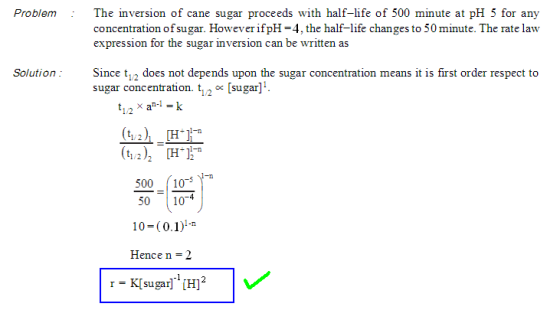
At 25° C and at a constant pH of 5, the inversion of sucrose proceeds with a constant half-life of 500 min. At this same temperature, but at a pH of 4, the half-life is constant at 50 min. The rate law is . What are the values of a and b?
Homework Answers
Answer: rate = k [sugar]-1[H+]2---------------> Yes you read is correct, not possible, but question test our knowledge.
The given rate law is

I know this question is from
http://faculty.virginia.edu/richardson/thermo/problems/problems/question/9/quest9.htm
Hope this helped you!
Thank You So Much! Please Rate this answer as you wish.("Thumbs Up")
Add Answer to:
At 25° C and at a constant pH of 5, the inversion of sucrose
proceeds with...
The rate constant for the first-order decomposition of N_2O_5 in the xeactron2 N_2O_5(g) rightarroe 4 NO_2(g)+O_2(g)...
 The rate constant for the first-order decomposition of N_2O_5 in the xeactron2 N_2O_5(g) rightarroe 4 NO_2(g)+O_2(g) is k_I = 3.38 times 10^-5 s^-1 at 25 degree C. What is the half-life of N205? What will be the pressure, initially 500 Torr, after 50 20 min after initiation of the reaction?
Part D is what is needed C. Sucrose is readily hydrolyzed i.e. broken down back to...
 Part D is what is needed
C. Sucrose is readily hydrolyzed i.e. broken down back to glucose and fructose by reaction with acidic solution. The hydrolysis can be monitored by measuring the angle of rotation of plane-polarized light passing through the solution because the concentration of sucrose can be inferred from this angle. An experiment on the hydrolysis of sucrose in 0.5 M HCl(aq) produced the following data: t/min 0 (sucrose) 0.316 /M 14 0.300 39 0.274 60 80 0.256...
Part D is what is needed
C. Sucrose is readily hydrolyzed i.e. broken down back to glucose and fructose by reaction with acidic solution. The hydrolysis can be monitored by measuring the angle of rotation of plane-polarized light passing through the solution because the concentration of sucrose can be inferred from this angle. An experiment on the hydrolysis of sucrose in 0.5 M HCl(aq) produced the following data: t/min 0 (sucrose) 0.316 /M 14 0.300 39 0.274 60 80 0.256...
An enzyme catalyzes conversion of sucrose to fructose. The half-life of the reaction depends on the...
An enzyme catalyzes conversion of sucrose to fructose. The half-life of the reaction depends on the concentration of sucrose. With an initial concentration of 3.0 M sucrose, t1/2 = 1.36x10⁻⁴ s. With an initial concentration of 1.0 M sucrose, t1/2 = 4.5x10⁻⁵ s. a. What is the reaction order in sucrose? b. Calculate the rate constant for the reaction.
The hydrolysis of sucrose (C12H22O11) into glucose and fructose in acidic water has a rate constant...
The hydrolysis of sucrose (C12H22O11) into glucose and fructose in acidic water has a rate constant of 1.8×10⁻⁴s−1 at 25 ∘C. Assuming the reaction is first order in sucrose, determine the mass of sucrose that is hydrolyzed when 2.60 L of a 0.120 M sucrose solution is allowed to react for 195 min.
The hydrolysis of sucrose (C12H22O11) into glucose and fructose in acidic water has a rate constant...
The hydrolysis of sucrose (C12H22O11) into glucose and fructose in acidic water has a rate constant of 1.8×10⁻⁴s−1 at 25 ∘C. Assuming the reaction is first order in sucrose, determine the mass of sucrose that is hydrolyzed when 2.40 L of a 0.160 M sucrose solution is allowed to react for 195 min .
The hydrolysis of sucrose (C12H22O11) into glucose and fructose in acidic water has a rate constant...
The hydrolysis of sucrose (C12H22O11) into glucose and fructose in acidic water has a rate constant of 1.8×10⁻⁴s−1 at 25 ∘C. Assuming the reaction is first order in sucrose, determine the mass of sucrose that is hydrolyzed when 2.70 L of a 0.120 M sucrose solution is allowed to react for 195 min .
1. If the rate constant of a reaction increases by 2.5 when the temperature is increased...
1. If the rate constant of a reaction increases by 2.5 when the temperature is increased from 25 C to 34 C, then what is the activation energy (in kJ/mole) of the reactions? 2. If a reaction is first order with a rate constant of 4.48 x 10 ^ -2 sec ^-1, how long is required for 3/4 of the initial concentration of reactant to be used up? 3. Which statement is true or NOT regarding the experimental determination of...
The reaction A + 2B → C proceeds according to the rate law, rate = k[A][B]...
The reaction A + 2B → C proceeds according to the rate law, rate = k[A][B] with k = 6.05 x 10⁻³ M-1 min-1. Assume that at the start of a particular reaction, [A] = 0.275 M, [B] = 0.0950 M. What is the initial rate of reaction? What is the rate when half of B has reacted? Give units! [Remember: ln(ab) = ln(a) + ln(b)]
The reaction A + 2B → C proceeds according to the rate law, rate = k[A][B]...
The reaction A + 2B → C proceeds according to the rate law, rate = k[A][B] with k = 4.44 x 10⁻³ M-1 min-1. Assume that at the start of a particular reaction, [A] = 0.0650 M, [B] = 0.0550 M. What is the initial rate of reaction? What is the rate when half of B has reacted? Give units! [Remember: ln(ab) = ln(a) + ln(b)]
Integrated Rate Laws 1. The rate law expression for the reaction of sucrose in water C12H22O11 ...
Integrated Rate Laws 1. The rate law expression for the reaction of sucrose in water C12H22O11 + H2O ---> 2 C6H12O6 Is rate = k[C12H22O11]. a. What is the order with respect to each reactant? b. What is the overall order of the reaction? c. After 2.57 hours, 6.00g/L of C12H22O11 has decreased to 5.40g/L. Express these concentrations in units of M. d. What is the value and units for k given the information in part c? e. Knowing the...
 The rate constant for the first-order decomposition of N_2O_5 in the xeactron2 N_2O_5(g) rightarroe 4 NO_2(g)+O_2(g) is k_I = 3.38 times 10^-5 s^-1 at 25 degree C. What is the half-life of N205? What will be the pressure, initially 500 Torr, after 50 20 min after initiation of the reaction?
 Part D is what is needed
C. Sucrose is readily hydrolyzed i.e. broken down back to glucose and fructose by reaction with acidic solution. The hydrolysis can be monitored by measuring the angle of rotation of plane-polarized light passing through the solution because the concentration of sucrose can be inferred from this angle. An experiment on the hydrolysis of sucrose in 0.5 M HCl(aq) produced the following data: t/min 0 (sucrose) 0.316 /M 14 0.300 39 0.274 60 80 0.256...
Part D is what is needed
C. Sucrose is readily hydrolyzed i.e. broken down back to glucose and fructose by reaction with acidic solution. The hydrolysis can be monitored by measuring the angle of rotation of plane-polarized light passing through the solution because the concentration of sucrose can be inferred from this angle. An experiment on the hydrolysis of sucrose in 0.5 M HCl(aq) produced the following data: t/min 0 (sucrose) 0.316 /M 14 0.300 39 0.274 60 80 0.256...
Most questions answered within 3 hours.
-
Where is the error in this code sequence?
String s1 = "Hello";
String s2 = "ello";...
asked 10 months ago -
Financial data for Joel de Paris, Inc., for last year
follow:
Joel de Paris, Inc.
Balance...
asked 10 months ago -
Consider this reaction:
Al2(SO4)3 (aq)+ BaCl3
(aq) Al2Cl6 (aq)- +
3BaSO4(s) . What is the...
asked 10 months ago -
Suppose that Savneet is considering increasing her
recent random sample from 20 car rentals to 40...
asked 10 months ago -
Trucks arrive at an unloading terminal at an average rate of 120
per hour.
Trucks arrive...
asked 10 months ago -
Why are methanol and ethanol completely soluble in water while
octanol is not very little soluble....
asked 10 months ago -
A facilities manager at a university reads in a research report
that the mean amount of...
asked 10 months ago -
When the CuSO4 is rehydrated by adding water to the anhydrous
compound, is this an endothermic...
asked 10 months ago -
A ray of sunlight is passing from diamond into crown glass; the
angle of incidence is...
asked 10 months ago -
A block of mass 0.249 kg is placed on top of a light, vertical
spring of...
asked 10 months ago -
how do the kidneys compensate in the presences of acidosis
a) trigger hyperventilate
b) reserve acid...
asked 10 months ago -
Question 501 pts
The rental rate of capital to the firm increases. Which of the
following...
asked 10 months ago