The reaction A + 2B → C proceeds according to the rate law, rate = k[A][B]...
The reaction A + 2B → C proceeds according to the rate law, rate = k[A][B]
with k = 4.44 x 10⁻³ M-1 min-1. Assume that at the start of a particular reaction, [A] = 0.0650 M, [B] = 0.0550 M. What is the initial rate of reaction? What is the rate when half of B has reacted? Give units! [Remember: ln(ab) = ln(a) + ln(b)]
Homework Answers
Request Answer!
We need at least 10 more requests to produce the answer.
0 / 10 have requested this problem solution
The more requests, the faster the answer.
Add Answer to:
The reaction A + 2B → C proceeds according to the rate law, rate
= k[A][B]...
The reaction A + 2B → C proceeds according to the rate law, rate = k[A][B]...
The reaction A + 2B → C proceeds according to the rate law, rate = k[A][B] with k = 6.05 x 10⁻³ M-1 min-1. Assume that at the start of a particular reaction, [A] = 0.275 M, [B] = 0.0950 M. What is the initial rate of reaction? What is the rate when half of B has reacted? Give units! [Remember: ln(ab) = ln(a) + ln(b)]
B) Determine the integrated rate law for this reaction. C) Calculate the half-life for this reaction....
 B) Determine the integrated rate law for this reaction.
C) Calculate the half-life for this reaction.
D) How much time is required for the concentration of A to
decrease to 4.25x10^-3 M
A certain reaction has the following general form: At a particular temperature and Alo 3.40 × 10⁻² M concentration versus time data were collected for this reaction, and a plot of ln A versus time resulted in a straight line with a slope value of -2.91 x 10⁻²...
B) Determine the integrated rate law for this reaction.
C) Calculate the half-life for this reaction.
D) How much time is required for the concentration of A to
decrease to 4.25x10^-3 M
A certain reaction has the following general form: At a particular temperature and Alo 3.40 × 10⁻² M concentration versus time data were collected for this reaction, and a plot of ln A versus time resulted in a straight line with a slope value of -2.91 x 10⁻²...
The reaction 2A + 2B → M + N has the rate law: Rate = k[A]2....
The reaction 2A + 2B → M + N has the rate law: Rate = k[A]2. At 25°C, k = 0.0311 L mol-1 s-1. If the initial concentrations of A and B are 0.321 M and 0.499 M, respectively. What will be the concentrations of A and B after 30.0 minutes?
10. Consider the reaction A + 2B → C ne rate law for this reaction is...
 10. Consider the reaction A + 2B → C ne rate law for this reaction is on der in and and order in B if the rate constant at 25°C is 1.25x 10⁵ , find the rate of reaction when the concentration of A is 0.27M and the concentration of B is 0.32 M UMA 21 11. Consider the reaction A +2B C + D. The rate law for this reaction is first order in A and zeroth order in...
1. For the reaction, A + 2B + C +2D, some measurements of the initial rate...
 1. For the reaction, A + 2B + C +2D, some measurements of the initial rate of reaction at varying concentration gave the following data. run # [A] [B] rate, moll's eman 19 1 0.100 0.200 0.000360 20.150 0.200 0.000540 3 0.150 0.250 0.001055 012 noite a. the rate law is therefore: rate = k[A[B] b. the rate law is therefore: rate = k[A][B]', UX physHouten c. the rate law is therefore: rate = K[A[B] d. the rate law is...
15. A. B. C. D. E. The rate law for the reaction 3A - 2B is...
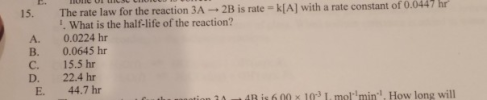 15. A. B. C. D. E. The rate law for the reaction 3A - 2B is rate = k[A] with a rate constant of 0.0447 hr What is the half-life of the reaction? 0.0224 hr 0.0645 hr 15.5 hr 22.4 hr 44.7 hr 4B is 600 x 10- 31 mol-1minHow long will
AB 3. For the reaction 2 A B , the rate law is a = k[A]....
 AB 3. For the reaction 2 A B , the rate law is a = k[A]. What are the units of the rate constant where time is measured in seconds? A) B) M. C) Ń D) EMS What are the units of the
2 Consider the reaction A + 2B-C Part A whose rate at 25°C was measured using...
 2
Consider the reaction A + 2B-C Part A whose rate at 25°C was measured using three different sets of initial concentrations as listed in the following table What is the rate law for this reaction? Express the rate law symbolically in terms of k. (A), and B). View Available Hint(s) A B Rate (AD (M) (M/s) 0.15 0.050 1.4 10-3 0.15 0.100 2.7-10- 0.30 0.050 5.4x10⁻³ 1 2 3 rate = k[A'B' Previous Answers Correct Part B Calculate the...
2
Consider the reaction A + 2B-C Part A whose rate at 25°C was measured using three different sets of initial concentrations as listed in the following table What is the rate law for this reaction? Express the rate law symbolically in terms of k. (A), and B). View Available Hint(s) A B Rate (AD (M) (M/s) 0.15 0.050 1.4 10-3 0.15 0.100 2.7-10- 0.30 0.050 5.4x10⁻³ 1 2 3 rate = k[A'B' Previous Answers Correct Part B Calculate the...
Which mechanism is consistent with the rate law rate = k[A][B]for the reaction A + 2B...
Which mechanism is consistent with the rate law rate = k[A][B]for the reaction A + 2B --> 2C? A) Step 1. A + B ---> F, slow Step 2. B + F ---> 2C, fast B) Step 1. B + B ---> D, slow Step 2. A + D ---> 2C, fast C) Step 1. A + A ---> E, slow Step 2. B + E ---> 2C, fast D) Step 1. A + B ---> G, fast Step 2....
Consider the reaction A ⟶ Products. The rate law for this reaction is rate = k[A]...
Consider the reaction A ⟶ Products. The rate law for this reaction is rate = k[A] where k= 3.00 X × 10-3 s-1 at a particular temperature. If the initial [A] = 0.500 M, what will be the concentration of A after 2.00 minutes
 B) Determine the integrated rate law for this reaction.
C) Calculate the half-life for this reaction.
D) How much time is required for the concentration of A to
decrease to 4.25x10^-3 M
A certain reaction has the following general form: At a particular temperature and Alo 3.40 × 10⁻² M concentration versus time data were collected for this reaction, and a plot of ln A versus time resulted in a straight line with a slope value of -2.91 x 10⁻²...
B) Determine the integrated rate law for this reaction.
C) Calculate the half-life for this reaction.
D) How much time is required for the concentration of A to
decrease to 4.25x10^-3 M
A certain reaction has the following general form: At a particular temperature and Alo 3.40 × 10⁻² M concentration versus time data were collected for this reaction, and a plot of ln A versus time resulted in a straight line with a slope value of -2.91 x 10⁻²...
 10. Consider the reaction A + 2B → C ne rate law for this reaction is on der in and and order in B if the rate constant at 25°C is 1.25x 10⁵ , find the rate of reaction when the concentration of A is 0.27M and the concentration of B is 0.32 M UMA 21 11. Consider the reaction A +2B C + D. The rate law for this reaction is first order in A and zeroth order in...
 1. For the reaction, A + 2B + C +2D, some measurements of the initial rate of reaction at varying concentration gave the following data. run # [A] [B] rate, moll's eman 19 1 0.100 0.200 0.000360 20.150 0.200 0.000540 3 0.150 0.250 0.001055 012 noite a. the rate law is therefore: rate = k[A[B] b. the rate law is therefore: rate = k[A][B]', UX physHouten c. the rate law is therefore: rate = K[A[B] d. the rate law is...
 15. A. B. C. D. E. The rate law for the reaction 3A - 2B is rate = k[A] with a rate constant of 0.0447 hr What is the half-life of the reaction? 0.0224 hr 0.0645 hr 15.5 hr 22.4 hr 44.7 hr 4B is 600 x 10- 31 mol-1minHow long will
 AB 3. For the reaction 2 A B , the rate law is a = k[A]. What are the units of the rate constant where time is measured in seconds? A) B) M. C) Ń D) EMS What are the units of the
 2
Consider the reaction A + 2B-C Part A whose rate at 25°C was measured using three different sets of initial concentrations as listed in the following table What is the rate law for this reaction? Express the rate law symbolically in terms of k. (A), and B). View Available Hint(s) A B Rate (AD (M) (M/s) 0.15 0.050 1.4 10-3 0.15 0.100 2.7-10- 0.30 0.050 5.4x10⁻³ 1 2 3 rate = k[A'B' Previous Answers Correct Part B Calculate the...
2
Consider the reaction A + 2B-C Part A whose rate at 25°C was measured using three different sets of initial concentrations as listed in the following table What is the rate law for this reaction? Express the rate law symbolically in terms of k. (A), and B). View Available Hint(s) A B Rate (AD (M) (M/s) 0.15 0.050 1.4 10-3 0.15 0.100 2.7-10- 0.30 0.050 5.4x10⁻³ 1 2 3 rate = k[A'B' Previous Answers Correct Part B Calculate the...
Most questions answered within 3 hours.
-
Where is the error in this code sequence?
String s1 = "Hello";
String s2 = "ello";...
asked 10 months ago -
Financial data for Joel de Paris, Inc., for last year
follow:
Joel de Paris, Inc.
Balance...
asked 10 months ago -
Consider this reaction:
Al2(SO4)3 (aq)+ BaCl3
(aq) Al2Cl6 (aq)- +
3BaSO4(s) . What is the...
asked 10 months ago -
Suppose that Savneet is considering increasing her
recent random sample from 20 car rentals to 40...
asked 10 months ago -
Trucks arrive at an unloading terminal at an average rate of 120
per hour.
Trucks arrive...
asked 10 months ago -
Why are methanol and ethanol completely soluble in water while
octanol is not very little soluble....
asked 10 months ago -
A facilities manager at a university reads in a research report
that the mean amount of...
asked 10 months ago -
When the CuSO4 is rehydrated by adding water to the anhydrous
compound, is this an endothermic...
asked 10 months ago -
A ray of sunlight is passing from diamond into crown glass; the
angle of incidence is...
asked 10 months ago -
A block of mass 0.249 kg is placed on top of a light, vertical
spring of...
asked 10 months ago -
how do the kidneys compensate in the presences of acidosis
a) trigger hyperventilate
b) reserve acid...
asked 10 months ago -
Question 501 pts
The rental rate of capital to the firm increases. Which of the
following...
asked 10 months ago