

Homework Answers
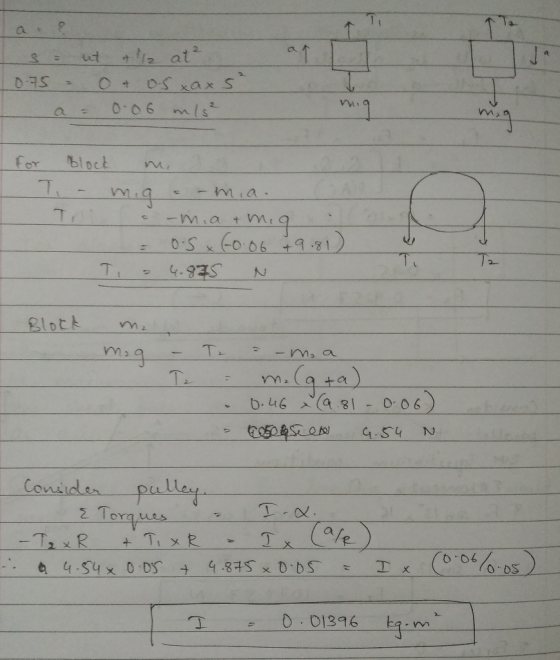
An Atwood's machine has one block of m1 = 0.150 kg and the other is of...
An Atwood's machine has one block of m1 = 0.150 kg and the other is of m2 = 0.210 kg. The disk pulley, which is mounted in horizontal, frictionless bearings, has a radius of 5.0 cm. When released from rest, the heavier block is observed to fall Δy = 80.0 cm in 4.0 sec. The moment of inertia for the pulley is: kg m2.
An Atwood's machine has one block of m1 = 0.370 kg and the other is of...
An Atwood's machine has one block of m1 = 0.370 kg and the other is of m2 = 0.420 kg. The disk pulley, which is mounted in horizontal, frictionless bearings, has a radius of 5.0 cm. When released from rest, the heavier block is observed to fall Δy = 92.0 cm in 4.7 sec. For the following questions, return your answers rounded to 4 significant figures. 1.) The rate of acceleration of each block is m/s2. 2.) The tension in...
In an Atwood's machine, one block has a mass of 826.0 g, and the other a...
In an Atwood's machine, one block has a mass of 826.0 g, and the other a mass of 991.0 g. The pulley, which is mounted in horizontal frictionless bearings, has a radius of 7.70 cm. When released from rest, the heavier block is observed to fall 72.2 cm in 1.88 s (without the string slipping on the pulley). What is the magnitude of the acceleration of the 826.0-g block? What is the magnitude of the acceleration of the 991.0-g block?...
In the figure, block 1 has mass m1 = 440 g, block 2 has mass m2...
 In the figure, block 1 has mass m1 = 440 g, block 2 has mass m2
= 580 g, and the pulley is on a frictionless horizontal axle and
has radius R = 5.2 cm. When released from rest, block 2 falls 75 cm
in 4.9 s without the cord slipping on the pulley. (a) What is the
magnitude of the acceleration of the blocks? What are (b) tension
T2 (the tension force on the block 2) and (c) tension...
In the figure, block 1 has mass m1 = 440 g, block 2 has mass m2
= 580 g, and the pulley is on a frictionless horizontal axle and
has radius R = 5.2 cm. When released from rest, block 2 falls 75 cm
in 4.9 s without the cord slipping on the pulley. (a) What is the
magnitude of the acceleration of the blocks? What are (b) tension
T2 (the tension force on the block 2) and (c) tension...
Block 1 has a mass of m1 = 450 g and Block 2 has a mass...
 Block 1 has a mass of
m1 = 450 g and Block 2 has a mass of m2 = 500 g. The pulley, which
is mounted on a horizontal axle with negligible friction through
its center, has a radius of 5.00 cm. When released from rest, Block
2 accelerates downward at a rate of 0.425 m/s2 without the cord
slipping on the pulley. What is the rotational inertia of the
pulley?
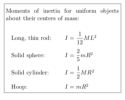
Moments of inertia for uniform objects about their centers...
Block 1 has a mass of
m1 = 450 g and Block 2 has a mass of m2 = 500 g. The pulley, which
is mounted on a horizontal axle with negligible friction through
its center, has a radius of 5.00 cm. When released from rest, Block
2 accelerates downward at a rate of 0.425 m/s2 without the cord
slipping on the pulley. What is the rotational inertia of the
pulley?
Moments of inertia for uniform objects about their centers...
In the figure, block 1 has mass m1 = 460 g, block 2 has mass m2 = 592 g, and the pulley is on a frictionless horizontal axle and has radius R = 4.70 cm
In the figure, block 1 has mass m1 = 460 g, block 2 has mass m2 = 592 g, and the pulley is on a frictionless horizontal axle and has radius R = 4.70 cm. When released from rest, block 2 falls 74.7 cm in 5.32 s without the cord slipping on the pulley. (a) What is the magnitude of the acceleration of the blocks? What are(b) tension T2 (the tension force on the block 2) and (c) tensionT1 (the...
In the figure, block 1 has mass m1 = 460 g, block 2 has mass m2 = 590 g, and the pulley is on a frictionless horizontal axle and has radius R = 4.7 cm
 In the figure, block 1 has mass m1 = 460 g,
block 2 has mass m2 = 590 g, and the pulley is
on a frictionless horizontal axle and has radius R = 4.7
cm. When released from rest, block 2 falls 80 cm in 5.4 s without
the cord slipping on the pulley. (a) What is the
magnitude of the acceleration of the blocks? What are(b) tension T2 (the tension
force on the block 2) and (c) tensionT1 (the...
In the figure, block 1 has mass m1 = 460 g,
block 2 has mass m2 = 590 g, and the pulley is
on a frictionless horizontal axle and has radius R = 4.7
cm. When released from rest, block 2 falls 80 cm in 5.4 s without
the cord slipping on the pulley. (a) What is the
magnitude of the acceleration of the blocks? What are(b) tension T2 (the tension
force on the block 2) and (c) tensionT1 (the...
Mass m1 = 5.80 kg is connected to mass m2 = 3.50 kg by a light...
Mass m1 = 5.80 kg is connected to mass m2 = 3.50 kg by a light string that passes over a frictionless pulley. The pulley has a moment of inertia of 0.490 kg · m2 and a radius of 0.280 m. Mass m2 sits on a frictionless horizontal surface. The string does not slip while in motion on the pulley. Find the tension force T1 on mass m1 in N
In the figure, block 1 has mass mi = 430 g, block 2 has mass m2...
 In the figure, block 1 has mass mi = 430 g, block 2 has mass m2 = 520 g, and the pulley is on a frictionless horizontal axle and has radius R = 5.4 cm. When released from rest, block 2 falls 74 cm in 4.9 s without the cord slipping on the pulley. (a) What is the magnitude of the acceleration of the blocks? What are (b) tension 72 (the tension force on the block 2) and (c) tension...
Two blocks with different masses m1 and m2 and m1 is larger than m2. They are...
Two blocks with different masses m1 and m2 and m1 is larger than m2. They are attached to either end of a light rope that passes over a light, frictionless pulley suspended from the ceiling. The mass are released from rest, and the more massive one starts to descend. After this block has descended 1.6 m, its speed is 2.2 ms-1. If the total mass is 4.1 kg, what is the mass of the heavier block m1 (unit is kg)?...
 In the figure, block 1 has mass m1 = 440 g, block 2 has mass m2
= 580 g, and the pulley is on a frictionless horizontal axle and
has radius R = 5.2 cm. When released from rest, block 2 falls 75 cm
in 4.9 s without the cord slipping on the pulley. (a) What is the
magnitude of the acceleration of the blocks? What are (b) tension
T2 (the tension force on the block 2) and (c) tension...
In the figure, block 1 has mass m1 = 440 g, block 2 has mass m2
= 580 g, and the pulley is on a frictionless horizontal axle and
has radius R = 5.2 cm. When released from rest, block 2 falls 75 cm
in 4.9 s without the cord slipping on the pulley. (a) What is the
magnitude of the acceleration of the blocks? What are (b) tension
T2 (the tension force on the block 2) and (c) tension...
 Block 1 has a mass of
m1 = 450 g and Block 2 has a mass of m2 = 500 g. The pulley, which
is mounted on a horizontal axle with negligible friction through
its center, has a radius of 5.00 cm. When released from rest, Block
2 accelerates downward at a rate of 0.425 m/s2 without the cord
slipping on the pulley. What is the rotational inertia of the
pulley?
Moments of inertia for uniform objects about their centers...
Block 1 has a mass of
m1 = 450 g and Block 2 has a mass of m2 = 500 g. The pulley, which
is mounted on a horizontal axle with negligible friction through
its center, has a radius of 5.00 cm. When released from rest, Block
2 accelerates downward at a rate of 0.425 m/s2 without the cord
slipping on the pulley. What is the rotational inertia of the
pulley?
Moments of inertia for uniform objects about their centers...
 In the figure, block 1 has mass mi = 430 g, block 2 has mass m2 = 520 g, and the pulley is on a frictionless horizontal axle and has radius R = 5.4 cm. When released from rest, block 2 falls 74 cm in 4.9 s without the cord slipping on the pulley. (a) What is the magnitude of the acceleration of the blocks? What are (b) tension 72 (the tension force on the block 2) and (c) tension...
Most questions answered within 3 hours.
-
Where is the error in this code sequence?
String s1 = "Hello";
String s2 = "ello";...
asked 11 months ago -
Financial data for Joel de Paris, Inc., for last year
follow:
Joel de Paris, Inc.
Balance...
asked 11 months ago -
Consider this reaction:
Al2(SO4)3 (aq)+ BaCl3
(aq) Al2Cl6 (aq)- +
3BaSO4(s) . What is the...
asked 11 months ago -
Suppose that Savneet is considering increasing her
recent random sample from 20 car rentals to 40...
asked 11 months ago -
Trucks arrive at an unloading terminal at an average rate of 120
per hour.
Trucks arrive...
asked 11 months ago -
Why are methanol and ethanol completely soluble in water while
octanol is not very little soluble....
asked 11 months ago -
A facilities manager at a university reads in a research report
that the mean amount of...
asked 11 months ago -
When the CuSO4 is rehydrated by adding water to the anhydrous
compound, is this an endothermic...
asked 11 months ago -
A ray of sunlight is passing from diamond into crown glass; the
angle of incidence is...
asked 11 months ago -
A block of mass 0.249 kg is placed on top of a light, vertical
spring of...
asked 11 months ago -
how do the kidneys compensate in the presences of acidosis
a) trigger hyperventilate
b) reserve acid...
asked 11 months ago -
Question 501 pts
The rental rate of capital to the firm increases. Which of the
following...
asked 11 months ago