Topic: A CIRCULATING CHARGED PARTICLE.
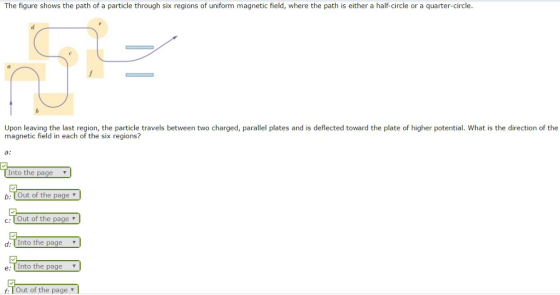
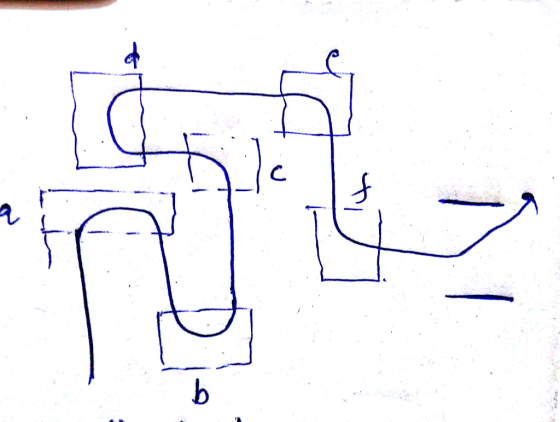
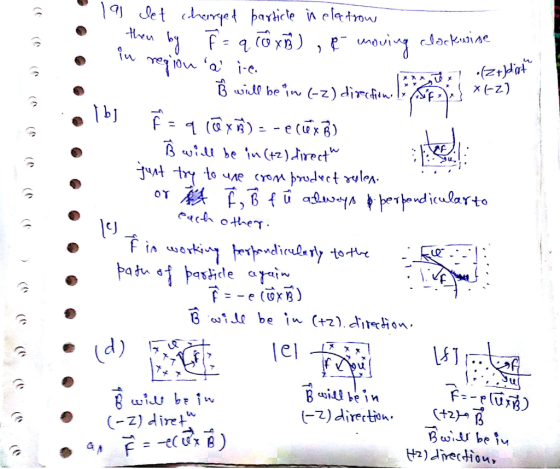
Following is the problem statement along with the correct answers. I need a detailed explanation for each case (a, b, c, d, e, and f).
Homework Answers
Add Answer to:
Topic: A CIRCULATING CHARGED PARTICLE.
Following is the problem statement along with the correct
answers. I...
A positively charged particle is moving from right to left between two parallel charged plates. A...
 A positively charged particle is moving from right to left
between two parallel charged plates. A uniform magnetic field
between the plates is chosen such that the particle is not
deflected. The direction of the magnetic field is
+ into the page out of the page toward the top of the page toward the bottom of the page
A positively charged particle is moving from right to left
between two parallel charged plates. A uniform magnetic field
between the plates is chosen such that the particle is not
deflected. The direction of the magnetic field is
+ into the page out of the page toward the top of the page toward the bottom of the page
A negatively charged particle enters a region between two parallel plates. Each plate (top and bottom)...
A negatively charged particle enters a region between two parallel plates. Each plate (top and bottom) are oppositely charged, hence the exists a uniform electric field between the plates along with a gravitational field). Assume the particle travels the region straight through completely un-deflected and exits. a) Determine and identify below) te polarities of the plates and the resulting Electric Field direction inside the plated region needed so the particle travels through un-deflected: b) If the particle has a mass...
2. A negatively charged particle enters a region between two parallel plates. Each plate (top and...
 2. A negatively charged particle enters a region between two parallel plates. Each plate (top and bottom) are oppositely charged as shown, hence there exists a uniform electric field between the plates (along with a gravitational field). Assume the particle travels straight through the region completely un-deflected and exits a) Sketch the resulting Electric Field inside the plated region: b) If the particle has a mass of 39.2 mg and a charge of+ 8.6 uC, determine the Electric Field E...
Physics: Parallel Capacitance Plates
A charged particle with a positive net electric charge travels with a velocity of 2×10⁷ m.s-1 in the positive x-direction between two plates of a parallel plate capacitor. A uniform magnetic field of 2 mT that is directed into the page also exists in the same location as the capacitor. a. If the parallel plates of the capacitor are separated by 3 cm, determine the voltage required over the plates in order to stop any deflection of the particle. V = __________ V b. ...
A 3.0 µg charged particle carrying -25 µC is injected along the +x direction into a...
A 3.0 µg charged particle carrying -25 µC is injected along the +x direction into a velocity selector. The velocity selector is composed of a parallel plate capacitor with 1 kV of potential between two plates separated by 1 cm and pair of solenoids with 3000 turns per cm separated by 2 mm. On the opposite side of the velocity selector from the injection site is a uniform 1.5 T magnetic field pointing in the +z direction. Draw a diagram...
Problem 1 chemists to determine the composition of a sample. Let's explore one type of mass spectrometer, which u...
 Problem 1 chemists to determine the composition of a sample. Let's explore one type of mass spectrometer, which uses electric and magnetic fields. For each step below, sketch a diagram to help you with the analysis Mass spectrometers, which separate ions based on mass, are often used by a. In Step 1 of mass spectrometry, an accelerator releases a charged particle from rest near one plate of a charged parallel-plate capacitor, so that the particle accelerates toward the other plate...
is a velocity selector that can beused to measure the speed of a charged particle....
 is a velocity selector that can be
used to measure the speed of a charged particle. A beam of
particles is directed along the axis of the instrument. A parallel
plate capacitor sets up an electric field E which is oriented
perpendicular to a uniform magnetic field B. If the plates are
separated by 8 mm and the value of the magnetic field is 0.2 T,
what voltage between the plates will allow particles of speed to
pass straight through...
is a velocity selector that can be
used to measure the speed of a charged particle. A beam of
particles is directed along the axis of the instrument. A parallel
plate capacitor sets up an electric field E which is oriented
perpendicular to a uniform magnetic field B. If the plates are
separated by 8 mm and the value of the magnetic field is 0.2 T,
what voltage between the plates will allow particles of speed to
pass straight through...
I would really appreciate if someone answer these question. Thank you. A charged particle moving in...
I would really appreciate if someone answer these question. Thank you. A charged particle moving in the presence of both an electric and magnetic field moved in a closed path (i.e. a path that begins and ends at the same point). If the energy of the particle at the end of the closed path is 2.0J greater than its energy when it began the path, which of the following statements is correct? a. The magnetic field performed 2.0 J of...
I mostly just need to confirm my answers thanks! In a typical parallel plate capacitor the...
 I mostly just need to confirm my answers thanks!
In a typical parallel plate capacitor the separation distance between the plates is "d". For a charged capacitor, if you increase only the separation distance of the plates the following occurs: The potential (V) between the plates remains constant but the electric field increases, The potential (V) between the plates increases but the electric field remains constant. The potential (V) between the plates remains constant and the electric remains constant. The...
I mostly just need to confirm my answers thanks!
In a typical parallel plate capacitor the separation distance between the plates is "d". For a charged capacitor, if you increase only the separation distance of the plates the following occurs: The potential (V) between the plates remains constant but the electric field increases, The potential (V) between the plates increases but the electric field remains constant. The potential (V) between the plates remains constant and the electric remains constant. The...
Velocity Selector-multiple choice
 The Velocity SelectorIn experiments where all the charged particles in a beam are required to have the same velocity (for example, when entering a mass spectrometer), scientists use a velocity selector. A velocity selector has a region of uniform electric and magnetic fields that are perpendicular to each other and perpendicular to the motion of the charged particles. Both the electric and magnetic fields exert a force on the charged particles. If a particle has precisely the right velocity, the...
 A positively charged particle is moving from right to left
between two parallel charged plates. A uniform magnetic field
between the plates is chosen such that the particle is not
deflected. The direction of the magnetic field is
+ into the page out of the page toward the top of the page toward the bottom of the page
A positively charged particle is moving from right to left
between two parallel charged plates. A uniform magnetic field
between the plates is chosen such that the particle is not
deflected. The direction of the magnetic field is
+ into the page out of the page toward the top of the page toward the bottom of the page
 2. A negatively charged particle enters a region between two parallel plates. Each plate (top and bottom) are oppositely charged as shown, hence there exists a uniform electric field between the plates (along with a gravitational field). Assume the particle travels straight through the region completely un-deflected and exits a) Sketch the resulting Electric Field inside the plated region: b) If the particle has a mass of 39.2 mg and a charge of+ 8.6 uC, determine the Electric Field E...
 Problem 1 chemists to determine the composition of a sample. Let's explore one type of mass spectrometer, which uses electric and magnetic fields. For each step below, sketch a diagram to help you with the analysis Mass spectrometers, which separate ions based on mass, are often used by a. In Step 1 of mass spectrometry, an accelerator releases a charged particle from rest near one plate of a charged parallel-plate capacitor, so that the particle accelerates toward the other plate...
 is a velocity selector that can be
used to measure the speed of a charged particle. A beam of
particles is directed along the axis of the instrument. A parallel
plate capacitor sets up an electric field E which is oriented
perpendicular to a uniform magnetic field B. If the plates are
separated by 8 mm and the value of the magnetic field is 0.2 T,
what voltage between the plates will allow particles of speed to
pass straight through...
is a velocity selector that can be
used to measure the speed of a charged particle. A beam of
particles is directed along the axis of the instrument. A parallel
plate capacitor sets up an electric field E which is oriented
perpendicular to a uniform magnetic field B. If the plates are
separated by 8 mm and the value of the magnetic field is 0.2 T,
what voltage between the plates will allow particles of speed to
pass straight through...
 I mostly just need to confirm my answers thanks!
In a typical parallel plate capacitor the separation distance between the plates is "d". For a charged capacitor, if you increase only the separation distance of the plates the following occurs: The potential (V) between the plates remains constant but the electric field increases, The potential (V) between the plates increases but the electric field remains constant. The potential (V) between the plates remains constant and the electric remains constant. The...
I mostly just need to confirm my answers thanks!
In a typical parallel plate capacitor the separation distance between the plates is "d". For a charged capacitor, if you increase only the separation distance of the plates the following occurs: The potential (V) between the plates remains constant but the electric field increases, The potential (V) between the plates increases but the electric field remains constant. The potential (V) between the plates remains constant and the electric remains constant. The...
Most questions answered within 3 hours.
-
Where is the error in this code sequence?
String s1 = "Hello";
String s2 = "ello";...
asked 10 months ago -
Financial data for Joel de Paris, Inc., for last year
follow:
Joel de Paris, Inc.
Balance...
asked 10 months ago -
Consider this reaction:
Al2(SO4)3 (aq)+ BaCl3
(aq) Al2Cl6 (aq)- +
3BaSO4(s) . What is the...
asked 10 months ago -
Suppose that Savneet is considering increasing her
recent random sample from 20 car rentals to 40...
asked 10 months ago -
Trucks arrive at an unloading terminal at an average rate of 120
per hour.
Trucks arrive...
asked 10 months ago -
Why are methanol and ethanol completely soluble in water while
octanol is not very little soluble....
asked 10 months ago -
A facilities manager at a university reads in a research report
that the mean amount of...
asked 10 months ago -
When the CuSO4 is rehydrated by adding water to the anhydrous
compound, is this an endothermic...
asked 10 months ago -
A ray of sunlight is passing from diamond into crown glass; the
angle of incidence is...
asked 10 months ago -
A block of mass 0.249 kg is placed on top of a light, vertical
spring of...
asked 10 months ago -
how do the kidneys compensate in the presences of acidosis
a) trigger hyperventilate
b) reserve acid...
asked 10 months ago -
Question 501 pts
The rental rate of capital to the firm increases. Which of the
following...
asked 10 months ago