Verilog HDL Design a logic module to multiply an 8-bit binary number A [0:7] by a...
Verilog HDL
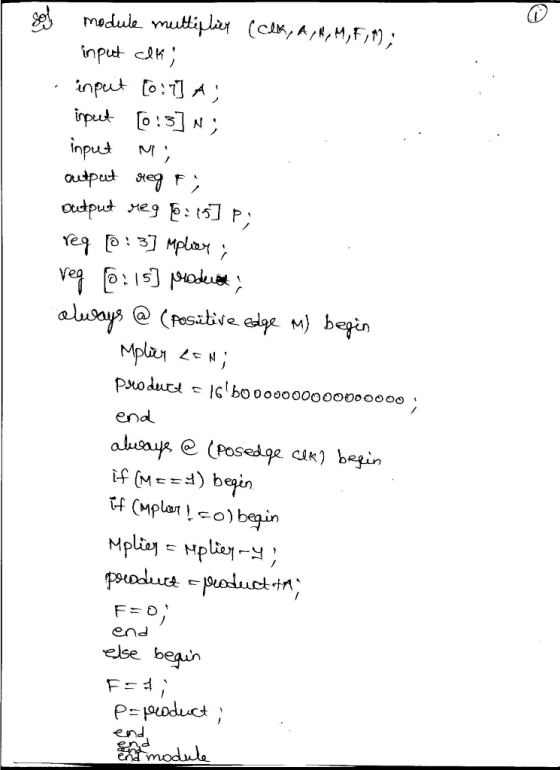
Design a logic module to multiply an 8-bit binary number A [0:7] by a 4-bit binary
number N [0:3]. The multiply is started when M is asserted. The output F is asserted
when the multiply is completed and the product P [0: 15] is available. The outputs need to
remain valid until the next multiply command is given. Assume M is valid for several of
your clock cycles and then is de-asserted.
Implement the multiply using repeated addition of A to form partial products.
Please also comment your code so I can understand
Homework Answers
Add Answer to:
Verilog HDL
Design a logic module to multiply an 8-bit binary number A [0:7]
by a...
Design a synchronous state machine which detects the serial bit sequence of 0 1 10 on the 1-bit i...
 Design a synchronous state machine which detects the serial bit sequence of 0 1 10 on the 1-bit input signal A (tested one bit at a time) and produces a "Moore-type positive-logic output of Y equal to 1 (and lasting just one clock period) only when that particular bit sequence is observed. At all other times, the output Y should be 0. The final 0 of the desired input sequence 0 110 can persist and become the first 0 of...
number 4 and 5 please! PROBLEM STATEMENT A logic circuit is needed to add multi-bit binary...
 number 4 and 5 please!
PROBLEM STATEMENT A logic circuit is needed to add multi-bit binary numbers. A 2-level circuit that would add two four-bit numbers would have 9 inputs and five outputs. Although a 2-level SOP or POS circuit theoretically would be very fast, it has numerous drawbacks that make it impractical. The design would be very complex in terms of the number of logic gates. The number of inputs for each gate would challenge target technologies. Testing would...
number 4 and 5 please!
PROBLEM STATEMENT A logic circuit is needed to add multi-bit binary numbers. A 2-level circuit that would add two four-bit numbers would have 9 inputs and five outputs. Although a 2-level SOP or POS circuit theoretically would be very fast, it has numerous drawbacks that make it impractical. The design would be very complex in terms of the number of logic gates. The number of inputs for each gate would challenge target technologies. Testing would...
Design a circuit that has a 3 bit binary input (representing 0 through 7) and outputs...
Design a circuit that has a 3 bit binary input (representing 0 through 7) and outputs a 1 if the input is a prime number. A prime number (or prime) is a natural number greater than 1 that has no positive divisors other than 1 and itself. a) Fill out a truth table that represents the logic equation for this circuit: Y = F(A,B,C). b) Using a Karnaugh map simplify the logic equation.
You will use Quartus II to build an 8 bit arithmetic logic unit that performs the...
You will use Quartus II to build an 8 bit arithmetic logic unit that performs the following functions: Control Value Function 000 Copy In1 to theResult unchanged 001 Copy In2 to theResult unchanged 010 Add In1 to In2 011 Subtract In2 from In1 100 And In1 and In2 101 Or In1 and In2 110 Shift left In1 by 1 bit 111 Shift right In1 by 1 bit You are allowed to use either gates/logic schematic, or else Verilog. We suggest...
Implement an arithmetic logic unit (ALU) using Verilog. Consider signed number arithmetic operation. The outputs of...
Implement an arithmetic logic unit (ALU) using Verilog. Consider signed number arithmetic operation. The outputs of the ALU should be 1) Addition of two 8-bit numbers 2) A Zero Flag. It is set (it is 1 if the condition is met and 0 otherwise) if the result is zero. 3) A Negative Flag. It is set (it is 1 if the condition is met and 0 otherwise) if the result is less than 0. 4) An Overflow Flag. It is...
Design the logic circuit to display a 3 bit octal numbers from 0 to 7 on...
 Design the logic circuit to display a 3 bit octal numbers from 0 to 7 on a seven segment display shown below (for number 1 use segments b and c; for 6 include segment (a) Write the Truth Table with A, B. C representing the input bits (A is the MSB) and a, b, c, d, e, f and g representing the outputs to the seven segments. (b) Implement the circuit using a Programmable Logic Array (use simplified notation to...
Please code the following in Verilog: Write the HDL gate-level hierarchical description of a four-bit adder-subtractor...
 Please code the following in Verilog:
Write the HDL gate-level hierarchical description of a four-bit adder-subtractor for unsigned binary numbers similar to the following circuit. You can instantiate the four-bit full adder described in the following example code Figure 4.13a, 4-Bit adder-subtractor without overflow Inputs: 4-Bit A, 4-Bit B, and Mode M (0-add/1-subtract) Interfaces: Carry Bits C1, C2, C3 Outputs: Carry C (1 Bit, C4), Sum S (4 bit) Bo A FA FA FA FA module Add half (input a,...
Please code the following in Verilog:
Write the HDL gate-level hierarchical description of a four-bit adder-subtractor for unsigned binary numbers similar to the following circuit. You can instantiate the four-bit full adder described in the following example code Figure 4.13a, 4-Bit adder-subtractor without overflow Inputs: 4-Bit A, 4-Bit B, and Mode M (0-add/1-subtract) Interfaces: Carry Bits C1, C2, C3 Outputs: Carry C (1 Bit, C4), Sum S (4 bit) Bo A FA FA FA FA module Add half (input a,...
Use as few 3-input NOR gates as possible to design a bubble detector circuit for 8-bit thermomete...
Use as few 3-input NOR gates as possible to design a bubble detector circuit for 8-bit thermometer code. An n-bit thermometer code represents an integer m, with m 1s followed by (n-m) 0s. 1-bit bubble is an error in coding when a solitary 0 (or 1) is found in between two 1s (or 0s). What is the size of your circuit in terms of the number of NOR gates used? Give a gate level schematic diagram for your circuit. Implement...
5.3 SYNCHRONOUS COUNTER DEVICE 74LS163 Test the operation of a 74LS163 four bit synchronous binary counter...
 5.3 SYNCHRONOUS COUNTER DEVICE 74LS163 Test the operation of a 74LS163 four bit synchronous binary counter Load the device with parallel data Examine and understand the RCO output signal of the counter device. ОBJEСТIVE: A C REFERENCE: Manufactures data sheets COMPONENTS: 1 x IC 74LS163 EQUIPMENT: Development board Logic probe Mult-meter INSTRUCTIONS: Connect the IC up so that it will count from 0 to 15 in binary. Connect the four Q outputs to the LED's on the development boards with...
In this lab, you will design a finite state machine to control the tail lights of...
 In this lab, you will design a finite state machine to control the tail lights of an unsual car. There are three lights on each side that operate in sequence to indicate thedirection of a turn. Figure ! shows the tail lights and Figure 2 shows the flashing sequence for (a) left turns and (b) right rums. ZOTTAS Figure 28:8: BCECECece BCECECECes BCECECECB BCECECBCB 8888 Figure 2 Part 1 - FSM Design Start with designing the state transition diagram for...
 Design a synchronous state machine which detects the serial bit sequence of 0 1 10 on the 1-bit input signal A (tested one bit at a time) and produces a "Moore-type positive-logic output of Y equal to 1 (and lasting just one clock period) only when that particular bit sequence is observed. At all other times, the output Y should be 0. The final 0 of the desired input sequence 0 110 can persist and become the first 0 of...
 number 4 and 5 please!
PROBLEM STATEMENT A logic circuit is needed to add multi-bit binary numbers. A 2-level circuit that would add two four-bit numbers would have 9 inputs and five outputs. Although a 2-level SOP or POS circuit theoretically would be very fast, it has numerous drawbacks that make it impractical. The design would be very complex in terms of the number of logic gates. The number of inputs for each gate would challenge target technologies. Testing would...
number 4 and 5 please!
PROBLEM STATEMENT A logic circuit is needed to add multi-bit binary numbers. A 2-level circuit that would add two four-bit numbers would have 9 inputs and five outputs. Although a 2-level SOP or POS circuit theoretically would be very fast, it has numerous drawbacks that make it impractical. The design would be very complex in terms of the number of logic gates. The number of inputs for each gate would challenge target technologies. Testing would...
 Design the logic circuit to display a 3 bit octal numbers from 0 to 7 on a seven segment display shown below (for number 1 use segments b and c; for 6 include segment (a) Write the Truth Table with A, B. C representing the input bits (A is the MSB) and a, b, c, d, e, f and g representing the outputs to the seven segments. (b) Implement the circuit using a Programmable Logic Array (use simplified notation to...
 Please code the following in Verilog:
Write the HDL gate-level hierarchical description of a four-bit adder-subtractor for unsigned binary numbers similar to the following circuit. You can instantiate the four-bit full adder described in the following example code Figure 4.13a, 4-Bit adder-subtractor without overflow Inputs: 4-Bit A, 4-Bit B, and Mode M (0-add/1-subtract) Interfaces: Carry Bits C1, C2, C3 Outputs: Carry C (1 Bit, C4), Sum S (4 bit) Bo A FA FA FA FA module Add half (input a,...
Please code the following in Verilog:
Write the HDL gate-level hierarchical description of a four-bit adder-subtractor for unsigned binary numbers similar to the following circuit. You can instantiate the four-bit full adder described in the following example code Figure 4.13a, 4-Bit adder-subtractor without overflow Inputs: 4-Bit A, 4-Bit B, and Mode M (0-add/1-subtract) Interfaces: Carry Bits C1, C2, C3 Outputs: Carry C (1 Bit, C4), Sum S (4 bit) Bo A FA FA FA FA module Add half (input a,...
 5.3 SYNCHRONOUS COUNTER DEVICE 74LS163 Test the operation of a 74LS163 four bit synchronous binary counter Load the device with parallel data Examine and understand the RCO output signal of the counter device. ОBJEСТIVE: A C REFERENCE: Manufactures data sheets COMPONENTS: 1 x IC 74LS163 EQUIPMENT: Development board Logic probe Mult-meter INSTRUCTIONS: Connect the IC up so that it will count from 0 to 15 in binary. Connect the four Q outputs to the LED's on the development boards with...
 In this lab, you will design a finite state machine to control the tail lights of an unsual car. There are three lights on each side that operate in sequence to indicate thedirection of a turn. Figure ! shows the tail lights and Figure 2 shows the flashing sequence for (a) left turns and (b) right rums. ZOTTAS Figure 28:8: BCECECece BCECECECes BCECECECB BCECECBCB 8888 Figure 2 Part 1 - FSM Design Start with designing the state transition diagram for...
Most questions answered within 3 hours.
-
Where is the error in this code sequence?
String s1 = "Hello";
String s2 = "ello";...
asked 10 months ago -
Financial data for Joel de Paris, Inc., for last year
follow:
Joel de Paris, Inc.
Balance...
asked 10 months ago -
Consider this reaction:
Al2(SO4)3 (aq)+ BaCl3
(aq) Al2Cl6 (aq)- +
3BaSO4(s) . What is the...
asked 10 months ago -
Suppose that Savneet is considering increasing her
recent random sample from 20 car rentals to 40...
asked 10 months ago -
Trucks arrive at an unloading terminal at an average rate of 120
per hour.
Trucks arrive...
asked 10 months ago -
Why are methanol and ethanol completely soluble in water while
octanol is not very little soluble....
asked 10 months ago -
A facilities manager at a university reads in a research report
that the mean amount of...
asked 10 months ago -
When the CuSO4 is rehydrated by adding water to the anhydrous
compound, is this an endothermic...
asked 10 months ago -
A ray of sunlight is passing from diamond into crown glass; the
angle of incidence is...
asked 10 months ago -
A block of mass 0.249 kg is placed on top of a light, vertical
spring of...
asked 10 months ago -
how do the kidneys compensate in the presences of acidosis
a) trigger hyperventilate
b) reserve acid...
asked 10 months ago -
Question 501 pts
The rental rate of capital to the firm increases. Which of the
following...
asked 10 months ago