Why does the oxygen consumption rate for ADP in the presence of an electron donor revert...
Homework Answers
The rate of oxygen consumption tells about the rate of electron transport in the mitochondria. Electron transport involves the transport of electrons from electron donors via various carrier complexes to the terminal electron acceptor which is oxygen. During electron transport protons are translocated from matrix to intermembrane space. This proton gradient is used to synthesize ATP from ADP and inorganic phosphate.
In presence of ADP, oxygen consumption would be higher to generate proton gradient which would then aid in conversion of ADP to ATP. The rates would revert to those exisiting before addition of ADP because after a higher oxygen consumption rate enough proton gradient would be produced to convert all of the ADP to ATP. The situation is now similar to that in absence of ADP or prior to addition of ADP .Now mitochondria would return to its basal level of oxygen consumption as before.
Add Answer to:
Why
does the oxygen consumption rate for ADP in the presence of an
electron donor revert...
Why does it make physiological sense for the presence of excess ADP to increase the activity...
Why does it make physiological sense for the presence of excess ADP to increase the activity of phosphofructokinase in the EMP glycolytic pathway?
How does the addition of ATP affect PFK affinity for ADP? The figure above is a...
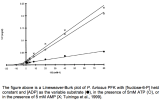 How does the addition of ATP affect PFK affinity for ADP?
The figure above is a Lineweaver-Burk plot of P. furiosus PFK with [fructose-6-P] held constant and [ADP] as the variable substrate (dot), in the presence of 5mM ATP (O), or in the presence of 5 mM AMP (X; Tuininga et al., 1999).
How does the addition of ATP affect PFK affinity for ADP?
The figure above is a Lineweaver-Burk plot of P. furiosus PFK with [fructose-6-P] held constant and [ADP] as the variable substrate (dot), in the presence of 5mM ATP (O), or in the presence of 5 mM AMP (X; Tuininga et al., 1999).
- I believed the inhibited protein was ATP synthase, however the data on Figure 2 does...
 - I believed the inhibited protein was ATP synthase, however the
data on Figure 2 does not support this. Please help!
The mitochondria from a patient suffering from muscle pain during physical exercises were analyzed to detect any defect in one of the components of the respiratory chain. Isolated mitochondria were incubated in an isotonic buffer, and changes in the oxygen consumption were measured as various components were sequentially added to the reaction. 1) The following graph (Fig. 1) shows...
- I believed the inhibited protein was ATP synthase, however the
data on Figure 2 does not support this. Please help!
The mitochondria from a patient suffering from muscle pain during physical exercises were analyzed to detect any defect in one of the components of the respiratory chain. Isolated mitochondria were incubated in an isotonic buffer, and changes in the oxygen consumption were measured as various components were sequentially added to the reaction. 1) The following graph (Fig. 1) shows...
Why are two photosystems needed when water is used as an electron donor?
Why are two photosystems needed when water is used as an electron donor?
1. The common rate of oxygen consumption of a human is about 15.80 mol per day....
 1. The common rate of oxygen consumption of a human is about 15.80 mol per day. The oxygen consumption can be summarized as following reaction: O2 + 4H+ + 4e = 2H2O a. What is current generated by this reaction at the common rate of oxygen consumption? b. Is this current larger or smaller than a current in a computer with power consumption at 8.50 * 102 W at 120.0 V? c. If all the electron flow in a human...
Question 1 The mitochondria from a patient suffering from muscle pain during physical exercises were analyzed...
 Question 1
The mitochondria from a patient suffering from muscle pain
during physical exercises were analyzed to detect any defect in one
of the components of the respiratory chain. Isolated mitochondria
were incubated in an isotonic buffer, and changes in the oxygen
consumption were measured as various components were sequentially
added to the reaction.
1) The following graph (Fig. 1) shows the changes of oxygen
concentration in a solution containing the patient’s mitochondria
or mitochondria from a healthy donor (control)....
Question 1
The mitochondria from a patient suffering from muscle pain
during physical exercises were analyzed to detect any defect in one
of the components of the respiratory chain. Isolated mitochondria
were incubated in an isotonic buffer, and changes in the oxygen
consumption were measured as various components were sequentially
added to the reaction.
1) The following graph (Fig. 1) shows the changes of oxygen
concentration in a solution containing the patient’s mitochondria
or mitochondria from a healthy donor (control)....
(A) For the following reaction identify: i the electron donor ii the electron acceptor iii...
(A) For the following reaction identify: i the electron donor ii the electron acceptor iii all redox pairs iv reducing agents v oxidizing agent Succinate + FAD+ <--> Fumarate + FADH2 (B) Why could less ATP produced from NADH from glycolysis than NADH from the citric acid cycle? (C) What role does succinate dehydrogenase play in oxidative phosphorylation?
Question 1 a Why in the absence of oxygen does oxaloacetate alone cause an accumulation of...
Question 1 a Why in the absence of oxygen does oxaloacetate alone cause an accumulation of citrate? Would any of the other intermediates in the cycle cause an accumulation of citrate in the presence of oxygen? (5 pts) b Toward the end of the paper Krebs states, "While the citric acid cycle thus seems to occur generally in animal tissues, it does not exist in yeast or in E. coli, for yeast and E. coli do not oxidize citric acid...
Which complex in the electron transport chain does not contribute to the proton gradient across the...
Which complex in the electron transport chain does not contribute to the proton gradient across the mitochondrial membrane? A. Complex I B. Complex IV C. Complex II D. Complex III Which statement regarding the mitochondrial electron transport chain and oxidative phosphorylation is true? A. Ubiquinone and the F zero subunit of ATP synthase are peripheral membrane proteins. B. Complexes I, II, III, and IV all are proton pumps. C. The final electron acceptor is water. D. Complex II is considered...
Question 1 (25 points). The mitochondria from a patient suffering from muscle pain during physical exercises...
 Question 1 (25 points).
The mitochondria from a patient suffering from muscle pain
during physical exercises were analyzed to detect any defect in one
of the components of the respiratory chain. Isolated mitochondria
were incubated in an isotonic buffer, and changes in the oxygen
consumption were measured as various components were sequentially
added to the reaction.
Part 1
The following graph (Fig. 1) shows the changes of oxygen
concentration in a solution containing the patient’s mitochondria
or mitochondria from a...
Question 1 (25 points).
The mitochondria from a patient suffering from muscle pain
during physical exercises were analyzed to detect any defect in one
of the components of the respiratory chain. Isolated mitochondria
were incubated in an isotonic buffer, and changes in the oxygen
consumption were measured as various components were sequentially
added to the reaction.
Part 1
The following graph (Fig. 1) shows the changes of oxygen
concentration in a solution containing the patient’s mitochondria
or mitochondria from a...
 How does the addition of ATP affect PFK affinity for ADP?
The figure above is a Lineweaver-Burk plot of P. furiosus PFK with [fructose-6-P] held constant and [ADP] as the variable substrate (dot), in the presence of 5mM ATP (O), or in the presence of 5 mM AMP (X; Tuininga et al., 1999).
How does the addition of ATP affect PFK affinity for ADP?
The figure above is a Lineweaver-Burk plot of P. furiosus PFK with [fructose-6-P] held constant and [ADP] as the variable substrate (dot), in the presence of 5mM ATP (O), or in the presence of 5 mM AMP (X; Tuininga et al., 1999).
 - I believed the inhibited protein was ATP synthase, however the
data on Figure 2 does not support this. Please help!
The mitochondria from a patient suffering from muscle pain during physical exercises were analyzed to detect any defect in one of the components of the respiratory chain. Isolated mitochondria were incubated in an isotonic buffer, and changes in the oxygen consumption were measured as various components were sequentially added to the reaction. 1) The following graph (Fig. 1) shows...
- I believed the inhibited protein was ATP synthase, however the
data on Figure 2 does not support this. Please help!
The mitochondria from a patient suffering from muscle pain during physical exercises were analyzed to detect any defect in one of the components of the respiratory chain. Isolated mitochondria were incubated in an isotonic buffer, and changes in the oxygen consumption were measured as various components were sequentially added to the reaction. 1) The following graph (Fig. 1) shows...
 1. The common rate of oxygen consumption of a human is about 15.80 mol per day. The oxygen consumption can be summarized as following reaction: O2 + 4H+ + 4e = 2H2O a. What is current generated by this reaction at the common rate of oxygen consumption? b. Is this current larger or smaller than a current in a computer with power consumption at 8.50 * 102 W at 120.0 V? c. If all the electron flow in a human...
 Question 1
The mitochondria from a patient suffering from muscle pain
during physical exercises were analyzed to detect any defect in one
of the components of the respiratory chain. Isolated mitochondria
were incubated in an isotonic buffer, and changes in the oxygen
consumption were measured as various components were sequentially
added to the reaction.
1) The following graph (Fig. 1) shows the changes of oxygen
concentration in a solution containing the patient’s mitochondria
or mitochondria from a healthy donor (control)....
Question 1
The mitochondria from a patient suffering from muscle pain
during physical exercises were analyzed to detect any defect in one
of the components of the respiratory chain. Isolated mitochondria
were incubated in an isotonic buffer, and changes in the oxygen
consumption were measured as various components were sequentially
added to the reaction.
1) The following graph (Fig. 1) shows the changes of oxygen
concentration in a solution containing the patient’s mitochondria
or mitochondria from a healthy donor (control)....
 Question 1 (25 points).
The mitochondria from a patient suffering from muscle pain
during physical exercises were analyzed to detect any defect in one
of the components of the respiratory chain. Isolated mitochondria
were incubated in an isotonic buffer, and changes in the oxygen
consumption were measured as various components were sequentially
added to the reaction.
Part 1
The following graph (Fig. 1) shows the changes of oxygen
concentration in a solution containing the patient’s mitochondria
or mitochondria from a...
Question 1 (25 points).
The mitochondria from a patient suffering from muscle pain
during physical exercises were analyzed to detect any defect in one
of the components of the respiratory chain. Isolated mitochondria
were incubated in an isotonic buffer, and changes in the oxygen
consumption were measured as various components were sequentially
added to the reaction.
Part 1
The following graph (Fig. 1) shows the changes of oxygen
concentration in a solution containing the patient’s mitochondria
or mitochondria from a...
Most questions answered within 3 hours.
-
Where is the error in this code sequence?
String s1 = "Hello";
String s2 = "ello";...
asked 10 months ago -
Financial data for Joel de Paris, Inc., for last year
follow:
Joel de Paris, Inc.
Balance...
asked 10 months ago -
Consider this reaction:
Al2(SO4)3 (aq)+ BaCl3
(aq) Al2Cl6 (aq)- +
3BaSO4(s) . What is the...
asked 10 months ago -
Suppose that Savneet is considering increasing her
recent random sample from 20 car rentals to 40...
asked 10 months ago -
Trucks arrive at an unloading terminal at an average rate of 120
per hour.
Trucks arrive...
asked 10 months ago -
Why are methanol and ethanol completely soluble in water while
octanol is not very little soluble....
asked 10 months ago -
A facilities manager at a university reads in a research report
that the mean amount of...
asked 10 months ago -
When the CuSO4 is rehydrated by adding water to the anhydrous
compound, is this an endothermic...
asked 10 months ago -
A ray of sunlight is passing from diamond into crown glass; the
angle of incidence is...
asked 10 months ago -
A block of mass 0.249 kg is placed on top of a light, vertical
spring of...
asked 10 months ago -
how do the kidneys compensate in the presences of acidosis
a) trigger hyperventilate
b) reserve acid...
asked 10 months ago -
Question 501 pts
The rental rate of capital to the firm increases. Which of the
following...
asked 10 months ago