
Homework Answers
Answer:
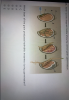
Here a fault is seen displacing rock layers B and C. So, definitely the fault is younger than these rock layers. A is also younger because it is an intrusive rock. On the left hand side of the fault plane, we are seeing an anticline in which layer B is in the center. As per definition, older layers are in the core or center of an anticline. So, definitely, B is older. We also see that on the left hand side of the fault plane, there is a syncline in which C layer is at center (but not seen here as it is displaced by the fault). And as per definition, younger layers are at the core of a syncline. So, here, B layer came first.
Add Answer to:
QUESTION 4 Based on the diagram below, which layer came first? (Note that is an intrusive...
15)What is the difference between a dike, a sill, a laccolith and a batholith? 16) Which...
15)What is the difference between a dike, a sill, a laccolith and a batholith? 16) Which two intrude with the layers (concordant)? 17) Which two are discordant (intrude through layers)? 18) Which is the largest of the four? 19) What is obsidian and how does it form? Is it a rock or a mineral? Explain. 20) What is a vesicle? Does it form in igneous intrusive or extrusive igneous rock? Why does it form ? 21) What is a pyroclastic...
27. Refer to the diagram below showing cereal grain germination. Which layer of the grain produces...
 27. Refer to the diagram below showing cereal grain germination. Which layer of the grain produces hydrolytic enzymes during germination? Oc ОА B OD
Based on the image below, what would rock classification would be appropriate for an igneous rock...
 Based on the image below, what would rock classification would be appropriate for an igneous rock containing 19% Olivine, 43% Pyroxene, 36% Calcium-rich Plagioclase, and 2% Hornblende? Composition Rock types FELSIC Granite Rhyolite INTERMEDIATE Diorite Andesite MAFIC Gabbro Basalt ULTRAMAFIC Peridotite Orthoclase feldspar Quartz Plagioclase feldspar Percentage of mineral by volume (Calcium-rich) (Sodium-rich) Pyroxene Muscovite Biotite mica Olivine Amphibole 70% 40% Silica content Sodium and potassium content Iron, magnesium, and calcium content 700'C Temperature at which melting starts 1200C) Felsic...
(20 pts) Given the conditions below, determine the layer thicknesses (D1 and D2) of flexible pavement based on 1993 AASHTO flexible pavement design concepts. Show all the tables and diagram used and...
 (20 pts) Given the conditions below, determine the layer thicknesses (D1 and D2) of flexible pavement based on 1993 AASHTO flexible pavement design concepts. Show all the tables and diagram used and assume other conditions if needed 8. Given Two layer system (asphalt layer (Dı) and granular base (D2)) on subgrade Design Period 20 years Expected ESALs, W18 30x106 ESALs Reliability-90% . ZR--1.282 .So- 0.45 APSI 1.7 Subgrade (MR) 12000 psi Granular Base AASHTO A-1-a (40000 psi) Granular Base Coefficient...
1a)For a client/server application using TCP on Layer-4, which program starts first: Client or Server or...
1a)For a client/server application using TCP on Layer-4, which program starts first: Client or Server or both at the same time? Explain why. b) For a client/server application using UDP on Layer-4, which program starts first: Client or Server or both at the same time? Explain why. 2) Consider an HTTP client that wants to retrieve a web document at a given URL. The IP address of the HTTP server is initially unknown. Which protocols besides HTTP are needed for...
QUESTION 4 Based on what you've learned this week, which of the following is a more...
 QUESTION 4 Based on what you've learned this week, which of the following is a more representative sampling method? O A Quota sampling OB. Stratified random sampling
QUESTION 3 Use the set of diagrams below to answer the next two questions. For help,...
 QUESTION 3 Use the set of diagrams below to answer the next two questions. For help, consult p. 394-397 in the textbook or use other resources to help figure out the difference between an anticline and a syncline in geology Diagram #1 Diagram #2 Which diagram shows an antiline (the other is a syncline)? Diagram 1 Diagram 2 QUESTION 4 Refer to the diagrams and then write, or in the blanks below to best complete the statement The youngest layer...
YOUNGEST TO OLDEST Problem 1: Relative Time-What came first? The cross-section below shows the results of...
 YOUNGEST TO OLDEST
Problem 1: Relative Time-What came first? The cross-section below shows the results of several geologic events. To the right of the diagram, list the sequences of geologic history starting with the oldest event and ending the youngest event. Present-day land surface S Youn o macho TR balts od bilo obes
YOUNGEST TO OLDEST
Problem 1: Relative Time-What came first? The cross-section below shows the results of several geologic events. To the right of the diagram, list the sequences of geologic history starting with the oldest event and ending the youngest event. Present-day land surface S Youn o macho TR balts od bilo obes
3.2) Complete the circuit diagram in Figure 4 below based on the logic circuit in Figure...
 3.2) Complete the circuit diagram in Figure 4 below based on the logic circuit in Figure 3 above Figure 4. Timing diagram based on logic circuit in Figure 3 4.1) Derive the Truth Table of the logic circuit in Figure 5 below Figure 5. Logic circuit of a multiplexer The circuit is called a multiplexer. Could you explain why? You are welcome to research online to help you with the answer 4.2)
Use the diagram to answer the question Based on the evidence in the diagram, which statement...
 Use the diagram to answer the question Based on the evidence in the diagram, which statement is true about fungi? Euglenozoans Forams Polytomy Diatoms Ciliates Red algae Domain Eukarya Green algae Plants Tubulinids Fungi Animals 2017 A. They are more closely related to plants than to animals B. They are more closely related to animals than to plants. C. They are more closely related to green algae than to plants. D. They are more closely related to green algae than...
 27. Refer to the diagram below showing cereal grain germination. Which layer of the grain produces hydrolytic enzymes during germination? Oc ОА B OD
 Based on the image below, what would rock classification would be appropriate for an igneous rock containing 19% Olivine, 43% Pyroxene, 36% Calcium-rich Plagioclase, and 2% Hornblende? Composition Rock types FELSIC Granite Rhyolite INTERMEDIATE Diorite Andesite MAFIC Gabbro Basalt ULTRAMAFIC Peridotite Orthoclase feldspar Quartz Plagioclase feldspar Percentage of mineral by volume (Calcium-rich) (Sodium-rich) Pyroxene Muscovite Biotite mica Olivine Amphibole 70% 40% Silica content Sodium and potassium content Iron, magnesium, and calcium content 700'C Temperature at which melting starts 1200C) Felsic...
 (20 pts) Given the conditions below, determine the layer thicknesses (D1 and D2) of flexible pavement based on 1993 AASHTO flexible pavement design concepts. Show all the tables and diagram used and assume other conditions if needed 8. Given Two layer system (asphalt layer (Dı) and granular base (D2)) on subgrade Design Period 20 years Expected ESALs, W18 30x106 ESALs Reliability-90% . ZR--1.282 .So- 0.45 APSI 1.7 Subgrade (MR) 12000 psi Granular Base AASHTO A-1-a (40000 psi) Granular Base Coefficient...
 QUESTION 4 Based on what you've learned this week, which of the following is a more representative sampling method? O A Quota sampling OB. Stratified random sampling
 QUESTION 3 Use the set of diagrams below to answer the next two questions. For help, consult p. 394-397 in the textbook or use other resources to help figure out the difference between an anticline and a syncline in geology Diagram #1 Diagram #2 Which diagram shows an antiline (the other is a syncline)? Diagram 1 Diagram 2 QUESTION 4 Refer to the diagrams and then write, or in the blanks below to best complete the statement The youngest layer...
 YOUNGEST TO OLDEST
Problem 1: Relative Time-What came first? The cross-section below shows the results of several geologic events. To the right of the diagram, list the sequences of geologic history starting with the oldest event and ending the youngest event. Present-day land surface S Youn o macho TR balts od bilo obes
YOUNGEST TO OLDEST
Problem 1: Relative Time-What came first? The cross-section below shows the results of several geologic events. To the right of the diagram, list the sequences of geologic history starting with the oldest event and ending the youngest event. Present-day land surface S Youn o macho TR balts od bilo obes
 3.2) Complete the circuit diagram in Figure 4 below based on the logic circuit in Figure 3 above Figure 4. Timing diagram based on logic circuit in Figure 3 4.1) Derive the Truth Table of the logic circuit in Figure 5 below Figure 5. Logic circuit of a multiplexer The circuit is called a multiplexer. Could you explain why? You are welcome to research online to help you with the answer 4.2)
 Use the diagram to answer the question Based on the evidence in the diagram, which statement is true about fungi? Euglenozoans Forams Polytomy Diatoms Ciliates Red algae Domain Eukarya Green algae Plants Tubulinids Fungi Animals 2017 A. They are more closely related to plants than to animals B. They are more closely related to animals than to plants. C. They are more closely related to green algae than to plants. D. They are more closely related to green algae than...
Most questions answered within 3 hours.
-
Where is the error in this code sequence?
String s1 = "Hello";
String s2 = "ello";...
asked 10 months ago -
Financial data for Joel de Paris, Inc., for last year
follow:
Joel de Paris, Inc.
Balance...
asked 10 months ago -
Consider this reaction:
Al2(SO4)3 (aq)+ BaCl3
(aq) Al2Cl6 (aq)- +
3BaSO4(s) . What is the...
asked 10 months ago -
Suppose that Savneet is considering increasing her
recent random sample from 20 car rentals to 40...
asked 10 months ago -
Trucks arrive at an unloading terminal at an average rate of 120
per hour.
Trucks arrive...
asked 10 months ago -
Why are methanol and ethanol completely soluble in water while
octanol is not very little soluble....
asked 10 months ago -
A facilities manager at a university reads in a research report
that the mean amount of...
asked 10 months ago -
When the CuSO4 is rehydrated by adding water to the anhydrous
compound, is this an endothermic...
asked 10 months ago -
A ray of sunlight is passing from diamond into crown glass; the
angle of incidence is...
asked 10 months ago -
A block of mass 0.249 kg is placed on top of a light, vertical
spring of...
asked 10 months ago -
how do the kidneys compensate in the presences of acidosis
a) trigger hyperventilate
b) reserve acid...
asked 10 months ago -
Question 501 pts
The rental rate of capital to the firm increases. Which of the
following...
asked 10 months ago