
Homework Answers
Bandwidth related rule is the Carson's rule that demonstrates that the both FM and PM require greater bandwidth than AM
Here FM indicates frequency modulation
PM indicates Phase modulation
AM indicates Amplitude modulation
Add Answer to:
QUESTION 7 rule demonstrates that both FM and PM require greater bandwidth than AM Chaudhuri's ОА...
Question 4: (20 points) An FM signal is modulated with message m(t)Am cos(2Tmt). The measured amp...
 Question 4: (20 points) An FM signal is modulated with message m(t)Am cos(2Tmt). The measured amplitude spectrum, SPM(f), is shown below: Amplitude spectrum of the frequency modulated signal 2 -2 5000 4000 3000 2000 -1000 1000 2000 3000 4000 5000 frequency f [Hz] a) What is the carrier frequency fe? b) What is the message frequency fm c) What is the FM modulation index Bf? Is it a narrowband or a wideband signal? d) Using Carson's rule, estimate the transmission...
QUESTION 5Select the correct statement(s) regarding amplitude modulation (AM). a. If the AM Index is greater...
QUESTION 5Select the correct statement(s) regarding amplitude modulation (AM). a. If the AM Index is greater than 1 (i.e., µAM>1), then over modulation occurs leading to signal distortion b. With AM, the message is captured as amplitude changes to the carrier’s amplitude. c. The AM modulated signal bandwidth is dependent upon the highest frequency (fm), and frequency bandwidth, of the message d. All of the above are correct QUESTION 6 Amplitude Modulation (AM) describes a method where the baseband message...
b) The figure below shows an FM demodulator. s'(t)Envelope detector Demodulated signal s(t) Differentiator Figure 4: Question 2(b) In the system above, the differentiator performs the time-differ...
 b) The figure below shows an FM demodulator. s'(t)Envelope detector Demodulated signal s(t) Differentiator Figure 4: Question 2(b) In the system above, the differentiator performs the time-differentiation operation s'(t) = as(t). Also, the envelope detector is assumed to be ideal, capable of extracting the envelope of the incoming signal perfectly. Describe, by equations, how the above FM demodulator may exactly recover the message signal from the FM signal. (6%) (c) Is the FM demodulator in Question 2(b) a coherent detector,...
Question 1 In the shown block diagram, the missing block is an integrator m(1) SIA True...
 Question 1 In the shown block diagram, the missing block is an integrator m(1) SIA True False AA Moving to another question will save this respo Question 2 The narrowband FM signal is expressed as: A(t) cos {2 11 ft+tan- '[kfa(t)}} True False Question 3 Given the message signal m(t) with peak value 2 and carrier signal 5 cos (108 11 t). If ky = x10, the value of (min equals 50.1 MHz O True False Question 4 The following...
Question 12 Consider that A is larger than B and both are positive numbers. B is...
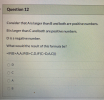 Question 12 Consider that A is larger than B and both are positive numbers. B is larger than C and both are positive numbers. D is a negative number. What would the result of this formula be? =IF(B>A,A,IF(B>C,D,IF(C>D,A,C))) OD OC OA B
Question 9.10 Consider a perfectly competitive firm. When the market price is greater than both the...
 Question 9.10 Consider a perfectly competitive firm. When the market price is greater than both the firm's marginal cost and average variable cost, the firm O A Is maximizing profits O BShould shut down O CShould increase its level of output O D Should reduce its level of output
can you please help with both? I am so stuck. It would be much appreciated Question...
 can you please help with both?
I am so stuck. It would be much appreciated
Question 5 Estimate the integral by Simpson's rule using n=6. a) 0.7000 b) O0.500 c) O 0.3500 d) 0.2500 e) 0.8000 Review Late! Question 6 Estimate the integral = x3 + 4 dx by Simpson's rule using n= 8. a) O 0.9361 b) O 1.0212 c) O 0.7659 d) 0.851 e) 0.6808 Review Later
can you please help with both?
I am so stuck. It would be much appreciated
Question 5 Estimate the integral by Simpson's rule using n=6. a) 0.7000 b) O0.500 c) O 0.3500 d) 0.2500 e) 0.8000 Review Late! Question 6 Estimate the integral = x3 + 4 dx by Simpson's rule using n= 8. a) O 0.9361 b) O 1.0212 c) O 0.7659 d) 0.851 e) 0.6808 Review Later
ID Question 9 1 pts If the concentration inside a cell is 5 times greater than...
 ID Question 9 1 pts If the concentration inside a cell is 5 times greater than the surrounding solution, then C. Water will diffuse into the cell. B. The solution's concentration is hypertonic to the cell's concentration. A. The solution's concentration is hypotonic to the cell's concentration. Q D. both A and C
Can you explain in detail how to do this question? I am completely stuck 5. Which...
 Can you explain in detail how to do this question? I am completely
stuck
5. Which aqueous salt would result in a solution pH greater than 7? e) NaNO3 a) Na(CH,COO) b) d) KCI b) CoCl3 c) NH4Br Na CH2o0
Can you explain in detail how to do this question? I am completely
stuck
5. Which aqueous salt would result in a solution pH greater than 7? e) NaNO3 a) Na(CH,COO) b) d) KCI b) CoCl3 c) NH4Br Na CH2o0
I am stuck with the last question, that what's the proportion of less than 160 cm...
 I am stuck with the last
question, that what's the proportion of less than 160 cm ?
Problem 2.182, page 100. Do part (a). Ignore part (b) in the text, and continue with the following questions (b) Pick site A, what proportion of artifacts were less than 220 cm from the central hearth? c) What proportion of artifacts were greater that or equal to 60 cm from the central hearth? (d) What proportion of artifacts were in between 100 cm...
I am stuck with the last
question, that what's the proportion of less than 160 cm ?
Problem 2.182, page 100. Do part (a). Ignore part (b) in the text, and continue with the following questions (b) Pick site A, what proportion of artifacts were less than 220 cm from the central hearth? c) What proportion of artifacts were greater that or equal to 60 cm from the central hearth? (d) What proportion of artifacts were in between 100 cm...
 Question 4: (20 points) An FM signal is modulated with message m(t)Am cos(2Tmt). The measured amplitude spectrum, SPM(f), is shown below: Amplitude spectrum of the frequency modulated signal 2 -2 5000 4000 3000 2000 -1000 1000 2000 3000 4000 5000 frequency f [Hz] a) What is the carrier frequency fe? b) What is the message frequency fm c) What is the FM modulation index Bf? Is it a narrowband or a wideband signal? d) Using Carson's rule, estimate the transmission...
 b) The figure below shows an FM demodulator. s'(t)Envelope detector Demodulated signal s(t) Differentiator Figure 4: Question 2(b) In the system above, the differentiator performs the time-differentiation operation s'(t) = as(t). Also, the envelope detector is assumed to be ideal, capable of extracting the envelope of the incoming signal perfectly. Describe, by equations, how the above FM demodulator may exactly recover the message signal from the FM signal. (6%) (c) Is the FM demodulator in Question 2(b) a coherent detector,...
 Question 1 In the shown block diagram, the missing block is an integrator m(1) SIA True False AA Moving to another question will save this respo Question 2 The narrowband FM signal is expressed as: A(t) cos {2 11 ft+tan- '[kfa(t)}} True False Question 3 Given the message signal m(t) with peak value 2 and carrier signal 5 cos (108 11 t). If ky = x10, the value of (min equals 50.1 MHz O True False Question 4 The following...
 Question 12 Consider that A is larger than B and both are positive numbers. B is larger than C and both are positive numbers. D is a negative number. What would the result of this formula be? =IF(B>A,A,IF(B>C,D,IF(C>D,A,C))) OD OC OA B
 Question 9.10 Consider a perfectly competitive firm. When the market price is greater than both the firm's marginal cost and average variable cost, the firm O A Is maximizing profits O BShould shut down O CShould increase its level of output O D Should reduce its level of output
 can you please help with both?
I am so stuck. It would be much appreciated
Question 5 Estimate the integral by Simpson's rule using n=6. a) 0.7000 b) O0.500 c) O 0.3500 d) 0.2500 e) 0.8000 Review Late! Question 6 Estimate the integral = x3 + 4 dx by Simpson's rule using n= 8. a) O 0.9361 b) O 1.0212 c) O 0.7659 d) 0.851 e) 0.6808 Review Later
can you please help with both?
I am so stuck. It would be much appreciated
Question 5 Estimate the integral by Simpson's rule using n=6. a) 0.7000 b) O0.500 c) O 0.3500 d) 0.2500 e) 0.8000 Review Late! Question 6 Estimate the integral = x3 + 4 dx by Simpson's rule using n= 8. a) O 0.9361 b) O 1.0212 c) O 0.7659 d) 0.851 e) 0.6808 Review Later
 ID Question 9 1 pts If the concentration inside a cell is 5 times greater than the surrounding solution, then C. Water will diffuse into the cell. B. The solution's concentration is hypertonic to the cell's concentration. A. The solution's concentration is hypotonic to the cell's concentration. Q D. both A and C
 Can you explain in detail how to do this question? I am completely
stuck
5. Which aqueous salt would result in a solution pH greater than 7? e) NaNO3 a) Na(CH,COO) b) d) KCI b) CoCl3 c) NH4Br Na CH2o0
Can you explain in detail how to do this question? I am completely
stuck
5. Which aqueous salt would result in a solution pH greater than 7? e) NaNO3 a) Na(CH,COO) b) d) KCI b) CoCl3 c) NH4Br Na CH2o0
 I am stuck with the last
question, that what's the proportion of less than 160 cm ?
Problem 2.182, page 100. Do part (a). Ignore part (b) in the text, and continue with the following questions (b) Pick site A, what proportion of artifacts were less than 220 cm from the central hearth? c) What proportion of artifacts were greater that or equal to 60 cm from the central hearth? (d) What proportion of artifacts were in between 100 cm...
I am stuck with the last
question, that what's the proportion of less than 160 cm ?
Problem 2.182, page 100. Do part (a). Ignore part (b) in the text, and continue with the following questions (b) Pick site A, what proportion of artifacts were less than 220 cm from the central hearth? c) What proportion of artifacts were greater that or equal to 60 cm from the central hearth? (d) What proportion of artifacts were in between 100 cm...
Most questions answered within 3 hours.
-
Where is the error in this code sequence?
String s1 = "Hello";
String s2 = "ello";...
asked 10 months ago -
Financial data for Joel de Paris, Inc., for last year
follow:
Joel de Paris, Inc.
Balance...
asked 10 months ago -
Consider this reaction:
Al2(SO4)3 (aq)+ BaCl3
(aq) Al2Cl6 (aq)- +
3BaSO4(s) . What is the...
asked 10 months ago -
Suppose that Savneet is considering increasing her
recent random sample from 20 car rentals to 40...
asked 10 months ago -
Trucks arrive at an unloading terminal at an average rate of 120
per hour.
Trucks arrive...
asked 10 months ago -
Why are methanol and ethanol completely soluble in water while
octanol is not very little soluble....
asked 10 months ago -
A facilities manager at a university reads in a research report
that the mean amount of...
asked 10 months ago -
When the CuSO4 is rehydrated by adding water to the anhydrous
compound, is this an endothermic...
asked 10 months ago -
A ray of sunlight is passing from diamond into crown glass; the
angle of incidence is...
asked 10 months ago -
A block of mass 0.249 kg is placed on top of a light, vertical
spring of...
asked 10 months ago -
how do the kidneys compensate in the presences of acidosis
a) trigger hyperventilate
b) reserve acid...
asked 10 months ago -
Question 501 pts
The rental rate of capital to the firm increases. Which of the
following...
asked 10 months ago