
Homework Answers
Add Answer to:
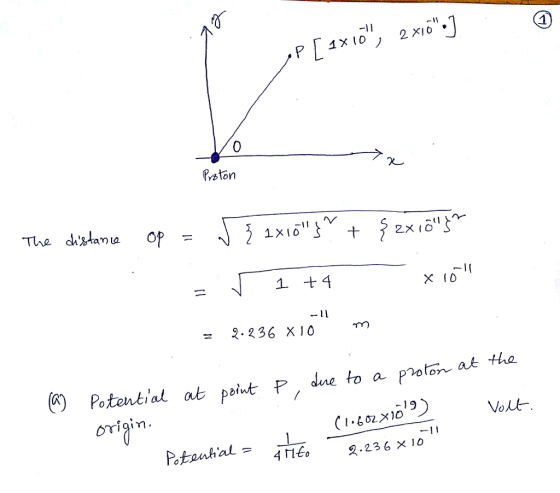
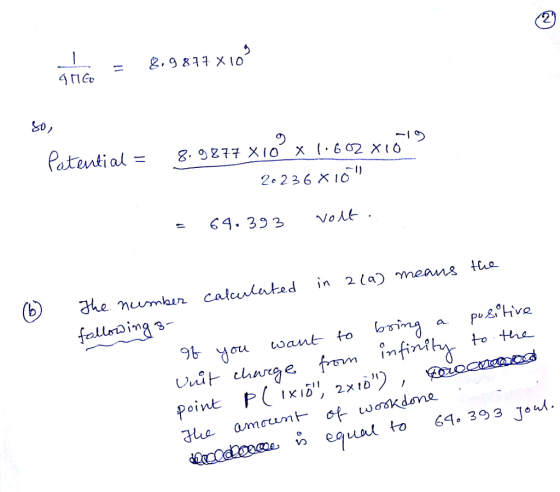
1.00-10." m . 2.00 저0" m) Proton 2. (a) Calculate the electric potential at point P....
A) A proton is placed at point A, where the electric potential is 100 V ....
A) A proton is placed at point A, where the electric potential is 100 V . The proton is released from rest. Some time later, the proton has reached point B, where the electric potential is -140 V . What is the de Broglie wavelength of the proton when it reaches point B? _____ m B) We then place an electron at point B and release it from rest. What is its de Broglie wavelength when it reaches point A?...
1) (a) Calculate the electric potential energy (in terms of eV) of a pair of proton...
 1) (a) Calculate the electric potential energy (in terms of eV) of a pair of proton that separated by a distance of 6 x 10-12m. (b) Calculate the electric potential energy (in terms of eV) of a system that consist of an electron and proton separated by a distance of 7.5 x 10⁻¹°m (c) A proton is initially at rest, it is then accelerated through a potential difference of 24kv. Calculate its final speed. (10 Points)
1. A proton is placed at point A, where the electric potential is 200 V ....
1. A proton is placed at point A, where the electric potential is 200 V . The proton is released from rest. Some time later, the proton has reached point B, where the electric potential is -120 V . What is the de Broglie wavelength of the proton when it reaches point B? 2.We then place an electron at point B and release it from rest. What is its de Broglie wavelength when it reaches point A?
The potential at point P in an electric field is 377 V. (Let's denote the electric...
The potential at point P in an electric field is 377 V. (Let's denote the electric potential energy as UE.) (a) What is the electrical potential energy of a proton placed at P, in eV and in joules? UE = UE = (b) What is the electrical potential energy of an electron at P, in eV and in joules? UE = UE =
deal with the following diagram, showing three point charges of -2.00 μC, +4.00 μC, and +6.00...
 deal with the following diagram, showing
three point charges of -2.00 μC, +4.00 μC, and +6.00 μC that are
placed along the x-axis.
(a)What is the sign of the electric potential at point P?
positive
negative
(b) What is the magnitude of the electric potential at point
P?
(c)Suppose a proton is initially very far away in the +y
direction. How much work would it take to bring this proton down
along the y-axis to point P?
(d)Would your answer...
deal with the following diagram, showing
three point charges of -2.00 μC, +4.00 μC, and +6.00 μC that are
placed along the x-axis.
(a)What is the sign of the electric potential at point P?
positive
negative
(b) What is the magnitude of the electric potential at point
P?
(c)Suppose a proton is initially very far away in the +y
direction. How much work would it take to bring this proton down
along the y-axis to point P?
(d)Would your answer...
What is the electric potential 4.2×10⁻¹¹ m from a proton (charge +e)? Let V=0 at r=∞....
What is the electric potential 4.2×10⁻¹¹ m from a proton (charge +e)? Let V=0 at r=∞. electric potential = 34V. What is the potential energy of an electron at this point in Joules?
Part A: A proton is placed at point A, where the electric potential is 175 V...
Part A: A proton is placed at point A, where the electric potential is 175 V . The proton is released from rest. Some time later, the proton has reached point B, where the electric potential is -160 V . What is the de Broglie wavelength of the proton when it reaches point B? Part B: We then place an electron at point B and release it from rest. What is its de Broglie wavelength when it reaches point A?
Problem with data for try #2: A proton moves 2.00 cm parallel to a uniform electric...
 Problem with data for try #2: A proton moves 2.00 cm parallel to a uniform electric field of 277 V/m. What potential difference did the proton move through? (Enter the absolute value of AV.) Defined symbols: E electric filed in V/m d distance the proton moves in m The answer is DeltaV potential difference in V Hints: The connection between work and electric potential is important. Remember that for a uniform force (your forces will always be uniform) W-Fd. The...
4. (a) What is the electric potential 2.00 cm from a 50.0 x 10⁻¹² C point...
 4. (a) What is the electric potential 2.00 cm from a 50.0 x 10⁻¹² C point charge? (b) What is the strength of the electric field 2.00 cm from a 50.0 x 101 C charge?
1.0 x 10⁻⁸ cm from a proton? (a) What is the electric potential V at a...
 1.0 x 10⁻⁸ cm from a proton? (a) What is the electric potential V at a distance r 14.4 (b) What is the electric potential energy in units J and ev of an electron at the given distance from the proton 1.48 10-18x 14.4 x ev (c) If the electron moves closer to th e proton, does the electric potential energy increase or decrease? O increase O decrease
 1) (a) Calculate the electric potential energy (in terms of eV) of a pair of proton that separated by a distance of 6 x 10-12m. (b) Calculate the electric potential energy (in terms of eV) of a system that consist of an electron and proton separated by a distance of 7.5 x 10⁻¹°m (c) A proton is initially at rest, it is then accelerated through a potential difference of 24kv. Calculate its final speed. (10 Points)
 deal with the following diagram, showing
three point charges of -2.00 μC, +4.00 μC, and +6.00 μC that are
placed along the x-axis.
(a)What is the sign of the electric potential at point P?
positive
negative
(b) What is the magnitude of the electric potential at point
P?
(c)Suppose a proton is initially very far away in the +y
direction. How much work would it take to bring this proton down
along the y-axis to point P?
(d)Would your answer...
deal with the following diagram, showing
three point charges of -2.00 μC, +4.00 μC, and +6.00 μC that are
placed along the x-axis.
(a)What is the sign of the electric potential at point P?
positive
negative
(b) What is the magnitude of the electric potential at point
P?
(c)Suppose a proton is initially very far away in the +y
direction. How much work would it take to bring this proton down
along the y-axis to point P?
(d)Would your answer...
 Problem with data for try #2: A proton moves 2.00 cm parallel to a uniform electric field of 277 V/m. What potential difference did the proton move through? (Enter the absolute value of AV.) Defined symbols: E electric filed in V/m d distance the proton moves in m The answer is DeltaV potential difference in V Hints: The connection between work and electric potential is important. Remember that for a uniform force (your forces will always be uniform) W-Fd. The...
 4. (a) What is the electric potential 2.00 cm from a 50.0 x 10⁻¹² C point charge? (b) What is the strength of the electric field 2.00 cm from a 50.0 x 101 C charge?
 1.0 x 10⁻⁸ cm from a proton? (a) What is the electric potential V at a distance r 14.4 (b) What is the electric potential energy in units J and ev of an electron at the given distance from the proton 1.48 10-18x 14.4 x ev (c) If the electron moves closer to th e proton, does the electric potential energy increase or decrease? O increase O decrease
Most questions answered within 3 hours.
-
Where is the error in this code sequence?
String s1 = "Hello";
String s2 = "ello";...
asked 11 months ago -
Financial data for Joel de Paris, Inc., for last year
follow:
Joel de Paris, Inc.
Balance...
asked 11 months ago -
Consider this reaction:
Al2(SO4)3 (aq)+ BaCl3
(aq) Al2Cl6 (aq)- +
3BaSO4(s) . What is the...
asked 11 months ago -
Suppose that Savneet is considering increasing her
recent random sample from 20 car rentals to 40...
asked 11 months ago -
Trucks arrive at an unloading terminal at an average rate of 120
per hour.
Trucks arrive...
asked 11 months ago -
Why are methanol and ethanol completely soluble in water while
octanol is not very little soluble....
asked 11 months ago -
A facilities manager at a university reads in a research report
that the mean amount of...
asked 11 months ago -
When the CuSO4 is rehydrated by adding water to the anhydrous
compound, is this an endothermic...
asked 11 months ago -
A ray of sunlight is passing from diamond into crown glass; the
angle of incidence is...
asked 11 months ago -
A block of mass 0.249 kg is placed on top of a light, vertical
spring of...
asked 11 months ago -
how do the kidneys compensate in the presences of acidosis
a) trigger hyperventilate
b) reserve acid...
asked 11 months ago -
Question 501 pts
The rental rate of capital to the firm increases. Which of the
following...
asked 11 months ago