
Homework Answers
initial speed of train = 45 mph = 20.11 m/s
distance of train from station = 6 miles = 9656 m
final speed of train = 15 mph = 6.706 m/s
distance of train from station = 0.5 miles=804.67 m
distance travelled = 9656-804.67 = 8851.39 m
let deceleration be a
6.7062 = 20.112+(2*a*8851.39)
a=-0.02 m/s2
deceleration = 0.02 m/s2
let time required be t
t=(20.11-6.706)/0.02=670.2 seconds
let final deceleration be a
02=6.7062+2*a*804.67
a=-0.028 m/s2
final deceleration = 0.028 m/s2
Add Answer to:
begins A commuter train traveling at 45MPH is ómiles from the station. The train to decelerate...
A train departs Station A to travel to Station B which is 1369 meters away. The...
A train departs Station A to travel to Station B which is 1369 meters away. The train begins at rest and accelerates at a rate of 1.36 m/s2 until it reaches a speed of 20.0 m/s. As the train approaches station B, it begins to decelerate at a rate of 0.62 m/s2 so that it comes to a complete stop just as it arrives at Station B. Determine the average velocity of the train over the entire trip.
A commuter train leaves a station( constant operating speed. a) What is the operating speed of...
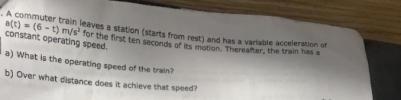 A commuter train leaves a station( constant operating speed. a) What is the operating speed of the train? b) Over what distance does it achieve that speed? starts from rest) and has a variable acceleration of ) m/s* for the first ten seconds of its motion. Thereafter, the train has a
. Movement of a train. A train starts from a station A and has a constant...
. Movement of a train. A train starts from a station A and has a constant acceleration of 0.4 for 2 minutes.for the next 75 seconds it continues with constant speed, and finally applies the brakes until it stops at station B due to a deceleration of 0. 8 m / s2. (a) Calculate the distance between stations A and B. (b) Prepare the graphs Position (x) - time (1), speed (v) - time (() and acceleration (a) - time...
Consider commuter trains serving contiguous stations. At each station, trains stop to load and unload passengers...
Consider commuter trains serving contiguous stations. At each station, trains stop to load and unload passengers and this requires a fixed "dwell" time, d. Between stations, trains travel at cruise speed, v. Ignore the effects of acceleration and deceleration. For safety reasons, consecutive trains must always be physically separated by a minimum block distance, b, where block distance is measured from the rear end of a leading train to the front end of the following train. Trains have physical length...
SELF ASSESSMENT B A commuter travels into town by KTM train and then has to catch...
 SELF ASSESSMENT B A commuter travels into town by KTM train and then has to catch a bus from station to the office. The time, X minutes, that the commuter has to wait for the bus can be modelled by the probability density function: f(x) = 0.5k(6 - x) ,0 SX4 ,4<xs6 otherwise where kis a constant. i. Find the value of k. ii. Sketch the graph of F(x) versus X. iv. Using F(x), show that the probability the commuter...
A train started from rest and moved with constant acceleration. At one time it was traveling...
A train started from rest and moved with constant acceleration. At one time it was traveling 30 m/s, and 170 m farther on it was traveling 49 m/s. Calculate (a) the acceleration, (b) the time required to travel the 170 m mentioned, (c) the time required to attain the speed of 30 m/s, and (d) the distance moved from rest to the time the train had a speed of 30 m/s.
Consider commuter trains of physical length, L, serving contiguous stations. At each station, trains stop to...
Consider commuter trains of physical length, L, serving contiguous stations. At each station, trains stop to load and unload passengers and this requires a fixed “dwell” time, d. Between stations, trains travel at cruise speed, v. We ignore effects of acceleration and deceleration. For safety reasons, consecutive trains must always maintain a physical separation of at least one block length, b, between the tail of one train and the head of the train immediately behind. Determine the maximum flow of...
A car starts from rest, and begins accelerating at a constant rate a1. It accelerates at...
A car starts from rest, and begins accelerating at a constant rate a1. It accelerates at this rate for a distance of 57.8m from its starting point, and then immediately begins to decelerate at a different constant rate a2, eventually coming to rest again after traveling an additional distance of 73.8m from where it began decelerating. The entire trip from start to finish( starting and ending at rest) lasts for a duration of 24.3s. a) what is the duration of...
Problem 5: The greatest possible acceleration or deceleration that a train may have is a and...
 Problem 5: The greatest possible acceleration or deceleration that a train may have is a and its maximum speed is v. Find the minimum time in which the train can get from one station to the next if the total distance between the stations is s. Assume the train starts from the first station at rest and stops when it reaches the next station.
A car starts from rest, and begins accelerating at a constant rate a1. It accelerates at...
A car starts from rest, and begins accelerating at a constant rate a1. It accelerates at this rate from a distance of 56.9 m from its starting point, and then immediately begins to decelerate at a different constant rate a2, eventually coming to rest again after traveling an additional distance of 79.4 m from where it began decelerating. the entire tripfrom start to finish(starting and ending at rest) lasts for a duration of 19.1 s. a)what is the magnitude of...
 A commuter train leaves a station( constant operating speed. a) What is the operating speed of the train? b) Over what distance does it achieve that speed? starts from rest) and has a variable acceleration of ) m/s* for the first ten seconds of its motion. Thereafter, the train has a
 SELF ASSESSMENT B A commuter travels into town by KTM train and then has to catch a bus from station to the office. The time, X minutes, that the commuter has to wait for the bus can be modelled by the probability density function: f(x) = 0.5k(6 - x) ,0 SX4 ,4<xs6 otherwise where kis a constant. i. Find the value of k. ii. Sketch the graph of F(x) versus X. iv. Using F(x), show that the probability the commuter...
 Problem 5: The greatest possible acceleration or deceleration that a train may have is a and its maximum speed is v. Find the minimum time in which the train can get from one station to the next if the total distance between the stations is s. Assume the train starts from the first station at rest and stops when it reaches the next station.
Most questions answered within 3 hours.
-
Where is the error in this code sequence?
String s1 = "Hello";
String s2 = "ello";...
asked 11 months ago -
Financial data for Joel de Paris, Inc., for last year
follow:
Joel de Paris, Inc.
Balance...
asked 11 months ago -
Consider this reaction:
Al2(SO4)3 (aq)+ BaCl3
(aq) Al2Cl6 (aq)- +
3BaSO4(s) . What is the...
asked 11 months ago -
Suppose that Savneet is considering increasing her
recent random sample from 20 car rentals to 40...
asked 11 months ago -
Trucks arrive at an unloading terminal at an average rate of 120
per hour.
Trucks arrive...
asked 11 months ago -
Why are methanol and ethanol completely soluble in water while
octanol is not very little soluble....
asked 11 months ago -
A facilities manager at a university reads in a research report
that the mean amount of...
asked 11 months ago -
When the CuSO4 is rehydrated by adding water to the anhydrous
compound, is this an endothermic...
asked 11 months ago -
A ray of sunlight is passing from diamond into crown glass; the
angle of incidence is...
asked 11 months ago -
A block of mass 0.249 kg is placed on top of a light, vertical
spring of...
asked 11 months ago -
how do the kidneys compensate in the presences of acidosis
a) trigger hyperventilate
b) reserve acid...
asked 11 months ago -
Question 501 pts
The rental rate of capital to the firm increases. Which of the
following...
asked 11 months ago