 correct?
Homework Answers
SOLUTION :
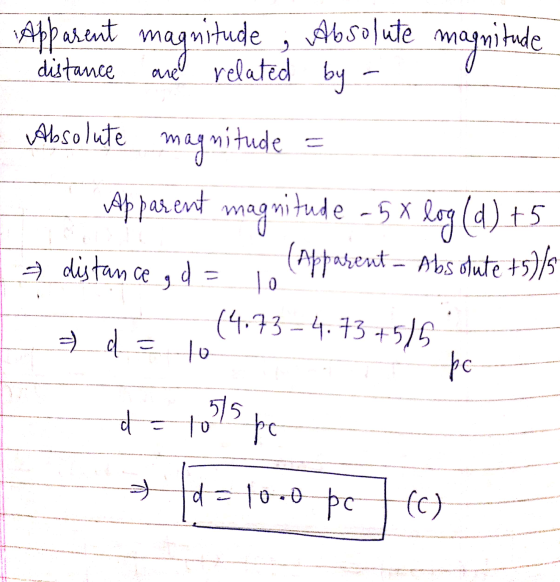
Distance of a star based on difference of apparent magnitude and absolute magnitude can be calculate by using the following formula :
Distance
= 10 ^[ ((apparent magnitude - absolute magnitude) + 5) / 5 ]
= 10^[ ((4.73 - 4.73) + 5) / 5 ]
= 10^[ 5 / 5]
= 10^1
= 10 parsecs : Option c. (ANSWER)
Yes you are correct
(C) distance = 10.0 pc
Add Answer to:
correct?
16. The star Sinbad 7 has an apparent magnitude of 4.73 and an absolute magnitude...
9) How distant is a star whose modulus is -7.5? 10) If its apparent magnitude (m)...
 9) How distant is a star whose modulus is -7.5? 10) If its apparent magnitude (m) = +13.5 and absolute magnitude (M) = +10, what is the distance to a star? PROBLEMS TO COMPLETE FOR PARALLAX 11) A star has a parallax of .025 seconds of arc—what is its distance in parsecs? The nearest star has a parallax of 76 arc seconds—what is its distance in light years? 12) If star were 2.40 pc from Earth, what would its distance...
If you can measure the apparent magnitude of a star and known the absolute magnitude of...
 If you can measure the apparent magnitude of a star and known the absolute magnitude of that type of star (e.g. RR Lyrae or Cepheids, then what can you determine distance temperature radius semi-major axis distance
Hi! So this table on the picture has star information needed. the queastion is: “A star...
 Hi! So this table on the picture has star information needed.
the queastion is:
“A star whose apparent magnitude and absolute magnitude are
identical is licated at 10 persecs away from us (by definition).
Star C is at 10 pc. Of the other four stars, rank them from
closest, closer, farther, farthest. (HINT: figure out if a star
would be brighter or dimmer IF it were located at 10
persecs.)”
So on second picture were my answers, and i got...
Hi! So this table on the picture has star information needed.
the queastion is:
“A star whose apparent magnitude and absolute magnitude are
identical is licated at 10 persecs away from us (by definition).
Star C is at 10 pc. Of the other four stars, rank them from
closest, closer, farther, farthest. (HINT: figure out if a star
would be brighter or dimmer IF it were located at 10
persecs.)”
So on second picture were my answers, and i got...
The star Polaris has an apparent magnitude of 1.98 and is located 133 parsecs away. What...
 The star Polaris has an apparent magnitude of 1.98 and is located 133 parsecs away. What is Polaris's absolute magnitude? Express your answer to 3 significant figures. absolute magnitude:
A star has apparent magnitude 10.0 and absolute magnitude 4.5. How far away is it? Express...
A star has apparent magnitude 10.0 and absolute magnitude 4.5. How far away is it? Express your answer using two significant figures.
1) If a star has an apparent magnitude of -0.4 and a parallax of 0.3”, what...
1) If a star has an apparent magnitude of -0.4 and a parallax of 0.3”, what is a) the distance modulus and b) the absolute magnitude?
A main sequence star whose spectral type is O6 has an apparent magnitude of mv= 5:8. i) Calculate...
A main sequence star whose spectral type is O6 has an apparent magnitude of mv= 5:8. i) Calculate the distance to the star: ignoring contributions of stellar extinction from ISM. ii) if interstellar medium contributes 1.3 magnitudes of extinction.
htness is distance-dependent. The brighter star may not actually e. We need to correct for the...
 htness is distance-dependent. The brighter star may not actually e. We need to correct for the distance so that we can actually r s. If you know the apparent magnitude and the parallax (distance number to the absolute magnitude scale. The absolute magnit what the magnitude of the star would be if it was located at 10 p Absolute magnitude Apparent magnitude+ 5+5 x log(paralla Convert these apparent magnitudes to absolute magnitudes. Apparent Magnitude 1.0.o Parallax 0.32" 0.012" Absolute Magnitude
The star Sirius has an apparent magnitude ?V = −1.46 and a parallax ? = 0.37921”.(a)...
The star Sirius has an apparent magnitude ?V = −1.46 and a parallax ? = 0.37921”.(a) Calculate its distance and absolute magnitude. (b) What would Sirius’ parallax be if it were measured from an observatory on Neptune’s moon Triton as Neptune orbited theSun?
1. A star has a parallax of 0.324 arcseconds and apparent magnitude in V-band m= +1.55....
1. A star has a parallax of 0.324 arcseconds and apparent magnitude in V-band m= +1.55. Later observations reveal that the “star” is actually a close binary, with members star 1 and star 2. Star 1 is found to have mı = +1.83. (a) Find the apparent magnitude of star 2, m2. [2 marks] (b) What is the ratio of the V-band flux received from star 1 to that received from star 2? (c) Find the distance to the system...
 9) How distant is a star whose modulus is -7.5? 10) If its apparent magnitude (m) = +13.5 and absolute magnitude (M) = +10, what is the distance to a star? PROBLEMS TO COMPLETE FOR PARALLAX 11) A star has a parallax of .025 seconds of arc—what is its distance in parsecs? The nearest star has a parallax of 76 arc seconds—what is its distance in light years? 12) If star were 2.40 pc from Earth, what would its distance...
 If you can measure the apparent magnitude of a star and known the absolute magnitude of that type of star (e.g. RR Lyrae or Cepheids, then what can you determine distance temperature radius semi-major axis distance
 Hi! So this table on the picture has star information needed.
the queastion is:
“A star whose apparent magnitude and absolute magnitude are
identical is licated at 10 persecs away from us (by definition).
Star C is at 10 pc. Of the other four stars, rank them from
closest, closer, farther, farthest. (HINT: figure out if a star
would be brighter or dimmer IF it were located at 10
persecs.)”
So on second picture were my answers, and i got...
Hi! So this table on the picture has star information needed.
the queastion is:
“A star whose apparent magnitude and absolute magnitude are
identical is licated at 10 persecs away from us (by definition).
Star C is at 10 pc. Of the other four stars, rank them from
closest, closer, farther, farthest. (HINT: figure out if a star
would be brighter or dimmer IF it were located at 10
persecs.)”
So on second picture were my answers, and i got...
 The star Polaris has an apparent magnitude of 1.98 and is located 133 parsecs away. What is Polaris's absolute magnitude? Express your answer to 3 significant figures. absolute magnitude:
 htness is distance-dependent. The brighter star may not actually e. We need to correct for the distance so that we can actually r s. If you know the apparent magnitude and the parallax (distance number to the absolute magnitude scale. The absolute magnit what the magnitude of the star would be if it was located at 10 p Absolute magnitude Apparent magnitude+ 5+5 x log(paralla Convert these apparent magnitudes to absolute magnitudes. Apparent Magnitude 1.0.o Parallax 0.32" 0.012" Absolute Magnitude
Most questions answered within 3 hours.
-
Where is the error in this code sequence?
String s1 = "Hello";
String s2 = "ello";...
asked 10 months ago -
Financial data for Joel de Paris, Inc., for last year
follow:
Joel de Paris, Inc.
Balance...
asked 10 months ago -
Consider this reaction:
Al2(SO4)3 (aq)+ BaCl3
(aq) Al2Cl6 (aq)- +
3BaSO4(s) . What is the...
asked 10 months ago -
Suppose that Savneet is considering increasing her
recent random sample from 20 car rentals to 40...
asked 10 months ago -
Trucks arrive at an unloading terminal at an average rate of 120
per hour.
Trucks arrive...
asked 10 months ago -
Why are methanol and ethanol completely soluble in water while
octanol is not very little soluble....
asked 10 months ago -
A facilities manager at a university reads in a research report
that the mean amount of...
asked 10 months ago -
When the CuSO4 is rehydrated by adding water to the anhydrous
compound, is this an endothermic...
asked 10 months ago -
A ray of sunlight is passing from diamond into crown glass; the
angle of incidence is...
asked 10 months ago -
A block of mass 0.249 kg is placed on top of a light, vertical
spring of...
asked 10 months ago -
how do the kidneys compensate in the presences of acidosis
a) trigger hyperventilate
b) reserve acid...
asked 10 months ago -
Question 501 pts
The rental rate of capital to the firm increases. Which of the
following...
asked 10 months ago