
Homework Answers


Add Answer to:
1125 and b 56 (a) Find ged(a, b) using: (i) The Euclidean Algorithm (ii) The fundamental...
Using the Extended Euclidean Algorithm, find the multiplicative inverse of: 31 mod 3480
Using the Extended Euclidean Algorithm, find the multiplicative inverse of: 31 mod 3480
2,3,4,5,6 please 2. Use the Euclidean algorithm to find the following: a gcd(100, 101) b. ged(2482,...
 2,3,4,5,6 please
2. Use the Euclidean algorithm to find the following: a gcd(100, 101) b. ged(2482, 7633) 3. Prove that if a = bq+r, then ged(a, b) = ged(b,r). such that sa tb ged(a,b) for the following pairs 4. Use Bézout's theorem to find 8 and a. 33, 44 b. 101, 203 c. 10001, 13422 5. Prove by induction that if p is prime and plaja... An, then pla, for at least one Q. (Hint: use n = 2 as...
2,3,4,5,6 please
2. Use the Euclidean algorithm to find the following: a gcd(100, 101) b. ged(2482, 7633) 3. Prove that if a = bq+r, then ged(a, b) = ged(b,r). such that sa tb ged(a,b) for the following pairs 4. Use Bézout's theorem to find 8 and a. 33, 44 b. 101, 203 c. 10001, 13422 5. Prove by induction that if p is prime and plaja... An, then pla, for at least one Q. (Hint: use n = 2 as...
Applied Cryptography Assignment Using the extended Euclidean algorithm, find the multiplicative inverse of: 13140 mod 40902
Applied Cryptography Assignment Using the extended Euclidean algorithm, find the multiplicative inverse of: 13140 mod 40902
Foundations of matematics question need help solving. Q1. Consider the Diophantine equation (i). Use Euclid's Algorithm...
 Foundations of matematics question need help solving.
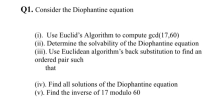
Q1. Consider the Diophantine equation (i). Use Euclid's Algorithm to compute ged(17,60) (ii). Determine the solvability of the Diophantine equation (iii). Use Euclidean algorithm's back substitution to find an ordered pair such that (iv). Find all solutions of the Diophantine equation (v). Find the inverse of 17 modulo 60 01. Consider the Diophantine equation 17x +60y-3 (D. Use Euclid's Algorithm to compute gcd(17,60) (i). Determine the solvability of the Diophantine equation (ii). Use...
Foundations of matematics question need help solving.
Q1. Consider the Diophantine equation (i). Use Euclid's Algorithm to compute ged(17,60) (ii). Determine the solvability of the Diophantine equation (iii). Use Euclidean algorithm's back substitution to find an ordered pair such that (iv). Find all solutions of the Diophantine equation (v). Find the inverse of 17 modulo 60 01. Consider the Diophantine equation 17x +60y-3 (D. Use Euclid's Algorithm to compute gcd(17,60) (i). Determine the solvability of the Diophantine equation (ii). Use...
a Find the greatest common divisor (gcd) of 322 and 196 by using the Euclidean Algorithm....
 a Find the greatest common divisor (gcd) of 322 and 196 by using the Euclidean Algorithm. gcd- By working back in the Euclidean Algorithm, express the gcd in the form 322m196n where m and n are integers b) c) Decide which of the following equations have integer solutions. (i) 322z +196y 42 ii) 322z +196y-57
B1 a. Let x := 3C1 + 1 and let y := 5C2 + 1. Use...
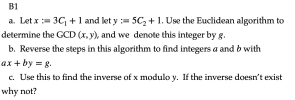 B1 a. Let x := 3C1 + 1 and let y := 5C2 + 1. Use the Euclidean algorithm to determine the GCD (x, y), and we denote this integer by g. b. Reverse the steps in this algorithm to find integers a and b with ax+by = 8. c. Use this to find the inverse of x modulo y. If the inverse doesn't exist why not?
1. Let m be a nonnegative integer, and n a positive integer. Using the division algorithm...
 1. Let m be a nonnegative integer, and n a positive integer. Using the division algorithm we can write m=qn+r, with 0 <r<n-1. As in class define (m,n) = {mc+ny: I,Y E Z} and S(..r) = {nu+ru: UV E Z}. Prove that (m,n) = S(n,r). (Remark: If we add to the definition of ged that gedan, 0) = god(0, n) = n, then this proves that ged(m, n) = ged(n,r). This result leads to a fast algorithm for computing ged(m,...
Q 9. In this question, you must clearly set out your working, describing your process with...
 Q 9. In this question, you must clearly set out your working, describing your process with full English sentences. (a) Using Euclid's Algorithm 14.13, show that ged(25, 33) = 1, and hence find integers x, y E Z such that x · 25+ y: 33 = 1. Clearly state the values of x and y. (b) By the Multiplicative Inverse Theorem 14.22, it follows from (a) that 25 has a multiplicative inverse, 25(-1), in Z33. Calculate 25(-1) using your answer...
PROBLEM 1 For each of the following pairs of integers, use the Euclidean Algorithm to find...
 PROBLEM 1 For each of the following pairs of integers, use the Euclidean Algorithm to find ged(a,b), and to write gcd(a,b) as a linear combination of a and b, i.e. find integers m and n such that gcd(a,b) = am + bn. (a) a = 36, b = 60. (b) a = 12628, b = 21361. (c) a = 901, b = -935. (d) a = 72, b = 714. (e) a = -36, b = -60.
(3) Hint: Use the Euclidean Algorithm (repeated application of division algorithm using previous remain- ders) to find...
 (3) Hint: Use the Euclidean Algorithm (repeated application of division algorithm using previous remain- ders) to find the greatest common divisor of the given pairs of elements and use that to express these principal ideals. (a) Express the ideals as 2178Z2808Z and 2178Zn 2808Z in Z as principal ideals. (b) Express the ideals (2r63 r+2x + 2) + (2r5 +3x4 + 4x +x+ 4) and (2r63z4 as principal ideals +2x +2)n (2r5 +34 + 4x3 + z2+4) in (Z/5Z)
(3)...
(3) Hint: Use the Euclidean Algorithm (repeated application of division algorithm using previous remain- ders) to find the greatest common divisor of the given pairs of elements and use that to express these principal ideals. (a) Express the ideals as 2178Z2808Z and 2178Zn 2808Z in Z as principal ideals. (b) Express the ideals (2r63 r+2x + 2) + (2r5 +3x4 + 4x +x+ 4) and (2r63z4 as principal ideals +2x +2)n (2r5 +34 + 4x3 + z2+4) in (Z/5Z)
(3)...
 2,3,4,5,6 please
2. Use the Euclidean algorithm to find the following: a gcd(100, 101) b. ged(2482, 7633) 3. Prove that if a = bq+r, then ged(a, b) = ged(b,r). such that sa tb ged(a,b) for the following pairs 4. Use Bézout's theorem to find 8 and a. 33, 44 b. 101, 203 c. 10001, 13422 5. Prove by induction that if p is prime and plaja... An, then pla, for at least one Q. (Hint: use n = 2 as...
2,3,4,5,6 please
2. Use the Euclidean algorithm to find the following: a gcd(100, 101) b. ged(2482, 7633) 3. Prove that if a = bq+r, then ged(a, b) = ged(b,r). such that sa tb ged(a,b) for the following pairs 4. Use Bézout's theorem to find 8 and a. 33, 44 b. 101, 203 c. 10001, 13422 5. Prove by induction that if p is prime and plaja... An, then pla, for at least one Q. (Hint: use n = 2 as...
 Foundations of matematics question need help solving.
Q1. Consider the Diophantine equation (i). Use Euclid's Algorithm to compute ged(17,60) (ii). Determine the solvability of the Diophantine equation (iii). Use Euclidean algorithm's back substitution to find an ordered pair such that (iv). Find all solutions of the Diophantine equation (v). Find the inverse of 17 modulo 60 01. Consider the Diophantine equation 17x +60y-3 (D. Use Euclid's Algorithm to compute gcd(17,60) (i). Determine the solvability of the Diophantine equation (ii). Use...
Foundations of matematics question need help solving.
Q1. Consider the Diophantine equation (i). Use Euclid's Algorithm to compute ged(17,60) (ii). Determine the solvability of the Diophantine equation (iii). Use Euclidean algorithm's back substitution to find an ordered pair such that (iv). Find all solutions of the Diophantine equation (v). Find the inverse of 17 modulo 60 01. Consider the Diophantine equation 17x +60y-3 (D. Use Euclid's Algorithm to compute gcd(17,60) (i). Determine the solvability of the Diophantine equation (ii). Use...
 a Find the greatest common divisor (gcd) of 322 and 196 by using the Euclidean Algorithm. gcd- By working back in the Euclidean Algorithm, express the gcd in the form 322m196n where m and n are integers b) c) Decide which of the following equations have integer solutions. (i) 322z +196y 42 ii) 322z +196y-57
 B1 a. Let x := 3C1 + 1 and let y := 5C2 + 1. Use the Euclidean algorithm to determine the GCD (x, y), and we denote this integer by g. b. Reverse the steps in this algorithm to find integers a and b with ax+by = 8. c. Use this to find the inverse of x modulo y. If the inverse doesn't exist why not?
 1. Let m be a nonnegative integer, and n a positive integer. Using the division algorithm we can write m=qn+r, with 0 <r<n-1. As in class define (m,n) = {mc+ny: I,Y E Z} and S(..r) = {nu+ru: UV E Z}. Prove that (m,n) = S(n,r). (Remark: If we add to the definition of ged that gedan, 0) = god(0, n) = n, then this proves that ged(m, n) = ged(n,r). This result leads to a fast algorithm for computing ged(m,...
 Q 9. In this question, you must clearly set out your working, describing your process with full English sentences. (a) Using Euclid's Algorithm 14.13, show that ged(25, 33) = 1, and hence find integers x, y E Z such that x · 25+ y: 33 = 1. Clearly state the values of x and y. (b) By the Multiplicative Inverse Theorem 14.22, it follows from (a) that 25 has a multiplicative inverse, 25(-1), in Z33. Calculate 25(-1) using your answer...
 PROBLEM 1 For each of the following pairs of integers, use the Euclidean Algorithm to find ged(a,b), and to write gcd(a,b) as a linear combination of a and b, i.e. find integers m and n such that gcd(a,b) = am + bn. (a) a = 36, b = 60. (b) a = 12628, b = 21361. (c) a = 901, b = -935. (d) a = 72, b = 714. (e) a = -36, b = -60.
 (3) Hint: Use the Euclidean Algorithm (repeated application of division algorithm using previous remain- ders) to find the greatest common divisor of the given pairs of elements and use that to express these principal ideals. (a) Express the ideals as 2178Z2808Z and 2178Zn 2808Z in Z as principal ideals. (b) Express the ideals (2r63 r+2x + 2) + (2r5 +3x4 + 4x +x+ 4) and (2r63z4 as principal ideals +2x +2)n (2r5 +34 + 4x3 + z2+4) in (Z/5Z)
(3)...
(3) Hint: Use the Euclidean Algorithm (repeated application of division algorithm using previous remain- ders) to find the greatest common divisor of the given pairs of elements and use that to express these principal ideals. (a) Express the ideals as 2178Z2808Z and 2178Zn 2808Z in Z as principal ideals. (b) Express the ideals (2r63 r+2x + 2) + (2r5 +3x4 + 4x +x+ 4) and (2r63z4 as principal ideals +2x +2)n (2r5 +34 + 4x3 + z2+4) in (Z/5Z)
(3)...
Most questions answered within 3 hours.
-
Where is the error in this code sequence?
String s1 = "Hello";
String s2 = "ello";...
asked 10 months ago -
Financial data for Joel de Paris, Inc., for last year
follow:
Joel de Paris, Inc.
Balance...
asked 10 months ago -
Consider this reaction:
Al2(SO4)3 (aq)+ BaCl3
(aq) Al2Cl6 (aq)- +
3BaSO4(s) . What is the...
asked 10 months ago -
Suppose that Savneet is considering increasing her
recent random sample from 20 car rentals to 40...
asked 10 months ago -
Trucks arrive at an unloading terminal at an average rate of 120
per hour.
Trucks arrive...
asked 10 months ago -
Why are methanol and ethanol completely soluble in water while
octanol is not very little soluble....
asked 10 months ago -
A facilities manager at a university reads in a research report
that the mean amount of...
asked 10 months ago -
When the CuSO4 is rehydrated by adding water to the anhydrous
compound, is this an endothermic...
asked 10 months ago -
A ray of sunlight is passing from diamond into crown glass; the
angle of incidence is...
asked 10 months ago -
A block of mass 0.249 kg is placed on top of a light, vertical
spring of...
asked 10 months ago -
how do the kidneys compensate in the presences of acidosis
a) trigger hyperventilate
b) reserve acid...
asked 10 months ago -
Question 501 pts
The rental rate of capital to the firm increases. Which of the
following...
asked 10 months ago