Calculating vorticity
In spherical polar coordinates (r, θ, φ), a fluid flow has velocity u = r^2 cos θ rˆ + (1/r) θˆ + (1/ sin θ) φˆ . Calculate the vorticity ω.
Homework Answers
Request Answer!
We need at least 10 more requests to produce the answer.
0 / 10 have requested this problem solution
The more requests, the faster the answer.
Struggling with this question, please help with questions underlined or bracketed in yellow, help will be...
 Struggling with this question, please help with
questions underlined or bracketed in yellow, help will be greatly
appreciated!
From Acheson: Elementary Fluid Dynamics
Hint from the Book answer to the amount of torque needed
at end of question:
7.2. A rigid sphere of radius a is immersed in an infinite expanse of viscous fluid. The sphere rotates with constant angular velocity Ω. The Reynolds number R-Ωα2/v is small, so that the slow flow equations apply (r, θ, φ) with θ=0...
Struggling with this question, please help with
questions underlined or bracketed in yellow, help will be greatly
appreciated!
From Acheson: Elementary Fluid Dynamics
Hint from the Book answer to the amount of torque needed
at end of question:
7.2. A rigid sphere of radius a is immersed in an infinite expanse of viscous fluid. The sphere rotates with constant angular velocity Ω. The Reynolds number R-Ωα2/v is small, so that the slow flow equations apply (r, θ, φ) with θ=0...
From Acheson: Elementary Fluid Dynamics Equation 7.3 and 6.12 (Slow Flow Equations) 7.2. A rigid sphere...
 From Acheson: Elementary Fluid Dynamics
Equation 7.3 and 6.12 (Slow Flow Equations)
7.2. A rigid sphere of radius a is immersed in an infinite expanse of viscous fluid. The sphere rotates with constant angular velocity Ω. The Reynolds number R-Ωα2/v is small, so that the slow flow equations apply (see eqns (7.3) and (6.12)). Using spherical polar coordinates (r, θ, φ) with θ-0 as the rotation axis, show that a purely rotary flow u us(r, e, s possible provided that...
From Acheson: Elementary Fluid Dynamics
Equation 7.3 and 6.12 (Slow Flow Equations)
7.2. A rigid sphere of radius a is immersed in an infinite expanse of viscous fluid. The sphere rotates with constant angular velocity Ω. The Reynolds number R-Ωα2/v is small, so that the slow flow equations apply (see eqns (7.3) and (6.12)). Using spherical polar coordinates (r, θ, φ) with θ-0 as the rotation axis, show that a purely rotary flow u us(r, e, s possible provided that...
Question 3 4-73 Solution For a given velocity field we are to calculate the vorticity Analysis...
 Question 3 4-73 Solution For a given velocity field we are to calculate the vorticity Analysis The velocity field is V = (u, v, w)-(3.0+ 2.Ox-y)--(2.0-2.01.) j+10.5ryk Question 4 4-97 Solution For a given velocity field we are to determine if the flow is rotational or irrotational. 1 The flow is steady. 2 The flow is two-dimensional in the r-eplane. The velocity components for flow over a circular cylinder of radiur are Assumptions Analysis 11,--r sin θ| 1 +
This is for EEE 241 (electromagnetics), using vector calculus. Please show work, will give a good rating A vector field...
 This is for EEE 241 (electromagnetics), using vector calculus.
Please show work, will give a good rating
A vector field is given in spherical coordinates as V (R,φ,0) = (100 cos θ) / R3 an + 50 sin θ / R3 a6- At the point P with spherical coordinates R-2, θ = 60° and φ = 20°, find: magnitude of V
A vector field is given in spherical coordinates as V (R,φ,0) = (100 cos θ) / R3 an +...
This is for EEE 241 (electromagnetics), using vector calculus.
Please show work, will give a good rating
A vector field is given in spherical coordinates as V (R,φ,0) = (100 cos θ) / R3 an + 50 sin θ / R3 a6- At the point P with spherical coordinates R-2, θ = 60° and φ = 20°, find: magnitude of V
A vector field is given in spherical coordinates as V (R,φ,0) = (100 cos θ) / R3 an +...
2.5.1 Resolve the spherical polar unit vectors into their Cartesian compo- nents ANS. f = sin...
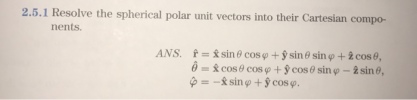 2.5.1 Resolve the spherical polar unit vectors into their Cartesian compo- nents ANS. f = sin θ cos φ + , sin θ sin φ + 2 cos θ, sin φ + cos φ
only do problem 3c, the second picture is the answer to problem 2, the answer I...
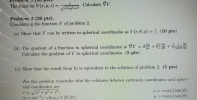 only do problem 3c, the second picture is the answer
to problem 2, the answer I got for 3b is -1/(r^2)
The tinction V(x, y,z) Problem 3 (20 pts). Considering the function V of problem 2, (a) Show that V can be written in spherical coordinates as V(r, θ, φ-1. (10 pts) r + θ + φ (b) The gradient of a function in spherical coordinates is VV Calculate the gradient of V in spherical coordinates. (5 pts) (e) Show...
only do problem 3c, the second picture is the answer
to problem 2, the answer I got for 3b is -1/(r^2)
The tinction V(x, y,z) Problem 3 (20 pts). Considering the function V of problem 2, (a) Show that V can be written in spherical coordinates as V(r, θ, φ-1. (10 pts) r + θ + φ (b) The gradient of a function in spherical coordinates is VV Calculate the gradient of V in spherical coordinates. (5 pts) (e) Show...
PLE 2 The point (0, 5 3 , −5) is given in rectangular coordinates. Find spherical...
PLE 2 The point (0, 5 3 , −5) is given in rectangular coordinates. Find spherical coordinates for this point. SOLUTION From the distance formula we have ρ = x2 + y2 + z2 = 0 + 75 + 25 = 10 Correct: Your answer is correct. and so these equations give the following. cos(φ) = z ρ = -1/2 Correct: Your answer is correct. φ = $$ Incorrect: Your answer is incorrect. cos(θ) = x ρ sin(φ) = θ...
In Exercises 13-22, sketch the graph described by the following spherical coordinates in three-di...
 I need help solving #13, #17 and #21. Only those three
In Exercises 13-22, sketch the graph described by the following spherical coordinates in three-dimensional space. 14, φ 21.0, s ρ cos θ sin φ s 2, OSpsin θ sin φ s 3.
In Exercises 13-22, sketch the graph described by the following spherical coordinates in three-dimensional space. 14, φ 21.0, s ρ cos θ sin φ s 2, OSpsin θ sin φ s 3.
I need help solving #13, #17 and #21. Only those three
In Exercises 13-22, sketch the graph described by the following spherical coordinates in three-dimensional space. 14, φ 21.0, s ρ cos θ sin φ s 2, OSpsin θ sin φ s 3.
In Exercises 13-22, sketch the graph described by the following spherical coordinates in three-dimensional space. 14, φ 21.0, s ρ cos θ sin φ s 2, OSpsin θ sin φ s 3.
3. Show that the velocity field with components (in spherical coordinates) K,-(4kr-3-2)cosa, pa-(2kr-3 +2)sin θ, ν, 0, k > 0,0 is a possible fluid velocity for an incompressible flow. For k 4,...
 3. Show that the velocity field with components (in spherical coordinates) K,-(4kr-3-2)cosa, pa-(2kr-3 +2)sin θ, ν, 0, k > 0,0 is a possible fluid velocity for an incompressible flow. For k 4, determine the stagnation points of the flow, if any. Hint: For stagnation point (W.,Vo,V)-(0,0,0) @s 2
3. Show that the velocity field with components (in spherical coordinates) K,-(4kr-3-2)cosa, pa-(2kr-3 +2)sin θ, ν, 0, k > 0,0 is a possible fluid velocity for an incompressible flow. For k 4,...
3. Show that the velocity field with components (in spherical coordinates) K,-(4kr-3-2)cosa, pa-(2kr-3 +2)sin θ, ν, 0, k > 0,0 is a possible fluid velocity for an incompressible flow. For k 4, determine the stagnation points of the flow, if any. Hint: For stagnation point (W.,Vo,V)-(0,0,0) @s 2
3. Show that the velocity field with components (in spherical coordinates) K,-(4kr-3-2)cosa, pa-(2kr-3 +2)sin θ, ν, 0, k > 0,0 is a possible fluid velocity for an incompressible flow. For k 4,...
Suppose that a scalar field is constant on a surface As shown in the lectures. there are two methods that one might use to obtain the normal to the surface, and they give the same direction (a) Let r...
 Suppose that a scalar field is constant on a surface As shown in the lectures. there are two methods that one might use to obtain the normal to the surface, and they give the same direction (a) Let r(u, v) be a parametric form for the surface S. Use the vector identity to show that Our ar-λ▽u where λ is a scalar field. [Note: no marks will be awarded for simply stating that a term is zero. If it is...
 Struggling with this question, please help with
questions underlined or bracketed in yellow, help will be greatly
appreciated!
From Acheson: Elementary Fluid Dynamics
Hint from the Book answer to the amount of torque needed
at end of question:
7.2. A rigid sphere of radius a is immersed in an infinite expanse of viscous fluid. The sphere rotates with constant angular velocity Ω. The Reynolds number R-Ωα2/v is small, so that the slow flow equations apply (r, θ, φ) with θ=0...
Struggling with this question, please help with
questions underlined or bracketed in yellow, help will be greatly
appreciated!
From Acheson: Elementary Fluid Dynamics
Hint from the Book answer to the amount of torque needed
at end of question:
7.2. A rigid sphere of radius a is immersed in an infinite expanse of viscous fluid. The sphere rotates with constant angular velocity Ω. The Reynolds number R-Ωα2/v is small, so that the slow flow equations apply (r, θ, φ) with θ=0...
 From Acheson: Elementary Fluid Dynamics
Equation 7.3 and 6.12 (Slow Flow Equations)
7.2. A rigid sphere of radius a is immersed in an infinite expanse of viscous fluid. The sphere rotates with constant angular velocity Ω. The Reynolds number R-Ωα2/v is small, so that the slow flow equations apply (see eqns (7.3) and (6.12)). Using spherical polar coordinates (r, θ, φ) with θ-0 as the rotation axis, show that a purely rotary flow u us(r, e, s possible provided that...
From Acheson: Elementary Fluid Dynamics
Equation 7.3 and 6.12 (Slow Flow Equations)
7.2. A rigid sphere of radius a is immersed in an infinite expanse of viscous fluid. The sphere rotates with constant angular velocity Ω. The Reynolds number R-Ωα2/v is small, so that the slow flow equations apply (see eqns (7.3) and (6.12)). Using spherical polar coordinates (r, θ, φ) with θ-0 as the rotation axis, show that a purely rotary flow u us(r, e, s possible provided that...
 Question 3 4-73 Solution For a given velocity field we are to calculate the vorticity Analysis The velocity field is V = (u, v, w)-(3.0+ 2.Ox-y)--(2.0-2.01.) j+10.5ryk Question 4 4-97 Solution For a given velocity field we are to determine if the flow is rotational or irrotational. 1 The flow is steady. 2 The flow is two-dimensional in the r-eplane. The velocity components for flow over a circular cylinder of radiur are Assumptions Analysis 11,--r sin θ| 1 +
 This is for EEE 241 (electromagnetics), using vector calculus.
Please show work, will give a good rating
A vector field is given in spherical coordinates as V (R,φ,0) = (100 cos θ) / R3 an + 50 sin θ / R3 a6- At the point P with spherical coordinates R-2, θ = 60° and φ = 20°, find: magnitude of V
A vector field is given in spherical coordinates as V (R,φ,0) = (100 cos θ) / R3 an +...
This is for EEE 241 (electromagnetics), using vector calculus.
Please show work, will give a good rating
A vector field is given in spherical coordinates as V (R,φ,0) = (100 cos θ) / R3 an + 50 sin θ / R3 a6- At the point P with spherical coordinates R-2, θ = 60° and φ = 20°, find: magnitude of V
A vector field is given in spherical coordinates as V (R,φ,0) = (100 cos θ) / R3 an +...
 2.5.1 Resolve the spherical polar unit vectors into their Cartesian compo- nents ANS. f = sin θ cos φ + , sin θ sin φ + 2 cos θ, sin φ + cos φ
 only do problem 3c, the second picture is the answer
to problem 2, the answer I got for 3b is -1/(r^2)
The tinction V(x, y,z) Problem 3 (20 pts). Considering the function V of problem 2, (a) Show that V can be written in spherical coordinates as V(r, θ, φ-1. (10 pts) r + θ + φ (b) The gradient of a function in spherical coordinates is VV Calculate the gradient of V in spherical coordinates. (5 pts) (e) Show...
only do problem 3c, the second picture is the answer
to problem 2, the answer I got for 3b is -1/(r^2)
The tinction V(x, y,z) Problem 3 (20 pts). Considering the function V of problem 2, (a) Show that V can be written in spherical coordinates as V(r, θ, φ-1. (10 pts) r + θ + φ (b) The gradient of a function in spherical coordinates is VV Calculate the gradient of V in spherical coordinates. (5 pts) (e) Show...
 I need help solving #13, #17 and #21. Only those three
In Exercises 13-22, sketch the graph described by the following spherical coordinates in three-dimensional space. 14, φ 21.0, s ρ cos θ sin φ s 2, OSpsin θ sin φ s 3.
In Exercises 13-22, sketch the graph described by the following spherical coordinates in three-dimensional space. 14, φ 21.0, s ρ cos θ sin φ s 2, OSpsin θ sin φ s 3.
I need help solving #13, #17 and #21. Only those three
In Exercises 13-22, sketch the graph described by the following spherical coordinates in three-dimensional space. 14, φ 21.0, s ρ cos θ sin φ s 2, OSpsin θ sin φ s 3.
In Exercises 13-22, sketch the graph described by the following spherical coordinates in three-dimensional space. 14, φ 21.0, s ρ cos θ sin φ s 2, OSpsin θ sin φ s 3.
 3. Show that the velocity field with components (in spherical coordinates) K,-(4kr-3-2)cosa, pa-(2kr-3 +2)sin θ, ν, 0, k > 0,0 is a possible fluid velocity for an incompressible flow. For k 4, determine the stagnation points of the flow, if any. Hint: For stagnation point (W.,Vo,V)-(0,0,0) @s 2
3. Show that the velocity field with components (in spherical coordinates) K,-(4kr-3-2)cosa, pa-(2kr-3 +2)sin θ, ν, 0, k > 0,0 is a possible fluid velocity for an incompressible flow. For k 4,...
3. Show that the velocity field with components (in spherical coordinates) K,-(4kr-3-2)cosa, pa-(2kr-3 +2)sin θ, ν, 0, k > 0,0 is a possible fluid velocity for an incompressible flow. For k 4, determine the stagnation points of the flow, if any. Hint: For stagnation point (W.,Vo,V)-(0,0,0) @s 2
3. Show that the velocity field with components (in spherical coordinates) K,-(4kr-3-2)cosa, pa-(2kr-3 +2)sin θ, ν, 0, k > 0,0 is a possible fluid velocity for an incompressible flow. For k 4,...
 Suppose that a scalar field is constant on a surface As shown in the lectures. there are two methods that one might use to obtain the normal to the surface, and they give the same direction (a) Let r(u, v) be a parametric form for the surface S. Use the vector identity to show that Our ar-λ▽u where λ is a scalar field. [Note: no marks will be awarded for simply stating that a term is zero. If it is...
Most questions answered within 3 hours.
-
Where is the error in this code sequence?
String s1 = "Hello";
String s2 = "ello";...
asked 11 months ago -
Financial data for Joel de Paris, Inc., for last year
follow:
Joel de Paris, Inc.
Balance...
asked 11 months ago -
Consider this reaction:
Al2(SO4)3 (aq)+ BaCl3
(aq) Al2Cl6 (aq)- +
3BaSO4(s) . What is the...
asked 11 months ago -
Suppose that Savneet is considering increasing her
recent random sample from 20 car rentals to 40...
asked 11 months ago -
Trucks arrive at an unloading terminal at an average rate of 120
per hour.
Trucks arrive...
asked 11 months ago -
Why are methanol and ethanol completely soluble in water while
octanol is not very little soluble....
asked 11 months ago -
A facilities manager at a university reads in a research report
that the mean amount of...
asked 11 months ago -
When the CuSO4 is rehydrated by adding water to the anhydrous
compound, is this an endothermic...
asked 11 months ago -
A ray of sunlight is passing from diamond into crown glass; the
angle of incidence is...
asked 11 months ago -
A block of mass 0.249 kg is placed on top of a light, vertical
spring of...
asked 11 months ago -
how do the kidneys compensate in the presences of acidosis
a) trigger hyperventilate
b) reserve acid...
asked 11 months ago -
Question 501 pts
The rental rate of capital to the firm increases. Which of the
following...
asked 11 months ago