I already asked this question, BUT I still NEED help. Please! No one has answered it!
Homework Answers
Add Answer to:
I already asked this question, BUT I still NEED help.
Please! No one has answered it!...
D Question 5 2 pts Suppose 160 mL of 8.0 M NaOH(aq) is added to 167...
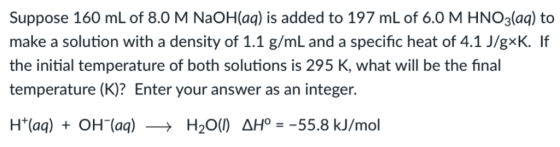
 D Question 5 2 pts Suppose 160 mL of 8.0 M NaOH(aq) is added to 167 mL of 6.0 M HNO3(aq) to make a solution with a density of 1.1 g/mL and a specific heat of 4.1 J/gxK. If the initial temperature of both solutions is 295 K, what will be the final temperature (K)? Enter your answer as an integer. H(aq) + OH(aq) + H2O(1) AH° = -55.8 kJ/mol
Gaseous methane (CH4) will react with gaseous oxygen (O2) to produce gaseous carbon dioxide (CO2 ...
 PART ONE:
PART TWO:
PART THREE:
PART FOUR:
Gaseous methane (CH4) will react with gaseous oxygen (O2) to produce gaseous carbon dioxide (CO2 and gaseous water (H20). Suppose 13. g of methane is mixed with 13.8 g of oxygen. Calculate the minimum mass of methane that could be left over by the chemical reaction. Round your answer to 2 significant digits A 1.32-g sample of a compound is burned in a bomb calorimeter, producing a temperature change from 20.85 °C...
PART ONE:
PART TWO:
PART THREE:
PART FOUR:
Gaseous methane (CH4) will react with gaseous oxygen (O2) to produce gaseous carbon dioxide (CO2 and gaseous water (H20). Suppose 13. g of methane is mixed with 13.8 g of oxygen. Calculate the minimum mass of methane that could be left over by the chemical reaction. Round your answer to 2 significant digits A 1.32-g sample of a compound is burned in a bomb calorimeter, producing a temperature change from 20.85 °C...
Can someone please help me with this? I already asked this and nobody answered. 1. A...
 Can someone please help me with this? I already asked this and
nobody answered.
1. A buffer called "Tris" is widely used in biochemistry. The (neutral) compound "Tris" itself is a weak base, so we'll notate it as "B." The pk, of its conjugate acid (HB) is 8.07. The overall goal of this problem is to calculate the pH change of a Tris buffer upon addition of some strong base. (a) Assume that you have a pH 8.40 Tris buffer...
Can someone please help me with this? I already asked this and
nobody answered.
1. A buffer called "Tris" is widely used in biochemistry. The (neutral) compound "Tris" itself is a weak base, so we'll notate it as "B." The pk, of its conjugate acid (HB) is 8.07. The overall goal of this problem is to calculate the pH change of a Tris buffer upon addition of some strong base. (a) Assume that you have a pH 8.40 Tris buffer...
Hi! Really need help with this problem! I saw that my question has been answered before...
 Hi! Really need help with this problem! I saw that my question
has been answered before but it was confusing.
The conductivity I got for NaCl in part II was 12,030
Heres the previous question. I already answered it. I just
need help with the math on Q13
Q.13. Calculate the mass of CuCl2:2 H2O that would be needed to prepare a 50.00-ml aqueous solution that would yield the same conductivity as the NaCl(aq) solution that you prepared in Part...
Hi! Really need help with this problem! I saw that my question
has been answered before but it was confusing.
The conductivity I got for NaCl in part II was 12,030
Heres the previous question. I already answered it. I just
need help with the math on Q13
Q.13. Calculate the mass of CuCl2:2 H2O that would be needed to prepare a 50.00-ml aqueous solution that would yield the same conductivity as the NaCl(aq) solution that you prepared in Part...
I need help finding calculated pH for part IV and part V please! pKa of acetic...
 I need help finding calculated pH for part IV and part V
please!
pKa
of acetic acid= 4.744
su 13.21 Part IV: Dilution of Buffered and Unbuffered Solutions Calculated pH | Calculated ApH Observed pH Observed ApH Number Preparation 15 ml. HC H3O2(aq) 15 ml NaC,HO2(aq) 5 ml Solution 1 25 mL H20 5 ml Solution 2 25 ml H20 4 30 mL HC H2O2(aq) 5 ml Solution 4 25 ml H2O 5 ml Solution 5 25 ml. H2O 4.10...
I need help finding calculated pH for part IV and part V
please!
pKa
of acetic acid= 4.744
su 13.21 Part IV: Dilution of Buffered and Unbuffered Solutions Calculated pH | Calculated ApH Observed pH Observed ApH Number Preparation 15 ml. HC H3O2(aq) 15 ml NaC,HO2(aq) 5 ml Solution 1 25 mL H20 5 ml Solution 2 25 ml H20 4 30 mL HC H2O2(aq) 5 ml Solution 4 25 ml H2O 5 ml Solution 5 25 ml. H2O 4.10...
Please help 2. Two solutions namely, 500 mL of 0.50 M HCl and 500 mL of...
 Please help
2. Two solutions namely, 500 mL of 0.50 M HCl and 500 mL of 0.50 M NaOH at the same temperature of 21.6 °C are mixed in a constant-pressure calorimeter. The heat capacity of the calorimeter was 450 J/oC. Given that the specific heat of the solution is 4.184 J/g°C, the density of the solution is 1.00 g/mL, and that the heat of neutralization for the process H* (aq) + OH (aq) -- H2O (1) is -56.2 kJ,...
Please help
2. Two solutions namely, 500 mL of 0.50 M HCl and 500 mL of 0.50 M NaOH at the same temperature of 21.6 °C are mixed in a constant-pressure calorimeter. The heat capacity of the calorimeter was 450 J/oC. Given that the specific heat of the solution is 4.184 J/g°C, the density of the solution is 1.00 g/mL, and that the heat of neutralization for the process H* (aq) + OH (aq) -- H2O (1) is -56.2 kJ,...
i need the K+ value this question was submitted already but the second answer i got...
 i need the K+ value this question was submitted already but
the second answer i got was incorrect.
Calculate the standard change in Gibbs free energy, AGn, for the following reaction at 25.0 °C. Standard Gibbs free energy of formation values can be found here. rxn: KCI K (aq)+ CI (ag) Number kJ/ mol Then, determine the concentration of K*(aq) if the change in Gibbs free energy, AGn, for the reaction is -8.45 kJ/mol. Number M
Calculate the standard change...
i need the K+ value this question was submitted already but
the second answer i got was incorrect.
Calculate the standard change in Gibbs free energy, AGn, for the following reaction at 25.0 °C. Standard Gibbs free energy of formation values can be found here. rxn: KCI K (aq)+ CI (ag) Number kJ/ mol Then, determine the concentration of K*(aq) if the change in Gibbs free energy, AGn, for the reaction is -8.45 kJ/mol. Number M
Calculate the standard change...
Can somebody please help me with this? I already asked this and nobody answered. 2. Pyridine...
 Can somebody please help me with this? I already asked this
and nobody answered.
2. Pyridine is a weak base. Its conjugate acid (call it BH*) has pk, 5.23. Consider the titration of 20.0 mL of 0.0500 M B with 0.100 M HCI (a) Write the net ionic equation for the titration reaction. What is the equilibrium constant for this reaction, and why can we assume that it "goes to completion"? Why should you expect pH < 7 at the...
Can somebody please help me with this? I already asked this
and nobody answered.
2. Pyridine is a weak base. Its conjugate acid (call it BH*) has pk, 5.23. Consider the titration of 20.0 mL of 0.0500 M B with 0.100 M HCI (a) Write the net ionic equation for the titration reaction. What is the equilibrium constant for this reaction, and why can we assume that it "goes to completion"? Why should you expect pH < 7 at the...
I need helping with this pre-lab. Any help will be appreciated. 10A CHEMICAL EQUATIONS: ENERGY RELATIONSHIPS...
 I need helping with this pre-lab. Any help will be
appreciated.
10A CHEMICAL EQUATIONS: ENERGY RELATIONSHIPS NAME 1315 Section Pre-Lab Assignment NOTE: The data used here are for illustrative purposes. The data you obtain will be different. A DETERMINATION OF CALORIMETER CONSTANT HCI (aq) + NaOH(aq) → NaCl (aq) + H2O (1) AH = -56.1 kJ/mol Record the molarity and volume of stock HCl solution used in this reaction and the initial, Ts, and final temperatures, T2. Report the temperature...
I need helping with this pre-lab. Any help will be
appreciated.
10A CHEMICAL EQUATIONS: ENERGY RELATIONSHIPS NAME 1315 Section Pre-Lab Assignment NOTE: The data used here are for illustrative purposes. The data you obtain will be different. A DETERMINATION OF CALORIMETER CONSTANT HCI (aq) + NaOH(aq) → NaCl (aq) + H2O (1) AH = -56.1 kJ/mol Record the molarity and volume of stock HCl solution used in this reaction and the initial, Ts, and final temperatures, T2. Report the temperature...
Can someone please help me solve this? I've been stuck on this question for a long...
Can someone please help me solve this? I've been stuck on this question for a long time and I'm still having trouble. Could you please also include the steps on how you would solve this, I have an exam coming up and somehow I still can't figure this out! Question: In a coffee-cup calorimeter, 1.74 g KOH is added to 125 ml of 0.80 M HCl. The following reaction occurs: KOH(s) + HCl(aq) → H2O(l) + KCl(aq) Due to the...
 D Question 5 2 pts Suppose 160 mL of 8.0 M NaOH(aq) is added to 167 mL of 6.0 M HNO3(aq) to make a solution with a density of 1.1 g/mL and a specific heat of 4.1 J/gxK. If the initial temperature of both solutions is 295 K, what will be the final temperature (K)? Enter your answer as an integer. H(aq) + OH(aq) + H2O(1) AH° = -55.8 kJ/mol
 PART ONE:
PART TWO:
PART THREE:
PART FOUR:
Gaseous methane (CH4) will react with gaseous oxygen (O2) to produce gaseous carbon dioxide (CO2 and gaseous water (H20). Suppose 13. g of methane is mixed with 13.8 g of oxygen. Calculate the minimum mass of methane that could be left over by the chemical reaction. Round your answer to 2 significant digits A 1.32-g sample of a compound is burned in a bomb calorimeter, producing a temperature change from 20.85 °C...
PART ONE:
PART TWO:
PART THREE:
PART FOUR:
Gaseous methane (CH4) will react with gaseous oxygen (O2) to produce gaseous carbon dioxide (CO2 and gaseous water (H20). Suppose 13. g of methane is mixed with 13.8 g of oxygen. Calculate the minimum mass of methane that could be left over by the chemical reaction. Round your answer to 2 significant digits A 1.32-g sample of a compound is burned in a bomb calorimeter, producing a temperature change from 20.85 °C...
 Can someone please help me with this? I already asked this and
nobody answered.
1. A buffer called "Tris" is widely used in biochemistry. The (neutral) compound "Tris" itself is a weak base, so we'll notate it as "B." The pk, of its conjugate acid (HB) is 8.07. The overall goal of this problem is to calculate the pH change of a Tris buffer upon addition of some strong base. (a) Assume that you have a pH 8.40 Tris buffer...
Can someone please help me with this? I already asked this and
nobody answered.
1. A buffer called "Tris" is widely used in biochemistry. The (neutral) compound "Tris" itself is a weak base, so we'll notate it as "B." The pk, of its conjugate acid (HB) is 8.07. The overall goal of this problem is to calculate the pH change of a Tris buffer upon addition of some strong base. (a) Assume that you have a pH 8.40 Tris buffer...
 Hi! Really need help with this problem! I saw that my question
has been answered before but it was confusing.
The conductivity I got for NaCl in part II was 12,030
Heres the previous question. I already answered it. I just
need help with the math on Q13
Q.13. Calculate the mass of CuCl2:2 H2O that would be needed to prepare a 50.00-ml aqueous solution that would yield the same conductivity as the NaCl(aq) solution that you prepared in Part...
Hi! Really need help with this problem! I saw that my question
has been answered before but it was confusing.
The conductivity I got for NaCl in part II was 12,030
Heres the previous question. I already answered it. I just
need help with the math on Q13
Q.13. Calculate the mass of CuCl2:2 H2O that would be needed to prepare a 50.00-ml aqueous solution that would yield the same conductivity as the NaCl(aq) solution that you prepared in Part...
 I need help finding calculated pH for part IV and part V
please!
pKa
of acetic acid= 4.744
su 13.21 Part IV: Dilution of Buffered and Unbuffered Solutions Calculated pH | Calculated ApH Observed pH Observed ApH Number Preparation 15 ml. HC H3O2(aq) 15 ml NaC,HO2(aq) 5 ml Solution 1 25 mL H20 5 ml Solution 2 25 ml H20 4 30 mL HC H2O2(aq) 5 ml Solution 4 25 ml H2O 5 ml Solution 5 25 ml. H2O 4.10...
I need help finding calculated pH for part IV and part V
please!
pKa
of acetic acid= 4.744
su 13.21 Part IV: Dilution of Buffered and Unbuffered Solutions Calculated pH | Calculated ApH Observed pH Observed ApH Number Preparation 15 ml. HC H3O2(aq) 15 ml NaC,HO2(aq) 5 ml Solution 1 25 mL H20 5 ml Solution 2 25 ml H20 4 30 mL HC H2O2(aq) 5 ml Solution 4 25 ml H2O 5 ml Solution 5 25 ml. H2O 4.10...
 Please help
2. Two solutions namely, 500 mL of 0.50 M HCl and 500 mL of 0.50 M NaOH at the same temperature of 21.6 °C are mixed in a constant-pressure calorimeter. The heat capacity of the calorimeter was 450 J/oC. Given that the specific heat of the solution is 4.184 J/g°C, the density of the solution is 1.00 g/mL, and that the heat of neutralization for the process H* (aq) + OH (aq) -- H2O (1) is -56.2 kJ,...
Please help
2. Two solutions namely, 500 mL of 0.50 M HCl and 500 mL of 0.50 M NaOH at the same temperature of 21.6 °C are mixed in a constant-pressure calorimeter. The heat capacity of the calorimeter was 450 J/oC. Given that the specific heat of the solution is 4.184 J/g°C, the density of the solution is 1.00 g/mL, and that the heat of neutralization for the process H* (aq) + OH (aq) -- H2O (1) is -56.2 kJ,...
 i need the K+ value this question was submitted already but
the second answer i got was incorrect.
Calculate the standard change in Gibbs free energy, AGn, for the following reaction at 25.0 °C. Standard Gibbs free energy of formation values can be found here. rxn: KCI K (aq)+ CI (ag) Number kJ/ mol Then, determine the concentration of K*(aq) if the change in Gibbs free energy, AGn, for the reaction is -8.45 kJ/mol. Number M
Calculate the standard change...
i need the K+ value this question was submitted already but
the second answer i got was incorrect.
Calculate the standard change in Gibbs free energy, AGn, for the following reaction at 25.0 °C. Standard Gibbs free energy of formation values can be found here. rxn: KCI K (aq)+ CI (ag) Number kJ/ mol Then, determine the concentration of K*(aq) if the change in Gibbs free energy, AGn, for the reaction is -8.45 kJ/mol. Number M
Calculate the standard change...
 Can somebody please help me with this? I already asked this
and nobody answered.
2. Pyridine is a weak base. Its conjugate acid (call it BH*) has pk, 5.23. Consider the titration of 20.0 mL of 0.0500 M B with 0.100 M HCI (a) Write the net ionic equation for the titration reaction. What is the equilibrium constant for this reaction, and why can we assume that it "goes to completion"? Why should you expect pH < 7 at the...
Can somebody please help me with this? I already asked this
and nobody answered.
2. Pyridine is a weak base. Its conjugate acid (call it BH*) has pk, 5.23. Consider the titration of 20.0 mL of 0.0500 M B with 0.100 M HCI (a) Write the net ionic equation for the titration reaction. What is the equilibrium constant for this reaction, and why can we assume that it "goes to completion"? Why should you expect pH < 7 at the...
 I need helping with this pre-lab. Any help will be
appreciated.
10A CHEMICAL EQUATIONS: ENERGY RELATIONSHIPS NAME 1315 Section Pre-Lab Assignment NOTE: The data used here are for illustrative purposes. The data you obtain will be different. A DETERMINATION OF CALORIMETER CONSTANT HCI (aq) + NaOH(aq) → NaCl (aq) + H2O (1) AH = -56.1 kJ/mol Record the molarity and volume of stock HCl solution used in this reaction and the initial, Ts, and final temperatures, T2. Report the temperature...
I need helping with this pre-lab. Any help will be
appreciated.
10A CHEMICAL EQUATIONS: ENERGY RELATIONSHIPS NAME 1315 Section Pre-Lab Assignment NOTE: The data used here are for illustrative purposes. The data you obtain will be different. A DETERMINATION OF CALORIMETER CONSTANT HCI (aq) + NaOH(aq) → NaCl (aq) + H2O (1) AH = -56.1 kJ/mol Record the molarity and volume of stock HCl solution used in this reaction and the initial, Ts, and final temperatures, T2. Report the temperature...
Most questions answered within 3 hours.
-
Where is the error in this code sequence?
String s1 = "Hello";
String s2 = "ello";...
asked 10 months ago -
Financial data for Joel de Paris, Inc., for last year
follow:
Joel de Paris, Inc.
Balance...
asked 10 months ago -
Consider this reaction:
Al2(SO4)3 (aq)+ BaCl3
(aq) Al2Cl6 (aq)- +
3BaSO4(s) . What is the...
asked 10 months ago -
Suppose that Savneet is considering increasing her
recent random sample from 20 car rentals to 40...
asked 10 months ago -
Trucks arrive at an unloading terminal at an average rate of 120
per hour.
Trucks arrive...
asked 10 months ago -
Why are methanol and ethanol completely soluble in water while
octanol is not very little soluble....
asked 10 months ago -
A facilities manager at a university reads in a research report
that the mean amount of...
asked 10 months ago -
When the CuSO4 is rehydrated by adding water to the anhydrous
compound, is this an endothermic...
asked 10 months ago -
A ray of sunlight is passing from diamond into crown glass; the
angle of incidence is...
asked 10 months ago -
A block of mass 0.249 kg is placed on top of a light, vertical
spring of...
asked 10 months ago -
how do the kidneys compensate in the presences of acidosis
a) trigger hyperventilate
b) reserve acid...
asked 10 months ago -
Question 501 pts
The rental rate of capital to the firm increases. Which of the
following...
asked 10 months ago