promoter mutations are: trans-dominant, cis-dominant, trans-recessive, or cis-recessive? when glucose levels drop in a bacterial cell:...
promoter mutations are: trans-dominant, cis-dominant, trans-recessive, or cis-recessive?
when glucose levels drop in a bacterial cell: cAMP is induced, cAMP is repressed , cGMP is induced or cGMP is repressed?
the trp repressor functions to control its own
expression as an example of:
induction by negative control, induction by positive control,
repression by negative control or repression by positive
control
Homework Answers
promoter mutations are: cis-dominant because it can control the expression of a structural gene on another chromosome.
when glucose levels drop in a bacterial cell: cAMP is induced, since cAMP is needed for the lactose metabolism, so that when glucose level drops, the bacteria can move on to consume lactose.
the trp repressor functions to control its own expression as an
example of: repression by negative control since
the repressor protein actively binds to the operator and turn off
the genes.
Add Answer to:
promoter mutations are: trans-dominant, cis-dominant,
trans-recessive, or cis-recessive?
when glucose levels drop in a bacterial cell:...
There are several possible mutations in the trp operon: trpP -is a mutation in the promoter...
 There are several possible mutations in the trp operon:
trpP -is a mutation in the promoter sequence
that prevents RNA polymerase from binding to the promoter and
initiate transcription of the trp operon genes.
trpOcis a mutation in the operator sequence
that prevents the trp repressor protein from binding to
the operator to block transcription of the trp operon
genes.
trpR-is a mutation in the repressor protein
that either prevents repressor protein from being made or produces
a mutant repressor...
There are several possible mutations in the trp operon:
trpP -is a mutation in the promoter sequence
that prevents RNA polymerase from binding to the promoter and
initiate transcription of the trp operon genes.
trpOcis a mutation in the operator sequence
that prevents the trp repressor protein from binding to
the operator to block transcription of the trp operon
genes.
trpR-is a mutation in the repressor protein
that either prevents repressor protein from being made or produces
a mutant repressor...
13. The promoter mutations, lacP A. Are recessive B. Are cis dominant C. Cannot be complemented...
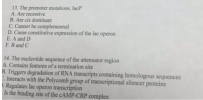 13. The promoter mutations, lacP A. Are recessive B. Are cis dominant C. Cannot be complemented D. Cause constitutive expression of the lac operon E. A and D F. B and C 14. The nucleotide sequence of the attenuator region A. Contains features of a termination site 8. Triggers degradation of RNA transcripts containing homologous sequences Interacts with the Polycomb group of transcriptional silencer proteins . Regulates lac operon transcription Is the binding site of the cAMP-CRP complex
expressed at high levels, comparable to its expression in the absence of trp 6. Based upon...
 expressed at high levels, comparable to its expression in the absence of trp 6. Based upon what you have learned about the E. coli trp operon, what could you say about expression of its structural genes in cells with large amounts of environmental trp, but expressing a mutant trp repressor that is unable to bind trp? A. The trp operon would be completely repressed due to the abundance of trp B. The trp operon would be transcribed much less than...
Page < 2 > of 2 D. The trp operon would be expressed at high levels,...
 Page < 2 > of 2 D. The trp operon would be expressed at high levels, comparable to its expression in the absence of trp 6. Based upon what you have learned about the E. coli trp operon, what could you say about expression of its structural genes in cells with large amounts of environmental trp, but expressing a mutant trp repressor that is unable to bind trp? A. The trp operon would be completely repressed due to the abundance...
The gene machine program shows you what happens when lactose is present in E. coli, and...
 The gene machine program shows you what happens when lactose is present in E. coli, and how the lac operon is under negative control. However, the lac operon is also under positive control from a protein called CRP, eAMP Receptor Protein. The absence of the lac repressor is essential but not sufficient for effective transcription of the lac operon. RNA polymerase also depends on the presence of CRP. Like the lac repressor, which can bind to the DNA and lactose....
The lac operon contains a DNA sequence known as the lac promoter (P or P+ for...
The lac operon contains a DNA sequence known as the lac promoter (P or P+ for wild type; P– for mutant (RNA polymerase does not bind)) that serves as the RNA polymerase binding site. The lac operon also contains a DNA sequence known as the Lac operator (O or O+ for wild type; O– or Oc for mutant (lac repressor cannot bind)) which is the binding site for lac repressor. The lac repressor, a protein, is encoded by the lac...
1. (1 pt) If a gene is repressible and under positive control, A. Is the regulatory...
1. (1 pt) If a gene is repressible and under positive control, A. Is the regulatory protein an activator or repressor? B. Explain how an effector molecule, which binds to the regulatory protein, alters the regulatory protein’s ability to regulate expression of the gene. 2. (1 pt) Cis and trans are two terms used to describe mutations. A. Explain the molecular difference between these terms. B. indicate which type of mutation (cis or trans) is dominant to wild-type and which...
Which of the following statements about Huntington's is true? You can retry this question, the average...
 Which of the following statements about Huntington's is true? You can retry this question, the average of your two answers is recorded. You should see feedback if you get a question wrong. O a. The mutated allele(s) has/have lost the function of keeping brain cells healthy, and is/are therefor a dominant disease O b. Huntington is a very rare and therfor recessive. c. Huntington strikes people after reproductive age and is therefor dominant. d. The mutated allele(s) has/have gained the...
For Questions 4-18, consider the mutations described in the left-hand column below. Identify whether the Lac operon will be ON or OFF in each of the environments listed across the top. The expression...
 For Questions 4-18, consider the mutations described in the left-hand column below. Identify whether the Lac operon will be ON or OFF in each of the environments listed across the top. The expression of the normal (wild type) operon is given. Note that "ON" and "OFF" refer to whether the operon is expressed at high levels (ON) or basal//low/no levels (OFF). (Hint: mutations render the indicated site inactive while leaving the remaining part of the operon or protein functional.) Note...
Microbiology study guide questions. Please Help! s. which of the following statements about water activity is not true? a) many fungi can tolerate aw levels of 07-0.8 b) many microorganisms grow...
 Microbiology study guide questions. Please Help!
s. which of the following statements about water activity is not true? a) many fungi can tolerate aw levels of 07-0.8 b) many microorganisms grow well at an aw of 0.98 e sear water has an aw of 0.98 e-xerephiles thrive in dry conditions DNA typically becomes disordered below an a of o.90 Which of the following descriptions about ribosome structure is not true? a) 80s is the size of the intact functional ribosome...
Microbiology study guide questions. Please Help!
s. which of the following statements about water activity is not true? a) many fungi can tolerate aw levels of 07-0.8 b) many microorganisms grow well at an aw of 0.98 e sear water has an aw of 0.98 e-xerephiles thrive in dry conditions DNA typically becomes disordered below an a of o.90 Which of the following descriptions about ribosome structure is not true? a) 80s is the size of the intact functional ribosome...
 There are several possible mutations in the trp operon:
trpP -is a mutation in the promoter sequence
that prevents RNA polymerase from binding to the promoter and
initiate transcription of the trp operon genes.
trpOcis a mutation in the operator sequence
that prevents the trp repressor protein from binding to
the operator to block transcription of the trp operon
genes.
trpR-is a mutation in the repressor protein
that either prevents repressor protein from being made or produces
a mutant repressor...
There are several possible mutations in the trp operon:
trpP -is a mutation in the promoter sequence
that prevents RNA polymerase from binding to the promoter and
initiate transcription of the trp operon genes.
trpOcis a mutation in the operator sequence
that prevents the trp repressor protein from binding to
the operator to block transcription of the trp operon
genes.
trpR-is a mutation in the repressor protein
that either prevents repressor protein from being made or produces
a mutant repressor...
 13. The promoter mutations, lacP A. Are recessive B. Are cis dominant C. Cannot be complemented D. Cause constitutive expression of the lac operon E. A and D F. B and C 14. The nucleotide sequence of the attenuator region A. Contains features of a termination site 8. Triggers degradation of RNA transcripts containing homologous sequences Interacts with the Polycomb group of transcriptional silencer proteins . Regulates lac operon transcription Is the binding site of the cAMP-CRP complex
 expressed at high levels, comparable to its expression in the absence of trp 6. Based upon what you have learned about the E. coli trp operon, what could you say about expression of its structural genes in cells with large amounts of environmental trp, but expressing a mutant trp repressor that is unable to bind trp? A. The trp operon would be completely repressed due to the abundance of trp B. The trp operon would be transcribed much less than...
 Page < 2 > of 2 D. The trp operon would be expressed at high levels, comparable to its expression in the absence of trp 6. Based upon what you have learned about the E. coli trp operon, what could you say about expression of its structural genes in cells with large amounts of environmental trp, but expressing a mutant trp repressor that is unable to bind trp? A. The trp operon would be completely repressed due to the abundance...
 The gene machine program shows you what happens when lactose is present in E. coli, and how the lac operon is under negative control. However, the lac operon is also under positive control from a protein called CRP, eAMP Receptor Protein. The absence of the lac repressor is essential but not sufficient for effective transcription of the lac operon. RNA polymerase also depends on the presence of CRP. Like the lac repressor, which can bind to the DNA and lactose....
 Which of the following statements about Huntington's is true? You can retry this question, the average of your two answers is recorded. You should see feedback if you get a question wrong. O a. The mutated allele(s) has/have lost the function of keeping brain cells healthy, and is/are therefor a dominant disease O b. Huntington is a very rare and therfor recessive. c. Huntington strikes people after reproductive age and is therefor dominant. d. The mutated allele(s) has/have gained the...
 For Questions 4-18, consider the mutations described in the left-hand column below. Identify whether the Lac operon will be ON or OFF in each of the environments listed across the top. The expression of the normal (wild type) operon is given. Note that "ON" and "OFF" refer to whether the operon is expressed at high levels (ON) or basal//low/no levels (OFF). (Hint: mutations render the indicated site inactive while leaving the remaining part of the operon or protein functional.) Note...
 Microbiology study guide questions. Please Help!
s. which of the following statements about water activity is not true? a) many fungi can tolerate aw levels of 07-0.8 b) many microorganisms grow well at an aw of 0.98 e sear water has an aw of 0.98 e-xerephiles thrive in dry conditions DNA typically becomes disordered below an a of o.90 Which of the following descriptions about ribosome structure is not true? a) 80s is the size of the intact functional ribosome...
Microbiology study guide questions. Please Help!
s. which of the following statements about water activity is not true? a) many fungi can tolerate aw levels of 07-0.8 b) many microorganisms grow well at an aw of 0.98 e sear water has an aw of 0.98 e-xerephiles thrive in dry conditions DNA typically becomes disordered below an a of o.90 Which of the following descriptions about ribosome structure is not true? a) 80s is the size of the intact functional ribosome...
Most questions answered within 3 hours.
-
Where is the error in this code sequence?
String s1 = "Hello";
String s2 = "ello";...
asked 10 months ago -
Financial data for Joel de Paris, Inc., for last year
follow:
Joel de Paris, Inc.
Balance...
asked 10 months ago -
Consider this reaction:
Al2(SO4)3 (aq)+ BaCl3
(aq) Al2Cl6 (aq)- +
3BaSO4(s) . What is the...
asked 10 months ago -
Suppose that Savneet is considering increasing her
recent random sample from 20 car rentals to 40...
asked 10 months ago -
Trucks arrive at an unloading terminal at an average rate of 120
per hour.
Trucks arrive...
asked 10 months ago -
Why are methanol and ethanol completely soluble in water while
octanol is not very little soluble....
asked 10 months ago -
A facilities manager at a university reads in a research report
that the mean amount of...
asked 10 months ago -
When the CuSO4 is rehydrated by adding water to the anhydrous
compound, is this an endothermic...
asked 10 months ago -
A ray of sunlight is passing from diamond into crown glass; the
angle of incidence is...
asked 10 months ago -
A block of mass 0.249 kg is placed on top of a light, vertical
spring of...
asked 10 months ago -
how do the kidneys compensate in the presences of acidosis
a) trigger hyperventilate
b) reserve acid...
asked 10 months ago -
Question 501 pts
The rental rate of capital to the firm increases. Which of the
following...
asked 10 months ago