Node method
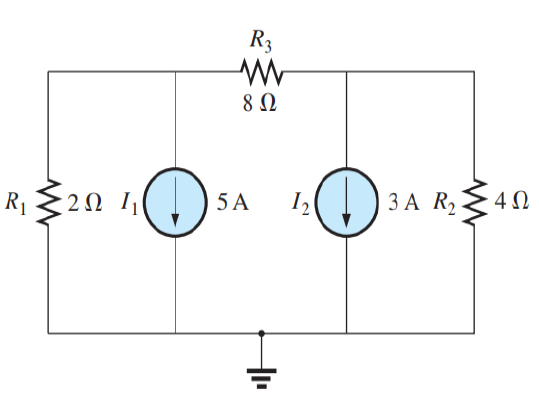
Use the node method and find The nodal voltages; the current in the resistor of R3; the voltage across R1 and the power across R2.
Homework Answers
Request Answer!
We need at least 10 more requests to produce the answer.
0 / 10 have requested this problem solution
The more requests, the faster the answer.
Problem 1. This problem is intended to reinforce your understanding of the nodal analysis and node-...
 Problem 1. This problem is intended to reinforce your understanding of the nodal analysis and node- branch equation formulation techniques. Consider the following simple circuit. a. Apply nodal analysis to generate a linear system of equations which can be used to compute the circuit node voltages. Where appropriate, please give matrix or vector entries as analytical formulas in terms of R1, R2, R3 and Is. b. Use the node-branch approach to form a linear system of equations which can be...
(1) Review materials related to the node voltage method and superposition. (2) Read through the entire...
 (1) Review materials related to the node voltage method and superposition. (2) Read through the entire handout to familiarize yourself with what you will do during lab. (3) Use the node voltage approach to find the voltages at nodes A through E in the circuit of Figure 1. Take Vs1 = 3V, Vs2 = 12V, R1 = 10k2, R2 = 3.3kg, R3 = 1k92, and R4 = 1kg. (4) Bring your prelab to lab. A R1 B R3 NN Vs1...
Calculate the current through and voltage across each circuit element using Mesh Analysis Determine the current throug...
 Calculate the current through and voltage across each circuit
element using Mesh Analysis
Determine the current through and voltage across each circuit
element using Nodal Analysis
Find the Thevenin equivalent circuit for the network external
to the resistor R5 and use it to calculate the voltage
across as well as the current through the resistor
R5
Find the Norton equivalent circuit for the network external to
the resistor R5 and employ it to compute the voltage
across as well as...
Calculate the current through and voltage across each circuit
element using Mesh Analysis
Determine the current through and voltage across each circuit
element using Nodal Analysis
Find the Thevenin equivalent circuit for the network external
to the resistor R5 and use it to calculate the voltage
across as well as the current through the resistor
R5
Find the Norton equivalent circuit for the network external to
the resistor R5 and employ it to compute the voltage
across as well as...
Solve this circuit using node-voltage method. Determine the currents through all the elements and voltages across...
 Solve this circuit using node-voltage method. Determine the
currents through all the elements and voltages across all elements.
Verify that the total power developed equals the total power
absorbed
Without repeating the node-voltage analysis, predict the node
voltages at nodes d, c, b and g, if node a was selected as the
reference node (or ground).
R2 560 n R, 1 kn R 430 Vs a ww R 820 n ww R3 2.2 kn V6R430 R, 1.5 k Rs 820...
Solve this circuit using node-voltage method. Determine the
currents through all the elements and voltages across all elements.
Verify that the total power developed equals the total power
absorbed
Without repeating the node-voltage analysis, predict the node
voltages at nodes d, c, b and g, if node a was selected as the
reference node (or ground).
R2 560 n R, 1 kn R 430 Vs a ww R 820 n ww R3 2.2 kn V6R430 R, 1.5 k Rs 820...
Node 2 R3 Node 3 w R2 The circuit shown has V1 = 10 V, 11...
 Node 2 R3 Node 3 w R2 The circuit shown has V1 = 10 V, 11 = 5 A, R1 = 32, R2 = 7 S2, R3 = 2 2 and R4 = 6 12. Use nodal analysis to find the voltages at nodes 2 and 3. Vnode2 = -14.97 V Vnode3 = -36.65 V Vnode2 = -0.693 V Vnode3 = -8.020 V Vnode2 = -0.169 V Vnode3 = -3.525 V Vnode2 = -3.00 V Vnode3 = -5.00 V
Find the node voltages v1, v, and v2. Use nodal analysis. R3 R 2 17 3...
 Find the node voltages v1, v, and v2. Use nodal analysis. R3 R 2 17 3 1 2 Given Variables: R1:2 ohm R2 1 ohm R3 1 ohm R4 2 ohm Vs:5 V Is : 1 A
current controlled voltage source 2i R2 V3 EV1 V2 R1 In the circuit above V1 =...
 current controlled voltage source 2i R2 V3 EV1 V2 R1 In the circuit above V1 = 86V,V2=96 V, 11-7AR1:39 ? and R2 : 35 ?. Use nodal analysis to find the voltage at node A in the circuit above. Note the presence of a dependent voltage source V3 Voltage across that source is 2i. i is the current through the resistor R2 and the source V2
RESISTOR VALUES: R1=1k, R2=2k, R3=3k, R4=3.9k, R5=5.1k, R6=6.2k, R7=6.8K NUMBERS: 2, 4, & 5 1 Short AB, as shown in...
 RESISTOR VALUES: R1=1k, R2=2k, R3=3k, R4=3.9k, R5=5.1k, R6=6.2k,
R7=6.8K
NUMBERS: 2, 4, & 5
1 Short AB, as shown in Figure 3 - 2 (a). Use mesh analysis to calculate the voltage across each resistor and the current through AB, IAB 2. Leave AB open, as shown in Figure 3 - 2 (b). Use nodal analysis to calculate the voltage across each resistor as well as the voltage across AB, VAB 3. Find Thevenin's and Norton's Equivalent using the results...
RESISTOR VALUES: R1=1k, R2=2k, R3=3k, R4=3.9k, R5=5.1k, R6=6.2k,
R7=6.8K
NUMBERS: 2, 4, & 5
1 Short AB, as shown in Figure 3 - 2 (a). Use mesh analysis to calculate the voltage across each resistor and the current through AB, IAB 2. Leave AB open, as shown in Figure 3 - 2 (b). Use nodal analysis to calculate the voltage across each resistor as well as the voltage across AB, VAB 3. Find Thevenin's and Norton's Equivalent using the results...
ENGR 2131 Electronics and Circuit Analysis Homework 2- Nodal and Mesh Analysis Due: Monday February 12,2018...
 ENGR 2131 Electronics and Circuit Analysis Homework 2- Nodal and Mesh Analysis Due: Monday February 12,2018 Name: 1- In the following circuit, use nodal analysis to find the voltage across R and R Consider: R1-500 Ω, R,-125 Ω, R3-250 Ω, R4-250 Ω, Rs = 500 Ω, 1.-1 mA. R, R2 R4 R, Rs 2- In the following circuit, use nodal analysis to find a) the voltage at node a and node b b) the current in RI and R3. Consider:...
Use node analysis to determine the node voltages at node 1,2 and 3 and also the...
 Use node analysis to determine the node voltages at node 1,2 and 3 and also the voltage across the 10mH inductance. Given V(t)-10c°s(30000t+π/4) volts. 10mH R1 C0.2AF R2 300Ω
 Problem 1. This problem is intended to reinforce your understanding of the nodal analysis and node- branch equation formulation techniques. Consider the following simple circuit. a. Apply nodal analysis to generate a linear system of equations which can be used to compute the circuit node voltages. Where appropriate, please give matrix or vector entries as analytical formulas in terms of R1, R2, R3 and Is. b. Use the node-branch approach to form a linear system of equations which can be...
 (1) Review materials related to the node voltage method and superposition. (2) Read through the entire handout to familiarize yourself with what you will do during lab. (3) Use the node voltage approach to find the voltages at nodes A through E in the circuit of Figure 1. Take Vs1 = 3V, Vs2 = 12V, R1 = 10k2, R2 = 3.3kg, R3 = 1k92, and R4 = 1kg. (4) Bring your prelab to lab. A R1 B R3 NN Vs1...
 Calculate the current through and voltage across each circuit
element using Mesh Analysis
Determine the current through and voltage across each circuit
element using Nodal Analysis
Find the Thevenin equivalent circuit for the network external
to the resistor R5 and use it to calculate the voltage
across as well as the current through the resistor
R5
Find the Norton equivalent circuit for the network external to
the resistor R5 and employ it to compute the voltage
across as well as...
Calculate the current through and voltage across each circuit
element using Mesh Analysis
Determine the current through and voltage across each circuit
element using Nodal Analysis
Find the Thevenin equivalent circuit for the network external
to the resistor R5 and use it to calculate the voltage
across as well as the current through the resistor
R5
Find the Norton equivalent circuit for the network external to
the resistor R5 and employ it to compute the voltage
across as well as...
 Solve this circuit using node-voltage method. Determine the
currents through all the elements and voltages across all elements.
Verify that the total power developed equals the total power
absorbed
Without repeating the node-voltage analysis, predict the node
voltages at nodes d, c, b and g, if node a was selected as the
reference node (or ground).
R2 560 n R, 1 kn R 430 Vs a ww R 820 n ww R3 2.2 kn V6R430 R, 1.5 k Rs 820...
Solve this circuit using node-voltage method. Determine the
currents through all the elements and voltages across all elements.
Verify that the total power developed equals the total power
absorbed
Without repeating the node-voltage analysis, predict the node
voltages at nodes d, c, b and g, if node a was selected as the
reference node (or ground).
R2 560 n R, 1 kn R 430 Vs a ww R 820 n ww R3 2.2 kn V6R430 R, 1.5 k Rs 820...
 Node 2 R3 Node 3 w R2 The circuit shown has V1 = 10 V, 11 = 5 A, R1 = 32, R2 = 7 S2, R3 = 2 2 and R4 = 6 12. Use nodal analysis to find the voltages at nodes 2 and 3. Vnode2 = -14.97 V Vnode3 = -36.65 V Vnode2 = -0.693 V Vnode3 = -8.020 V Vnode2 = -0.169 V Vnode3 = -3.525 V Vnode2 = -3.00 V Vnode3 = -5.00 V
 Find the node voltages v1, v, and v2. Use nodal analysis. R3 R 2 17 3 1 2 Given Variables: R1:2 ohm R2 1 ohm R3 1 ohm R4 2 ohm Vs:5 V Is : 1 A
 current controlled voltage source 2i R2 V3 EV1 V2 R1 In the circuit above V1 = 86V,V2=96 V, 11-7AR1:39 ? and R2 : 35 ?. Use nodal analysis to find the voltage at node A in the circuit above. Note the presence of a dependent voltage source V3 Voltage across that source is 2i. i is the current through the resistor R2 and the source V2
 RESISTOR VALUES: R1=1k, R2=2k, R3=3k, R4=3.9k, R5=5.1k, R6=6.2k,
R7=6.8K
NUMBERS: 2, 4, & 5
1 Short AB, as shown in Figure 3 - 2 (a). Use mesh analysis to calculate the voltage across each resistor and the current through AB, IAB 2. Leave AB open, as shown in Figure 3 - 2 (b). Use nodal analysis to calculate the voltage across each resistor as well as the voltage across AB, VAB 3. Find Thevenin's and Norton's Equivalent using the results...
RESISTOR VALUES: R1=1k, R2=2k, R3=3k, R4=3.9k, R5=5.1k, R6=6.2k,
R7=6.8K
NUMBERS: 2, 4, & 5
1 Short AB, as shown in Figure 3 - 2 (a). Use mesh analysis to calculate the voltage across each resistor and the current through AB, IAB 2. Leave AB open, as shown in Figure 3 - 2 (b). Use nodal analysis to calculate the voltage across each resistor as well as the voltage across AB, VAB 3. Find Thevenin's and Norton's Equivalent using the results...
 ENGR 2131 Electronics and Circuit Analysis Homework 2- Nodal and Mesh Analysis Due: Monday February 12,2018 Name: 1- In the following circuit, use nodal analysis to find the voltage across R and R Consider: R1-500 Ω, R,-125 Ω, R3-250 Ω, R4-250 Ω, Rs = 500 Ω, 1.-1 mA. R, R2 R4 R, Rs 2- In the following circuit, use nodal analysis to find a) the voltage at node a and node b b) the current in RI and R3. Consider:...
 Use node analysis to determine the node voltages at node 1,2 and 3 and also the voltage across the 10mH inductance. Given V(t)-10c°s(30000t+π/4) volts. 10mH R1 C0.2AF R2 300Ω
Most questions answered within 3 hours.
-
Where is the error in this code sequence?
String s1 = "Hello";
String s2 = "ello";...
asked 11 months ago -
Financial data for Joel de Paris, Inc., for last year
follow:
Joel de Paris, Inc.
Balance...
asked 11 months ago -
Consider this reaction:
Al2(SO4)3 (aq)+ BaCl3
(aq) Al2Cl6 (aq)- +
3BaSO4(s) . What is the...
asked 11 months ago -
Suppose that Savneet is considering increasing her
recent random sample from 20 car rentals to 40...
asked 11 months ago -
Trucks arrive at an unloading terminal at an average rate of 120
per hour.
Trucks arrive...
asked 11 months ago -
Why are methanol and ethanol completely soluble in water while
octanol is not very little soluble....
asked 11 months ago -
A facilities manager at a university reads in a research report
that the mean amount of...
asked 11 months ago -
When the CuSO4 is rehydrated by adding water to the anhydrous
compound, is this an endothermic...
asked 11 months ago -
A ray of sunlight is passing from diamond into crown glass; the
angle of incidence is...
asked 11 months ago -
A block of mass 0.249 kg is placed on top of a light, vertical
spring of...
asked 11 months ago -
how do the kidneys compensate in the presences of acidosis
a) trigger hyperventilate
b) reserve acid...
asked 11 months ago -
Question 501 pts
The rental rate of capital to the firm increases. Which of the
following...
asked 11 months ago