

Homework Answers
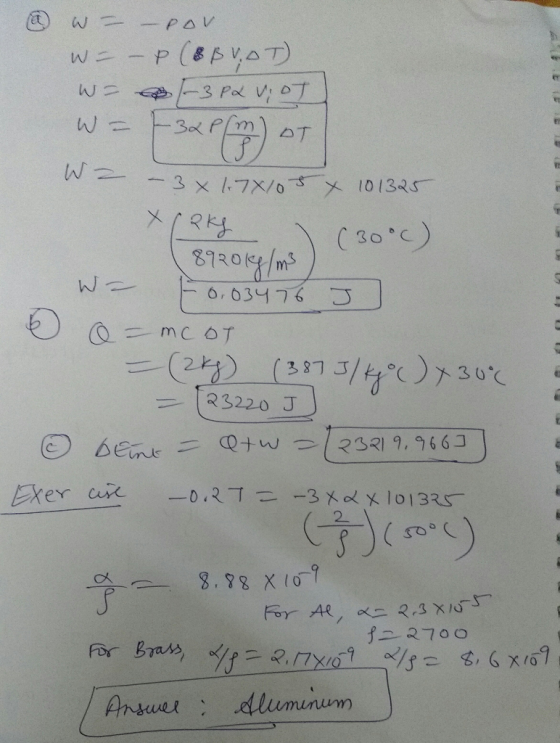
Add Answer to:
A 2.0 kg bar of copper is heated at atmospheric pressure so that its temperature increases...
A 1.00 kg copper bar is heated to atmospheric pressure so that its temperature increases from...
A 1.00 kg copper bar is heated to atmospheric pressure so that its temperature increases from 20 ° C to 50 ° c. The density of copper is 8.92 x 10³ kg and the coefficient of volumetric expansion is 4.5 x 10⁻⁵ (C0) -1 Determine the change in volume of the copper bar. (Remember that p = m / V)
I need help with the missing equation: Analyze Find the work done on the copper bar...
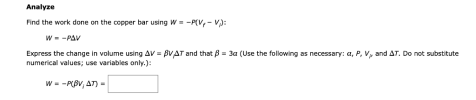 I need help with the missing equation:
Analyze Find the work done on the copper bar using WPVf- V): Express the change in volume using Δν = ßvAT and that β = 3α (Use the following as necessary: α, P, V., and ΔΤ. Do not substitute numerical values; use variables only.):
I need help with the missing equation:
Analyze Find the work done on the copper bar using WPVf- V): Express the change in volume using Δν = ßvAT and that β = 3α (Use the following as necessary: α, P, V., and ΔΤ. Do not substitute numerical values; use variables only.):
A 0.80 kg block of aluminum is heated at atmospheric pressure so that its temperature increases...
 A 0.80 kg block of aluminum is heated at atmospheric pressure so that its temperature increases from 22.0°C to 40.0°C. (a) Find the work done on the aluminum. mJ (b) Find the energy added to it by heat. kJ (c) Find the change in its internal energy. kJ
A 1.00 kg block of aluminum is heated at atmospheric pressure so that its temperature increases...
A 1.00 kg block of aluminum is heated at atmospheric pressure so that its temperature increases from 22.0°C to 40.0°C. (a) Find the work done on the aluminum. (b) Find the energy added to it by heat. (c) Find the change in its internal energy. Please explain thank you.
A spray can containing a propellant gas at twice atmospheric pressure (202 kPa) and having a...
 A spray can containing a propellant gas at twice atmospheric pressure (202 kPa) and having a volume of 119.00 cm is at 27°C. It is then tossed into an open fire. (Warning: Do not do this experiment; it is very dangerous.) When the temperature of the gas in the can reaches 195°C, what is the pressure inside the can? Assume any change in the volume of the can is negligible. SOLUTION Conceptualize Intuitively, you should expect that the pressure of the gas...
One mole of H20( is supercooled to-5.00°C at 1 bar pressure before freezing at that temperature....
 One mole of H20( is supercooled to-5.00°C at 1 bar pressure before freezing at that temperature. Calculate ASys, ASum, and ASeotal for this process. Is it spontaneous? CPm (H20, 1)- 75.3 J/mol.K CPm (H20, s)-37.7 J/mol.K AHfusion 6.008 kJ/mol Hint: remember that ASs is computed using q along a reversible path, while ASur is computed using the actual heat transfer during the freezing. For the following equilibrium reaction: Here is an ICE table, starting from no moles of pure 0z...
A lead block of mass 7.0 kg is originally at a temperature of 15°C and 1 atm. It is then heated to a temperature of 64°...
 A lead block of mass 7.0 kg is originally at a temperature of 15°C and 1 atm. It is then heated to a temperature of 64°C without any change in pressure. The specific heat of lead is 128 J/(kg - °C), its density is 1.13 x 10⁴ kg/m3, and the coefficient of linear expansion is 29 x 10 -6/oC (a) Determine the work done by the lead block (b) How much heat energy is transferred during this process? J (c)...
All parts of this question pertain to a monatomic ideal gas, initially at T=300K and atmospheric...
All parts of this question pertain to a monatomic ideal gas, initially at T=300K and atmospheric pressure (1.01× 10⁵ Pa). There is 1.0 mole of this gas is inside a cylinder with a sliding piston and interior diameter of 20cm. The piston can slide with negligible friction and without allowing any gas to enter or escape. For ideal gas calculations use R= 8.314 J/mol·K. a) What is the initial height of the piston? b) Now imagine that burner is placed...
Level II: Thermodynamics (Sketch, reasoning, numerical solution, and assess for credit). A metal smith starts with...
 Level II: Thermodynamics (Sketch, reasoning, numerical solution, and assess for credit). A metal smith starts with mass miron of molten iron at T. How much mass of water meter would he need to make the temperature of lead and water 70°C? Set up the problem, but do not solve it. [Use the values in the table below to help you). TABLE 12.4 Specific heats of solids and liquids TABLE 12.8 Melting and boiling temperatures and heats of transformation at standard...
PartA A1. A mixture of three gases has the following analysis by mass 25% O, 43% CO, 32% N, The mixture has a volume of 0.8 m23 when its temperature and pressure are 30 °C and 1.25 bar respectively (...
 PartA A1. A mixture of three gases has the following analysis by mass 25% O, 43% CO, 32% N, The mixture has a volume of 0.8 m23 when its temperature and pressure are 30 °C and 1.25 bar respectively (a) Calculate [3096] (i) The analysis by volume (ii) The gas constant and the molecular mass of the mixture [15%] [ 1096] (ii) The mixture mass and the mass of the three gases [ 10 %] (iv) The partial pressure of...
 I need help with the missing equation:
Analyze Find the work done on the copper bar using WPVf- V): Express the change in volume using Δν = ßvAT and that β = 3α (Use the following as necessary: α, P, V., and ΔΤ. Do not substitute numerical values; use variables only.):
I need help with the missing equation:
Analyze Find the work done on the copper bar using WPVf- V): Express the change in volume using Δν = ßvAT and that β = 3α (Use the following as necessary: α, P, V., and ΔΤ. Do not substitute numerical values; use variables only.):
 A 0.80 kg block of aluminum is heated at atmospheric pressure so that its temperature increases from 22.0°C to 40.0°C. (a) Find the work done on the aluminum. mJ (b) Find the energy added to it by heat. kJ (c) Find the change in its internal energy. kJ
 A spray can containing a propellant gas at twice atmospheric pressure (202 kPa) and having a volume of 119.00 cm is at 27°C. It is then tossed into an open fire. (Warning: Do not do this experiment; it is very dangerous.) When the temperature of the gas in the can reaches 195°C, what is the pressure inside the can? Assume any change in the volume of the can is negligible. SOLUTION Conceptualize Intuitively, you should expect that the pressure of the gas...
 One mole of H20( is supercooled to-5.00°C at 1 bar pressure before freezing at that temperature. Calculate ASys, ASum, and ASeotal for this process. Is it spontaneous? CPm (H20, 1)- 75.3 J/mol.K CPm (H20, s)-37.7 J/mol.K AHfusion 6.008 kJ/mol Hint: remember that ASs is computed using q along a reversible path, while ASur is computed using the actual heat transfer during the freezing. For the following equilibrium reaction: Here is an ICE table, starting from no moles of pure 0z...
 A lead block of mass 7.0 kg is originally at a temperature of 15°C and 1 atm. It is then heated to a temperature of 64°C without any change in pressure. The specific heat of lead is 128 J/(kg - °C), its density is 1.13 x 10⁴ kg/m3, and the coefficient of linear expansion is 29 x 10 -6/oC (a) Determine the work done by the lead block (b) How much heat energy is transferred during this process? J (c)...
 Level II: Thermodynamics (Sketch, reasoning, numerical solution, and assess for credit). A metal smith starts with mass miron of molten iron at T. How much mass of water meter would he need to make the temperature of lead and water 70°C? Set up the problem, but do not solve it. [Use the values in the table below to help you). TABLE 12.4 Specific heats of solids and liquids TABLE 12.8 Melting and boiling temperatures and heats of transformation at standard...
 PartA A1. A mixture of three gases has the following analysis by mass 25% O, 43% CO, 32% N, The mixture has a volume of 0.8 m23 when its temperature and pressure are 30 °C and 1.25 bar respectively (a) Calculate [3096] (i) The analysis by volume (ii) The gas constant and the molecular mass of the mixture [15%] [ 1096] (ii) The mixture mass and the mass of the three gases [ 10 %] (iv) The partial pressure of...
Most questions answered within 3 hours.
-
Where is the error in this code sequence?
String s1 = "Hello";
String s2 = "ello";...
asked 11 months ago -
Financial data for Joel de Paris, Inc., for last year
follow:
Joel de Paris, Inc.
Balance...
asked 11 months ago -
Consider this reaction:
Al2(SO4)3 (aq)+ BaCl3
(aq) Al2Cl6 (aq)- +
3BaSO4(s) . What is the...
asked 11 months ago -
Suppose that Savneet is considering increasing her
recent random sample from 20 car rentals to 40...
asked 11 months ago -
Trucks arrive at an unloading terminal at an average rate of 120
per hour.
Trucks arrive...
asked 11 months ago -
Why are methanol and ethanol completely soluble in water while
octanol is not very little soluble....
asked 11 months ago -
A facilities manager at a university reads in a research report
that the mean amount of...
asked 11 months ago -
When the CuSO4 is rehydrated by adding water to the anhydrous
compound, is this an endothermic...
asked 11 months ago -
A ray of sunlight is passing from diamond into crown glass; the
angle of incidence is...
asked 11 months ago -
A block of mass 0.249 kg is placed on top of a light, vertical
spring of...
asked 11 months ago -
how do the kidneys compensate in the presences of acidosis
a) trigger hyperventilate
b) reserve acid...
asked 11 months ago -
Question 501 pts
The rental rate of capital to the firm increases. Which of the
following...
asked 11 months ago