
Homework Answers
Add Answer to:
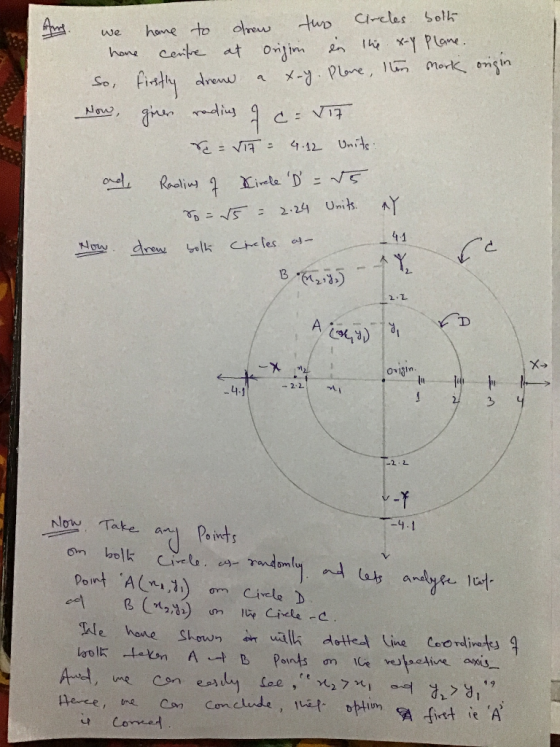
6. In the xy-plane, C and D are circles centered at the origin with radii V17...
Consider a uniformly charged ring in the xy plane,centered at the origin. The ring has radius...
 Consider a uniformly charged ring in the xy plane, centered
at the origin. The ring has radius a and positive charge q distributed evenly along its circumference. PartAWhat is the direction of the electric fieldat
any point on the z axis?parallel to the x axisparallel to the y axisparallel to the z axisin a circle parallel to the xy planePartBWhat is the magnitude of the electric
fieldalong the positive z axis?Use k in your answer, where .E(z) =PartCImagine a small metal ball of mass m and negative charge -q0. The ball is released...
Consider a uniformly charged ring in the xy plane, centered
at the origin. The ring has radius a and positive charge q distributed evenly along its circumference. PartAWhat is the direction of the electric fieldat
any point on the z axis?parallel to the x axisparallel to the y axisparallel to the z axisin a circle parallel to the xy planePartBWhat is the magnitude of the electric
fieldalong the positive z axis?Use k in your answer, where .E(z) =PartCImagine a small metal ball of mass m and negative charge -q0. The ball is released...
A force in the xy plane is given by = where F is a constant and...
A force in the xy plane is given by = where F is a constant and r=. a.) Find the magnitude of the force. b.)Show that is perpendicular to =x c.) Find the work done by this force on a particle that moves once around a circle of radius 5 m centered at the origin. A force in the xy plane is given by hat{i}+yhat{j} c.) Find the work done by this force on a particle that moves once around...
A uniform circular ring of charge Q and radius r in the xy-plane is centered at the origin.
 A uniform circular ring of charge Q and radius r in the xy-plane is centered at the origin. (a) Derive a formula for the (z-directed) electric field E(z) at any point on the +z-axis, and graph this for-∞ < z < ∞ (indicate direction as ±; note E(-z) =-E(z). (b) At what value of z is E(z) maximal, and what is this maximum? (c) Sketch the field lines-note the bottleneck!
1). The average (arithmetic mean) of 7 different numbers is 5 Consider the following two quantities:...
1). The average (arithmetic mean) of 7 different numbers is 5 Consider the following two quantities: A. The median of the 7 numbers. B. 5. A. Quantity A is greater than Quantity B B. Quantity B is greater than Quantity A C. The two quantities are equal. D. The relationship cannot be determined without more information. 2). List S = {16, 9, 23, X, 13, 16} In list S, the mean and median are equal to one another. What is...
A particle moves on a counter clockwise, origin-centered circular path in the x y-plane at a...
 A particle moves on a counter clockwise, origin-centered circular path in the x y-plane at a constant rate. The radius of the circle is r, the mass of the particle is m, and the particle completes one revolu tion in time τ a) Neatly draw the following things 1. The path of the particle 2. A dot on the path when the particle is at 00 90° and 210° where 0 is mea sured from the x-axis (posi tive counter-clockwise)...
Given the function 1 f(x,y) = answer the following questions. 36 - 16x2 - 16y2 a....
 Given the function 1 f(x,y) = answer the following questions. 36 - 16x2 - 16y2 a. Find the function's domain. b. Find the function's range. c. Describe the function's level curves. d. Find the boundary of the function's domain. e. Determine if the domain is an open region, a closed region, both, or neither. f. Decide if the domain is bounded or unbounded. a. Choose the correct domain. OA. 9 The set of all points in the xy-plane that satisfy...
(1 point) A body of mass 10 kg moves in the xy-plane in a counterclockwise circular path of radius 3 meters centered at the origin, making one revolution every 11 seconds. At the time t 0, the b...
 (1 point) A body of mass 10 kg moves in the xy-plane in a counterclockwise circular path of radius 3 meters centered at the origin, making one revolution every 11 seconds. At the time t 0, the body is at the rightmost point of the circle. A. Compute the centripetal force acting on the body at time t. B. Compute the magnitude of that force. HINT. Start with finding the angular velocity o [rad/s] of the body (the rate of...
C) 41.5 D) 50.9 24 In the xy-plane, the graph of a linear equation of the...
 C) 41.5 D) 50.9 24 In the xy-plane, the graph of a linear equation of the form y =mx+ b and the graph of an exponential equation of the form y = ab* both contain points (1,3) and (2,4). If the point (r, s) is on the graph of the linear equation and the point (r, t) is on the graph of the exponential equation, where 0 < r< 4 and s > t,which of the following must be true?...
The coordinates of an object moving in the xy plane vary with time according to the...
 The coordinates of an object moving in the xy plane vary with time according to the equations x-_9.47 sin at and y = 4.00-9.47 cos út, where ω is a constant, x and y are in meters, and t is in seconds. (a) Determine the components of velocity of the object at t = O. (Use the following as necessary: ω·) V--9.47 cos(t),9.47 sin(m/s (b) Determine the components of the acceleration of the object at t-0. (Use the following as...
The figure below shows two charges on an xy-plane. a. Calculate the electric potential at points A, B, C, and D. b. Calculate the magnitude and direction of the electric field at the origin (0,0)....
 The figure below shows two charges on an xy-plane.
a. Calculate the electric potential at points A, B, C, and
D.
b. Calculate the magnitude and direction of the electric field
at the origin (0,0).
c. On the figure, draw a few equipotential lines as well as
some electric field lines that indicate the direction of the
electric field.
d. Sketch the electric potential as a function of x, with x on
the horizontal axis and V(x) on the vertical...
The figure below shows two charges on an xy-plane.
a. Calculate the electric potential at points A, B, C, and
D.
b. Calculate the magnitude and direction of the electric field
at the origin (0,0).
c. On the figure, draw a few equipotential lines as well as
some electric field lines that indicate the direction of the
electric field.
d. Sketch the electric potential as a function of x, with x on
the horizontal axis and V(x) on the vertical...
 Consider a uniformly charged ring in the xy plane, centered
at the origin. The ring has radius a and positive charge q distributed evenly along its circumference. PartAWhat is the direction of the electric fieldat
any point on the z axis?parallel to the x axisparallel to the y axisparallel to the z axisin a circle parallel to the xy planePartBWhat is the magnitude of the electric
fieldalong the positive z axis?Use k in your answer, where .E(z) =PartCImagine a small metal ball of mass m and negative charge -q0. The ball is released...
Consider a uniformly charged ring in the xy plane, centered
at the origin. The ring has radius a and positive charge q distributed evenly along its circumference. PartAWhat is the direction of the electric fieldat
any point on the z axis?parallel to the x axisparallel to the y axisparallel to the z axisin a circle parallel to the xy planePartBWhat is the magnitude of the electric
fieldalong the positive z axis?Use k in your answer, where .E(z) =PartCImagine a small metal ball of mass m and negative charge -q0. The ball is released...
 A particle moves on a counter clockwise, origin-centered circular path in the x y-plane at a constant rate. The radius of the circle is r, the mass of the particle is m, and the particle completes one revolu tion in time τ a) Neatly draw the following things 1. The path of the particle 2. A dot on the path when the particle is at 00 90° and 210° where 0 is mea sured from the x-axis (posi tive counter-clockwise)...
 Given the function 1 f(x,y) = answer the following questions. 36 - 16x2 - 16y2 a. Find the function's domain. b. Find the function's range. c. Describe the function's level curves. d. Find the boundary of the function's domain. e. Determine if the domain is an open region, a closed region, both, or neither. f. Decide if the domain is bounded or unbounded. a. Choose the correct domain. OA. 9 The set of all points in the xy-plane that satisfy...
 (1 point) A body of mass 10 kg moves in the xy-plane in a counterclockwise circular path of radius 3 meters centered at the origin, making one revolution every 11 seconds. At the time t 0, the body is at the rightmost point of the circle. A. Compute the centripetal force acting on the body at time t. B. Compute the magnitude of that force. HINT. Start with finding the angular velocity o [rad/s] of the body (the rate of...
 C) 41.5 D) 50.9 24 In the xy-plane, the graph of a linear equation of the form y =mx+ b and the graph of an exponential equation of the form y = ab* both contain points (1,3) and (2,4). If the point (r, s) is on the graph of the linear equation and the point (r, t) is on the graph of the exponential equation, where 0 < r< 4 and s > t,which of the following must be true?...
 The coordinates of an object moving in the xy plane vary with time according to the equations x-_9.47 sin at and y = 4.00-9.47 cos út, where ω is a constant, x and y are in meters, and t is in seconds. (a) Determine the components of velocity of the object at t = O. (Use the following as necessary: ω·) V--9.47 cos(t),9.47 sin(m/s (b) Determine the components of the acceleration of the object at t-0. (Use the following as...
 The figure below shows two charges on an xy-plane.
a. Calculate the electric potential at points A, B, C, and
D.
b. Calculate the magnitude and direction of the electric field
at the origin (0,0).
c. On the figure, draw a few equipotential lines as well as
some electric field lines that indicate the direction of the
electric field.
d. Sketch the electric potential as a function of x, with x on
the horizontal axis and V(x) on the vertical...
The figure below shows two charges on an xy-plane.
a. Calculate the electric potential at points A, B, C, and
D.
b. Calculate the magnitude and direction of the electric field
at the origin (0,0).
c. On the figure, draw a few equipotential lines as well as
some electric field lines that indicate the direction of the
electric field.
d. Sketch the electric potential as a function of x, with x on
the horizontal axis and V(x) on the vertical...
Most questions answered within 3 hours.
-
Where is the error in this code sequence?
String s1 = "Hello";
String s2 = "ello";...
asked 11 months ago -
Financial data for Joel de Paris, Inc., for last year
follow:
Joel de Paris, Inc.
Balance...
asked 11 months ago -
Consider this reaction:
Al2(SO4)3 (aq)+ BaCl3
(aq) Al2Cl6 (aq)- +
3BaSO4(s) . What is the...
asked 11 months ago -
Suppose that Savneet is considering increasing her
recent random sample from 20 car rentals to 40...
asked 11 months ago -
Trucks arrive at an unloading terminal at an average rate of 120
per hour.
Trucks arrive...
asked 11 months ago -
Why are methanol and ethanol completely soluble in water while
octanol is not very little soluble....
asked 11 months ago -
A facilities manager at a university reads in a research report
that the mean amount of...
asked 11 months ago -
When the CuSO4 is rehydrated by adding water to the anhydrous
compound, is this an endothermic...
asked 11 months ago -
A ray of sunlight is passing from diamond into crown glass; the
angle of incidence is...
asked 11 months ago -
A block of mass 0.249 kg is placed on top of a light, vertical
spring of...
asked 11 months ago -
how do the kidneys compensate in the presences of acidosis
a) trigger hyperventilate
b) reserve acid...
asked 11 months ago -
Question 501 pts
The rental rate of capital to the firm increases. Which of the
following...
asked 11 months ago