
Homework Answers
 Raoult's Law only works
for ideal mixtures.
Raoult's Law only works
for ideal mixtures.
it applies to mixtures of two volatile liquids. It covers cases where the two liquids are entirely miscible in all proportions to give a single liquid. An ideal mixture is one which obeys Raoult's Law, However, some liquid mixtures get fairly close to being ideal. These are mixtures of two very closely similar substances. like n-butane and n-pentane.
In a pure liquid, some of the more energetic molecules have enough energy to overcome the intermolecular attractions and escape from the surface to form a vapour The smaller the intermolecular forces, the more molecules will be able to escape at any particular temperature.If you have a second liquid, the same thing is true. At any particular temperature a certain proportion of the molecules will have enough energy to leave the surface. In an ideal mixture of these two liquids, the tendency of the two different sorts of molecules to escape is unchanged. only half as many of each molecule escaping - but the proportion of each escaping is still the same. The diagram will be 50:50 mixture of the two liquids. It means that there are only half as many of each molecule on the surface as in the pure liquids.
The intermolecular attractions between two molecules of n-butane or n-pentane of each must all be exactly the same if the mixture is to be ideal. This is why mixtures get close to ideal behaviour. They are similarly sized molecules and so have similarly sized van der Waals attractions between them. However, they obviously aren't identical - and so although they get close to being ideal, they aren't actually ideal.
Raoult's Law
The definition below is the one to use if you are talking about mixtures of two volatile liquids.
"The partial vapour pressure of a component in a mixture is equal to the vapour pressure of the pure component at that temperature multiplies by its mole fraction in the mixture."
To predict possible vapour pressure at boiling point
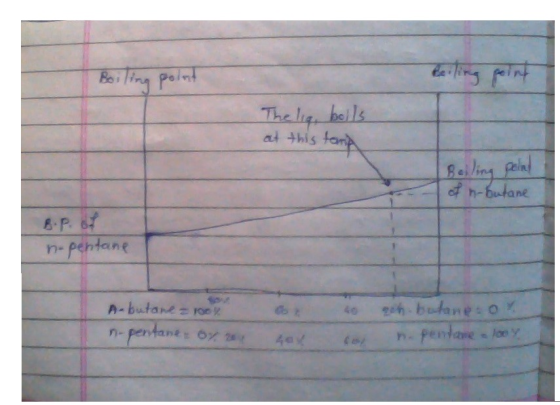
For mixtures of n-butane and n-pentane, we expect that their boiling points would form a straight line joining the two points. we are going to add another line. This second line will show the composition of the vapour over the top of any particular boiling liquid.
If you boil a liquid mixture, you would expect to find that the more volatile substance escapes to form a vapour more easily than the less volatile one.
That means that in the case to find a higher proportion of n-butane (the more volatile component) in the vapour than in the liquid. we can discover this composition by condensing the vapour and analysing it. That would give us a point on the diagram.
The below diagram shows what happens if we boil a particular mixture. Notice that the vapour over the top of the boiling liquid has a composition which is much richer in n-butane - the more volatile component.
Add Answer to:
For a mixture of n-butane (1) + n-pentane(2) at 298.15 K, what would be the predicted...
give correct answer and get best ratings 4. For a mixture of n-butane (1) n-pentane(2) at...
 give correct answer and get best ratings
4. For a mixture of n-butane (1) n-pentane(2) at 298.15 K, what would be the predicted bubble- point pressure using Raoult's Law if your mixture was 20% n-butane by mole? Would you expect Raoult's law to be a good model for this system? Why or why not?
give correct answer and get best ratings
4. For a mixture of n-butane (1) n-pentane(2) at 298.15 K, what would be the predicted bubble- point pressure using Raoult's Law if your mixture was 20% n-butane by mole? Would you expect Raoult's law to be a good model for this system? Why or why not?
The following mixture of hydrocarbons is obtained as one stream in a peroleum refinery on a...
The following mixture of hydrocarbons is obtained as one stream in a peroleum refinery on a mole basis: 5% ethane, 10% propane, 40% n-butane, 45% isobutane. Assuming the shortcut K-ratio model. 1) compute the bubble point of the mixture at 5 bar. 2) compute the dew point of the mixture at 5 bar. 3) find the amounts and compositions of the vapor and liquid phases that would result if this mixture were to be isothermally flash vaporized at 30 degrees...
At 330 K the vapor pressure of pure n-pentane is 1.92 atm and the vapor pressure...
 At 330 K the vapor pressure of pure n-pentane is 1.92 atm and the vapor pressure of pure n-octane is 0.07 atm. If 330K is the normal boiling point for a solution of these two substances, what will the mole fractions of each substance be in that solution? [If you can't figure out how to do this mathematically, you can estimate from the plot..... for reduced credit.] Octane+Pentane Pvaps at 330K po Pentane P (atm) Ptot Pv Pent Pv Oct...
3. Consider the hexafluorobenzene(1)-cyclohexane(2) mixture at 50 °C. The vapor pressures for the pure species are...
 3. Consider the hexafluorobenzene(1)-cyclohexane(2) mixture at 50 °C. The vapor pressures for the pure species are psat = 34.10 kPa and Pat = 36.30 kPa. a. (10%) Assuming Raoult's law, calculate the pressure range of the 2-phase region when the mole fraction of hexaflourobenzene is 0.8. b. (10%) Experiments show that this mixture at 50°C has an azeotrope. Show mathematically that Raoult's law is unable to predict an azeotropic behavior. c. (10%) Use the modified Raoult's law with the van...
3. Consider the hexafluorobenzene(1)-cyclohexane(2) mixture at 50°C. The vapor pressures for the pure species are Prat...
 3. Consider the hexafluorobenzene(1)-cyclohexane(2) mixture at 50°C. The vapor pressures for the pure species are Prat = 34.10 kPa and Pat = 36.30 kPa. a. (10%) Assuming Raoult's law, calculate the pressure range of the 2-phase region when the mole fraction of hexaflourobenzene is 0.8. b. (10%) Experiments show that this mixture at 50-C has an azeotrope. Show mathematically that Raoult's law is unable to predict an azeotropic behavior. c. (10%) Use the modified Raoult's law with the van Laar...
You have a 3.00-L container filled with N₂ (MM = 28.02 g/mol) at 298.15 K and...
You have a 3.00-L container filled with N₂ (MM = 28.02 g/mol) at 298.15 K and 1.75 atm pressure connected to a 2.00-L container filled with Ar (MM = 39.95 g/mol) at 298.15 K and 2.15 atm pressure. A stopcock connecting the containers is opened and the gases are allowed to equilibrate between the two containers. What is the density of the final gas mixture? Assume ideal behavior. (Use R = 0.08206 L.atm/mol.K) (HINT: What is the total mass, m,...
2. Using K-values, determine a) The liquid phase composition of a ethane/propane mixture with a bubble...
 2. Using K-values, determine a) The liquid phase composition of a ethane/propane mixture with a bubble point of -30 Fat 50 psia. b) The compositions of liquid and vapor phase for a system that, during a flash point separation at -30 °F at 50 psia splits into 40 mole % liquid and 60 mole % vapor.
Inside a catalytic reactor at 400 K and 1 bar, equilibrium is established for pentane isomerization...
 Inside a catalytic reactor at 400 K and 1 bar, equilibrium is established for pentane isomerization reactions among n-C5, 1-C5, and neo-Cs. To study the equilibrium composition, we can consider the following two reactions. We have also found a source that provides the standard-state Gibbs free energy of formation, AGYI, for the three isomers whose values in kJ/mol at 400 K are listed below. (1) n-C,(9) Hi-C (g) Species AG,400K (kJ/mol) (II) i-C, (g) neo-C (g) n-pentane 40.17 i-pentane 34.31...
1. At 241.95 K, the vapor pressure of liquid propane and n-butane are 160.0 kPa and...
 1. At 241.95 K, the vapor pressure of liquid propane and n-butane are 160.0 kPa and 26.7 kPa, respectively.) a) Calculate the total pressure above a solution that contains 0.2 moles of propane and 0.6 moles of n-butane. Assume that the two components form an ideal solution. b) What is the composition of the vapor phase in equilibrium with the liquid phase? c) Calculate AmiG and AmixS for the formation of this mixture.
are justified. 2. Experimental measurements of VLE for a two-component system at 100°C gives the following...
 are justified. 2. Experimental measurements of VLE for a two-component system at 100°C gives the following data: * = 0.30 P (kPa) .21 91 350.0 1.00 1.00 392.7 0.75 0.70 365.0 0.00 0.00 a. (5%) Use Raoult's law to predict the bubble pressure and vapor composition for this system at b. (10%) Using the three points from the table, calculate the coefficients in the 2-parameter Margules equation, assuming the modified Raoult's law is applicable. c. (10%) Using the result from...
 give correct answer and get best ratings
4. For a mixture of n-butane (1) n-pentane(2) at 298.15 K, what would be the predicted bubble- point pressure using Raoult's Law if your mixture was 20% n-butane by mole? Would you expect Raoult's law to be a good model for this system? Why or why not?
give correct answer and get best ratings
4. For a mixture of n-butane (1) n-pentane(2) at 298.15 K, what would be the predicted bubble- point pressure using Raoult's Law if your mixture was 20% n-butane by mole? Would you expect Raoult's law to be a good model for this system? Why or why not?
 At 330 K the vapor pressure of pure n-pentane is 1.92 atm and the vapor pressure of pure n-octane is 0.07 atm. If 330K is the normal boiling point for a solution of these two substances, what will the mole fractions of each substance be in that solution? [If you can't figure out how to do this mathematically, you can estimate from the plot..... for reduced credit.] Octane+Pentane Pvaps at 330K po Pentane P (atm) Ptot Pv Pent Pv Oct...
 3. Consider the hexafluorobenzene(1)-cyclohexane(2) mixture at 50 °C. The vapor pressures for the pure species are psat = 34.10 kPa and Pat = 36.30 kPa. a. (10%) Assuming Raoult's law, calculate the pressure range of the 2-phase region when the mole fraction of hexaflourobenzene is 0.8. b. (10%) Experiments show that this mixture at 50°C has an azeotrope. Show mathematically that Raoult's law is unable to predict an azeotropic behavior. c. (10%) Use the modified Raoult's law with the van...
 3. Consider the hexafluorobenzene(1)-cyclohexane(2) mixture at 50°C. The vapor pressures for the pure species are Prat = 34.10 kPa and Pat = 36.30 kPa. a. (10%) Assuming Raoult's law, calculate the pressure range of the 2-phase region when the mole fraction of hexaflourobenzene is 0.8. b. (10%) Experiments show that this mixture at 50-C has an azeotrope. Show mathematically that Raoult's law is unable to predict an azeotropic behavior. c. (10%) Use the modified Raoult's law with the van Laar...
 2. Using K-values, determine a) The liquid phase composition of a ethane/propane mixture with a bubble point of -30 Fat 50 psia. b) The compositions of liquid and vapor phase for a system that, during a flash point separation at -30 °F at 50 psia splits into 40 mole % liquid and 60 mole % vapor.
 Inside a catalytic reactor at 400 K and 1 bar, equilibrium is established for pentane isomerization reactions among n-C5, 1-C5, and neo-Cs. To study the equilibrium composition, we can consider the following two reactions. We have also found a source that provides the standard-state Gibbs free energy of formation, AGYI, for the three isomers whose values in kJ/mol at 400 K are listed below. (1) n-C,(9) Hi-C (g) Species AG,400K (kJ/mol) (II) i-C, (g) neo-C (g) n-pentane 40.17 i-pentane 34.31...
 1. At 241.95 K, the vapor pressure of liquid propane and n-butane are 160.0 kPa and 26.7 kPa, respectively.) a) Calculate the total pressure above a solution that contains 0.2 moles of propane and 0.6 moles of n-butane. Assume that the two components form an ideal solution. b) What is the composition of the vapor phase in equilibrium with the liquid phase? c) Calculate AmiG and AmixS for the formation of this mixture.
 are justified. 2. Experimental measurements of VLE for a two-component system at 100°C gives the following data: * = 0.30 P (kPa) .21 91 350.0 1.00 1.00 392.7 0.75 0.70 365.0 0.00 0.00 a. (5%) Use Raoult's law to predict the bubble pressure and vapor composition for this system at b. (10%) Using the three points from the table, calculate the coefficients in the 2-parameter Margules equation, assuming the modified Raoult's law is applicable. c. (10%) Using the result from...
Most questions answered within 3 hours.
-
Where is the error in this code sequence?
String s1 = "Hello";
String s2 = "ello";...
asked 11 months ago -
Financial data for Joel de Paris, Inc., for last year
follow:
Joel de Paris, Inc.
Balance...
asked 11 months ago -
Consider this reaction:
Al2(SO4)3 (aq)+ BaCl3
(aq) Al2Cl6 (aq)- +
3BaSO4(s) . What is the...
asked 11 months ago -
Suppose that Savneet is considering increasing her
recent random sample from 20 car rentals to 40...
asked 11 months ago -
Trucks arrive at an unloading terminal at an average rate of 120
per hour.
Trucks arrive...
asked 11 months ago -
Why are methanol and ethanol completely soluble in water while
octanol is not very little soluble....
asked 11 months ago -
A facilities manager at a university reads in a research report
that the mean amount of...
asked 11 months ago -
When the CuSO4 is rehydrated by adding water to the anhydrous
compound, is this an endothermic...
asked 11 months ago -
A ray of sunlight is passing from diamond into crown glass; the
angle of incidence is...
asked 11 months ago -
A block of mass 0.249 kg is placed on top of a light, vertical
spring of...
asked 11 months ago -
how do the kidneys compensate in the presences of acidosis
a) trigger hyperventilate
b) reserve acid...
asked 11 months ago -
Question 501 pts
The rental rate of capital to the firm increases. Which of the
following...
asked 11 months ago