
Homework Answers


Add Answer to:
6. In the circuit shown, lcs-0.5 fA. VR 4V, V4 00, and β 100. Find all...
Qucstion 3. [20 marks] Considcr the circuit shown to the right For l he RIT, β-100, V4-00, VBE,on...
 Consider the circuit shown on the right.....
Qucstion 3. [20 marks] Considcr the circuit shown to the right For l he RIT, β-100, V4-00, VBE,on-0.7V. CE,sut-0.2V, and VA 00 For the MOSFET, K, 100 TriA/V2, λ O, +10V +10V 1.46ML Ao. Capacitors are assumed AC short circuits 4KS2 1KS2 3.a. [8 maks Calculate the operating point I) 3.c. [8 marks] Use the small signal model to calculate the voltage gain of the circuit Vout VIV 7 Vin
Qucstion 3. [20...
Consider the circuit shown on the right.....
Qucstion 3. [20 marks] Considcr the circuit shown to the right For l he RIT, β-100, V4-00, VBE,on-0.7V. CE,sut-0.2V, and VA 00 For the MOSFET, K, 100 TriA/V2, λ O, +10V +10V 1.46ML Ao. Capacitors are assumed AC short circuits 4KS2 1KS2 3.a. [8 maks Calculate the operating point I) 3.c. [8 marks] Use the small signal model to calculate the voltage gain of the circuit Vout VIV 7 Vin
Qucstion 3. [20...
In the following circuit: Vg=24V,ix=2A,β=1.5,V1=12V,V3=3V,V4=4V Find V: Find Vx: Find the power consumed in element 1:...
 In the following circuit:
Vg=24V,ix=2A,β=1.5,V1=12V,V3=3V,V4=4V
Find V:
Find Vx:
Find the power consumed in element 1:
Find the power consumed in element 2:
Find the power consumed in element 3:
Find the power consumed in element 4:
Find the power consumed in the independent voltage source:
Find the power consumed in the not independent current
source:
1 + 1 V4 + . + I + L V1 1
In the following circuit:
Vg=24V,ix=2A,β=1.5,V1=12V,V3=3V,V4=4V
Find V:
Find Vx:
Find the power consumed in element 1:
Find the power consumed in element 2:
Find the power consumed in element 3:
Find the power consumed in element 4:
Find the power consumed in the independent voltage source:
Find the power consumed in the not independent current
source:
1 + 1 V4 + . + I + L V1 1
9. Using B=00, design the circuit shown so that the emitter currents of Q1, Q2, and...
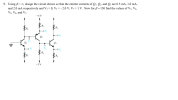 9. Using B=00, design the circuit shown so that the emitter currents of Q1, Q2, and Q3 are 0.5 mA, 1.0 mA, and 2.0 mA respectively and V3 = 0, V5 = - 2.0 V, V7= 1 V. Now for p = 150 find the values of V3, V4, V5, V6, and V7. +5 V i OV, -5 V
Use nodal analysis to find V0 in the circuit shown below. In addition, find all branch...
 Use nodal analysis to find V0 in the circuit shown below. In
addition, find all branch currents and check your answers using KCL
at every node. Please answer step-by-step. Thank you very much.
Question 8. Use nodal analysis to find Vo in the circuit shown below. In addition, find all branch currents and check your answers using KCL at every node 2000 4 k2 I, 2 mA
Use nodal analysis to find V0 in the circuit shown below. In
addition, find all branch currents and check your answers using KCL
at every node. Please answer step-by-step. Thank you very much.
Question 8. Use nodal analysis to find Vo in the circuit shown below. In addition, find all branch currents and check your answers using KCL at every node 2000 4 k2 I, 2 mA
Assume ? = 100, Find Thevenin equivalent circuit and based on Thevenin circuit find all branch...
 Assume ? = 100, Find Thevenin equivalent circuit and based on
Thevenin circuit find all branch currents and voltages.
+15 V RBI = 100 kΩ. S Rς = Σ5 ΚΩ RB2 = 50 ΚΩ > RE = Σ 3 ΚΩ
Assume ? = 100, Find Thevenin equivalent circuit and based on
Thevenin circuit find all branch currents and voltages.
+15 V RBI = 100 kΩ. S Rς = Σ5 ΚΩ RB2 = 50 ΚΩ > RE = Σ 3 ΚΩ
Prob rm#1 In the circuit shown; a) Find all remaining branch voltages and currents. b) Demonstrate...
 Prob rm#1 In the circuit shown; a) Find all remaining branch voltages and currents. b) Demonstrate conservation of power. sv 2 A 3A 2レ IA 1A
3. (Bonus) Determine a state variable model for the circuit in Figure 2. Note that If the voltage...
 3. (Bonus) Determine a state variable model for the circuit in Figure 2. Note that If the voltage at the left and right hand side of a resistor R is v and vR, respectively, and the current is assumed to flow through the resistor from left to right, then the current passing through the resistor R is iR We know that the voltage drop across a capacitor is uc = the current passing through the capacitor branch is ic cat,...
+3V Question 6: (15 pts) 9.1 ks 3 5.1.2 For the BJT circuit as shown, it...
 +3V Question 6: (15 pts) 9.1 ks 3 5.1.2 For the BJT circuit as shown, it contains a pnp (01) and a npn (Q2) BJT transistors, please find approximated values for the labeled node voltages V1, V2,V3, V4, Vs having the gain parameter B = 100. (Note: Early effect is ignored here; Veel are assumed to be 0.7V for both pnp and npn devices.) 100 kn vor o, 9.1k0 F or 34.3k
For the circuit shown in Fig. , find the val- ues of all labeled currents and...
 For the circuit shown in Fig. , find the val- ues of all labeled currents and voltages for the B = 100. Assume V BEI = VEB2 = 0.7 V. +15V 200 ΚΩ 10k TE2 1 k12 - Vez 182 Tai IBI Vai VBIO- Q Icz va - Vez -o Ver 100 kΩ: 10 kΩ 1kΩ =
Consider the circuit shown in Figure 1. Transistors Q1 and Q2 are identical and can be...
 Consider the circuit shown in Figure 1. Transistors Q1 and Q2
are identical and can be
describe with the following parameters: IS = 5
×10−16 A, β = 100 and VA = 5 V.
1. when Vin = 1,5V
ICQ1=ICQ2.
2. Write an equation for currents IC1 and
IC2 in terms of the voltages
Vin(VBQ1) and
VBQ2. For it
you can omit the Early effect and assume IE ≈
IC. Solve the equations to find so
Analyze the value of...
Consider the circuit shown in Figure 1. Transistors Q1 and Q2
are identical and can be
describe with the following parameters: IS = 5
×10−16 A, β = 100 and VA = 5 V.
1. when Vin = 1,5V
ICQ1=ICQ2.
2. Write an equation for currents IC1 and
IC2 in terms of the voltages
Vin(VBQ1) and
VBQ2. For it
you can omit the Early effect and assume IE ≈
IC. Solve the equations to find so
Analyze the value of...
 Consider the circuit shown on the right.....
Qucstion 3. [20 marks] Considcr the circuit shown to the right For l he RIT, β-100, V4-00, VBE,on-0.7V. CE,sut-0.2V, and VA 00 For the MOSFET, K, 100 TriA/V2, λ O, +10V +10V 1.46ML Ao. Capacitors are assumed AC short circuits 4KS2 1KS2 3.a. [8 maks Calculate the operating point I) 3.c. [8 marks] Use the small signal model to calculate the voltage gain of the circuit Vout VIV 7 Vin
Qucstion 3. [20...
Consider the circuit shown on the right.....
Qucstion 3. [20 marks] Considcr the circuit shown to the right For l he RIT, β-100, V4-00, VBE,on-0.7V. CE,sut-0.2V, and VA 00 For the MOSFET, K, 100 TriA/V2, λ O, +10V +10V 1.46ML Ao. Capacitors are assumed AC short circuits 4KS2 1KS2 3.a. [8 maks Calculate the operating point I) 3.c. [8 marks] Use the small signal model to calculate the voltage gain of the circuit Vout VIV 7 Vin
Qucstion 3. [20...
 In the following circuit:
Vg=24V,ix=2A,β=1.5,V1=12V,V3=3V,V4=4V
Find V:
Find Vx:
Find the power consumed in element 1:
Find the power consumed in element 2:
Find the power consumed in element 3:
Find the power consumed in element 4:
Find the power consumed in the independent voltage source:
Find the power consumed in the not independent current
source:
1 + 1 V4 + . + I + L V1 1
In the following circuit:
Vg=24V,ix=2A,β=1.5,V1=12V,V3=3V,V4=4V
Find V:
Find Vx:
Find the power consumed in element 1:
Find the power consumed in element 2:
Find the power consumed in element 3:
Find the power consumed in element 4:
Find the power consumed in the independent voltage source:
Find the power consumed in the not independent current
source:
1 + 1 V4 + . + I + L V1 1
 9. Using B=00, design the circuit shown so that the emitter currents of Q1, Q2, and Q3 are 0.5 mA, 1.0 mA, and 2.0 mA respectively and V3 = 0, V5 = - 2.0 V, V7= 1 V. Now for p = 150 find the values of V3, V4, V5, V6, and V7. +5 V i OV, -5 V
 Use nodal analysis to find V0 in the circuit shown below. In
addition, find all branch currents and check your answers using KCL
at every node. Please answer step-by-step. Thank you very much.
Question 8. Use nodal analysis to find Vo in the circuit shown below. In addition, find all branch currents and check your answers using KCL at every node 2000 4 k2 I, 2 mA
Use nodal analysis to find V0 in the circuit shown below. In
addition, find all branch currents and check your answers using KCL
at every node. Please answer step-by-step. Thank you very much.
Question 8. Use nodal analysis to find Vo in the circuit shown below. In addition, find all branch currents and check your answers using KCL at every node 2000 4 k2 I, 2 mA
 Assume ? = 100, Find Thevenin equivalent circuit and based on
Thevenin circuit find all branch currents and voltages.
+15 V RBI = 100 kΩ. S Rς = Σ5 ΚΩ RB2 = 50 ΚΩ > RE = Σ 3 ΚΩ
Assume ? = 100, Find Thevenin equivalent circuit and based on
Thevenin circuit find all branch currents and voltages.
+15 V RBI = 100 kΩ. S Rς = Σ5 ΚΩ RB2 = 50 ΚΩ > RE = Σ 3 ΚΩ
 Prob rm#1 In the circuit shown; a) Find all remaining branch voltages and currents. b) Demonstrate conservation of power. sv 2 A 3A 2レ IA 1A
 3. (Bonus) Determine a state variable model for the circuit in Figure 2. Note that If the voltage at the left and right hand side of a resistor R is v and vR, respectively, and the current is assumed to flow through the resistor from left to right, then the current passing through the resistor R is iR We know that the voltage drop across a capacitor is uc = the current passing through the capacitor branch is ic cat,...
 +3V Question 6: (15 pts) 9.1 ks 3 5.1.2 For the BJT circuit as shown, it contains a pnp (01) and a npn (Q2) BJT transistors, please find approximated values for the labeled node voltages V1, V2,V3, V4, Vs having the gain parameter B = 100. (Note: Early effect is ignored here; Veel are assumed to be 0.7V for both pnp and npn devices.) 100 kn vor o, 9.1k0 F or 34.3k
 For the circuit shown in Fig. , find the val- ues of all labeled currents and voltages for the B = 100. Assume V BEI = VEB2 = 0.7 V. +15V 200 ΚΩ 10k TE2 1 k12 - Vez 182 Tai IBI Vai VBIO- Q Icz va - Vez -o Ver 100 kΩ: 10 kΩ 1kΩ =
 Consider the circuit shown in Figure 1. Transistors Q1 and Q2
are identical and can be
describe with the following parameters: IS = 5
×10−16 A, β = 100 and VA = 5 V.
1. when Vin = 1,5V
ICQ1=ICQ2.
2. Write an equation for currents IC1 and
IC2 in terms of the voltages
Vin(VBQ1) and
VBQ2. For it
you can omit the Early effect and assume IE ≈
IC. Solve the equations to find so
Analyze the value of...
Consider the circuit shown in Figure 1. Transistors Q1 and Q2
are identical and can be
describe with the following parameters: IS = 5
×10−16 A, β = 100 and VA = 5 V.
1. when Vin = 1,5V
ICQ1=ICQ2.
2. Write an equation for currents IC1 and
IC2 in terms of the voltages
Vin(VBQ1) and
VBQ2. For it
you can omit the Early effect and assume IE ≈
IC. Solve the equations to find so
Analyze the value of...
Most questions answered within 3 hours.
-
Where is the error in this code sequence?
String s1 = "Hello";
String s2 = "ello";...
asked 11 months ago -
Financial data for Joel de Paris, Inc., for last year
follow:
Joel de Paris, Inc.
Balance...
asked 11 months ago -
Consider this reaction:
Al2(SO4)3 (aq)+ BaCl3
(aq) Al2Cl6 (aq)- +
3BaSO4(s) . What is the...
asked 11 months ago -
Suppose that Savneet is considering increasing her
recent random sample from 20 car rentals to 40...
asked 11 months ago -
Trucks arrive at an unloading terminal at an average rate of 120
per hour.
Trucks arrive...
asked 11 months ago -
Why are methanol and ethanol completely soluble in water while
octanol is not very little soluble....
asked 11 months ago -
A facilities manager at a university reads in a research report
that the mean amount of...
asked 11 months ago -
When the CuSO4 is rehydrated by adding water to the anhydrous
compound, is this an endothermic...
asked 11 months ago -
A ray of sunlight is passing from diamond into crown glass; the
angle of incidence is...
asked 11 months ago -
A block of mass 0.249 kg is placed on top of a light, vertical
spring of...
asked 11 months ago -
how do the kidneys compensate in the presences of acidosis
a) trigger hyperventilate
b) reserve acid...
asked 11 months ago -
Question 501 pts
The rental rate of capital to the firm increases. Which of the
following...
asked 11 months ago